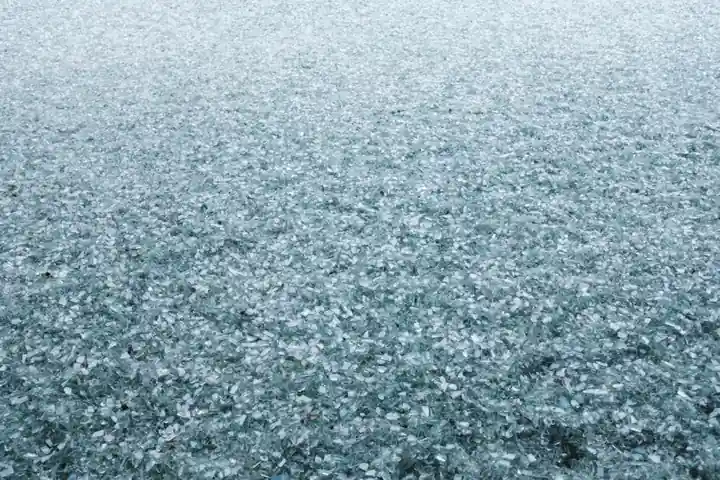
Reclamation is the bottleneck of the sodium silicate route: the water-glass binder does not burn out during casting, so a thin, glassy sodium silicate film stays welded to every silica grain after shakeout [S1]. That residual film is why simple attrition or thermal calcining, the workhorses of green-sand and resin-bonded recovery, under-perform on silicate systems.
The economic stakes are real: a 2023-commissioned wet-reclamation pilot in Stuttgart now processes 1 t/h of used water-glass sand, removes contaminants at 98% effectiveness, and lets foundries substitute reclaimed grain for up to 95% of their new-sand demand [S3]. The process runs at 60% lower drying energy than a thermal line, and limits wastewater to 12 L per metric ton of sand in a closed-loop circuit [S3].
Why the binder film survives shakeout and pouring
Sodium silicate cured by ester reaction or CO₂ gassing forms an amorphous silicate glass that, unlike phenolic or furan resins, has no organic fraction to pyrolyse out at iron pour temperatures around 1,300-1,450 °C [S1]. The result is a sintered silicate skin, typically 20-80 µm thick, bonded mechanically and chemically to the quartz surface, and it is this skin that defeats mechanical reclamation aimed at the sand reclamation unit stage of a typical resin sand line.
Beyond simple film thickness, two material behaviours make the problem worse. First, the silicate film is hygroscopic: stored used sand absorbs moisture and the bond re-gels, which is why dry-reuse alone drops sharply above 30% replacement [S4]. Second, repeated thermal cycling drives α-quartz toward the cristobalite polymorph, locking the silicate chemistry into a phase that resists both mechanical scrubbing and mild acid washes [S4].
Comparison of the three main reclamation routes
Foundries evaluating sodium silicate sand recovery weigh three routes against the same decision criteria: binder-removal effectiveness, new-sand replacement ratio, energy cost per ton, and wastewater or dust load. [S3]
Dry mechanical attrition (rubber- or blade-lined muller): cheap, low-energy, but only scratches the surface film; replacement ratios stall around 30-50% and fines rise sharply, degrading mould permeability on a sand casting mold line. Combined thermal-mechanical calcining: burns off organics effectively but the silicate film merely vitrifies further, consuming 22-30 m³ of natural gas per metric ton reclaimed with no chemical degradation of the binder [S3]. Wet chemical leaching (the DEANTEC / FSP route): dissolves the silicate film in hot dilute alkali, claims 98% contaminant removal, cuts gas to 13-16 m³/t, and lets foundries hit the 95% new-sand substitution ceiling [S3].
Process routes that actually work
Steam leaching of CO₂-cured sodium silicate sand is a documented bench-scale route that strips the silicate gel by hydrothermal dissolution, and 2023 results showed recovered sand with bond-clay content low enough to reuse as core sand [S4]. Parallel work on chemical-solution washing (NaOH plus surfactant at 60-90 °C) returned reclaimed sand with tensile and flowability values within 5-10% of new silica [S4].
Additive-modified silicate binders are the upstream lever: a 2025 geopolymeric binder system was reported to overcome the irreversible cristobalite lock-up that plagues multi-cycle sodium silicate waste, raising the number of effective reuse cycles before landfilling [S4]. On the equipment side, novel wet-conditioning modules are now being installed at the discharge of the sand cooler so that the silicate film is attacked while the grain is still warm, cutting reagent residence time roughly in half. The trade-off is process water: a closed-loop circuit with condensate demineralisation limits fresh-water demand to 12 L per metric ton of sand, but effluent pH must be neutralised before discharge [S3].
Operating limits and failure modes
Thermal reclamation of silicate sand hits a hard ceiling at about 600-700 °C: above that the silicate film fuses with the quartz surface rather than detaching, and the resulting grain is unusable even after milling [S3]. Mechanical-only lines fail at a different point, fines generation: the fine fraction must stay under roughly 0.3% of throughput, otherwise mould permeability collapses and gas-defect rates on iron castings rise sharply, a sensitivity that operators of any sand blasting machine downstream will recognise from abrasive-quality specifications [S3].
Wet routes introduce their own failure modes: if the leaching pH drifts below 9 the silicate film re-precipitates rather than dissolving, and if the process water carries more than 200 mg/L of dissolved Ca²⁺ or Mg²⁺ the hardness ions react with residual silicate and blind the wash stage. Closed-loop distillation solves the water-quality side by stripping ions, but the evaporator must be sized for at least 0.95 t of condensate per ton of dried sand, and that 95% energy recovery figure is the key reason the wet route can match thermal cost on a per-ton basis [S3].
Who this is (and is not) for

Sodium silicate bonded sand is the right choice for foundries that need low smoke and fume on iron and non-ferrous pours, that operate ester-cured or CO₂-gassed core lines, and that can absorb a dedicated reclamation circuit. The same system is a poor fit for jobbing shops running short ferrous campaigns with frequent binder switches, because the residual silicate cross-contaminates phenolic and furan returns and drives defect rates up. [S1]
For the latter group, the practical answer is to keep silicate sand on a segregated loop with a dedicated sand mixer and a wet-reclamation or additive-modified binder upgrade, rather than blending it back into a general-purpose resin sand line. High-volume ferrous foundries burning more than 6 t/h of moulding sand can clear payback on a wet-reclamation retrofit in under three years on European gas prices, with annual gas savings on the order of €240,000 ($256,000) at the 6 t/h benchmark [S3].
Standards, sourcing, and the data behind the numbers
The 98% contaminant-removal and 95% new-sand replacement figures quoted above are vendor claims from the FSP/DEANTEC wet-reclamation pilot commissioned in Stuttgart in late 2022 and reported by Foundry Magazine in March 2023; they have not yet been independently audited in the public literature [S3]. The 22-30 m³ gas/t baseline for thermal and combined thermal-mechanical reclamation is a commonly cited industry range but should be verified against the specific equipment vendor before being used in a business case [S3].
Peer-reviewed work on steam leaching of CO₂ sodium silicate sand and on geopolymeric binder modifications is recent (2020-2025) and concentrates on lab and pilot scale, so foundry engineers specifying a full production line should treat the published cycle-life and replacement-ratio numbers as upper bounds rather than guaranteed values [S4]. For context on the broader pour-side problems these reclaimed grains feed into, see the analysis of why silica sand causes rattail and scab defects in green sand molds, which documents why grain-surface chemistry, not just grain size, drives those surface defects.
Track the next node: a thermal-treatment stage was announced for the Stuttgart pilot in late 2022, and if it lands at the 13-16 m³ gas/t range the combined wet-plus-thermal line would push new-sand replacement above the current 95% ceiling [S3]. Independent third-party validation of the 98% removal claim, still missing in the public record, is the other signal worth watching before any European specification is locked in.