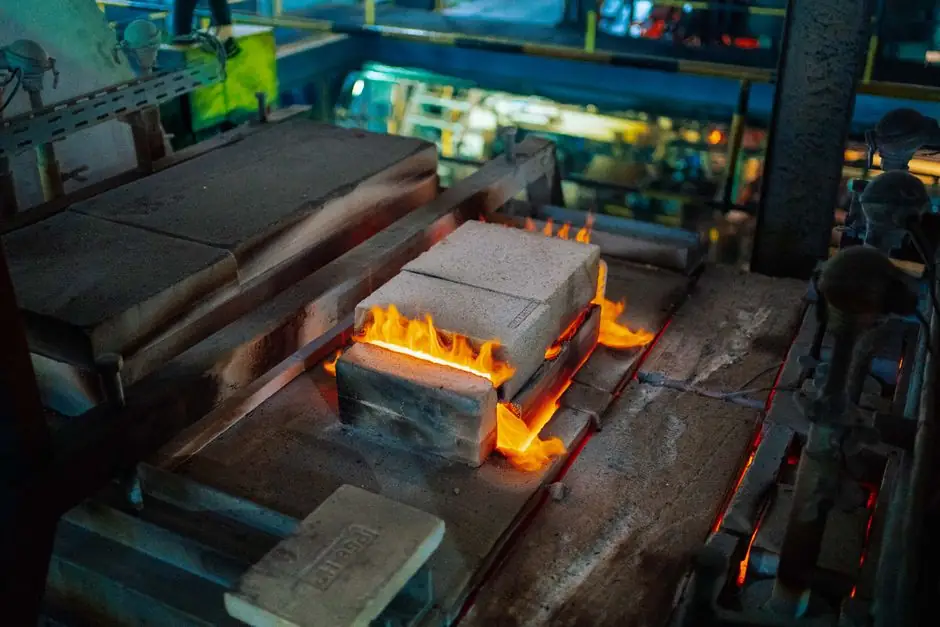
Fuel-fired crucible furnaces commonly sit around 12% thermal efficiency, and some configurations lose up to 88% of the burner's energy input to the lining, flue gas, and shell before any metal reaches pour temperature [S2].
The root cause is the heat path itself: combustion gases heat the outside of a refractory pot, the pot wall conducts heat inward, and only then does the charge absorb energy, so every interface is a loss surface [S1][S4].
Indirect Conduction Through the Crucible Wall
Crucible furnaces transfer heat by thermal conduction through the refractory wall, and that single wall layer is the reason a fuel-fired unit sits in the 12% band while a well-tuned direct-fired bath can exceed 50% [S2][S4]. The crucible is a physical barrier between the heat source and the molten metal, and it sets the ceiling on melting efficiency regardless of burner quality [S7]. In methane-fired CFD studies, the mean cavity temperature is highly sensitive to where the exhaust port sits, how many burners fire, and the air-fuel ratio, which means the same furnace can swing tens of percent in delivered heat just from geometry and trim [S4].
Wall conduction also means the lining absorbs a sizeable share of burner output before the charge ever sees it, and the lining then reradiates that stored energy outward through the shell during every cycle [S2]. For perspective, a 5.5 kg LG2 bronze melt starting at 10°C needs only about 3243 kJ of useful heat (specific heat 0.38 kJ/kg/°C, latent heat ~170 kJ/kg), yet a small gas-fired rig typically has to deliver tens of thousands of kilojoules of fuel energy to deliver that, putting real-world efficiency in the low single digits for hobby-scale setups [S5].
Flue Gas, Excess Air, and Combustion Quality
Fuel-fired crucible furnaces lose a large share of input energy up the stack, with CFD work showing that methane and oxygen levels in the exit gas shift sharply with burner count, port location, and air-fuel ratio, so an over-lean or over-rich setting dumps unburned fuel or hot excess air straight out of the furnace [S4]. Reported field data on fuel-fired furnaces and boilers puts overall thermal efficiency near 80% only when the convection section is well-recovered; without that recovery, the same hardware drops sharply, and crucible furnaces rarely have the integrated convective coil of a process heater [S8].
Fuel-fired models are also notorious for high emissions and exhaust heat loss, and the traditional Chinese-style oil-fired crucible design is repeatedly cited for low thermal efficiency, high oil consumption, and small crucible volume [S3][S6]. Excess air in particular carries both sensible heat and latent heat of water vapour out of the stack, so every percent of excess air above the stoichiometric target is a direct subtraction from delivered heat to the charge.
Scale, Surface-to-Volume Ratio, and Cycling Losses
Crucible furnaces are built for small batches, and the small melt size forces frequent heating and cooling, so each cycle pays a fixed parasitic load for lining warm-up and shell radiation [S2]. The surface-area-to-volume ratio of a small crucible is also unfavourable, which makes shell heat loss disproportionately large compared with larger furnace types built around a refractory-lined bath or an induction coil [S2].
This is why fuel-fired crucible furnaces keep their place in foundries despite the efficiency penalty: they accept a wide range of alloys in small batches without cross-contamination, and that flexibility is hard to replicate with a more efficient but alloy-restricted design [S3]. The 12% figure is therefore not a defect to be fixed in isolation but the inherent cost of the indirect-heating geometry, and the rest of the losses stack on top of it.
Fuel Choice and Operating-Cost Trade-offs
Fuel-fired crucible furnaces are popular because the capital cost is lower and the heat input per unit furnace footprint can be very high, which makes them suitable for bulk melting in smaller foundries and job shops [S3]. The trade is operating cost: a gas-fired melt of 5.5 kg of bronze in a hobby-scale A4/A6 crucible is hard to price against an electric furnace drawing roughly 3 kW for about four hours at a shoulder electricity rate of $0.17/kWh, because the propane consumption per melt of a small fuel-fired rig is typically several times the delivered useful heat [S5].
Electric resistance crucible furnaces nearly eliminate point-of-use emissions and tighten atmosphere control, but the cost of electricity can make them economically inefficient even when they are thermally cleaner, so the decision is rarely efficiency-only [S2]. In practice a foundry weighs capital cost, alloy flexibility, batch size, and local energy prices, and only after that does the 12% thermal efficiency number become a tie-breaker.
Comparison: Fuel-Fired vs Electric vs Induction Crucible
Three heating routes dominate the crucible-furnace market, and they trade off along four practical axes: [S4]
Thermal efficiency: fuel-fired indirect heating commonly lands near 12% for small units, electric resistance sits higher because there is no flue gas path, and induction couples directly into the charge so it is the most efficient of the three but at the cost of crucible and coil complexity [S2][S3]. Capital cost: fuel-fired has the lowest entry price, electric resistance is mid-range, and induction is the most expensive to specify and install [S3]. Atmosphere and emissions control: fuel-fired exhausts CO2, NOx, and unburned hydrocarbon whenever combustion is off-stoichiometric, electric resistance is clean at the point of use, and induction is similarly clean but adds electromagnetic shielding and coil-cooling load [S2][S3]. Alloy flexibility: fuel-fired handles the widest range of ferrous and non-ferrous charges in small batches, electric resistance is broadly compatible, and induction is the most restrictive because coupling depends on the charge's electrical resistivity.
What Foundries Can Actually Recover
Three levers are available without changing furnace type. First, retune the air-fuel ratio and burner count against the CFD map for the specific cavity, since methane and oxygen in the exit gas respond strongly to these settings [S4]. Second, reduce cycling by batching up to the largest practical charge the crucible allows, which cuts the per-cycle lining warm-up penalty that drags small units toward the 12% floor [S2]. Third, recover flue-gas heat with a recuperative or regenerative burner arrangement, which is the lever that pushes fuel-fired process equipment from the low tens into the 70%–80% band once the convection section is well-designed [S8].
For processes that need more than incremental gain, a switch to induction or a tightly sealed electric resistance crucible is the next step up in delivered efficiency, at the cost of higher capital and tighter alloy coupling; this is the same trade-off that pushes a cupola furnace toward iron-only duty and away from steel. Operators weighing the move should also review crucible furnace selection criteria and how the refractory wall limits what any burner can deliver, and look at how fired brick lining choices interact with thermal cycling on the same hardware. For plants still running fuel-fired rigs, instrumenting the stack with a calibrated thermal imager is a quick way to baseline flue-gas temperature and confirm whether a recuperator is worth the spend.