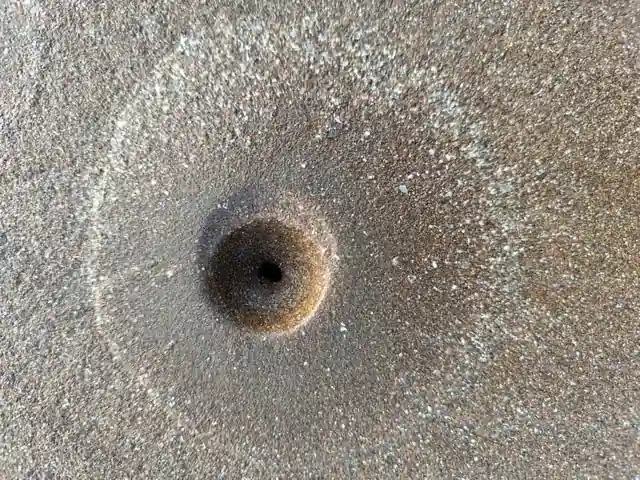
Rattails, veins, buckles and scabs are mechanical-thermal expansion defects that originate in the surface layer of a green sand mold when molten metal contacts quartz grains and the resulting strain exceeds the mold's wet tensile strength [S3][S4].
Foundries running bentonite-bonded silica systems see all four names used interchangeably: rat tails and buckles describe shallow raised seams on the casting surface, while scabs are detached crusts of metal-painted sand a few millimetres thick with sharp edges firmly bonded to the casting [S1][S3].
The 573°C Quartz Transformation Is the Trigger
Silica sand has the highest refractoriness of common molding aggregates, but it is also the most thermally active: quartz undergoes a reversible alpha-to-beta transformation at 573°C with a sudden volumetric jump that drives the entire failure sequence [S1][S3].
Because the casting skin reaches this transformation isotherm within seconds, compressive stresses build up in the hot surface layer while the cooler sand behind it resists movement. When those compressive stresses exceed the deformability of the mold wall, the surface layer buckles upward and either stays attached (rat tail) or shears off entirely (scab) [S3][S4].
Wet Tensile Strength Decides Whether You Get a Rat Tail or a Scab
Low-strength sand molds built with bentonites of poor thermal stability allow the heated shell to deform and break, exposing fractured wet surfaces to the melt and producing a more violent scab rather than a cosmetic rat tail [S2].
The green sand's wet tensile strength is therefore the engineering gate: below it, the surface layer detaches and the metal paints a sand crust; above it, the layer buckles in place and only a thin seam appears. This is why foundries targeting rattail-free castings specify activated sodium bentonite with high specific surface and tight moisture control [S3].
Mold Compaction and Geometry Stack the Stress
Highly compacted sections of the mold are particularly at risk because they store more elastic energy that is released against the hot surface as the quartz expands, increasing the local compressive load above the buckling threshold [S3].
Cavity scabbing initiates at the upper horizontal mold wall from the condensation zone, while bottom scabbing forms below the metal flow where the same condensation-zone stress acts on the drag surface. If the raised shell stays connected at its edges, you read rat tails; if the sand shell breaks apart under the metal load, the fragment ends up as a typical bottom scab [S3][S4].
Comparing the Three Common Countermeasures
Operators have three practical levers, and the choice depends on which constraint is binding on a given line [S1][S3]:
1. Sand grain size. Coarser silica grains expand by smaller absolute length per grain and give the surface layer more void space to absorb the 573°C jump, lowering scab risk but worsening surface finish and veining on cores.
2. Bentonite quality and activation. Better bentonites with larger specific surface and optimal activation raise wet tensile strength so the hot shell resists detachment, at the cost of higher additive consumption and muller load.
3. Mold cooling and conditioning. Cool patterns, active mold cooling, and proper mulled sand temperature reduce the temperature gradient through the surface layer, which lowers peak compressive stress; this is the lever that costs capital but no consumable budget.
Sand Mixer and Sand Cooler Are the Equipment That Enforce the Fix
Because the cure lives in bentonite activation and mulled-sand temperature, the sand mixer is where wet tensile strength is actually set, and the sand cooler is what keeps that activated bentonite from being cooked off between batch and pour. [S3]
Foundries that skip either step see the wet tensile number drift out of the safe window, and the casting then carries the visible signature: a rat tail where the surface buckled in place, or a scab where the shell broke away and fused to the metal [S3][S6].
Limits and Failure Modes of the Standard Fix
Adding more bentonite is not a free upgrade: excess active bentonite raises green strength but also raises hot strength, which can drive the system from rattails into the more severe buckles and veins failure mode rather than eliminating expansion defects [S3].
Switching to a non-silica aggregate (chromite, zircon, olivine) removes the 573°C transformation entirely but introduces its own problems: higher sand cost per tonne, faster cooler loading because of higher specific heat, and recycle-stream contamination when mixed back into a silica line. For most iron and non-ferrous production the economic answer is still better-conditioned silica, not a different mineral [S1][S3].
Inspection Signals Worth Tracking on the Floor
Track three numbers weekly and the rattail/scab rate follows: mulled-sand temperature at the mixer discharge (target typically below 50°C to protect bentonite activation), compactability of the prepared sand, and wet tensile strength of a standard specimen. A drift in any one of these will show up on the casting surface before it shows up in the lab report [S2][S3].
Foundries that also inspect castings visually and reject pieces with sharp-edged metallic crusts a few millimetres thick bonded to the surface will keep the feedback loop tight enough to distinguish a one-off pouring-temperature excursion from a real sand-system problem [S3][S6].
Spec-level background on the components involved: checking and testing apparatus.
This topic is covered further in Tangential Key Pair for Reversing Flywheel Loads: Geometry, Taper, and Failure Modes.