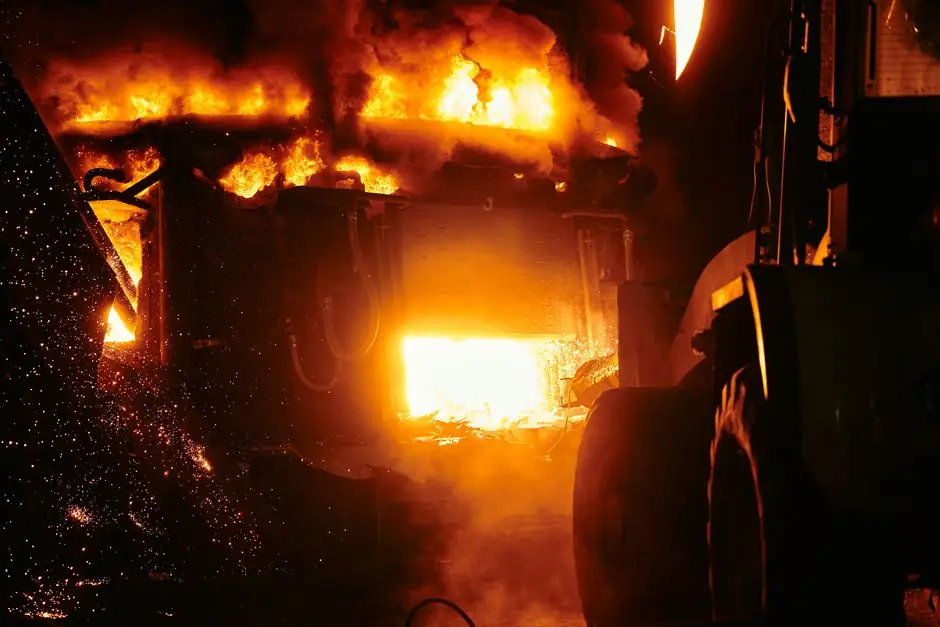
A cupola furnace is a vertical coke-fired shaft, and that single piece of geometry, plus the chemistry of the coke bed, fixes the whole reason it is restricted to cast iron rather than steel [S4][S5].
Cupolas are sized in diameters from 0.5 m to roughly 4.0 m, run continuously, and typically deliver 1–30 t/h of melt; U.S. cupolas still account for about 32% of foundry iron output, around 4.7 million tons per year, with gray iron near 2.4 Mt and ductile iron near 2.1 Mt [S1][S4][S5].
Peak temperature ceiling vs. steel's melting point
A standard cold-blast cupola with stoichiometric air burns coke to a flame temperature that the foundry literature pegs near 1,700 °C, and oxygen enrichment only pushes the hot-metal temperature to roughly 1,540–1,650 °C at the tap, with TPK (tons per 1,000 scfm Equivalent Blast Rate) clustering between 2.3 and 3.3 in U.S. practice [S1].
Plain-carbon steel needs 1,490–1,540 °C to start melting and closer to 1,520–1,580 °C for typical low-carbon grades to remain fully molten, while alloy and stainless steels push beyond 1,500–1,520 °C liquidus with very narrow superheat windows [S2]. A cupola running at its practical ceiling simply does not have the headroom to superheat low-carbon steel cleanly without a severe drop in campaign life and refractory survival [S1].
Carbon and sulfur pick-up from the coke bed
Every kilogram of metal descending through the cupola passes through incandescent coke, so the melt picks up carbon to near saturation, typically 3.0–4.3% C in the tapped iron, which is exactly the composition window for gray, ductile, and Ni-resist cast irons [S3][S4].
Steel, by definition, has to be decarburized: structural carbon steel sits below about 0.25% C, medium-carbon grades run 0.30–0.50% C, and even high-carbon tool steel caps near 1.0–1.2% C, so a cupola would have to burn carbon in and then refine it out again, an operation no shaft furnace can do in a single pass [S3]. Sulfur from coke partitions into the iron as FeS, and a basic oxygen or electric arc furnace is needed to drive it down to the 0.005–0.020% S that modern steel specifications demand; a cupola cannot desulfurize to that level while still burning sulfur-bearing coke [S3][S1].
Why the chemistry suits cast iron but not steel
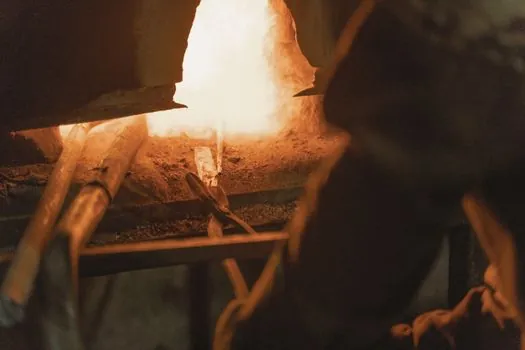
Cast iron is not "dirty steel", it is a deliberate Fe-C-Si alloy where carbon exceeds 2%, silicon is held at 1.8–2.8%, and graphite flakes or spheroids carry the load; the cupola's high carbon, high sulfur, and silicon pickup from coke and ferrosilicon additions line up almost perfectly with gray and ductile iron target ranges [S1][S3].
Steel needs tight control of C, S, P, N, and O at the same time; even basic oxygen steelmaking starts from a tapped blast-furnace iron with about 4.5% C and then blows it down with oxygen over 20–40 minutes, something a continuous shaft has no residence time to accomplish [S2]. A cupola also cannot be tilted, stirred, or slag-flushed the way an induction furnace, [converter](link-not-used), or basic oxygen vessel can, so inclusions and slag entrapment cannot be removed in the same vessel [S1][S2].
Charge tolerance, but only within the iron family
The cupola's signature advantage is that it digests contaminated, oily, painted, and zinc-coated scrap, plus mixed foundry returns, which electric melting furnaces reject because zinc boils at 907 °C and shreds refractories, so the same dirty-scrap tolerance that makes cupolas cheap also locks them into iron chemistry [S1].
That same coke bed cannot handle the refractories of a high-melting-point alloy: copper-base bronzes have been run historically at small scale, but anything approaching 1,500 °C liquidus with low carbon tolerance is filtered out by the shaft's own physics, which is why Ni-resist iron (about 14–22% Ni, 1.5–2.5% C) and some Cu-bearing irons are the practical upper limit, not steel [S4].
Continuous operation favors single-product iron campaigns
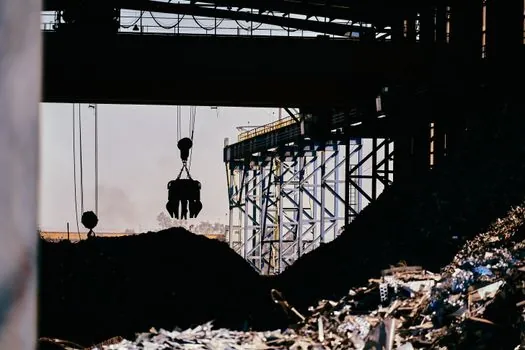
Cupolas run as a campaign: coke bed lit, alternating layers of metal, flux, and coke fed through the charge door, blast on, iron tapped continuously, and at end of campaign the drop-bottom doors swing open to dump the residual bed [S4][S5].
That geometry suits a steady pour of one iron grade all day, but steelmaking is a batch refining cycle; a crucible furnace or channel induction unit, where a heel of metal must stay molten between heats, gives the start/stop control a steel heat needs, while a cupola has no such pause button [S5]. The cupola furnace is therefore a melting device, not a refining device, and the iron/steel boundary is the same line that separates melting from refining in the broader foundry taxonomy.
Comparison: cupola vs induction vs arc for cast iron vs steel
On four decision criteria, the cupola wins for gray/ductile iron, loses for steel: peak temperature (cupola 1,540–1,650 °C, induction up to ~1,800 °C in iron practice, EAF up to ~1,800–1,900 °C), carbon pick-up (cupola high and uncontrolled, induction/arc adjustable to 0.02–1.0% C), sulfur control (cupola 0.05–0.15% S from coke, induction/arc desulfurizable to 0.005–0.020% S with slag), and scrap tolerance (cupola eats dirty zinc-coated scrap, induction/arc need clean, dense, homogeneous charge to survive the refractory lining) [S1][S2].
Continuous melt rate is the cupola's edge: a 1.5–4.0 m diameter cupola delivers 1–30 t/h, while a 40 t/h gray-iron line is the threshold where ASM still calls a cupola the "better economic solution" versus an electric furnace, and modern U.S. foundries at that scale keep cupolas running on dirty return scrap that would shut down an induction furnace within a campaign [S1][S2].
Where cupolas still make sense, and where they cannot
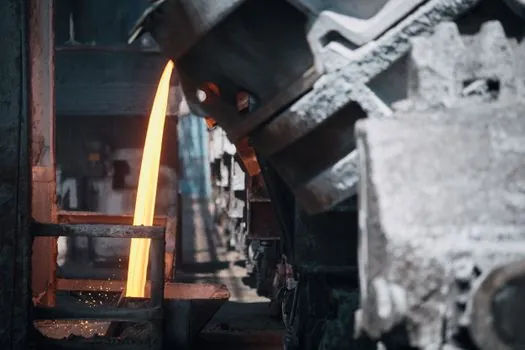
Cupolas are a fit for high-tonnage gray iron and ductile iron producers with dirty return-scrap streams, a stable single-grade schedule, and a coke supply chain; they are not a fit for foundries that need to swing between iron and steel, hold tight carbon and sulfur limits, or stop and start multiple times per shift [S1][S2][S5].
Trackable signals for the next planning cycle: any disclosed retrofit of a U.S. cupola to oxygen-enriched hot blast above the current 1,540–1,650 °C tap range, and any published campaign in which a cupola charges nickel-bearing returns with the aim of running low-alloy iron closer to the steel liquidus; both would compress the iron/steel boundary that currently keeps the cupola furnace firmly in the cast-iron camp. For comparison, related coverage of why a channel induction furnace must keep a molten heel shows the contrasting start/stop logic that steel-grade flexibility demands.