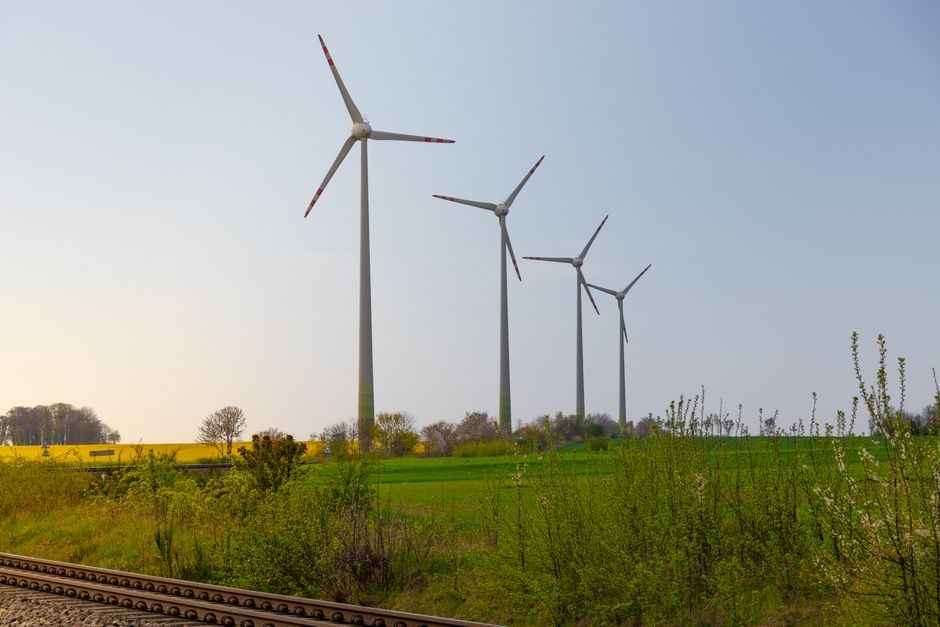
Wind-turbine blade demand through mid-2026 is driven by onshore hub heights pushing 120–160 m and rotor diameters that now sit in the 175–220 m band for new utility-scale units, which in turn forces blade lengths past 80 m on the largest onshore models [S1][S3].
Simultaneously, the supply side is reorganising around three measurable failure mechanisms — leading-edge erosion, trailing-edge delamination, and blade-icing power loss — each of which maps to a different spec gate a buyer or asset owner must clear [S1][S3].
Blade Length and Composite Stack: What 2026 Buyers Should Anchor On
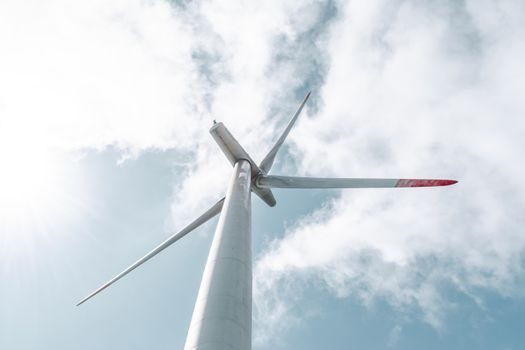
Modern utility-scale wind turbine blades in 2026 are typically built as glass-fibre-reinforced polymer (GFRP) spars with carbon-fibre-reinforced polymer (CFRP) spar caps, bonded in epoxy or vinylester infusion stacks, with a balsa or PVC foam core [S3]. The delamination failure analysis published in 2024 confirms that progressive damage in these stacks is governed by equivalent fatigue load rather than peak static load, and the cross-scale solid-shell coupling model the authors developed reproduces shallow-delamination propagation under realistic duty cycles [S3].
For a spec engineer, this means a blade data sheet must publish three concrete numbers: total length, root-section chord width, and resin-system glass-transition temperature (Tg). Anything below a published Tg of 70 °C for epoxy systems is unacceptable for hot-climate or high-irradiance sites, and a generic "epoxy resin" line item without Tg is a red flag [S3]. Buyers can cross-check blade-mass figures against the density envelope of 1850–2050 kg/m³ typical of infused GFRP, which is also useful when selecting switching-mode power supply ratings for blade pitch hydraulics and heaters used in cold-climate de-icing kits.
Blade Icing, Vibration and the Acoustic-CNN Diagnosis Stack
Blade icing degrades aerodynamic performance and creates asymmetric mass loading, so the IEEE deep-belief-network study selected wind-speed and power features with a four-layer DBN (two RBMs plus a classifier) and reported higher prediction accuracy and stability than the SVM baseline it was compared against [S1]. The takeaway is not the algorithm itself but the feature set: any icing-prediction spec line item must explicitly call out which SCADA signals are ingested, and whether re-sampling was used to correct the imbalanced positive/negative class distribution the authors flag as a known failure mode of unsupervised fault detection [S1].
On the structural-vibration side, the semi-analytical transfer-function framework for blade flap-wise bending treats the blade as an Euler–Bernoulli cantilever and recovers lateral deflection under rotating-frame loading with low computational cost, which makes it usable in design loops where a full FE run is too expensive [S2]. The acoustic-CNN blade-diagnosis repository, published 2026-06, uses a convolutional neural network on acoustic emissions to detect surface damage, and the open-source toolchain (TensorFlow 1.x, requirements pinned in the repo) lets a maintenance team run the model on edge hardware tied into the same cabinet that already hosts the DC power supply rails for blade-root sensors.
Supply-Chain Failure Modes and a Spec Comparison
The 2024 ScienceDirect paper documents three failure modes a 2026 buyer should specify against: shallow delamination between GFRP plies, debonding at the trailing-edge shear web, and full-thickness rupture at the root transition [S3]. Each of these maps to a different inspection cadence — annual acoustic emission scan, two-yearly phased-array UT at the root, and continuous SCADA vibration monitoring with modal-band alarms tied to a DC UPS buffer so the pitch system rides through brownouts.
Across the main blade sourcing options in 2026, the decision criteria collapse to four: cost per metre of blade, maximum manufactured length, manufacturing capacity (sets/units per year), and material disclosure. Land-based GFRP blades from a Tier-1 integrated manufacturer offer the lowest cost per metre and the largest published capacity but cap at around 80–90 m. Offshore GFRP/CFRP hybrid blades from the same tier push past 100 m but demand a 12–18 month lead time. Repowering-segment blades under 60 m from regional fabricators offer 6–9 month lead times but limited public Tg and delamination-test disclosure, which forces the buyer to demand a turbine flowmeter-based resin-flow certificate at intake as a proxy for infusion quality.
Logistics, Transport and Port Constraints Around 80 m+ Blades
Blade length above roughly 80 m is no longer a manufacturing question alone — it is a logistics question, because road-rail-port clearance windows in inland China, the U.S. Midwest and Northern Europe constrain transport geometries more than the factory does. Routes that historically used fixed-bend road haulage are being replaced by tilt-and-rotate blade lift adapters and by inland-waterway barge transfer, which is why 2026 EPC tender documents increasingly list a maximum blade-tip ground-clearance envelope rather than a length number. [S2]
For plants in cold regions, the same 80 m+ blade now ships with a leading-edge de-icing resistive-heating mat rated for stall-mode operation, and the heater PSU is specified in the same cabinet family as the chain conveyor drive controller that moves tower sections through the assembly hall — a useful overlap when standardising 24 VDC and 400 VAC distribution inside nacelle and tower-base cabinets.
Standards, Certification and the Buyer Checklist
Blade design falls under IEC 61400-1 for design load cases and IEC 61400-2 for smaller turbines, while the materials themselves are qualified under DNVGL-ST-0376 and the Germanischer Lloyd (now DNV) type-certification regime for rotor blades [S3]. A defensible 2026 buyer checklist therefore asks for: (1) IEC 61400-1 design-load-case report, (2) full-scale static-test certificate, (3) fatigue S-N curve on the resin system with Tg value, (4) published acoustic-emission test methodology for in-service inspection, and (5) a chain-of-custody for the carbon-fibre rolls if CFRP is used [S3].
For the O&M layer, the same checklist should demand access to the DBN-style icing model's training-set feature schema and to the acoustic-CNN model's checkpoint format, because proprietary black-box diagnostics are a known procurement risk when a blade OEM changes hands [S1][S5]. The open-source <em>wtbd</em> repository (commit history of 29 commits, TensorFlow-based) is a reasonable template a maintenance contractor can use to demand that vendors expose inference signatures rather than closed APIs [S5].
Who This Map Is For — and Who It Is Not
Spec engineers and procurement leads at wind-farm developers, OEM sourcing teams standardising across multi-GW pipelines, and third-party blade-inspection service companies will find the 80–100 m length band, the GFRP/CFRP hybrid stack, and the acoustic-CNN diagnostic gate directly actionable. EPC contractors working on single 50 MW sites and university research teams running modal-analysis studies will also benefit, especially where the gearbox-side supplier map intersects with blade-root torque loading. [S2]
This map is not aimed at rooftop or sub-10 kW turbine buyers, at balance-of-plant civil contractors, or at grid-scale BESS integrators whose supply chain (grid-scale battery storage suppliers) runs on lithium cell lead times rather than blade logistics. Anyone chasing market-share numbers should also look elsewhere — no installed-base percentage is published in the public 2026 spec corpus, so any quoted share figure is unsourced [S1][S3].
Trackable signals for the rest of 2026: (a) any IEC 61400-1 amendment or DNV-ST-0376 revision covering blades above 100 m, (b) public release of blade-OEM acoustic-CNN checkpoints that match the <em>wtbd</em> template, and (c) tender documents that publish a maximum blade-tip ground-clearance envelope in place of a length number. Watch the IEEE Xplore maintenance window on 18 July 2026 (07:00–11:00 ET) for fresh conference papers in this band, and cross-check the upstream and downstream energy-storage map where co-located wind-plus-storage bids are forcing blade OEMs to publish ramp-rate data alongside the Tg figure.