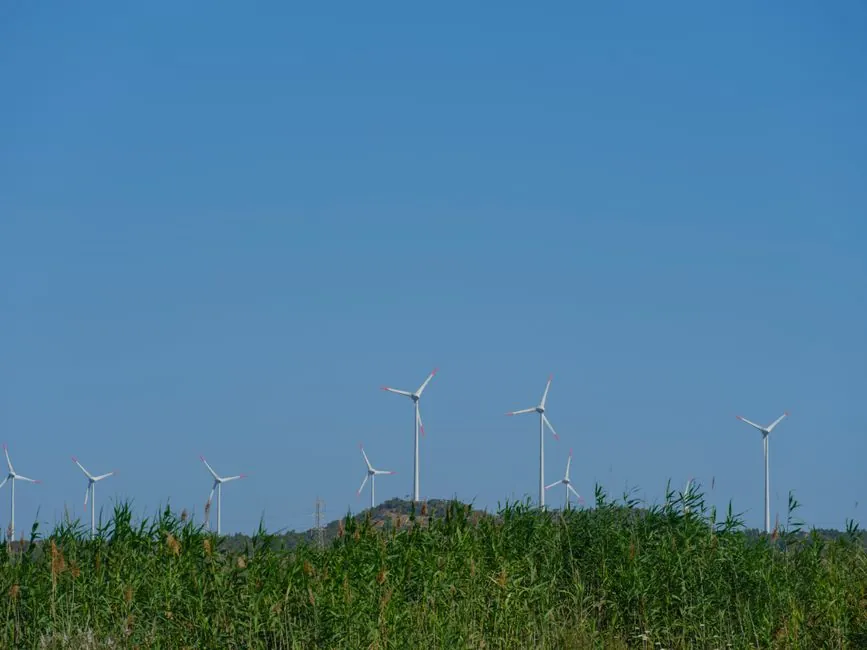
Procurement teams evaluating utility-scale wind turbines in 2026 should treat the turbine as a system of three coupled decisions: drive-train architecture, rotor topology, and structural health monitoring (SHM) scope, because each one independently shifts both CapEx and the 20-year CoE.
The reference unit is the horizontal-axis, three-blade, upwind machine (HAWT), which dominates new utility installations; vertical-axis machines (VAWT) remain a niche technology covered in the selection section below [S5]. A single 1 MW land-based machine displaces roughly 1,500 t of CO2 per year versus a coal-equivalent megawatt, which is the carbon baseline most ESG-linked PPAs are written against [S1].
Drive-Train Architecture: Geared vs Direct-Drive
Gearbox-equipped turbines still hold the majority of installed base in the 1.5–3.0 MW land class, because the gearbox steps low rotor RPM up to generator-friendly 1,500–1,800 RPM, shrinking generator mass and cost [S2]. The reliability penalty is real: gearbox failures are the largest single line item in onshore wind O&M budgets, which is why direct-drive (DD) and hybrid-drivetrain topologies (PMSG + partial gearbox) are gaining share in the 4 MW+ class [S2].
For procurement, the practical cut is rotor diameter: below 120 m, geared asynchronous or DFIG drivetrains are still cost-optimal; above 140 m, PMSG direct-drive begins to win on lifetime energy yield despite higher nacelle mass, because the removed gearbox removes the single biggest LCoE risk [S2]. The doubly-fed induction generator (DFIG) remains common in 1.5–2.5 MW machines and is what most ride-through and grid-code compliance tests in literature are written against [S4].
If a vendor cannot hand you a 20-year gearbox-replacement cost curve written into the TSA, treat the LCoE number on their datasheet as marketing, not engineering.
Rotor Topology: HAWT vs VAWT Selection Rules
HAWTs account for the overwhelming majority of utility-scale turbines and are the only topology that vendors like Vestas, Siemens Gamesa, GE, Mingyang, and Envision currently mass-produce above 3 MW [S5]. VAWTs (Darrieus, Savonius, H-rotor) have no yaw mechanism, accept wind from any direction, and tolerate turbulent urban airflow better, but their lower aerodynamic efficiency and taller structural columns have kept them out of the utility LCoE race [S5].
Use the four-criterion test below before letting a VAWT bid onto a procurement shortlist:
Criterion 1, rated wind speed band: VAWTs are competitive only at sites with mean wind speeds below 6 m/s, where HAWT cut-in losses dominate; criterion 2, footprint: VAWTs need roughly 1.5–2.0× the land area per MWh for the same annual energy yield; criterion 3, hub height: HAWTs scale linearly with tower height (modern land turbines reach 120–160 m hub), while VAWT structural mass scales worse; criterion 4, O&M access: VAWT drivetrains sit at ground level, so gearbox service does not require 100 m+ crane work, which is the single biggest VAWT O&M advantage [S5].
If the bid envelope is onshore utility LCoE, HAWT wins by default; VAWT belongs on distributed, low-wind, or architecturally constrained sites only.
Structural Health Monitoring: Sensors, Scope, Trigger Values
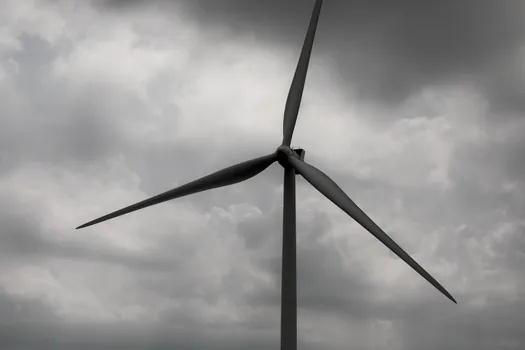
Modern land turbines routinely exceed 140 m tip height with 55 m blades, so the tower-foundation assembly is the structural element most likely to fail and most expensive to ignore [S1]. A spec-first SHM scope should cover four sensor groups: vibrating-wire embedment strain gauges and sister bars in the foundation pedestal, soil/concrete interface pressure cells, electronic plumb lines or MEMS tiltmeters on the tower base, and multipoint borehole extensometers into the anchor rock [S1].
The data-acquisition layer should be a web-based monitoring service with automated SMS/email alerts when any parameter crosses its trigger value, because stochastic aerodynamic loading means a passive SCADA pull will miss the 30-second event window that precedes most foundation events [S1]. Buyers should also require non-contact deformation checks (automatic 3D ATS, laser scanning, drone surveys) at the 6-month and 12-month marks to catch tower twist and foundation settlement that point sensors under-sample [S1].
For a process engineer, the practical instrument stack reads like a pressure transmitter family at the foundation, a flow meter analog for yaw hydraulic and lubrication circuits, and a linear guide equivalent in the pitch and yaw bearings where motion quality drives bearing life. Pitch-controlled variable-speed machines (the de-facto standard) further add a closed-loop hydraulic or electric pitch position sensor to the SHM scope [S4].
Instrumentation Stack Inside the Nacelle
The nacelle instrument stack has stabilised into a standard bill of materials: a PMSG or DFIG stator temperature RTD chain, a gearbox oil temperature and pressure pressure transmitter pair, a main bearing vibration pickup (IEPE accelerometer, typically 100 mV/g), a yaw drive industrial valve hydraulic-pressure sensor, and a wind vane/anemometer pair on the nacelle roof for power-curve verification [S1].
Procurement should require a per-turbine OPC UA or MODBUS-TCP data export from the SCADA gateway, because the SHM vendor's cloud is not where your LCoE reconciliation will be run, and locked vendor clouds are the most common reason an SHM system never feeds the O&E team's actual maintenance plan. Crossed-roller yaw and pitch bearings (the crossed-roller guide principle) are the mechanical components most exposed to monitoring data quality, because pitch bearing wear shows up as a 1× rotor-frequency torque ripple long before it shows up as a visible gap [S1].
Where grid connection is in scope, the doubly-fed induction generator (DFIG) ride-through control loop needs a stator-voltage and rotor-current pair sampled at 4 kHz minimum, which is the bandwidth most off-the-shelf industrial turbine flowmeter data loggers cannot reach and a frequent scope gap in first-time procurement packages [S4].
CoE, Reliability, and the 20-Year Service Contract

The wind industry's hard target is the lowest cost of energy (CoE), which forces every procurement decision to be scored on lifetime energy yield divided by lifetime cost, not on CapEx alone [S1]. A 1 MW machine that runs 95% availability at 35% capacity factor will out-earn a 1.2 MW machine that runs 88% availability at 32%, even though the larger nameplate looks better on the press release.
Insist on three contractual artefacts: an availability guarantee written in percentage points per quarter (industry-standard 95–97% onshore), a power-curve tolerance band (typically ±5% against the warranted curve at hub-height measured wind speed), and a gearbox-replacement cost cap that decays on a published schedule over the 20-year service window [S2]. The TSA should also define the SHM data ownership clause, because the data, not the steel, is what lets you renegotiate year-15 service terms.
Standards, Codes, and the Procurement Shortlist
The applicable technical baseline for utility-scale turbines sits in the IEC 61400 series (design requirements, power performance measurement, structural loads, and acoustic noise); buyers should require compliance with the relevant part on the vendor's datasheet, not a generic "IEC compliant" line. Foundation monitoring should be designed against the same geotechnical instrumentation standards used in civil works (vibrating-wire gauges and extensometers per the relevant ISO/EN instrumentation standards), and grid interconnection must meet the regional grid code (for example, ENTSO-E RfG in Europe, FERC Order 661A in the US, or GB/T 19963 in China) [S1].
For O&M scope, condition-monitoring systems should reference ISO 13373 for vibration monitoring on the rotating machinery (gearbox, main bearing, generator) and ISO 10816 for vibration severity evaluation on the whole nacelle. Buyers should also require that all load-bearing fasteners meet the relevant material and traceability standard (e.g. EN 10204 type 3.1 certificates for forged hubs and ring-forged shafts), and that welding qualifications are documented per ISO 3834 or ASME Section IX as applicable.
Procurement Watch-List and Next Signals

Two near-term signals are worth tracking before issuing the ITT. First, drive-train cost parity between DFIG + 3-stage gearbox and PMSG direct-drive in the 5–6 MW land class: every 5% swing in permanent-magnet price shifts the crossover by roughly 12 months [S2]. Second, the structural-monitoring-as-a-service business model: vendors are now bundling foundation and tower SHM with the TSA at zero incremental CapEx, which compresses the SHM line item out of the bid form entirely, so a vendor that does not bundle is a yellow flag on technical maturity, not on price [S1].
Specifying teams that anchor their bid evaluation on drive-train topology, rotor topology, and a documented SHM scope, with the contractual artefacts listed above, will close 2026 procurements with auditable LCoE numbers rather than vendor-curated ones.
Background reading: 2026 Water Solenoid Valve Maker Guide: ASCO, Parker, Danfoss, Burkert, SMC, Festo, Norg....