
Worm-gear servo reducers built for zero or sub-1 arc-minute backlash cover ratios from 4.75:1 up to 60:1, with input speeds rated to 5,000-6,000 rpm, and are explicitly intended for cyclic, non-continuous positioning rather than continuous-duty reversing service [S1][S4][S6].
The practical engineering question is not whether a worm reducer can be made tight, but whether its sliding-contact geometry, heat generation, and damping behavior match the motion profile of the load. Below 20:1 the contact geometry no longer delivers the position-locking and damping advantages that justify the format [S1].
Backlash numbers you can actually write into a spec
Angular backlash is the spec designers use for servo drive sizing, defined as the small free movement between meshing teeth before the output responds during reversal [S2][S7]. On high-torque servo-worm units the standard published figure is less than 1 arc-minute at assembly, with optional in-field adjustment, and 50-100 mm center-distance frames cover output torques up to 885 lb.ft [S4].
For higher-ratio servo-worm gearboxes the published backlash comes in two grades, Precise and Extra-Precise, with ratios from 2:1 to 60:1, torque capacity up to 4,400 lb.ft (6,000 Nm), and input speeds up to 6,000 rpm [S6]. Spring-loaded split-worm wheels and dual-lead (duplex) worm pairs are the two manufacturing routes used to push the gearset into a preloaded, zero-backlash state without distorting the housing [S5].
The duplex approach adjusts backlash by axial shifting of the worm, with a published worm-wheel backlash range of -0.045 to +0.045 mm and a 2 mm axial adjustment window capable of producing a zero-backlash pair [S5]. That is the engineering lever a designer should ask a vendor to demonstrate with a measured trace, not a catalog line.
Where the worm format fits a servo axis
Zero-backlash worm-gear units are designed for cyclic, non-continuous positioning applications such as indexing tables, pick-and-place, and electronic line-shafting, where the right-angle layout, single-stage high ratio, and integrated servo-motor flange reduce machine footprint [S1][S4].
The same line of reducers targets precision rotary axis drives, traveling gantries and columns, material-handling axis drives, zero-backlash axis drives, and electronic line shafting in material handling, automation, aerospace, machine tool, and robotics cells [S4]. In each case the reducer is paired with a servo motor via an input flange and coupling, and the output bore accepts an ISO 9409-1 flange for direct load mounting [S4].
When the motion is one-directional, such as a conveyor or a mixer, a standard worm reducer remains the most economical right-angle choice; a precision planetary unit is the safer option where servo-driven automation, positioning accuracy, and continuous-duty operation dominate the requirement [S3].
Worm vs planetary: a criteria comparison for servo sizing
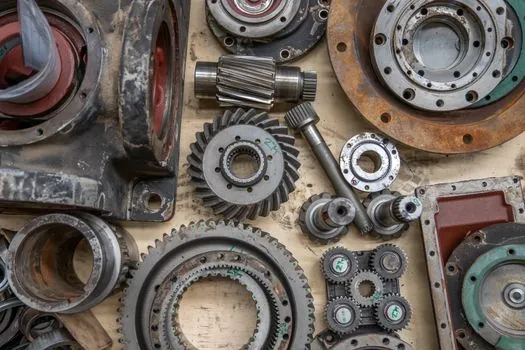
The honest comparison is not which is better in absolute terms, but which fits the operating condition [S3]. A worm reducer delivers high ratio, right-angle output, and self-locking behavior in one compact stage, at the cost of sliding-contact friction, heat, and limited efficiency; a planetary gearbox delivers higher efficiency, lower backlash under reversing load, and higher continuous-duty input speeds.
On the four criteria that drive a gear reducer decision for servo positioning, the data lines up as follows. Backlash: servo-worm units are published at sub-1 arc-minute standard, planetary precision grades are typically lower but at higher cost [S4][S6]. Ratio range: worm single-stage up to 60:1, planetary stacks higher at the expense of length and additional stages [S3][S6]. Input speed: worm up to 5,000-6,000 rpm, planetary typically higher and continuous-duty rated [S4][S6]. Reversing under load: worm is described as not ideal for precise reversing motion, planetary is the default for cyclic reversing servo axes [S2][S3].
For simple machinery without servo positioning, low-backlash, high-input-speed, or high-efficiency demands, a standard worm reducer is usually the most practical choice; the moment a servo drive is added and reversal is part of every cycle, the comparison shifts toward precision planetary [S3].
Backlash, compliance, and the failure modes that follow
Backlash and compliance both cause lost motion, but they are different mechanisms: backlash is the clearance between gear teeth or coupling elements, compliance is the elastic deflection of shafts, mounts, and belts under load [S2]. A system can have sub-1 arc-minute gearbox backlash and still feel spongy if the drivetrain has long shafts, belt sections, or flexible motor mounts.
The five operating consequences that show up first in a poorly specified worm-servo axis are positioning inaccuracy and poor repeatability at reversal, the audible clunk and current-spike signature as the drivetrain snaps from one tooth flank to the other, surface-finish defects in cutting, dosing, printing, and labeling, accelerated tooth and bearing wear from impact loading, and finally servo-tuning instability, where the controller sees commands that do not move the load and responds with overshoot or hunting [S2].
Backlash grows over time through gear-tooth wear from poor lubrication, contamination, overload, or shock, through bearing wear or preload loss that lets the output shaft move, and through mounting-bolt loosening that allows the housing to shift under load [S2]. For worm reducers, the additional wear mechanism is the sliding contact between worm thread and wheel teeth, which generates heat, shortens lubricant life, and accelerates the wear path that opens backlash [S3].
When a worm servo reducer is the wrong choice

Ratios below 20:1 are not suggested for zero-backlash worm servo units, because the lead angle no longer supports the contact geometry that makes the format useful, and the unit behaves more like a standard right-angle reducer with higher apparent backlash [S1].
Standard worm reducers without the servo-specific gearing and bearing package are also limited by backlash, input speed, and efficiency in servo applications, which is the reason most servo-sizing guides steer designers toward precision planetary once the duty cycle turns reversing and continuous [S3].
Continuous-duty high-speed operation, high-efficiency requirements, and machines where heat dissipation inside a sealed right-angle housing is the binding constraint are the three cases where a worm servo reducer will under-perform, regardless of the published backlash number [S2][S3].
Selection checklist for a worm-servo sizing call
Confirm the motion profile is cyclic and non-continuous, and that the reversing frequency is low enough that sliding-contact heat stays inside the housing rating; that is the operating envelope where zero-backlash worm units earn their place [S1][S3]. Match the ratio to the 20:1-60:1 window, choose the backlash grade (Precise or Extra-Precise) against the positioning tolerance, and verify the input-speed rating against the servo press or motor profile, with servo-worm units rated up to 5,000-6,000 rpm depending on frame size [S4][S6].
Specify the output interface (compression hub or ISO 9409-1 flange) and the bearing package, with input angular-contact bearings for high input speed and output tapered-roller bearings for radial and axial load capacity [S4]. Ask the vendor for a measured backlash trace at assembly, with documentation of the adjustment window for in-field zero-backlash setting, and check that the housing material and surface treatment match the ambient conditions of the cell [S4][S5].
Trackable signals to watch on future updates: vendor publication of angular-backlash curves across the full 4.75:1 to 60:1 ratio range, the spread between Precise and Extra-Precise grades as a function of frame size, and the published in-field adjustment range that supports a true zero-backlash pair without housing rework [S4][S5][S6].
For related coverage, see Why a Higher Contact Angle Lifts Axial Capacity in Angular Contact Bearings.