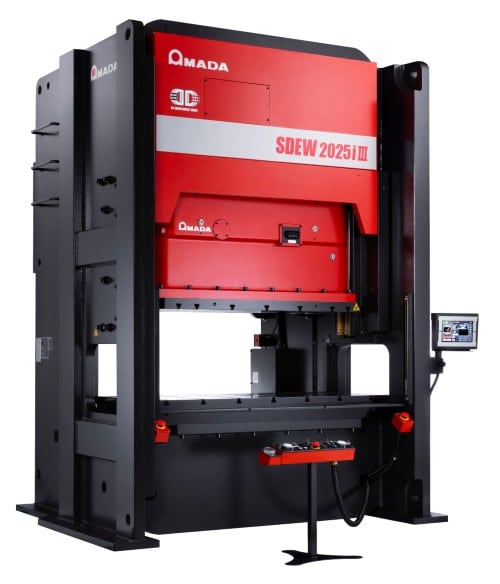
The defining feature of a servo press, as distinguished from a conventional mechanical or hydraulic press, is that the entire press ram profile is software-defined. Every parameter of the stroke including approach velocity, contact deceleration, force ramp, dwell time, retract speed, and end-positioning is described as a function of time, position, or load and is repeated with sub-millimeter and sub-percent force accuracy. Coretec, one of the principal Japanese manufacturers, describes the tool as combining the mechanical strength of a hydraulic cylinder with the compactness of an integrated electric actuator, and emphasizes that the press tool carries its own CPU so that program numbers, load values, and self-diagnostic data are stored locally in the tool itself, eliminating controller mismatch errors at cell changeover.
In a typical installation a servo press consists of three physical subassemblies: a press tool or actuator containing the servo motor, feedback encoder, ball or roller screw, load cell or force sensor, linear guide, and integrated CPU; a separate controller or power unit that supplies DC bus power, handles I/O and fieldbus traffic, and runs the press program; and a host PLC, PC, or HMI that supervises recipe selection, results logging, and line-level traceability. Communication between tool, controller, and line PLC is most commonly carried over Ethernet, RS-485, or industrial fieldbus networks such as CC-Link, EtherCAT, or PROFIBUS, and modern controllers expose load, stroke, and speed curves in graphical form for each individual pressing event for in-process statistical process control.
A servo press is an electrically driven forming, joining, and assembly machine in which a permanent-magnet or induction servo motor drives a ballscrew or planetary roller screw through a precision motion profile. Closed-loop control of position, velocity, and force allows a single machine to replace mechanical, pneumatic, and hydraulic presses for many joining and inspection tasks. Industrial servo presses are deployed in press-fitting, staking, riveting, crimping, bonding, and in-line quality verification in the automotive, electronics, medical device, and semiconductor industries.
Chapter 1 / 06
Chapter 1: Fundamentals and Working Principle
A servo press is a force- and position-controlled linear actuator driven by a closed-loop servo motor rather than by a fixed-speed flywheel, pneumatic cylinder, or hydraulic piston. The Coretec CS Type instruction manual identifies the principal components as the press tool, the controller, and the connection cabling, with the controller running the user program and the tool containing the servo amplifier, motor, encoder, ballscrew, and load-measuring transducer. The Delta Electric Servo Press instruction manual groups the same elements into a motor, ballscrew, linear guide, load cell, and integrated controller, the latter being responsible for recipe storage, PID loop closure, and results evaluation.
Working principle. The servo drive commands a rotational position to the motor; that rotation is converted to linear motion by a ball or planetary roller screw; the resulting ram displacement is measured by the motor encoder and, in higher-precision machines, by an additional linear encoder; the reaction force on the workpiece is measured by a load cell or strain-gauge force sensor mounted between the screw nut and the ram. The controller closes two nested loops: a position loop on ram displacement and a force loop on load cell output. By switching authority between the two loops mid-stroke the press can approach rapidly under position control, decelerate on contact, and then switch to force control to maintain a programmed load for a programmed dwell.
Operating modes. The Delta manual defines six pressing modes that are common across the industry: motionless, position mode, force mode, distance mode, force-position mode, and force-distance mode. In position mode the controller drives the ram to a target absolute position regardless of the force required; in force mode the controller holds a target load for a programmed time; in distance mode the controller travels a programmed stroke from a trigger event such as detected contact; in force-position mode a force threshold defines the switch point at which a position target is then enforced; in force-distance mode a force threshold triggers a distance-driven segment. Motionless mode is a low-power hold used for clamping without stroke.
Programming and traceability. Coretec's programming language permits the description of complex multi-axis motion profiles equivalent in expressiveness to a robot language, and the controller stores program numbers, tool data, and pressing results in self-memory so that the program travels with the tool. Recipe parameters such as target load, target position, approach speed, and upper/lower evaluation limits can be changed by the host PLC through a table reference, which means a single program can serve multiple product variants. Zone evaluation is provided as a continuous check on the stroke-load curve, with up to 32 zones per program and immediate stop on a zone violation, giving the press the same statistical process control capability that is normally associated with a coordinate measuring machine.
Why a servo and not a hydraulic or mechanical press. Mechanical presses are limited to a fixed cam profile, hydraulic presses drift under thermal load and consume energy continuously, and pneumatic presses cannot control force precisely. A servo press is fully electric, so it idles at zero energy, holds a force indefinitely with no duty cycle limit, and reproduces the same load-displacement curve shot after shot. Coretec illustrates the contrast in its tandem-application literature, noting that a maximum 300 kN load has been demonstrated with two shafts operating in synchronism, a duty cycle that would be impractical for an air-over-oil press and impossible for a fixed-stroke mechanical press.
Chapter 2 / 06
Chapter 2: Specifications and Key Parameters
Specifications for a servo press are usually presented in two tiers: a rated force expressed in kilonewtons, and a parameter set that covers stroke length, maximum velocity, positioning repeatability, force repeatability, duty cycle, controller I/O count, supported fieldbuses, and environmental ratings. The Promess EMAP sizing table reproduced in the source materials gives force ratings from 0.2 kN through 100 kN and above, with corresponding strokes of 100 to 660 mm and a speed of 200 mm/sec for most sizes, falling to 175 mm/sec at 80 kN. The same table is the cleanest published mapping in the source set between a numeric force rating and a single numeric stroke and speed, and it is reproduced verbatim below.
Force, stroke, and speed. The relationship between rated force and available stroke is not linear: small presses below 5 kN are typically offered in strokes of 100 to 350 mm, mid-range presses from 5 to 30 kN are offered in strokes of 180 to 550 mm, and heavy presses above 30 kN are most commonly offered in strokes of 330 to 660 mm. Maximum ram speed for the EMAP family is 200 mm/sec for all sizes up to 60 kN, decreasing to 175 mm/sec at 80 kN, which reflects the mechanical limit on the rotational speed of the screw as force rises. Coretec gives specific example profiles: an MS100-100B unit is rated for 90 mm/sec approach speed and will hold 70 kN for 15 minutes, an MS100-350B is rated for 50 mm/sec approach and supports repeat operation at 80 kN, and an MS30M-200B is rated for 125 mm/sec approach and supports repeat operation at 30 kN.
Force and position repeatability. Repeatability is a separate specification from absolute accuracy and is the figure that matters for in-line production. Coretec states that the CS Type press evaluates load, stroke, and load-rate values against upper and lower limits at final, peak, and user-selected points, and that zone evaluation allows continuous evaluation in the stroke-load area. The Delta manual describes a separate calibration procedure in which the load cell is calibrated against a reference force standard, with PID parameters for the force loop then tuned in the device-parameters menu. Numerical repeatability values are not stated in the source documents and should be requested from the manufacturer as a model-specific data sheet.
Duty cycle and thermal rating. One of the defining advantages of the electric servo press is that holding force consumes energy only in proportion to losses in the motor, so duty cycle is effectively 100 percent at rated force for indefinite dwell. The MC Machinery Slim Line press product page states explicitly that holding time is unlimited and duty cycle is 100 percent, which contrasts with hydraulic presses that require cooling pauses. Coretec's tandem-application data corroborates this by describing repeat operation under sustained high load for 15 minutes in the example profile.
Controller and I/O. The Delta instruction manual dedicates chapters 8 and 9 to I/O monitoring and external control, and lists I/O and communications definitions for digital inputs, digital outputs, and fieldbus interfaces. Ethernet and RS-485 are both used; Coretec's catalog states that Ethernet provides high-speed signal functionality and that large volumes of graphical data can be collected nearly instantaneously, while RS-485 remains in the lineup for legacy cells. The Delta manual also documents an external I/O initialization sequence, an external process procedure, and a recipe-switching interface that allows the host PLC to select between stored programs, which together define the integration boundary between the press and the line controller.
Environmental. Janome describes the JP Series 5 clean room model as suitable for ISO Class 4 clean environments, with low dust generation that enables high-precision pressing for medical, semiconductor, and electronic component manufacturing. Coretec states that its press tools are also designed for clean room use and invites consultation for special environment use. For high-temperature, high-humidity, or hazardous-area installations the manufacturer should be consulted for a derated specification.
Force (kN)
Force (lbf)
Stroke (mm)
Speed (mm/sec)
0.2
45
100
200
1
225
100, 300
200, 150
3
675
100, 300
200
5
1,125
200, 350
200
8
1,800
200, 350, 500
200
12
2,700
200, 350, 500
200
20
4,500
180, 350, 550
200
30
6,750
180, 350, 550
200
40
9,000
330, 660
200
60
13,500
330, 660
200
80
18,000
330, 660
175
100
22,500
330
varies by model
Chapter 3 / 06
Chapter 3: Types and Configurations
Servo presses are classified in three independent ways: by structural form, by force and stroke class, and by application-specific configuration. The first axis, structural form, distinguishes a column or C-frame press, an inline rod-type actuator press, a twin-rod or tandem press, and a multi-axis custom press stand. The second axis, force and stroke class, maps the press into a small parts assembly machine below 5 kN, a general industrial press from 5 to 30 kN, or a heavy forming press above 30 kN. The third axis covers specialized configurations such as clean room, tandem, multi-press, and bonding variants.
Standard single-axis tool. The most common configuration is a single inline actuator press tool. Coretec's CS Type tool is a representative example: a self-contained cylinder-shaped tool with a through-rod or piston-end output, an integrated CPU, an integrated load cell, and a single power and signal cable to the controller. This form factor is the workhorse of the press-fitting and staking industry and is used wherever a single press operation is required at a single workstation. Multi-axis press fitting is achieved by mounting several of these tools side by side at minimum mounting pitch, exploiting the compactness that Coretec identifies as a defining feature of the design.
Tandem and multi-shaft configurations. When the required force exceeds the rating of a single tool, two or more tools can be ganged on a common frame and operated in synchronism. Coretec documents a tandem use case in which two shafts deliver a combined 300 kN load, and describes a multiple-shaft fully synchronized custom press stand equipped with frame, power unit, and control panel. This configuration is used for large parts such as automotive body panels, large bearings, or structural components where uniform force across a wide area is required. Synchronism is enforced by the controller rather than by a mechanical linkage, so the individual tools can still be programmed with different contact speeds and dwell times if the part geometry requires it.
Multi-press and turnkey cells. Coretec describes a multi-press configuration in which the press is delivered as a stand-alone unit requiring only a power cable connection, with no program setting necessary, suitable for simple use. At the next level of integration the press is supplied as a turnkey cell with frame, guarding, load-monitoring instrumentation, and a control panel, ready to drop into a manual assembly line. The MC Machinery Slim Line press is representative of the bonding-oriented configuration, in which the press is paired with a dispensing system and a holding fixture so that the adhesive bead is compressed and held at a defined force while it cures.
Application-specific variants. Janome offers a clean room variant of its JP Series 5 servo press, identified as the JPU-1005C and JPT-1005C, suitable for ISO Class 4 clean environments used in medical, semiconductor, and electronic component manufacturing. Coretec offers a clean room design in its catalog and states that the company will consult on special environment use, including high-temperature or high-humidity installations. The Delta instruction manual, although not explicitly a product catalog, documents pressing modes that are characteristic of assembly applications: motionless clamping, position mode for stop-distance joints, force mode for compliance-critical joints such as polymer bearing insertion, and distance mode for crimping and staking. Together these variants cover the principal application niches in which electric servo presses are deployed today.
Form factor summary. In summary, the standard inline tool dominates low- and mid-force applications, the tandem or multi-shaft press covers high-force applications, the multi-press and turnkey cell covers manual assembly, the bonding press covers adhesive joining, and the clean room press covers contamination-controlled industries. Coretec's statement that the company will help realize special designs is typical of the industry: most manufacturers offer custom frames, custom strokes, custom load cell ranges, and custom fieldbus interfaces as engineered-to-order options built on the same tool platform.
Standard inline actuator tool (single press axis, integrated CPU and load cell).
Tandem or multi-shaft synchronized press for forces above single-tool rating.
Multi-press turnkey cell with frame, power unit, and control panel.
Bonding press with adhesive dispense and cure-hold force control.
Clean room variant qualified to ISO Class 4 (Janome JP Series 5 JPU-1005C and JPT-1005C; Coretec clean room design).
Custom press stand for large parts and special environment use.
Chapter 4 / 06
Chapter 4: Selection Criteria for Procurement
Selection of a servo press is driven by the joint to be made, the cycle time required, the available envelope in the workstation, the cleanliness class of the surrounding process, and the level of traceability demanded by the customer. The dominant mechanical selection parameters are rated force, stroke, approach speed, and repeatability. The dominant integration parameters are controller I/O count, fieldbus type, and recipe handling. The dominant lifecycle parameters are duty cycle, mean time between failures, calibration interval, and the manufacturer's local support footprint.
Force and stroke. The required rated force is determined by the joint geometry and the safety factor. As a rule of thumb the rated force of the press should be at least 1.5 to 2 times the maximum expected process force, so that the controller can regulate the loop in the linear range of the load cell and so that the screw is not operated continuously at its mechanical limit. The stroke must be at least the sum of the joint height, the fixture clearance, and the approach and retract distances; the Promess EMAP sizing table shows that mid-range presses from 5 to 30 kN are typically offered in strokes of 180 to 550 mm, so most assembly applications can be served by a standard stroke. For very tall stacks or deep-draw applications, the manufacturer should be consulted for a long-stroke variant.
Speed and cycle time. Approach speed determines the time spent in non-productive motion and is therefore the single largest contributor to cycle time. Coretec's example profiles illustrate the trade-off: 125 mm/sec for a 30 kN unit, 90 mm/sec for a 100 kN unit, and 50 mm/sec for a heavier 350 mm-stroke 100 kN unit. The Promess EMAP table shows 200 mm/sec for presses up to 60 kN. The user should select the smallest press that meets the force requirement, because peak ram speed is a function of the screw lead and the maximum motor speed and falls as force rises.
Repeatability and measurement. Force repeatability and position repeatability are not the same figure and should be requested separately. Coretec's evaluation function checks final, peak, and user-selected points against upper and lower limits, with zone evaluation allowing up to 32 zones per program. The Delta manual describes a load cell calibration procedure and a PID tuning procedure in the device-parameters menu, which together determine the closed-loop force accuracy. For applications in which 100 percent inspection is required, the press should be ordered with results output to the line PLC so that every cycle is graded and logged.
Integration. The Coretec catalog identifies Ethernet, RS-485, and FA networks as supported communications. The Delta instruction manual documents external I/O initialization, external process control, and recipe switching, which are the three integration points that the line PLC must implement. Fieldbus choice should match the existing line standard, and the press should support at least one of CC-Link, EtherCAT, PROFIBUS, or PROFINET, depending on the line architecture. The number of digital inputs and outputs should be sized for at least the safety circuit, the part-present sensor, the start button, the completion output, and the alarm output, with margin for fixture interlocks.
Environment and lifecycle. Cleanliness is a hard requirement in semiconductor and medical device manufacturing, and the press should be ordered as a clean room variant qualified to ISO Class 4 if required; Janome's JP Series 5 clean room model is representative. Duty cycle should be confirmed as 100 percent at rated force, which is a defining advantage of the electric servo press over hydraulic machines. Calibration interval is typically annual for the load cell and is supported by the self-diagnostics in the tool. Finally, the manufacturer's local service footprint should be assessed, because most servo press field service is software- and parameter-oriented and can be carried out remotely, but mechanical service on the screw or load cell requires a certified technician.
Chapter 5 / 06
Chapter 5: Standards, Compliance, and Testing
Servo presses sold into industrial markets are subject to general machinery safety standards in the destination market and to application-specific standards in the customer's industry. The source documents cite JIS B 9700-1, JIS B 9700-2, and JIS B 9960-1 as the relevant Japanese Industrial Standards for machine displays, warning devices, and instructional documentation for servo presses. The Coretec CS Type instruction manual dedicates Chapter 1 to 'FOR SAFE USE' and includes separate sections on precautions before use, warning symbols, use precautions, design precautions, transport precautions, precautions before operation, maintenance and inspection precautions, storage precautions, and disposal precautions.
General machinery safety. The provisions of JIS B 9700-1 govern the general principles for the design of safety-related parts of machinery and are the base standard referenced by virtually all downstream press standards. JIS B 9960-1 covers the safety of machinery used for the mechanical processing of materials, including presses, and is the standard most directly applicable to a press that performs forming, joining, or assembly. JIS B 9700-2 covers the validation of safety-related parts of control systems and is the standard against which the press safety circuit, emergency stop circuit, and guard interlock circuit are typically validated. The user should require the manufacturer to demonstrate compliance with the specific clauses of these three standards that apply to the press in its installed configuration.
Marking. The servo press shall display the required markings in a clear, easily read, and durable method. According to the source document on safety requirements, the markings include at minimum the manufacturer's name and address, the year of manufacture, the serial number, the rated force, the maximum stroke, the maximum speed, the supply voltage and phase, and the mass of the press. Warning devices, where fitted, are subject to JIS B 9700-2 and JIS B 9960-1. Instructional documentation, including the operation and maintenance manual, is also subject to these standards.
Application-specific standards. Press-fitting and joining applications in the automotive industry are subject to IATF 16949 quality management requirements, which require 100 percent inspection and traceability of critical joints. The Coretec catalog emphasizes that the press tool stores program numbers, load values, and self-diagnostic data in self-memory, which supports traceability at the individual joint level. In the medical device industry, presses used for the assembly of implants or instruments are subject to ISO 13485 quality management and, in many jurisdictions, to FDA 21 CFR Part 11 for electronic records and electronic signatures. The Delta instruction manual describes a recipe switching function and a pressing counter that together provide the audit trail required by these standards.
Functional safety. The emergency stop circuit, guard interlock, and two-hand control circuits on a servo press are safety-related parts of a control system and are subject to the performance levels defined in JIS B 9700-2 and the corresponding ISO 13849-1. A typical servo press will offer category 3 or category 4 performance on the emergency stop and the guard interlock. Hydraulic presses, by contrast, are subject to additional standards for the hydraulic circuit, which is one of the reasons why servo presses are increasingly preferred in cells with multiple safety devices.
Testing. Factory acceptance testing typically includes a force verification test, a position verification test, a speed verification test, a duty cycle test, and a functional safety test. The Coretec example profiles show that the manufacturer tests for both static load hold (70 kN for 15 minutes in the MS100-100B example) and for repeated dynamic load (repeat operation at 80 kN in the MS100-350B example, and at 30 kN in the MS30M-200B example). The Delta instruction manual describes a load cell calibration procedure in which the load cell is calibrated against a reference standard, followed by PID tuning of the force loop, which together form the closed-loop accuracy test. Site acceptance testing is typically limited to verification of the fieldbus interface, the I/O mapping, and the safety circuit, with the detailed force and position tests being deferred to the manufacturer's certificate of conformity.
Chapter 6 / 06
Chapter 6: Market Landscape and Buying Process
The servo press market is supplied by a small number of global manufacturers and a larger number of regional specialists. Coretec, Janome Industrial Equipment, Promess Inc, Delta Electronics, and MC Machinery are all named in the source materials, each with a distinct product orientation. Coretec focuses on high-precision press tools and custom press stands, with documented tandem and clean room capabilities. Janome focuses on clean room servo presses for the medical, semiconductor, and electronic component industries, with the JP Series 5 clean room model qualified to ISO Class 4. Promess focuses on the EMAP family of electric servo presses with a broad force and stroke range. Delta focuses on integrated controller-driven presses with extensive recipe and I/O functionality documented in its instruction manual. MC Machinery focuses on bonding-type servo presses with unlimited hold time and 100 percent duty cycle.
Product orientation by manufacturer. Coretec is the most application-flexible of the named manufacturers, with product literature describing standard tools, tandem tools, multi-press systems, custom press stands, and clean room designs. Janome's catalog is concentrated on the JP Series 5 family, with the clean room variant as the flagship configuration. Promess publishes a clean sizing table from 0.2 kN to 100 kN and offers a wide stroke and speed envelope, which positions it as a general-purpose supplier to assembly automation integrators. Delta positions its servo press as an integrated controller and tool combination, with the instruction manual emphasizing the recipe handling, pressing modes, and I/O integration. MC Machinery focuses narrowly on the bonding use case, with the Slim Line press as the headline product.
Distribution and channels. Servo presses are typically sold through a combination of direct sales to large OEMs and through distribution to small and mid-sized manufacturers. Coretec operates a direct model with engineering support, as evidenced by the invitation in the catalog to consult on special environment use. Janome sells through its own sales channels and emphasizes the clean room capability as a differentiator. Promess sells through a network of automation distributors and emphasizes the EMAP family as a modular product. Delta sells through its industrial automation channel and bundles the press with its broader controller and drive product lines. MC Machinery sells through the MC Machinery fastening solutions channel and emphasizes the bonding application.
Buying process. A typical procurement cycle begins with a joint specification, in which the user defines the rated force, stroke, speed, repeatability, I/O count, fieldbus type, and cleanliness class. A shortlist of suppliers is then drawn from the manufacturers active in the relevant industry and geography. A formal request for quotation is issued, and the supplier responds with a data sheet, a price, a delivery time, and a list of options. A factory acceptance test is scheduled, either at the supplier's site or via video link, and the press is shipped to the user. Site acceptance testing is performed after installation, and the press is released to production once the safety circuit, the fieldbus interface, and the recipe handling have been verified.
Pricing and total cost of ownership. Initial purchase price is dominated by the rated force, the stroke, and the cleanliness class, with clean room variants commanding a premium. Total cost of ownership is dominated by energy consumption, maintenance, and downtime. Because the electric servo press idles at zero energy and holds force indefinitely, its energy cost is materially lower than that of a hydraulic press, particularly in applications with long hold times. Maintenance is dominated by the ball or roller screw and the load cell, both of which are serviceable items with defined replacement intervals. Downtime is minimized by the self-diagnostic functions in the tool, which count operation cycles and travel distance and support systematic maintenance as described in the Coretec catalog.
Risk management. The principal risks in a servo press procurement are specification risk, integration risk, and lifecycle risk. Specification risk is the risk that the press is undersized or oversized for the application, and is mitigated by a clear joint specification and a factory acceptance test. Integration risk is the risk that the press cannot be integrated into the line, and is mitigated by an early review of the fieldbus, I/O, and recipe handling. Lifecycle risk is the risk that the press cannot be maintained over its service life, and is mitigated by a service contract with the manufacturer or a certified third party. The Coretec instruction manual, the Delta instruction manual, and the Promess data sheet together form a complete documentary basis for managing all three risks.
FAQ
What is a servo press and how does it differ from a hydraulic press?
A servo press is an electrically driven linear actuator in which a servo motor, a ball or roller screw, and a load cell are closed-loop controlled to deliver a programmed force and position profile. Unlike a hydraulic press, a servo press idles at zero energy, holds a force indefinitely with no duty cycle limit, and reproduces the same load-displacement curve shot after shot. Hydraulic presses require cooling pauses and drift under thermal load, whereas the MC Machinery Slim Line press advertises unlimited hold time and 100 percent duty cycle.
What force and stroke range is available in a typical electric servo press?
The Promess EMAP sizing table covers forces from 0.2 kN to 100 kN with strokes of 100 to 660 mm and a maximum speed of 200 mm/sec for most sizes, falling to 175 mm/sec at 80 kN. Small presses below 5 kN are typically offered in strokes of 100 to 350 mm, mid-range presses from 5 to 30 kN are offered in strokes of 180 to 550 mm, and heavy presses above 30 kN are most commonly offered in strokes of 330 to 660 mm. The user should select the smallest press that meets the force requirement, because peak ram speed falls as force rises.
What pressing modes are supported by a modern servo press controller?
The Delta Electric Servo Press instruction manual defines six pressing modes: motionless, position mode, force mode, distance mode, force-position mode, and force-distance mode. Motionless mode is a low-power hold used for clamping without stroke. Position mode drives the ram to a target absolute position regardless of the force required. Force mode holds a target load for a programmed time. Distance mode travels a programmed stroke from a trigger event. Force-position mode uses a force threshold as the switch point to a position target. Force-distance mode uses a force threshold to trigger a distance-driven segment.
Can a servo press be used in a clean room?
Yes. Janome offers the JP Series 5 clean room model in the JPU-1005C and JPT-1005C variants, qualified to ISO Class 4 clean environments for the medical, semiconductor, and electronic component manufacturing industries. Coretec also describes a clean room design in its catalog and invites consultation on special environment use. Low dust generation is a defining advantage of the electric servo press, because there is no hydraulic fluid and the only wearing parts are the screw and the linear guide, both of which can be specified with low-particulation lubricants and bellows.
How does a servo press perform traceability and quality control?
Coretec documents that the press tool carries its own CPU and self-memory, so program numbers, load values, and self-diagnostic data are stored locally in the tool and travel with it. Results for each pressing event are output to the host PLC, and Ethernet is used to transfer large volumes of graphical data nearly instantaneously, supporting line-level statistical process control. The evaluation function checks final, peak, and user-selected points against upper and lower limits, and zone evaluation allows up to 32 zones per program with immediate stop on a zone violation, which together implement 100 percent in-process inspection.
What safety standards apply to a servo press?
The source document on servo press safety requirements cites JIS B 9700-1 for general principles, JIS B 9700-2 for warning devices and safety-related parts of control systems, and JIS B 9960-1 for the safety of machinery used for the mechanical processing of materials. The Coretec CS Type instruction manual dedicates Chapter 1 to 'FOR SAFE USE' with separate sections on use, design, transport, operation, maintenance, storage, and disposal precautions. The press shall display the required markings in a clear, easily read, and durable method, and warning devices, where fitted, are subject to the same JIS B 9700-2 and JIS B 9960-1 framework.
How is a servo press specified and procured?
Procurement begins with a joint specification covering rated force, stroke, speed, repeatability, I/O count, fieldbus type, and cleanliness class. A shortlist of suppliers is drawn from manufacturers active in the relevant industry, such as Coretec, Janome, Promess, Delta, and MC Machinery. A formal request for quotation is issued, a factory acceptance test is scheduled, and the press is released to production after site acceptance testing of the safety circuit, the fieldbus interface, and the recipe handling. The Coretec, Delta, and Promess documents in the source set together form a complete documentary basis for managing specification, integration, and lifecycle risk.
Servo Press Manufacturers
Source-backed product routes. Open a company dossier for procurement scope and cited evidence.