
On a modern packaging line the worm reducer is rarely the headline machine, yet it sits behind almost every motion: label-applicator rollers, carton erector star wheels, infeed screws, and case packer belts all run through compact right-angle worm units sized between 5:1 and 80:1 with output torque from 8 Nm to 250 Nm and input power from 0.09 kW to 1.5 kW [S4].
Selection is driven by four numbers: output torque, input speed, duty cycle, and ambient temperature; miss any one and you get oil breakdown, backlash drift, or a hot housing in a sealed enclosure. A worked example in current literature sizes a 0.75 kW four-pole motor against a packaging conveyor head pulley purely from those four inputs plus ratio [S6].
Why a Worm, and Where It Fits on a Packaging Line
Worm reducers are favoured on packaging lines because the perpendicular shaft layout gives a right-angle output in a compact footprint, with self-locking behaviour that prevents back-driving on vertical lifts and inclined conveyors [S1][S7]. Quiet operation and shock-load tolerance also make them common on conveyor sections, lifts, and star-wheel indexing drives where a packaged product can arrive in slug bursts [S3].
On a labelling or cartoning line, each machine typically carries its own compact worm reducer driving belts, star wheels, label rollers, or carton formers at the speed and torque the centralised motion controller demands [S4]. The reducer is selected for precise torque at low rpm, high efficiency to limit heat build-up in a sealed machine enclosure, and long-term backlash stability [S4].
Spec Map: Ratios, Torque, Power, Backlash, Noise
Current manufacturer data for sub-1.5 kW packaging duty shows a ratio range of 5:1 to 80:1, output torque from 8 Nm to 250 Nm, input power 0.09 kW to 1.5 kW, backlash below 10 arc-min on the precision class, noise at or below 62 dB(A) at 1 m, and efficiency up to 85% at the 5:1 end of the range [S4]. Protection is IP54 standard with IP65 optional, the housing is die-cast aluminium with an anodised finish, and the worm wheel is machined from brass for lower-duty label rollers or tin bronze for higher-loaded carton formers, lapped against a ground steel worm [S4].
Speed ratio itself is just worm-wheel teeth divided by worm starts; a 40-tooth wheel on a 2-start worm gives i = 40/2 = 20, so output speed is 1/20 of input and torque is multiplied by 20 before losses [S1]. In practice packaging ratios cluster in the 10:1 to 60:1 band, which is where the ratio-versus-efficiency trade-off is still acceptable.
Sizing Procedure: Torque, Service Factor, Thermal De-Rate
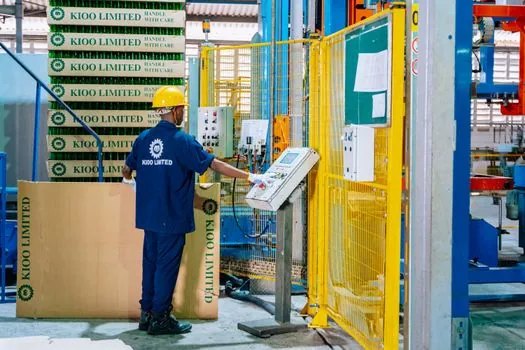
Selection starts with the running torque at the driven shaft, then multiplies by a service factor of 1.25 to 2.5 depending on duty class, and finally de-rates for ambient temperature above 30 deg C to keep the housing within thermal limits [S4][S5]. For ambient above 40 deg C the guidance is explicit: either upsize one frame size or switch to synthetic PAG lubrication to maintain thermal headroom [S4].
Input speed is set by the motor: a four-pole motor at 50 Hz runs near 1450 rpm, at 60 Hz near 1750 rpm, and the chosen ratio then fixes the output speed and the available torque after efficiency losses [S6]. Current selection guidance for packaging and bottling lines repeats the same three inputs: output torque, input speed, and efficiency ratings, with efficiency treated as a first-class constraint rather than a footnote [S5].
Comparison: Worm vs Helical vs Planetary on a Packaging Line
The three families line up against the criteria that matter on a packaging line as follows. Worm reducers offer a right-angle, compact footprint, self-locking action, low noise, and cost-effective design, but they are limited on efficiency, with one compact packaging-line gearbox line citing efficiency approaching 85% [S1][S4][S7]. Helical and bevel-helical units deliver higher efficiency, often above 95%, and better thermal headroom, but at the price of a longer axial envelope and no inherent self-locking [S2]. Planetary units give the highest torque density and the best efficiency in a coaxial package, yet they cost more per Nm and are sensitive to mounting alignment [S2].
For washdown zones, selection guidance for packaging reducers also calls out sealing and surface finish as a primary criterion, alongside torque, efficiency, and long-term reliability [S2]. A practical rule: pick worm for sub-1.5 kW label, cap, and carton-former stations where right-angle drive and silence dominate; pick helical or planetary for main conveyor drives above 1.5 kW where efficiency and thermal margin matter more than footprint.
Materials, Lubrication, and Protection Class

Standard packaging worm units pair a ground steel worm with a brass or tin bronze wheel; brass is typical for lower-duty label rollers, tin bronze for the higher-loaded carton formers, and bearings are deep-groove ball on light frames, tapered roller on heavier frames [S4]. Housings are die-cast aluminium with integrated cooling ribs to push heat out of the sealed machine cavity [S4].
Oil seals and a vent plug keep lubricant in and dust out while balancing internal pressure to prevent oil leakage during thermal cycling [S1]. For sites above 40 deg C, synthetic PAG is specified in place of mineral oil to hold viscosity and protect the bronze wheel; the gearbox itself is rated IP54 as standard with IP65 as an option for washdown exposure [S4].
Failure Modes and What to Watch After Install
The three failure modes seen in the field are oil leak from a clogged or missing vent plug, backlash drift from bronze-wheel wear on under-sized units, and thermal trip on units that were not de-rated for ambient [S1][S4]. Each one is a sizing or maintenance miss, not a material defect: leak points to pressure balance, backlash drift to an under-applied service factor, and thermal trip to a missing ambient de-rate [S4].
Verbatim from current selection guidance: "Selecting a worm gearbox for packaging applications begins with a thorough evaluation of output torque, input speed, and efficiency ratings tailored to the application" [S5]. Treat that trio as a checklist, then layer on duty class and ambient before any vendor shortlist is built.
Compliance, Standards, and Audit Trail

Packaging worm units ship with a documented quality system and a mark auditors will actually look for: ISO 9001 manufacturing certification, CE marking for European-standard installations, and input/output interfaces compliant with IEC standards and available in NEMA C-face configurations for North-American-spec motors [S4]. For a general overview of how a worm reducer sits inside the wider reducer family, the encyclopedia entry is the right starting point; for the broader gear reducer taxonomy, the same site covers helical, bevel, and planetary in adjacent pages.
Worm units are one option inside the wider packaging machine drive train, which also includes gearmotors, servo drives, and belt-driven stations; the vacuum packaging machine page covers the sealing-end drives where a separate small worm or helical unit often runs the seal bar. Materials handling around the line, from infeed conveyors to case packer outfeed, is covered under logistics packaging and packaging material entries on the same site.
Track the following two signals over the next planning cycle: published efficiency curves at ratios above 40:1 on sub-1.5 kW packaging frames, and IP66-rated worm housings entering catalogue at the same power band, since both shift the worm-versus-helical decision on washdown packaging lines. For heavier-duty comparisons outside packaging, see the spec map on worm reducers for mining, which covers the higher-torque envelope.