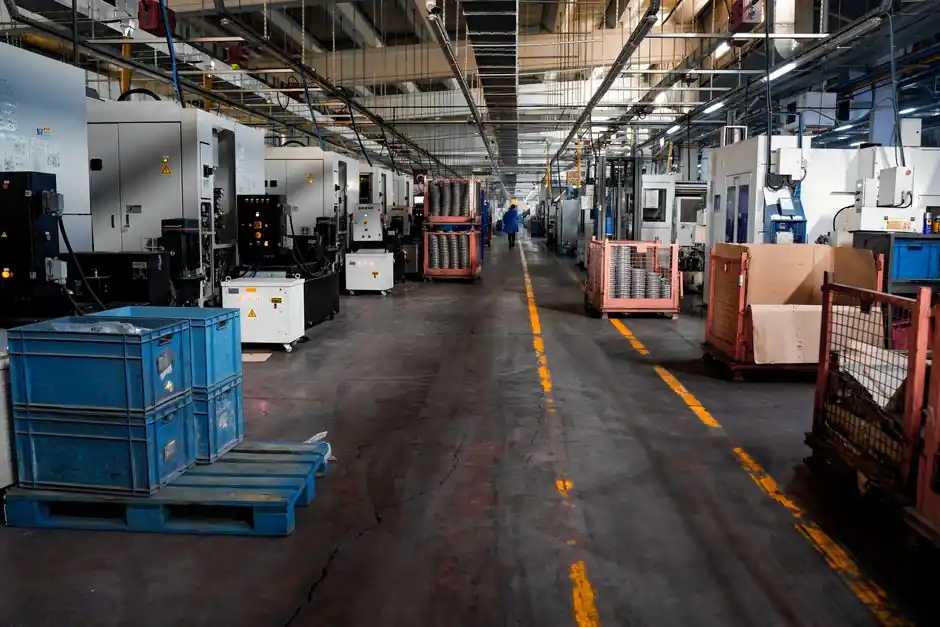
Automotive production cells demand planetary reducers sized by continuous torque at the driven shaft, not by motor nameplate, with a service factor of 1.5 to 2.0 applied for the reversing and shock-loaded motion profiles typical of transfer, index, and screw-drive stations [S4].
Frame sizes 60 to 180 mm cover the 200 W to 11 kW servo band that dominates body-in-white transfer, seat-track assembly, headlamp aiming, and paint-shop door drives, with right-angle units available in SS42 to SS180 frames for low-ratio 1:10 cells up to 5 kW [S5]. DirectIndustry lists 1,113 catalog planetary products from 169 manufacturers, which signals the supply fragmentation buyers must navigate with a written spec envelope before vendor contact [S4].
Torque Sizing and Service Factor for Line Duty
Rated output torque must cover the maximum working torque of the equipment with a 1.2 to 1.5x safety factor, rising to 1.5 to 2.0x under shock-load conditions such as cam-actuated index tables and press-feed transfers [S3]. A working torque of 100 N·m therefore requires a catalog rated torque of at least 120 N·m under uniform loading, or 150 to 200 N·m once press impulse and reversing load are folded into the duty cycle.
Catalog torque is published as a continuous T2N and a peak T2max, with T2max constrained to roughly 1,000 to 3,000 load cycles per hour depending on manufacturer rating method [S4]. For welding-gun positioners and seat-weld clamps, which cycle above this band, frame-size upsize or external cooling is the standard mitigation. Output torque scales with ratio: a 10:1 unit on a 3,000 RPM motor delivers 300 RPM at the gearbox output, with torque multiplied by the ratio minus mesh and bearing losses [S7].
Backlash, Accuracy Class, and Torsional Stiffness
Backlash is graded into three bands: standard at 10 to 15 arc-min, reduced at 5 to 8 arc-min, and precision below 5 arc-min on two-stage units from specialist suppliers [S4]. For painting robots and headlamp-beam aiming, the precision band is mandatory; for conveyor transfers and door drives, the standard band is acceptable. Torsional stiffness, published separately at 5 to 50 N·m/arc-min by frame size, governs CNC feed axes and packaging-index duty rather than the backlash number alone.
Ratio accuracy error should stay at or below 1% for ordinary conveying equipment and at or below 0.1% for precision machine tools and robots, with the manufacturer's transmission-ratio-error curve used to confirm [S3]. Backlash grows with service life, so the manufacturer's backlash-life curve is the document to request, not the as-new figure on the datasheet alone.
Ratio Architecture: Single-Stage, Two-Stage, Right-Angle
Single-stage planetary reducers cover nominal ratios of 3:1, 4:1, 5:1, 7:1, 8:1, and 10:1 in most catalogs, with some vendors extending to 12:1 and 14:1 by changing the ring-gear tooth count [S4]. Two-stage planetary reducers combine two planetary sub-assemblies in series to reach 20:1 up to 100:1, and a helical pre-stage pushes the assembly to 1,000:1 or higher for low-speed screw-drive and turntable duty.
Right-angle units are specified when floor space is constrained and the output shaft must sit perpendicular to the input, with frame-to-power mapping for the planetary family (42 frame at 50-100 W up to 180 frame at 7 kW and above) and a parallel right-angle family (SS42 at 100-200 W up to SS180 at 2-5 kW for ratios at or below 1:10) [S5]. A helical gear reducer pre-stage is the cheaper path to 200:1 or higher when the backlash budget is 15 to 30 arc-min.
IP Rating, Cooling, and Paint-Shop Environment
IP54 is sufficient for ordinary assembly halls, IP65 is required for damp or dusty cells, and IP67 is necessary for outdoor or wash-down zones such as car-wash equipment and outdoor conveyor lines [S3]. Cooling selection follows the duty envelope: natural cooling is acceptable at or below 500 RPM and 50 N·m, forced-air cooling with an added fan is required at or above 1,000 RPM and 100 N·m, and water cooling with a cooling jacket is necessary above 60 °C ambient [S3].
Continuous torque derates above 30 °C ambient, and most catalog ratings assume a 90 °C maximum housing temperature with mineral oil or synthetic PAO grease [S4]. For paint-shop robots and oven-area indexers that run near T2N, an external cooling fan or forced-lubrication kit is cheaper than upsizing one frame size, and a planetary reducer reference is the starting point for matching topology to the cell layout. Installation coaxiality between input shaft and motor shaft must stay at or below 0.1 mm or premature bearing damage follows [S3].
Comparison: Planetary vs RV, Harmonic, and Cycloidal Alternatives

Planetary reducers deliver high torque density in a compact package and dominate robotics, motion control, and servo-drive applications [S2]. RV reducers are heavier and more expensive per newton-metre at equivalent ratio but offer higher shock-load tolerance and torsional stiffness for high-ratio, low-backlash cells. A helical gear reducer pre-stage is the cheaper way to drop input speed when backlash budget is 15 to 30 arc-min.
For high-ratio, low-speed, continuous duty the side-by-side evaluation should include RV and worm reducer topologies, since their thermal envelopes differ materially from a planetary [S4]. Cycloidal and harmonic reducers fill specific niches, with harmonic units excelling at zero-backlash positioning and cycloidal units handling shock better than a standard planetary. Stepper motor planetary reducers improve torque output, positioning accuracy, and mechanical efficiency on indexing stations, but the same torque and backlash gates still apply [S1].
What It Is For, What It Is Not For
Planetary reducers are for: servo-driven axis motion, transfer and index tables, seat-track assembly, weld-clamp actuation, headlamp aiming, paint-shop door drives, and any cell where a 200 W to 11 kW servo must be matched to a defined output speed and torque envelope with backlash at or below 15 arc-min. They are not for: very high-ratio (above 1,000:1) continuous-duty applications where an RV or worm topology is thermally superior, environments requiring IP68 or submersion rating beyond what standard catalog units provide, or applications where the radial load on the output shaft exceeds the catalog bearing limit and the bearing life calculation no longer closes [S3][S4].
Spec discipline follows a fixed sequence: lock the continuous torque and service factor first, then the ratio and backlash class, then the IP rating and cooling method, then the frame-to-motor power match [S5]. For material-handling cells with similar torque profiles, the same gates apply with a coaxial torque emphasis documented in a parallel planetary reducer selection guide for material handling cells. For powertrain and chassis component manufacturing, the upstream casting and machining equipment is gated separately, and a resin sand molding line selection map for automotive parts sets the metallurgical envelope the reducer cell must support. For agricultural-machinery lines with comparable shock-load profiles, the planetary reducer selection for agricultural machinery notes show how service factors shift when dust and ambient temperature push the IP and cooling gates higher.
Two trackable signals for the next 90 days: (1) backlash-life curves from the major servo-grade planetary vendors, which are still inconsistently published and remain the single most common cause of premature planet-bearing failure when overspec'd by buyers; (2) catalog expansion of right-angle SS frames above 5 kW at ratios above 1:10, currently a gap relative to the in-line planetary family and a known bottleneck for paint-shop door-drive retrofits.
Component reference pages worth checking: planetary reducer, cycloidal reducer, and gear reducer.