Automated pallet wrapping machines have moved from optional to standard equipment in mid-size and large warehouses in 2026, with the global market valued at USD 3.8 billion in 2025 and projected to reach USD 4.03 billion in 2026 at a 6.1% CAGR through 2036 [S1].
The selection problem is no longer whether to automate, but which class of wrapping machine fits a given throughput, load profile, and floor space, given that manual wrapping typically consumes 10–30% more stretch film than machine wrapping and produces inconsistent load containment [S1].
Three Wrapper Classes and Their Decision Boundaries
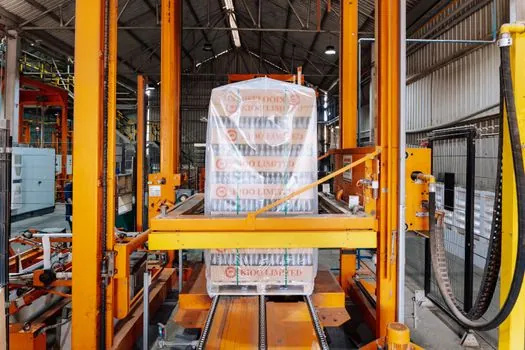
Semi-automatic turntable wrappers, rotary-arm wrappers, and automatic ring/conveyor wrappers serve distinct throughput and load-geometry bands, and warehouse specifiers usually choose by mapping daily pallet volume and load stability to one of these three families [S1]. A turntable machine rotates the pallet on a platform while the film carriage moves vertically, which makes it the lowest-cost option for regular, stable loads in the 15–30 pallets/hour range [S1]. Rotary-arm machines hold the pallet stationary and orbit the film dispenser, which is the correct choice for unstable, lightweight, or tall loads that cannot be safely rotated [S1]. Automatic ring or conveyor wrappers integrate directly with upstream palletizers and conveyors, sustaining 60+ pallets/hour with no operator intervention at the wrap station [S1][S2].
Comparing the three options against the four decision criteria that matter in a warehouse RFQ:
Throughput: turntable 15–30 loads/hour, rotary arm 20–40 loads/hour, ring/conveyor 60+ loads/hour, with the automatic class dominating any operation beyond a single shift of 200+ pallets [S1]. Load type fit: turntable requires stable, uniform pallets; rotary arm accepts tall, light, or off-center loads; ring/conveyor assumes standardized pallet dimensions matching the conveyor spec [S1]. Film efficiency: all three classes deliver the 10–30% film savings versus hand wrapping, but pre-stretch carriages on automatic machines can push that figure toward the upper end of the range [S1]. Floor space and integration: turntables need the most clearance for the rotating pallet footprint, rotary arms need vertical clearance for the arm sweep, and ring/conveyor systems need a straight inline layout with conveyor handoff [S2].
Where Wrapping Sits in the Packaging Automation Stack
A packaging automation system combines conveying, primary packaging machinery, controls, sensors, and end-of-line equipment, and wrapping is the final stabilization step before shipment [S2]. Product input typically enters via conveyors or feeders, automated handling aligns and transports the load, primary packaging machines perform filling, sealing, labeling, or carton forming, and inspection sensors verify package integrity before palletizing and wrapping close the line [S2].
Within that stack, the shrink-wrapping machine variant is specified when retail-facing packs need a tight, transparent overwrap, while stretch-wrapping remains the default for unit-load pallet stabilization in distribution centers [S2]. End-of-line equipment selection, including pallet wrapping, palletizing, and load stabilization, is driven by shipment readiness goals rather than primary-line speed, so the wrapper is often procured separately from the upstream filler or sealer [S2].
What Drives the Move From Manual to Automated Wrapping in 2026
Three operational failures push warehouses to automate, and each maps to a measurable cost line that a specifier can defend in a capital request [S1]. Film waste from hand wrapping runs 10–30% above machine consumption, which on a 100-pallet-per-day operation consuming roughly 500 g of film per pallet compounds into several tonnes of avoidable film per year [S1]. Transit damage from loosely wrapped pallets drives claim frequency up and on-time delivery down, and automated machines deliver consistent tension and even overlap that hand wrapping cannot repeat [S1]. Repetitive-motion injuries on manual wrap stations add workers' compensation exposure and turnover cost, both of which scale with staffing levels and shift length [S1].
The market response is visible in the numbers: Grand View Research tracks USD 3.8 billion in 2025 revenue, USD 4.03 billion projected for 2026, and USD 7.29 billion by 2036, with e-commerce and smart-warehouse upgrades cited as the primary demand drivers [S1]. Cold chain logistics, food and beverage, and retail distribution are the named verticals adding wrapping machine capacity most aggressively in the 2026 cycle [S1].
Selection Criteria a Specifier Should Lock Down Before the RFQ
Five inputs determine the correct machine class, and writing them into the purchase specification up front prevents oversizing the equipment and the recurring cost that follows [S1][S2]. Daily pallet volume and peak hourly rate set the throughput band, with the 15–30, 20–40, and 60+ loads/hour breakpoints defining the three machine classes [S1]. Load geometry (weight, height, footprint, and stability) determines whether a turntable is acceptable or a rotary arm is mandatory [S1]. Available floor space, including ceiling height for rotary-arm sweep, constrains machine footprint and rules out some classes before price is even discussed [S1][S2]. Film specification (gauge, width, pre-stretch ratio) drives the carriage selection and the 10–30% film-savings claim that justifies the capital cost [S1]. Integration requirements, including conveyor handoff, palletizer interface, and plant control system connectivity, decide whether the wrapper stands alone or ties into a wider electrical automation layer [S2].
Use Cases by Warehouse Profile
A 5,000 m² regional distribution center shipping 80–150 pallets per day on mixed SKUs is a textbook semi-automatic turntable installation, with the operator loading pallets via hand jack and the machine handling film tension and overlap [S1]. A cold-chain facility wrapping palletized frozen or chilled goods needs a wrapper specified for low-temperature operation, often as a rotary-arm machine so the load never has to be rotated on a cold, slippery turntable surface [S1]. A 24/7 cross-dock or e-commerce fulfillment center shipping 400+ pallets per shift is the canonical case for a fully automatic ring or conveyor wrapper integrated with the upstream palletizer and the plant WMS or coding machine line [S1][S2]. A small workshop or last-mile dispatch point doing under 30 pallets per day is usually still best served by a hand-pallet wrapper with pre-stretch film, since the capital cost of even a semi-automatic machine cannot be recovered at that volume [S1].
Constraints, Failure Modes, and Common Mis-specifications
The most common selection error in 2026 is over-buying a fully automatic ring wrapper for a site that ships 100 pallets per day, where a semi-automatic turntable delivers the same film and labor savings at a fraction of the capital and integration cost [S1][S2]. A second failure mode is specifying a turntable for unstable tall loads such as bagged pet food or bottled water, where the rotating mass shifts the center of gravity and creates a tip-over risk that the rotary-arm topology eliminates [S1]. A third issue is ignoring ceiling height for rotary-arm machines, since the arm sweep envelope must clear the tallest pallet plus a safety margin and is often the binding constraint in retrofit brownfield sites [S1]. A fourth is under-specifying the pre-stretch carriage, which is the mechanism that drives the 10–30% film-savings figure and is the single component most likely to be downgraded to cut vendor price [S1].
For related selection context, the Wrapping Machine Selection for Cold Chain Logistics: 2026 Spec Map covers the low-temperature duty cycle in detail, and the Wrapping machine selection for apparel distribution: 2026 spec map addresses the high-SKU, low-weight load case that often pushes buyers toward rotary-arm topology.
Standards, Sourcing, and Trackable Signals for the Next 6 Months
Wrapping equipment itself is not governed by a single IEC or ISO process-safety standard in the way pressure equipment is, but the integration into a packaging automation system typically references general machinery safety (ISO 12100) and electrical safety (IEC 60204-1) for the wrapper's control panel and electrical automation interface [S2]. Load testing of finished pallets often references ASTM D4169 or ISTA 3E for transport simulation, which specifiers use to validate the wrapper's tension settings before signing off on a film and overlap recipe [S1]. Vendors publish machine throughput in pallets per hour under stated load conditions, and buyers should request those conditions in writing because the 15–30, 20–40, and 60+ bands are achievable only with standard 1.2 × 1.0 m pallets and consistent film gauge [S1].
Trackable signals to watch through the next two quarters: the Grand View Research 2027 update to the 2036 USD 7.29 billion projection, any new ISTA or ASTM revisions touching pallet-load testing protocols, and vendor announcements of ring-wrapper models with integrated vision inspection for in-line wrap-quality verification [S1][S2].