Orbital horizontal stretch wrappers (17.7-85.4 in ring range, up to 90 RPM ring speed) now dominate Tier 1 automotive line-end packaging for long, irregular parts such as exhaust pipes, drive shafts, bumpers up to 80 in long, and leaf springs, where standard turntable pallet wrappers physically cannot load the geometry [S2].
For tier suppliers shipping boxed and palletized components (bumpers, dashboards, trim, fasteners), heavy-duty pallet wrapping machines with 2.0 m turntables, 300% powered pre-stretch, and dual-roller film carriages remain the workhorse, with the line typically running 500+ pallets per day at automotive tier warehouses [S4].
Why a Turntable Pallet Wrapper Fails on a Drive Shaft
Turntable rotation depends on the load being roughly cuboid, centered, and within the turntable's rated footprint, plus a clearance margin of 50-100 mm beyond pallet diagonal for stable film tension [S4]. An automotive drive shaft or exhaust pipe is long, often 1.5-2.0 m, with flared tips, brackets, and sharp edges that snag 20-25 µm stretch film and produce uneven web tension on a rotating platen [S2].
Horizontal orbital wrappers invert the geometry: the load stays stationary on a belt conveyor and a vertical film ring orbits the part, applying 5-6.7 in narrow stretch film under a mechanical tensioning system, which conforms the film web tightly to the part's contour without snagging [S2]. This is the standard solution for mufflers, bent heavy steel exhaust pipes, side rails, fascias, trim extrusions, and bumper assemblies exiting an assembly line [S2].
For background on how orbital and turntable architectures differ, see the entry on shrink wrapping machine configurations and the broader logistics packaging equipment taxonomy.
Matching the Orbital Ring to the Part
Ring size is the single most important spec for an orbital wrapper on an automotive line: it must clear the widest cross-section of the part with margin for film and conveyor hardware. Current production ring sizes span 17.7 in (compact units for narrow profiles) up to 85.4 in (Pro 1100 and larger Pro 1400, 1700, 2200 units built for full truck bumpers and multi-hundred-pound suspension components) [S2].
Ring speed is the throughput lever. The Dynawrap Pro 600 runs at 90 RPM orbital ring speed with continuous belt conveyors, specifically engineered to keep pace with upstream CNC and welding stations where a 30-second wrap station would create a backup on the assembly line [S2]. For mixed-model lines, recipe-free autonomy via 3D depth-sensing cameras is offered as an option across both Joy and Pro series, scanning irregular parts volumetrically on entry to the wrap zone [S2].
Safety integration is non-optional at these ring speeds: light curtains, electro-welded mesh guards, and emergency auto-stop must be hard-wired into the cell, since a 90 RPM ring is not a benign mechanism to stand next to without guarding [S2].
Pallet Wrapper Specs for Tier Supplier Warehouses
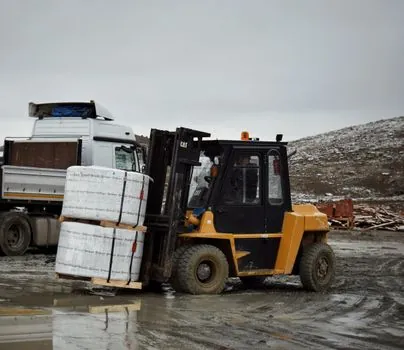
For automotive tier suppliers shipping in 1200x1000 mm Euro pallets or 1400x1200 mm blocks, the turntable diameter must exceed the pallet's diagonal by at least 100 mm to prevent overhang, uneven film tension, and load tipping during rotation [S4]. A 1.8 m turntable handles 1200x1000 mm pallets safely (pallet diagonal approximately 1562 mm), but a 2.0 m turntable is the recommended high-volume spec because it covers 1400x1200 mm blocks without centering delays, and carries only a 15-20% price premium over the 1.8 m unit [S4].
Pre-stretch ratio drives film cost, the largest operating expense on a pallet wrap line. A powered pre-stretch of 300% reduces film consumption by approximately 33% versus 200% stretch, because 1 m of film becomes 4 m of wrapped surface and the film thins from 20-25 µm to roughly 6-8 µm on the load [S4]. At 500+ pallets/day, the math is hard: 250% stretch consumes about 4.5 rolls/day, 300% stretch about 3.5 rolls/day, and at $35/roll the annual waste from under-stretching exceeds $12,775 per machine [S4].
Only a dual-roller, independently driven pre-stretch mechanism can deliver 300% without tearing the film, and the actual achievable stretch is film-dependent, so always test with the film you intend to run [S4].
Decision Matrix: Orbital vs Turntable Pallet Wrapper
Four selection criteria separate the two architectures cleanly for an automotive parts spec. Geometry fit: orbital wrappers accept long, irregular, sharp-edged parts (drive shafts, exhaust, bumpers) where turntables physically cannot; turntable wrappers fit cuboidal pallet loads from 1200x1000 mm up to 1400x1200 mm. Throughput: orbital ring speeds reach 90 RPM with continuous conveyors for line-end packaging; turntable wrappers are sized for 500+ pallets/day warehouse throughput. Film spec: orbital systems use narrow 5-6.7 in stretch film with mechanical tensioning; turntable systems use 20-25 µm wide-web film at 300% powered pre-stretch. Integration: orbital cells integrate robotic pick-and-place, ERP/WMS via OPC UA, MQTT, and EtherNet/IP, plus VCI anti-rust dosing for Tier 1/Tier 2 suppliers; turntable wrappers integrate WMS for SKU-level inventory visibility and sequenced line-feed delivery [S1][S2][S4].
If the part is longer than the turntable's diagonal, or has flared ends, brackets, or sharp edges, the answer is orbital. If the part ships in a corrugated or solid-board box on a standard pallet, the answer is a 2.0 m turntable with 300% pre-stretch.
Corrugated, Honeycomb, and Film: What Wraps What
Automotive tier suppliers are increasingly substituting honeycomb cardboard solutions for wooden export crates, with claimed cost reductions of 40-70%, weight reductions of 75-85%, and 80% recycled content, all 100% recyclable at end of life [S3]. These custom-insert corrugated packs are designed to position parts efficiently and maximize parts-per-container for sea freight, but they are not a substitute for stretch film; the outer pack still gets stretch-wrapped or strapped for handling stability.
For Tier 1 inbound logistics, dedicated contract warehousing with WMS-level SKU tracking and real-time production-schedule integration is the standard for just-in-time parts delivery, with the failure mode being a two-hour-late component that stops a vehicle assembly line [S1]. A pallet wrapper that mis-applies film, leaves a tail, or fails to hold load integrity during inter-plant transfer is a JIT risk on the same level as a missed carrier appointment.
Mondi's automotive logistics packaging portfolio covers the corrugated and solid-board side of this, with solutions spanning standard transport designs to specialized configurations for Tier 1 and OEM customers [S5].
Connectivity, Traceability, and Corrosion Protection
Modern orbital cells ship with native ERP and WMS connectivity over OPC UA, MQTT, and EtherNet/IP, plus predictive maintenance diagnostics and remote monitoring, which is the spec a Tier 1 procurement team should require rather than treat as a value-add [S2]. For steel parts (exhaust, springs, fasteners) that sit in storage or ocean containers, VCI (volatile corrosion inhibitor) anti-rust integration is offered as a line-item, not an option to forget, since rust claims are a recurring chargeback in automotive tier contracts [S2].
Dual-film carriages are the right spec for continuous operation, allowing one reel to be swapped without stopping the line, and they are available across the Pro series for high-volume lines [S2]. For facilities still running semi-automatic turntable towers, mast height must be confirmed against the maximum pallet height in the SKU mix; standard semi-automatic towers span 2400-3000 mm, and a steel mast is recommended over aluminum for durability at high cycle counts [S4].
Who Should Not Spec an Orbital Wrapper

Orbital wrappers are wrong for pure pallet-load warehouses with no long-parts line. The capital cost, the 17.7-85.4 in ring sizing requirement, and the safety infrastructure (light curtains, mesh guards) only pay back when parts physically cannot ride a turntable. A warehouse shipping 500+ mixed-SKU pallets per day with no long components is better served by a 2.0 m turntable with 300% pre-stretch and a steel mast [S4].
Conversely, a Tier 1 line-end cell wrapping drive shafts on a 90 RPM orbital ring is the wrong place to economize with a turntable; the geometry simply will not work, and the snagging on sharp exhaust brackets will tear film and stall the line [S2]. A spec map for a related line-end process, Cold Box Core Shooter Selection for Automotive Castings, follows the same logic: pick the equipment class that matches the geometry and throughput, not the one with the lowest invoice.
Lead-Time, Sourcing, and Standards Signals
Heavy-duty custom pallet wrappers carry a 12-month minimum electrical warranty and 24-month mechanical warranty baseline according to current supplier literature, and turntable sizing should be future-proofed because retrofitting a 1.8 m turntable to handle a new 1400x1200 mm SKU is more expensive than buying the 2.0 m unit upfront [S4]. For international Tier 1 and Tier 2 shipping, packaging supplier networks typically source to automotive-grade specifications and can ship within standard automotive logistics lead times, with the honeycomb solutions cited as 40-70% lower cost than full wooden box alternatives [S3].
Trackable signals for the next spec cycle: published cycle-time benchmarks for 90 RPM orbital cells on bumper assemblies, and updated Tier 1 supplier guidance on VCI film chemistry compatibility with electric vehicle battery pack enclosures, where corrosion inhibitor residues on busbars and cooling plates are a separate failure mode from traditional exhaust rust.