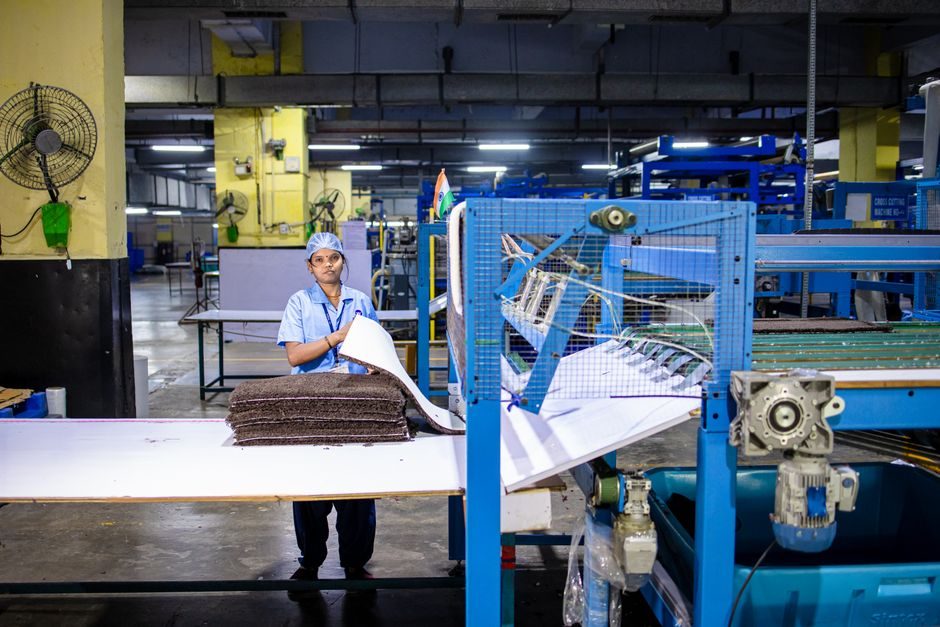
China hosts the bulk of the global wrapping-machine supply base, with Alibaba, Made-in-China, and Taiwantrade directories collectively listing several hundred vendors as of 2026-06; the Made-in-China board-wrapping sub-segment alone shows 12 manufacturers with 36 products, combined annual revenue around USD 6.94 million and 2,000+ m² of plant area [S4].
Sourcing is concentrated in three coastal clusters — Suzhou/Jiangsu for stretch and pallet lines, Shanghai for automatic bundle wrappers, and Guangdong/Zhejiang for end-of-line case packers — which mirrors the Wrapping Machine Sizing and Selection: Capacity, Geometry and Film Logic framework of capacity, geometry, and film logic that procurement teams apply when short-listing vendors. For a working definition and variant map, the wrapping machine encyclopedia entry classifies the category into stretch, shrink, bundle, and board wrappers, each with its own supply chain.
Cluster Map: Where the Capacity Sits
Jiangsu, led by Suzhou, is the densest cluster for stretch and automatic wrappers, with multi-product vendors carrying 16–25 bundles/min on bundle packers such as the ZB680F format covering 1, 2, 4, 6, 8, 10, 12-piece pack-off [S2]. Shanghai suppliers dominate automatic case and bundle machinery, with model ZB680F published at 16–25 bundles/min and a 1–12 piece format range [S2], which fits directly inside the automatic wrapping machine category where PLC-controlled, servo-driven end-of-line cells are the norm.
Taiwan's Taiwantrade lists independent stretch and shrink vendors with export-ready CE/UL documentation, often competing on automation grade rather than price [S5]. Guangdong factories typically run heavier-case and pallet-load stretch lines for the export logistics market. The Brightwin Group profile is illustrative: a 2026-vintage China-based supplier offering cube-wrapping cells with full export documentation [S3].
Throughput and Automation Bands Buyers Quote
Buyers short-listing from Made-in-China and Alibaba consistently see three throughput tiers: 1–15 bundles/min (entry/semi-automatic, lowest cost), 16–60 bundles/min (mid-range automatic, the cluster of ZB680F-class machines) [S2], and 60–120 bundles/min (high-speed servo lines, often multi-axis). The inclusion of 1–12 piece format flexibility on a single ZB680F platform [S2] is now a published differentiator rather than a custom option, meaning mid-tier buyers can standardise on one machine SKU for multiple SKUs.
Automation grade — manual, semi-automatic, fully automatic — is the next filter on every Made-in-China search facet, and it ties directly into whether the line is downstream of an existing coding machine or upstream of a filling machine in an integrated packaging cell. Across the three tiers, throughput per euro moves roughly 3–4× from manual to fully automatic, but so do the integration scope and the after-sales spare-parts obligation.
Selection Criteria Buyers Use Against Chinese Vendors
Five criteria show up on virtually every RFQ circulated in 2026: (1) throughput in bundles/min or packs/min, (2) format range in pieces per pack [S2], (3) automation grade and PLC/HMI platform, (4) film compatibility (PE stretch film gauge, POY shrink film gauge, BOPP overwrap), and (5) after-sales coverage — measured in on-site engineer response time, not just email ticketing. Vendors that publish 1–12-piece format flexibility on a single model [S2] score higher on criterion 2 than vendors that quote only single-format machines.
Film-frame structure and driven type (electric vs pneumatic) are the next two facets that separate a stretch wrapping machine supplier from a shrink wrapping machine supplier, even though both product names appear on the same B2B listing pages [S6]. Buyers specifying pallet-load stretch typically demand turntable diameters from 1.5 m to 2.5 m and 200–300% pre-stretch ratio; shrink lines require tunnel length matched to pack height and conveyor speed synced to the cutting machine upstream.
Price Bands and Lead-Time Signals
Mid-range automatic stretch wrappers from Suzhou/Jiangsu vendors land in the USD 8,000–25,000 FOB band, while high-speed servo stretch lines with pre-stretch carriage and PLC/HMI push to USD 30,000–80,000; shrink wrappers with heat tunnel and conveyor range USD 12,000–45,000 depending on tunnel length. Board-wrapping lines, being heavier, are typically quoted on RFQ and rarely carry list prices on the directory pages [S4]. Lead-time signals on the directory pages show 15–30 days for stock automatic lines and 45–75 days for configured cells, with 30% deposit / 70% before shipment as the standard T/T pattern on Made-in-China RFQs [S2].
Buyers comparing the wrapping-machine cost curve against adjacent categories should look at the Bearing Price Trend 2026: Quoted Bands, Raw-Material Drag and What Buyers Should Lock Now note for raw-material drag logic, since stretch-line gearboxes, turntable bearings, and conveyor bearings all ride the same steel-input wave. For a capital-equipment capex comparable, the CNC Machine Price Trend and 2026 Outlook: Tier Spread, Cost Levers and Buy Signals article provides a useful parallel on how tier-1 vs tier-3 Chinese suppliers spread their quotes.
Limitations and Failure Modes of the B2B Directory Channel
Directory pages return "0 results" on the open Made-in-China search when query terms are too broad, which is what happens with the bare "Wrapping Machine" query as of 2026-04 [S6]; buyers must use product-specific sub-categories such as "Stretch Wrapping Machine" [S6] or "Board Wrapping Machine" [S4] to surface vendor data. Alibaba category browsing returns the category page with no vendor count published [S1], so the Alibaba channel functions better as a product-search utility than a supplier-count benchmark.
Common failure modes when sourcing from this channel are: (a) format-range overstatement — vendors quoting 1–12-piece flexibility but only validated on 4 or 6 pieces in real production [S2]; (b) PLC/HMI brand ambiguity — "Delta/Siemens optional" in marketing copy, but with firmware lock-in on the cheaper option; (c) film compatibility stated as "PE/POF/PVC" without gauge or shrink-ratio verification; (d) after-sales coverage limited to mainland China, with export buyers expected to source spares locally. Vendors that publish explicit average-speed bands of 16–25 bundles/min with named model codes [S2] are measurably lower risk than vendors quoting only "high speed" in marketing copy.
Standards, Documentation and Compliance Signals
Export-ready stretch and shrink lines from Suzhou and Shanghai carry CE marking under the EU Machinery Directive 2006/42/EC and frequently PVoC/SABS for African and Middle East shipments; food-contact applications require FDA-grade film path or 3A sanitary frame on the core machine contact surfaces. The 16–25 bundles/min ZB680F format range published with model number and packing-type block [S2] is the kind of documentation package auditors check first, since it proves the vendor has actually tested the format spread.
For buyers who must cross-check vendor claims against independent capacity data, the Petrochemical Capacity by Country: 2026 Build Tracks, Ethylene Tilt and Sourcing Cues piece shows the same Made-in-China directory methodology applied to plant-level data — and the same RFQ-driven sourcing logic where buyers post requirements and let specialists match suppliers. The cluster-level coverage is robust: 12 manufacturers and 36 products in the board-wrapping sub-segment alone [S4], with 2,000+ m² of plant area and 72 employees aggregated across that sample [S4].
Trackable signals to watch over the next 90 days: (1) Suzhou stretch-line vendors publishing new pre-stretch carriage specs in the 250–350% range, (2) Shanghai bundle-wrapper vendors adding servo-controlled film-feed replacing pneumatic, and (3) Made-in-China directory counts growing past the 200-vendor mark for the "Stretch Wrapping Machine" sub-category [S6] — each of these will shift the median price band documented above.