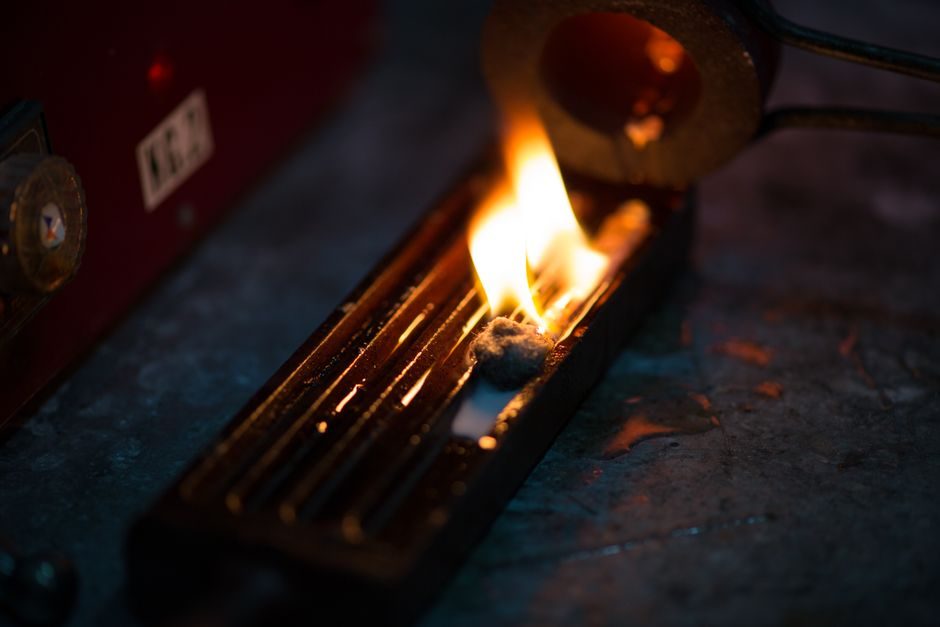
ASTM B6 Special High Grade (SHG) zinc, with a minimum 99.990% Zn content, is the de facto upstream raw material for hot-dip galvanizing and most downstream zinc-alloy production [S3]. The standard defines three primary grades: SHG at ≥99.990% Zn, High Grade (HG) at ≥99.90% Zn, and Prime Western (PW) at ≥98.0% Zn [S3].
Downstream demand is split between structural coatings (galvanized steel products), cast zinc alloy components (die castings and spin castings), and high-purity semiconductor and battery feedstock, each pulling from a different purity window and a different spec standard [S1][S2][S5].
Upstream Raw Material: ASTM B6 and LME-Grade SHG
ASTM B6 specifies the chemical composition, physical form, sampling, and testing methods for commercial-grade zinc ingots used in galvanizing, alloy manufacturing, and chemical processing [S3]. The standard limits impurity ceilings for lead (Pb), cadmium (Cd), iron (Fe), and tin (Sn) because these elements directly affect coating quality and zinc-bath chemistry in the galvanizing pot [S3].
PW-grade zinc (≥98.0% Zn) is still traded but has been largely displaced by SHG in modern continuous galvanizing lines because higher Fe and Pb levels accelerate dross formation and shorten pot maintenance cycles [S3].
Downstream Path 1: Hot-Dip Galvanizing and the ASTM A123 Chain
The largest downstream sink for zinc ingots is hot-dip galvanizing of steel products, where zinc ingot feedstock is melted in a 440–460 °C zinc bath and the steel article is dipped to form a metallurgical Fe-Zn coating [S3]. ASTM A123/A123M is the primary finished-product standard for hot-dip galvanized steel, and it implicitly assumes B6 SHG-grade feedstock for uniform, well-adhered coatings [S3].
The quality chain runs B6 (raw material) → A123/A153 (process and coating) → A53 (galvanized steel pipe), so a galvanizing line that substitutes PW for SHG will see more dross, longer downtime, and shorter pot life [S3]. Galvanized rebar, structural sections, and transmission-tower steel are the highest-volume downstream users; for example, batch galvanizing of fasteners and small parts typically specifies A153 alongside the same SHG feedstock requirement [S3].
Downstream Path 2: Zinc Die-Casting Alloys and Spin-Casting Ingots
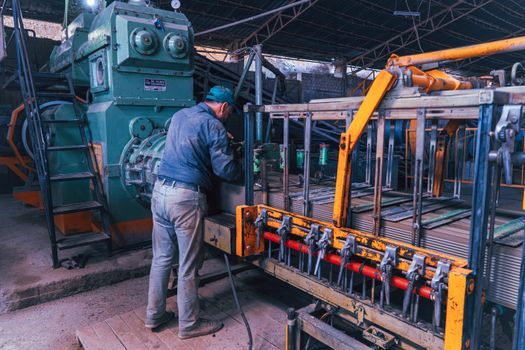
ASTM B952/B952M covers four zinc alloys in ingot form for spin casting: Spin Casting Alloy SC-A, SC-B, SC-C, and ZA-73, setting chemical composition limits for Al, Mg, Cu, Fe, Pb, Cd, Sn, Ni, and Zn [S1]. The companion European standard for die-casting alloys is EN 1774 (Zinc and zinc alloys — Alloys for foundry purposes — Ingot and liquid), which defines tighter composition limits for the casting alloys such as Zamak 2, 3, 5, and 7 to allow for production-side composition drift [S6].
Practical selection uses four criteria: (1) required as-cast strength and hardness, with ZA-27 and ZA-73 offering the highest tensile and creep performance; (2) dimensional accuracy, where hot-chamber zinc die casting machine cells deliver the tightest tolerances on small parts; (3) corrosion environment, where Fe and Pb ceilings protect long-term creep life; and (4) downstream finish compatibility, including plating and chromate conversion coatings [S1][S6]. For thin-wall, high-volume hardware (locks, fasteners, connector shells), Zamak 3 and Zamak 5 remain the workhorse alloys, while ZA-8 and ZA-12 target structural die castings in industrial and automotive markets [S6].
Downstream Path 3: High-Purity Zinc for Semiconductors and PCB Finishes
The semiconductor-grade segment requires zinc at 4N (99.99%) to 5N (99.999%) purity, well above galvanizing grades, with single-digit ppm ceilings for transition metals that would otherwise diffuse into sputter targets and thin films [S2][S5]. The global semiconductor industry consumed an estimated 42,000 metric tons of high-purity zinc ingots in 2025, primarily for sputtering target fabrication, compound-semiconductor production (zinc selenide, zinc sulfide), and advanced PCB surface finishes [S5].
Foundries in Taiwan, South Korea, and the United States pushing toward sub-3 nm process nodes are accelerating demand for ultra-clean, low-impurity zinc feedstock at 5N purity, with the global PCB market valued at over $89 billion in 2025 as a parallel demand anchor [S5]. The same spec chain that controls semiconductor zinc also gates zinc oxide used in varistors and in zinc-air battery anodes, both of which ride the same upstream 5N feedstock lines [S2].
Selection Criteria and Cross-Standard Comparison

Specifying engineers typically pick an ingot grade against four decision criteria: purity window, impurity ceiling for the application's worst-case element, governing standard, and downstream form factor. The table below lines up the main zinc-ingot grades used in 2026 industrial sourcing against those criteria. [S3]
Grade → governing standard → min Zn → typical use: (a) ASTM B6 PW → ASTM B6 → 98.0% → legacy batch galvanizing, low-spec chemical use; (b) ASTM B6 HG → ASTM B6 → 99.90% → general alloying, lower-tier die castings; (c) ASTM B6 SHG / LME → ASTM B6 → 99.990% → continuous galvanizing, Zamak die castings; (d) 99.995% refined → in-house spec (e.g. SAM-style) → 99.995% → high-grade die castings and battery-grade ZnO; (e) 4N–5N HP zinc → semi/internal → 99.99–99.999% → sputtering targets, ZnSe/ZnS compounds, semiconductor-grade ZnO [S2][S3][S5]. The relevant downstream casting spec for (a)–(d) alloys is EN 1774 in Europe and ASTM B240 for continuous-cast bar stock, with B952 governing spin-casting feed [S1][S6].
Traceability, Marking, and Sourcing Discipline
Ingot-level traceability is required by major specifications: IS 209 (1992) mandates that each ingot, slab, tile, or plate be legibly marked with cast/lot number, grade, and indication of source of manufacture, and gives the purchaser the right to witness sampling and testing [S4]. ASTM B6 mirrors that requirement with brand, grade, and batch-number marking on every ingot, which is the only practical way to back-trace a coating failure to a specific heat [S3].
For the 5N segment, traceability extends through the sputter-target production run, with each lot typically shipped with an ICP-MS analysis showing sub-ppm detection limits for Fe, Cu, Ni, and Cr [S5]. On the copper cathode supply chain side, parallel spec discipline applies, and a galvanizer that runs mixed-metal pots will find that copper contamination bleeds into the zinc bath faster than iron, so SHG's ≤0.001% Cu ceiling is the binding constraint in continuous lines [S2].
Limits, Failure Modes, and What the Specs Do Not Catch
B6 sets composition but does not specify grain structure or surface oxide, and ingots that pass chemistry can still introduce hydrogen and oxide inclusions if stored in humid conditions before charging [S3]. High-purity zinc for semiconductors is even more sensitive: surface oxide formation during transport is a direct yield hit on sputter targets, and B6-grade material is unsuitable for 4N/5N applications because the Pb and Cd ceilings are two to three orders of magnitude too loose [S2][S5].
For die-casting foundries, the binding failure mode is not the ingot chemistry but the melt-handling discipline: iron pickup from steel crucibles can push Fe above the EN 1774 limit within a few hours of holding, which is why most specification sheets require lot-level certification rather than supplier self-declaration [S6]. A practical trackable signal for buyers in 2026 is whether the supplier publishes a per-heat ICP-OES or ICP-MS certificate with detection limits at 1 ppm or below; suppliers still issuing only a Zn-plus-impurities sum report are not aligned with the high-purity segment's quality chain [S2][S5].
Spec-level background on the components involved: pressure transmitter, and flow meter.