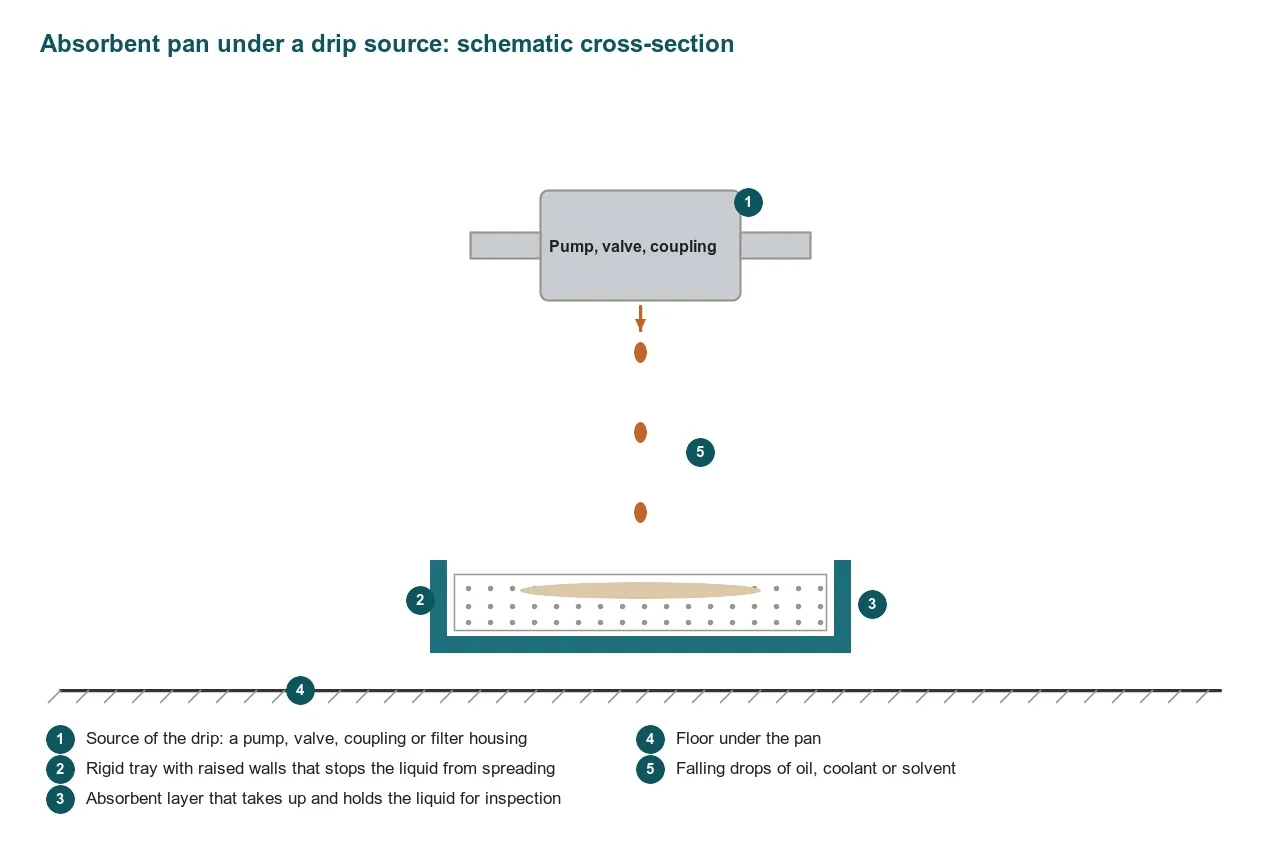
An absorbent pan is a rigid, shallow tray that holds a layer of absorbent and sits under a machine, drum, valve, coupling or other equipment to catch and retain small leaks, drips, overspray and spills of oil, coolant, solvent and similar liquids. It has two working parts that do different jobs. The walls of the tray stop the liquid from spreading across the floor. The absorbent inside, a pad, a pillow or a granular fill, takes the liquid up and holds it, so that it does not puddle, splash or evaporate into the walkway. Pans are bought as molded polymer trays with a pad, as sheet metal trays in galvanized steel, stainless steel or aluminum, and as grated trays that keep a container above the liquid, in sizes from a hand-held square to a tray that lines a shelf.
The buying decision is small in money and large in consequence, because a pan is often the last object between a slow leak and the floor. The engineer or maintenance lead who orders them is really settling four questions: where the drips start, how much liquid can arrive before somebody looks, what the liquid does to the tray and to the absorbent, and where the used absorbent goes afterwards. A pan that is too shallow overflows on a weekend. A pad of the wrong grade floats on coolant or soaks up rain. A tray of the wrong polymer goes soft. The decision is made drip point by drip point, and it changes with every new machine, drum or tapping station brought into the plant.
Diagram: SpecForge original drawing of an absorbent pan under a drip source, made for this page.
Five things decide an absorbent pan purchase. First the sump and absorbent capacity against the leak rate and the interval between inspections. Second the tray material against the liquid: molded polyethylene for most oils and water-based fluids, welded steel or stainless steel for solvents and flammables. Third the absorbent grade: gray universal, white oil-only or yellow chemical, each matched to the fluid. Fourth the fit: footprint, wall height, grate and access at the drip point. Fifth the waste route the used absorbent will follow. Get these right and the pan does its work unnoticed.
Chapter 1 / 06
What an Absorbent Pan Is and How It Works
An absorbent pan is an assembly of four parts, and each can fail on its own. The base and the four walls form a sump, a shallow box open at the top, with a flat bottom and a rim rolled or hemmed so that the pan can be lifted and wiped. On the base sits the absorbent layer: a cut pad, a pillow, a folded length of roll or a granular fill. Some pans add a grate that keeps a container above the liquid. The fourth part is easy to forget: the patch of floor under the pan, which has to be level and within reach of the person who empties it. Nothing in the pan is fixed. It is placed, watched, emptied and put back.
The working principle is the pairing of containment with retention, and the two belong to different parts. Containment is the job of the walls. Liquid that lands inside cannot travel sideways, so the area it can wet is the floor area of the pan and the volume it can occupy is the depth of the sump. Retention is the job of the absorbent. Meltblown polypropylene is made by melting the resin and blowing it out as fine fibrous strands, and the resulting web holds from 12 to 20 times its own weight in fluid. Liquid enters the spaces between the fibers and is held there by capillary action. A saturated pad can therefore be lifted and carried without dripping, while later drops wait in the sump until the pad is changed.
Picture an oil seal on a pump shaft that weeps while the machine runs. Each drop falls onto the pad, spreads through the fiber web and stops, and the wet patch darkens as it grows outward from the point of impact. As the drip continues the pad reaches its capacity, and from then on the liquid passes through it and pools in the sump below. The sump is the reserve that buys time: the pad takes the steady seep, and the sump catches what the pad cannot hold. A pan checked at the start of every shift shows the depth of that pool as a trend, and a rising trend tells the planner when a seal or a joint must be repaired.
The reason for buying a pan instead of laying a pad on the floor is the wall. A loose pad is a surface absorbent: it works while the liquid falls on it, and it fails when a drop lands beside it, when the pad is kicked aside or when liquid runs underneath it. The wall turns a target into a catcher. That matters because a wet floor is a regulated hazard. The United States rule on walking-working surfaces, 29 CFR 1910.22(a)(2), requires workroom floors to be kept clean and, as far as feasible, dry, and names leaks and spills among the hazards to be kept off walking surfaces. A pan keeps a slow leak off that floor while the leak is being found and fixed.
An absorbent pan is sized for the leak that a fitting makes in normal service: the seep from a seal, the drip from a tap after it is shut, the condensate from a compressed air line. It is the first of several layers, not the only one. Behind it stands the drip tray or bund that holds a leaking container, and behind that the spill pallet and the plant drainage that take a lost drum or a burst hose. The oil storage rules for England and Wales show the order: they treat a drip tray under a container and a bund around it as two forms of secondary containment, and require a drip tray at a remote fill point to catch the oil spilled during a delivery. The pan covers the small end of that order.
In a plant the pan appears wherever a liquid is handled and can escape. Under machine tools it catches coolant, way oil and the fluid that seeps from a hydraulic power unit. Under drums it takes the drip from a tap or a bung. At a dispensing station it stands beneath the can being filled. Along pipe runs it sits under couplings, and on shelf levels and the lower decks of a pallet rack a shallow tray lines the surface under small containers. Outdoors it waits under a hose connection on a yard. Each place asks for a different shape: narrow and long under a pipe, round under a drum, small and square under a single drip.
Chapter 2 / 06
Absorbent Pan Types and Structural Variants
The commonest type is a molded polymer tray with an absorbent pad laid in it. The polymer is polyethylene, a material that will not rust or corrode. Utility trays of this kind come in six sizes, 12 to 40 inches (305 to 1,016 mm) wide, 36 to 48 inches (914 to 1,219 mm) long and 3.5 to 4.75 inches (89 to 121 mm) deep, holding 12 to 30 gallons (45 to 113 L) of sump. Many have a ribbed bottom that keeps cans and pails above small spills, and they nest inside one another when empty. At the small end a universal drip pan is sold with a matching pillow about 10 by 10 by 3 inches (254 by 254 by 76 mm).
Sheet metal trays form the second type, and they are chosen where a polymer will not serve. One design is made in 16 gauge aluminum, galvanized steel or stainless steel, with the corners fully welded by MIG and TIG processes instead of spot welded, and every tray is then leak tested. The edge is hemmed so that handling does not cut the hand. A tray of this kind measures 18 by 36 by 1 inch (46 by 91 by 2.5 cm) and holds 2.81 gallons (10.6 L). Its low wall suits a shelf, a rack level or the floor under a hose. The metal can be bonded to earth to limit the build-up of static electricity with flammable liquids, which a polymer tray cannot do.
Grated sump trays add a third variant. A low containment tray of molded polyethylene, 54 by 29.75 by 3.5 inches (1,372 by 756 by 89 mm), holds 16.5 gallons (62 L) of sump. Fitted with its optional grate it holds 14 gallons (53 L), and the containers stand raised out of their own leaks. A round drum tray works the same way: its optional bottom grate lifts a drum 67 mm (2.6 inches) clear of spilled liquid, and it is built for the drips and overflows of drum filling. The grate keeps the base of a container dry and its label legible. A grate that lies in a walking route needs a top pattern that resists slips.
The absorbent layer comes in grades that are colored by convention, so that the waste stream can be read at a glance. Gray is universal: meltblown polypropylene that takes oils, coolants, solvents and water-based fluids, supplied with or without a spunbond cover stock that adds strength, or needle-punched polypropylene made for high traffic areas. White is oil-only: meltblown polypropylene with no chemical additives, hydrophobic, so it repels water and takes petroleum fluids, which suits outdoor use. Yellow marks absorbent for hazardous fluids: chemically inert polypropylene for acids and bases, colored to warn the handler at disposal. Universal fills also include recycled polymeric foam pillows, cellulose granules made from recycled paper and corn cob granules, a natural plant fill.
The boundary with neighboring products is a matter of scale and of walls. Absorbent mats and pads are surface absorbents: they lie on the floor and have no walls. Absorbent booms are barriers for larger spills on water or on floors, placed to encircle and channel a release that has already spread. Spill pallets, bunded stores and secondary containment systems are permanent installations sized to hold a whole container. The absorbent pan sits between the leak source on one side, the seal, the tap or the coupling, and the waste container or the floor drain on the other. It stands upstream of the oil-water separator that treats plant drainage, because liquid caught in a pan never reaches it.
Chapter 3 / 06
Key Specification Parameters and Standards
Six parameters describe an absorbent pan, and a supplier's sheet may state only three of them. Footprint and inside dimensions decide whether the pan fits under the machine foot or around the drum. Wall height decides how much liquid can pool before the rim is reached. Sump capacity is the volume held to the rim, and it falls when a grate is fitted. Absorbent capacity is what the layer takes up, a separate figure. Load capacity matters as soon as a container stands on the pan, yet molded trays are commonly sold by sump volume rather than by a rated load. Tray material and absorbent grade decide what may be put in it.
Absorbent capacity is the parameter most often misread, because it is stated in two ways. The first is a multiple of the absorbent's own weight: meltblown polypropylene holds 12 to 20 times its weight in fluid. The second is a volume per pad, per pillow or per pack, almost always an upper limit measured on one test liquid, so that a viscous oil gives a lower figure. Two ASTM methods draw the line between materials. ASTM F716 produces laboratory data on how absorbent materials perform, and how well they retain what they have taken up, on chemical and light hydrocarbon spills. ASTM F726 covers adsorbents that remove floating oil from water and states that its tests are not appropriate for absorbent materials.
Three kinds of rule bear on where a pan is enough. The OSHA rule on walking-working surfaces requires workroom floors to be clean and, as far as feasible, dry, free of leaks and spills, and inspected regularly. For oil stored in England and Wales in containers of 201 liters or more, a drum must stand in secondary containment, usually a drip tray, holding at least one quarter of the drum; a tray that can hold several drums needs one quarter of their combined capacity. Fixed tanks, mobile bowsers, intermediate bulk containers and other single containers need 110 percent. For flammable liquids in store, the HSE guide HSG51, published in 2015, asks for containment of at least 110 percent of the largest metal container and suggests non-combustible absorbent granules for small spills.
Parameter
Typical value or range
What it decides
Pan footprint, small
10 by 10 inches (254 by 254 mm)
Fits one drip point under a seal or tap
Tray footprint, utility
12 to 40 by 36 to 48 inches (305 to 1,016 by 914 to 1,219 mm)
Covers a machine base or a drum
Wall height, shallow trays
1 to 4.75 inches (25 to 121 mm)
Volume before the rim
Sump capacity, sheet metal tray
2.81 gallons (10.6 L)
Holds drips; lines a shelf or rack
Sump capacity, molded tray
12 to 30 gallons (45 to 113 L)
Reserve behind the pad
Sump lost to a grate
16.5 to 14 gallons (62 to 53 L)
Containers stand dry, volume is smaller
Absorbent pickup, meltblown polypropylene
12 to 20 times pad weight
How much pad the leak needs
Drum tray with grate
21.1 gallons (80 L)
Drips and overflows of drum filling
Tray material
Polyethylene; 16 gauge galvanized steel, stainless steel or aluminum
Chemical resistance, grounding, washing
Absorbent grades
Gray universal, white oil-only, yellow chemical
Water-based, oil-only or aggressive liquids
Minimum drip tray for a 205 L drum
One quarter of the drum, about 51 L (13.5 gallons)
Legal minimum for oil drums in England and Wales
Single container containment
110 percent of the container
Where a bunded pallet replaces a pan
Chapter 4 / 06
Selection and Duty Calculations
Sizing an absorbent pan starts with three numbers for every drip point: how fast the liquid arrives, how long nobody looks, and how wide the wet footprint is. The first two give a volume to hold. The third gives a footprint to cover. Tray material, absorbent grade and grate then follow from the liquid itself.
The first step is an inventory of drip points rather than a shopping list of pans. For each machine, drum stand, tapping station and hose connection the engineer records the liquid, the way it escapes, the area it can wet and the person who will notice it. A seal that weeps only while running, a tap that drips after shutoff and a coupling that sprays on connection are three different duties. The liquid sets the absorbent grade and the tray material. The way it escapes sets the shape: a narrow pan under a pipe, a round tray under a drum, a long tray along a manifold. The wet area sets the footprint, with margin for a drop that does not fall straight.
The first calculation turns a leak rate into a volume. Multiply the rate at which liquid arrives by the longest interval between inspections. Take a coupling that loses 0.1 L per hour and a plant that closes from Friday evening to Monday morning, 72 hours: about 7.2 L (1.9 gallons) arrives with nobody present. A hand-sized pan cannot hold that, so the answer is a larger sump, an earlier repair or a level switch in the sump that alarms at a set depth. The same sum works in reverse. The depth of liquid found in a pan at the end of a shift is the leak rate, and a rate that rises week by week is a seal on its way out.
The second calculation applies wherever the law sizes the containment for you. Under the oil storage rules for England and Wales a drum of 205 liters needs a drip tray holding a quarter of the drum, about 51 L (13.5 gallons), and a tray that could hold four such drums needs 205 liters. A 2,500 liter container needs 2,750 liters, a bunded pallet, not a pan. These figures mark the line at which the absorbent pan stops being the answer. Below it a pan with a pad is reasonable for drips. At and above it the container itself must sit in containment of the legal size, and the role of the pan shrinks to the tap, the bung and the fill point.
The third step matches materials to the liquid, and it is done twice: once for the tray and once for the absorbent. Oils, diesel, coolants and water-based fluids go into polyethylene trays on gray universal absorbent, or on white oil-only absorbent where rain or wash water is present. Acids, bases and solvents go into a tray that resists them, polyethylene for many of them and stainless steel for others, on yellow chemical absorbent. A flammable liquid calls for a bonded metal tray, control of vapor and heat sources, and absorbent that will not add fuel. ASTM F726 carries a note worth keeping for every grade: material compatibility must exist between the sorbent and the substance that may be sorbed.
The last step is the choice of features. A grate pays for itself where a container has to stand dry: the base stays clean, the label stays legible and a steel drum does not sit in water. Handles matter for any tray that will be carried to a drain point, and nestability matters where empty trays are stored in numbers. Color is a feature too: a yellow tray shows up on a gray floor, while a dark tray hides oil, so the pad has to be the visible indicator. For an unattended point, a float or vibrating level switch mounted at a set depth in the sump turns a quiet overflow into an alarm.
Condition at the drip point
Choose
What to check
Slow seep at a seal or a flanged joint
Small molded pan with a gray universal pad
Leak rate against pad capacity
Coolant or other water-based fluid
Gray universal pad in a polyethylene tray
A white oil-only pad will not take water
Oil or fuel outdoors, in rain
White oil-only pad; tray that resists sunlight
Pad must repel water and keep the oil
Acid, base or solvent dispensing
Yellow chemical absorbent; tray checked against the liquid
Drip tray of at least one quarter of the drum, about 51 L (13.5 gallons)
Required from 201 liter containers
IBC or other single container
Bunded pallet or store at 110 percent of the container
A pan serves only the valve and hose
Drum filling and can tapping
Grated drum tray with a pad
Holds drips and overflows of filling 55 gallon (208 L) drums
Drip point unseen over a weekend
Larger sump, earlier repair or an alarmed level switch
72 hours of a leak can exceed a small pan
Chapter 5 / 06
Installation, Maintenance, and Typical Failure Modes
An absorbent pan works only while it is in the right place, dry enough to take the next drop and watched by somebody. Installation takes minutes. Keeping it serviceable is a routine. Nearly every failure traced to a pan comes from breaking one of those three conditions, not from a defect in the pan itself.
Installation begins with the floor. The pan goes on a level surface, so that the liquid spreads over the whole sump instead of gathering at one corner. The pan is centered on the drip point with margin for a drop that falls from a turning part, and it is kept out of the walking route. A metal tray used with flammable liquids is bonded to earth. Outdoors the tray is shielded from sun and protected from vehicles: the oil storage rules for England and Wales require containers to be positioned away from forklift truck routes or guarded against impact, and a pan deserves the same care.
Inspection is a walk-round, not a work order. At the start of each shift the operator looks at every pan on the route and notes three things: the depth of liquid in the sump, the size of the darkened patch on the pad, and any stain on the floor around the pan. The OSHA rule on walking-working surfaces requires those surfaces to be inspected regularly and as necessary. The 2015 HSE guide asks for inspections that check for leaks and for damage or deterioration, with containers stacked so that a leaking one is readily spotted. The EPA housekeeping rules for used oil say the same of containers: keep them in good condition, do not let them rust, leak or deteriorate, and fix structural defects at once.
Disposal begins at the pan and is decided by what the absorbent holds. Free liquid is drained into the labeled waste container before the pad is touched, and a pad soaked with oil can be wrung out and used again: sorbent pads can be reused between 2 and 8 times depending on the viscosity of the oil. In the United States, rags and sorbents used on a used-oil spill cease to be used oil once the free-flowing oil has been removed: they can then be managed as solid waste, provided they show no hazardous waste characteristic, but they stay regulated as used oil if they are to be burned for energy recovery. Absorbent wet with a solvent or an acid carries that waste's classification. Spent pads go into separate containers by color.
The typical failures are few and repetitive. The overflowing pan comes from a leak that outgrew the sump or from an inspection that did not happen. The wrong absorbent shows as a puddle that the pad ignores: a white oil-only pad floating on coolant, a gray pad outdoors soaked with rain and dripping oil. The degraded tray shows as a crack at a corner, a wall gone soft after contact with a solvent, or rust through the base of a steel tray that stood in water. Then come the failures of position: a pan pushed aside by a pallet truck, a pan used as a tray for tools, a pan hidden behind a machine and forgotten until the floor around it darkens.
If the pan is overflowing, stop the drip, or mark the spot with a warning sign and warning tape until it is dry.
Drain the free liquid into the labeled waste container before lifting anything.
Lift the pad out flat, let it drain over the sump, and bag it with waste of the same color.
Wipe the sump, inspect base and corners for cracks or corrosion, and refit the grate.
Lay a fresh pad of the same grade, return the pan to its marked spot, and record the liquid removed.
Check or symptom
Likely cause
Action
Liquid in the sump at every check
Leak rate above pad capacity
Measure depth, repair the leak, fit a larger pan
Pad darkened edge to edge
Absorbent saturated, liquid passing through
Replace the pad, drain the free liquid
Puddle beside a dry pad
Wrong grade, such as oil-only on coolant
Change to the grade for the liquid
Stain on the floor around the pan
Liquid under the rim, cracked base, pan off level
Lift the pan, find the path, level or replace
Wall soft, stained or cracked
Solvent attack or brittleness from sunlight
Change tray material, recheck compatibility
Rust on a steel tray
Standing water, scratched coating
Replace; use polymer or stainless steel when wet
Pan displaced, tools inside
Vehicle impact, misuse as a tray
Mark the spot, guard it, brief the crews
Solvent-wet absorbent in an open bin
Fuel and vapor near the work area
Move at once to a closed steel container
Yellow pad in gray waste
Waste streams not separated
Segregate by color, rebrief the handlers
Chapter 6 / 06
Industry Applications and Procurement Checks
Metalworking plants are heavy users. Every machine tool has places where coolant, way oil and the fluid from a hydraulic power unit escape: the wipers of a slideway, the fittings of the power unit, the spindle nose. A narrow pan under each slide and a larger tray under the power unit keep these fluids off a floor that operators share with forklifts. A packaging line runs small pans under the lubricator of each module, and a drum top pad for a 55 gallon (208 L) drum keeps the top of the drum clean around its pump and dispenser can. The liquid is oily or water-based, so polyethylene trays with gray universal absorbent cover most points, and white oil-only pads serve the areas that are washed down.
Warehouses and drum stores use pans where liquid is transferred rather than stored. A drum on its tapping stand drips from the tap after shutoff, so a grated tray stands under the can being filled. An IBC tank on a bunded pallet still needs a small tray at its discharge valve. Battery charging bays put a tray under each charger position. Vehicle depots lay a drip tray under each hose connection on the fuel island, and every station where a machine is lubricated gets a pan under its grease points until the excess has stopped running. Compressed air systems are a case of their own: the condensate drained from a compressor and from the air lines carries oil, and a pan under each drain point catches what the condensate trap lets through.
Chemical, pharmaceutical, food and laboratory work adds stricter rules on the absorbent. Acids and bases are taken up on yellow chemical absorbent in trays chosen against a compatibility list, a storage rack of reagent bottles carries a stainless steel tray on each shelf, and the person who changes the pad wears protective clothing and a respirator. The gland of a metering pump and the bonnet of a diaphragm valve on a dosing line are classic drip points. Flammable solvents call for bonded metal trays and for non-combustible absorbent, with the spent material removed to a closed steel container. Food plants favour stainless steel trays that can be washed. In every one of these settings the dispensing point lies within reach of an eye wash station.
An order for absorbent pans should state, for each drip point, the liquid and its safety data sheet and the interval between inspections. It should give the maximum footprint the pan may occupy, the minimum sump capacity in liters or gallons and whether a grate is required. It should name the tray material, linear low density polyethylene, 16 gauge galvanized steel, stainless steel or aluminum. It should name the absorbent grade and color, gray universal, white oil-only or yellow chemical, and the pad or pillow size that fits the sump. The buyer should ask the supplier for the sump capacity with and without the grate, the absorbent capacity and the liquid on which it was measured, the load capacity where a container will stand on the pan, and a chemical resistance list for the tray. Where the law sizes the containment, as it does for oil drums in England and Wales, the order should quote the required capacity. Quantities are set drip point by drip point, with spare pads of each grade held near the points that use them.
FAQ
What is an absorbent pan and how does it work?
An absorbent pan is a rigid shallow tray with a layer of absorbent inside, placed under a machine, drum, valve or coupling to catch drips and small leaks. The tray and its walls do the containing: liquid that lands inside cannot spread across the floor. The absorbent does the retaining: its fibers take the liquid up by capillary action and hold it, so it does not puddle or splash. Meltblown polypropylene, the usual pad material, holds 12 to 20 times its own weight in fluid. Once the pad is full, extra liquid pools in the sump below, which acts as a reserve until the pad is changed.
What types of absorbent pan are available?
Three types cover most duties. A molded polyethylene tray with an absorbent pad is the general purpose pan; utility sizes run from 12 to 40 inches (305 to 1,016 mm) wide and hold 12 to 30 gallons (45 to 113 L). Sheet metal trays in 16 gauge galvanized steel, stainless steel or aluminum have welded, leak-tested corners and suit shelves, racks and flammable liquids because they can be grounded. Grated sump trays add a grate or ribbed base that keeps the container above its own leak. The absorbent layer is chosen separately as gray universal, white oil-only or yellow chemical grade.
How much liquid does an absorbent pan hold?
Two capacities matter and they are different. Sump capacity is the volume the tray holds to its rim, about 2.81 gallons (10.6 L) for a shallow steel tray 18 by 36 by 1 inch (46 by 91 by 2.5 cm), and 12 to 30 gallons (45 to 113 L) for molded utility trays. Absorbent capacity is what the pad takes up, often quoted as an upper limit per pad for one test liquid. A grate lowers the usable sump: one low tray drops from 16.5 to 14 gallons (62 to 53 L) when its grate is fitted. Choose the sump volume from the leak rate multiplied by the longest interval between inspections.
Which absorbent should go in the pan: gray, white or yellow?
Match the color to the liquid. Gray universal absorbent takes oils, coolants, solvents and water-based fluids, which suits most indoor machine and drum drip points. White oil-only absorbent is hydrophobic polypropylene: it repels water and takes petroleum fluids, so it is the grade for outdoor use and for places that get washed down. Yellow chemical absorbent is chemically inert polypropylene for acids, bases and aggressive liquids, and its color warns handlers at disposal. An oil-only pad left on a coolant drip stays dry while the coolant puddles beside it, which is a common grading mistake.
Where should absorbent pans be placed?
Put a pan wherever liquid escapes in normal service: under machine tools and hydraulic power units, under drum taps and bung holes, at dispensing and filling stations, beneath hose and pipe couplings, and on shelf and rack levels under small containers. Keep it level, clear of walking routes and clear of the isolation valve. Outdoors, use oil-only absorbent and a tray that resists sunlight. Where a drum of 205 liters stands in England or Wales, the law requires a drip tray of at least one quarter of the drum, about 51 L (13.5 gallons). At an unattended point, add a level switch so that an overflow raises an alarm.
How do I dispose of used absorbent from a pan?
The absorbed liquid decides the waste class. In the United States, rags and sorbents from a used-oil spill are no longer used oil once the free-flowing oil is removed; they may be managed as solid waste if they show no hazardous waste characteristic, but they remain regulated as used oil if they are to be burned for energy recovery. Sorbents still holding free-flowing used oil follow the used oil management standards. Drain the free liquid into the labeled container first, then bag the pad with waste of the same color. Absorbent wet with a solvent, an acid or another chemical follows the rules for that chemical, which vary from state to state.
Is an absorbent pan enough, and which standards apply?
A pan handles drips and small leaks at their source; it is neither spill response nor storage containment. Larger spills on floors or water call for absorbent booms and loose absorbent, and a container that the law requires to be bunded needs a spill pallet or bunded store, sized at 110 percent for a single container under the English and Welsh oil storage rules. ASTM F716 is a test method for the absorbent itself: it measures the performance and retention of absorbent materials on chemical and light hydrocarbon spills, while ASTM F726 covers adsorbents on water. In the United States, 29 CFR 1910.22 requires clean, dry floors.