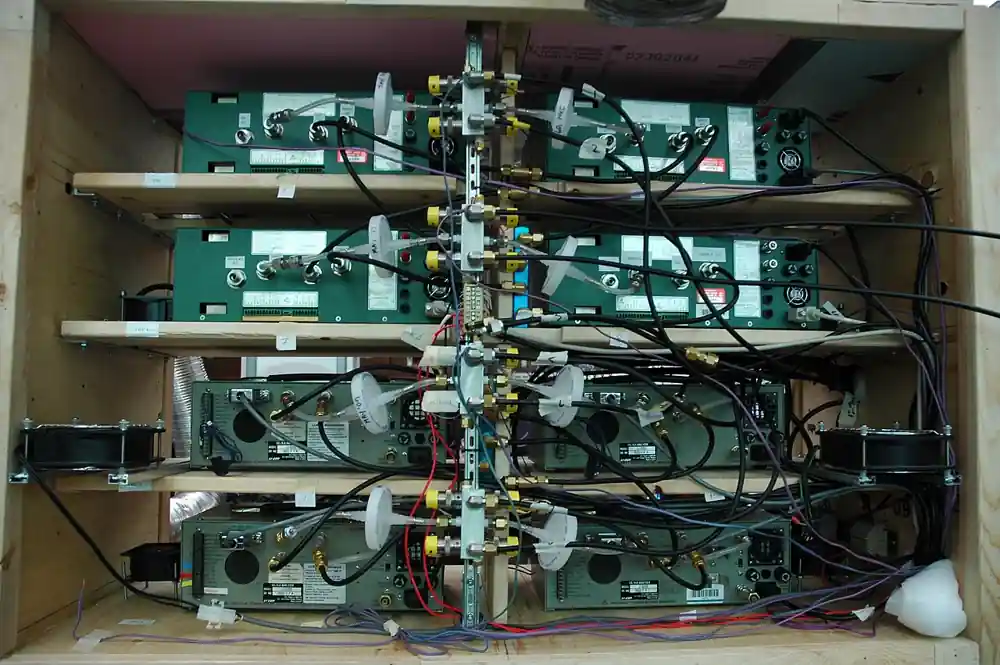
A dew point transmitter is a fixed process instrument that measures the temperature at which a gas stream becomes saturated with water vapor and reports that temperature continuously as a 4 to 20 mA or Modbus signal. The dew point is the temperature at which, at constant pressure, the gas holds all the water vapor it can and condensation begins, so a colder tolerance means a drier gas. Where a thermometer answers how hot, this instrument answers how dry, and it does so as a number a purchase contract can cite: pressure dew point in deg C, measured in a live stream the way a process gas analyzer measures it rather than on a laboratory bench.
What this page settles is how a plant proves dryness. Compressed and processed gas systems carry moisture contracts: instrument air to ISO 8573-1 class 2, refrigerated dryer output near plus 3 deg C, ozone generator feed near minus 60 deg C, pipeline gas at tariff limits. The transmitter is the instrument that converts dryer hardware performance into those contract numbers day and night, and the buyer commits at once to a sensing technology, a measuring point and pressure, an installation style, and a signal destination. A wrong choice on any of the four produces a number that is legally wet or silently wrong, so each chapter feeds the RFQ line set: technology, certified range, accuracy at the class limit, sampling, output, and the calibration plan a supplier must stand behind.
This page treats the dew point transmitter as a purchasing object: what saturation physics makes the number mean, how pressure dew point converts to atmospheric reference, where polymer, aluminum oxide, and chilled mirror sensing each hold their accuracy, and how ISO 8573-1 class limits, sampling practice, and calibration intervals combine into a defensible RFQ. It is written for engineers who write purchase specifications, not for readers who want a brochure summary.
Chapter 1 / 06
What a Dew Point Transmitter Is and What Is Being Decided
A dew point transmitter is a loop instrument: a sensing probe exposed to the gas, electronics that convert the sensor response into a dew point temperature, and a two-wire 4 to 20 mA output scaled in engineering units, with RS-485 Modbus as the common digital companion. The measurement is continuous, in line or in a conditioned sample, and the number it produces, pressure dew point in deg C, is the same unit the dryer specification and the purity contract use. In family terms it sits with the continuous analyzers rather than with indicating gauges: it exists to produce a logged, trended, alarmable record, and the gas analyzer train it often joins is simply the rack version of the same idea, one module per measured species.
What is actually being decided in this purchase is how the plant proves dryness, and the decision resolves into three obligations. Verification: the transmitter must show, with a traceable certificate, that the gas meets its stated ISO 8573-1 class at the stated pressure. Control: on desiccant dryers the same signal can time tower switching, holding dew point based cycles instead of the clock, which saves purge air. Evidence: audits, custody transfers, and freeze protection investigations all read the logged trend, so the instrument must hold calibration long enough to make the trend mean something. A buyer who buys only a range and a price gets a number; a buyer who buys the whole obligation set gets a defensible record.
The monitored fluid is usually compressed air, made by a screw compressor, dried by refrigerated or desiccant hardware, and distributed through headers to instruments, actuators, coating nozzles, and process users. Moisture in that system corrodes pipe, spits water into pneumatic cylinders, ruins paint and resin surfaces, and freezes in outdoor drops every winter. Because compressor load, ambient humidity, and dryer condition all swing, the dryness number swings with them, which is why the measurement must be continuous rather than an annual laboratory spot check. A single wet month discovered in April costs more than the transmitter that would have flagged it in November.
The unit of the contract deserves its own paragraph because it drives every later choice. Relative humidity depends on gas temperature: the same moisture load reads 30 percent RH in a warm header and 90 percent in a cold one, so an RH figure drifts with the thermometer and means nothing on its own. Dew point is an absolute humidity measure tied to the saturation physics of water vapor, so it holds its meaning across temperature changes and, with the measuring pressure documented, converts between line conditions and atmospheric reference. That is why dryness contracts and ISO classes state dew point, not percent RH. The one-word spelling dewpoint transmitter appears on some datasheets and purchase orders; the instrument is the same, and the RFQ should name whichever spelling the site standard uses so the certificate matches.
Integration decides the last rows of the RFQ. A two-wire loop powered transmitter wires with the same conventions as a temperature transmitter on the same skid, lands on the same analog input cards, and reports to the PLC, the dryer controller, or both. Relay output versions exist where the transmitter itself must act, most often driving desiccant tower changeover directly. The chapters that follow cover the saturation physics behind the number, the three sensing technologies and where each is honest, the datasheet rows that decide a compliant quotation, and the installation and calibration practice that keeps the certificate true after the purchase order is closed.
Chapter 2 / 06
How Dew Point Sensing Works
The physics is saturation. Air or process gas at any temperature carries water vapor at a partial pressure set by how much water is present, and the saturation vapor pressure of water rises steeply with temperature, close to doubling every 10 deg C through the industrial range. Cool a gas at constant pressure and its water partial pressure stays fixed while the saturation pressure falls, until the two meet: that temperature is the dew point, and any further cooling condenses the surplus. Every moisture number on this page, from ISO class limits to dryer switching setpoints, is a temperature read off that saturation curve, which is why dryness is specified in deg C and why the transmitter is fundamentally a very careful thermometer with a wetted detector in front of it.
Pressure multiplies the effect. Compress gas from atmospheric to 7 bar and the water partial pressure rises with total pressure, so the same moisture load condenses at a warmer temperature: the pressure dew point at 7 bar sits far above the atmospheric dew point of the identical gas. As an approximate local rule, near atmospheric pressure each 0.1 bar of total pressure change moves the dew point by roughly 1 deg C, and across a 7 bar jump the effect compounds; a pressure dew point of minus 40 deg C at 7 bar corresponds to an atmospheric dew point near minus 58 deg C on standard conversion charts. Conversion between the two references is legitimate but adds uncertainty and must be documented, and chapter 5 returns to when measuring at full line pressure is the better purchase.
The thin-film polymer capacitive sensor is the industrial default. A polymer dielectric film sits between porous electrodes; water vapor absorbs into the polymer in proportion to the water activity at the film, raising the dielectric constant and the measured capacitance. The film stack sits beside a temperature sensor, an RTD PT100 element in quality probes, because the capacitance to humidity mapping is temperature dependent and must be compensated in real time. Response is fast by moisture standards, minutes to a step change, and drift is small, which is what makes a 1 to 2 year recalibration cycle credible. Certified spans reach minus 40 deg C as standard with options to minus 60, and laboratory grades of the same construction reach minus 80.
The aluminum oxide probe goes deeper. An aluminum substrate is anodized into a porous oxide layer topped by a thin gold film, forming a capacitor whose pores adsorb water vapor; the impedance of the stack maps to the frost point. Where polymer films certify to minus 40 or minus 60 deg C, oxide probes read minus 110 to plus 20 deg C, covering specialty, dielectric, and vacuum gases no polymer can certify. The price is speed and aging: equilibration at deep frost points takes tens of minutes, and the oxide layer drifts measurably as it ages, so recalibration every 6 to 12 months is the working norm rather than a sales suggestion. Tantalum oxide variants of the same construction extend stability and life in demanding service.
The chilled mirror hygrometer is the reference method rather than a routine transmitter. A mirror in the sample stream is cooled by Peltier elements until a dew or frost layer just forms; an optical detector senses the change in scattered light, and the control loop holds the mirror at that equilibrium. The mirror temperature, read by a calibrated platinum resistance element, is by construction the dew point, traceable to national standards with accuracy of plus or minus 0.1 to 0.2 deg C. That traceability is why chilled mirror instruments calibrate the other two technologies, referee custody disputes, and anchor audits, and why their cost, contamination sensitivity, and service burden keep them out of routine dryer duty.
Response behaves asymmetrically in all three technologies, and the asymmetry explains most commissioning arguments. Wetting a dry sensor is fast; drying a wet one is slow, because water must desorb out of the polymer film or the oxide pores, and at minus 60 deg C the equilibrium water content is so low that the tail of the response takes hours. Datasheets therefore state response as t63 or t90 to a defined humidity step. For scale, a thermocouple answers a temperature step in seconds, a bare polymer film answers a moisture step in minutes, and a wet sampling system can hold the old answer for a day. Dead volume, plastic tubing, and saturated filters dominate response time far more than sensor chemistry does, which chapter 6 turns into installation rules.
Chapter 3 / 06
Sensor Types, Construction, and Duty Boundaries
Packaging decides where the instrument can live. The common form is an inline insertion probe: a 316L stainless stem through a threaded or flanged boss, a sintered stainless filter cap over the sensor, and a head carrying the electronics, IP65 rated or better, with options for a local display and explosion protected variants. Duct probes serve plenum and dryer air streams; remote probes on cable separate the sensing tip from the electronics when the gas runs hot; and miniature pipe mount styles, the Vaisala DMT143 being a common example, thread directly into small compressed air lines where a sampling cabinet would be absurd. Wall mount transmitters with a remote probe head cover the sampling cabinet case.
Sampling systems buy the sensor a livable climate. When the gas runs above the probe temperature rating, carries dust or oil, or sits at conditions the probe cannot take inline, a small bypass conditions it: tap, isolation valve, cooler, coalescing filter, flow control, probe cell, and a return or safe vent. The tap sits 5 to 10 pipe diameters downstream of the dryer so the sample is mixed and representative. Tubing is stainless steel throughout; elastomer and porous plastic tubing absorb water and re-release it for days, smearing every reading that passes through. Where the line must stay pressurized during probe removal, a ball valve retractor or a protective pocket machined like a thermowell lets the probe come out under pressure without a shutdown.
Technology follows duty, and the honest boundaries run as follows. Polymer transmitters are the compressed air workhorse: certified spans cover routine class 2 duty at minus 40 deg C with options to minus 60 for class 1 margins, response suits control, and two-wire packaging suits headers and dryer skids. Aluminum oxide probes own the deep end, minus 110 deg C frost points in specialty, dielectric, and vacuum gas, at the price of slower response and the 6 to 12 month recalibration discipline. Chilled mirror instruments are reference and custody devices: accurate to a tenth of a degree, expensive, and quick to lose that accuracy when oil or dust reaches the mirror. Most plants therefore buy polymer for the standing wall of dryness numbers and rent or designate a chilled mirror for the audit that settles arguments.
The ISO 8573-1 moisture classes convert sensor numbers into contract language. The classes are stated as pressure dew point limits, commonly quoted at a 7 bar reference pressure, and each class matches a hardware reality: a refrigerated dryer saturates near plus 3 deg C, class 4, because a colder exchanger would freeze its condensate, while desiccant hardware reaches class 2 at minus 40 and class 1 at minus 70 with properly regenerated beds. The table pairs each class with the duty that demands it, so the RFQ can cite a class instead of arguing hardware.
ISO 8573-1 moisture class
Pressure dew point limit at 7 bar
Duty that demands it
Class 1
minus 70 deg C
Ozone generator feed, desiccant verified specialty air, deep dry instrument systems
Class 2
minus 40 deg C
Instrument and control air, outdoor winter headers, paint and electronics plant air
Class 3
minus 20 deg C
Protected instrument air, general workshop air with frost exposure in cold runs
Class 4
plus 3 deg C
Refrigerated dryer output, general plant air indoors
Minimum dryness bulk air where water carryover is merely inconvenient
Sampling discipline closes the construction picture. A bypass loop with needle valves sets and holds flow, and the flow is verified either with a rotameter or by reading a differential pressure transmitter across a fixed restriction in the sample line; steady flow matters because oxide and chilled mirror sensors need moving gas to equilibrate, while polymer probes tolerate stagnation better but still answer faster under flow. Dead legs collect water and lie. Filter elements are consumables with a schedule, not decorations with an infinity symbol, and the housing size belongs in the RFQ because an undersized filter saturates in weeks on a wet system.
Chapter 4 / 06
Key Specification Parameters
The table below lists the datasheet rows that decide whether a quotation matches the service; the paragraphs after it explain the two rows buyers most often misuse. Read every value as a band to be confirmed against the specific datasheet, because vendors certify the same probe body to different spans and the certificate, not the model name, carries the claim.
Attribute
Typical range or options
What it decides
Certified measuring range
polymer minus 80 to plus 20 deg C, certified to minus 40, options minus 60; oxide minus 110 to plus 20
Whether the span covers the class limit with margin at the dry end
Accuracy at operating point
polymer plus or minus 2 deg C; oxide plus or minus 2 to 3 deg C; chilled mirror plus or minus 0.1 to 0.2 deg C
Compliance band at the class limit, not at the catalog midpoint
Response time
t63 in minutes for polymer; tens of minutes for oxide at deep frost points
How fast a dryer upset is seen and how tightly towers can be switched
Probe pressure rating
0 to 10 bar typical inline, options to 50 bar; higher via sampling reduction
Inline insertion against a sampling cabinet decision
Probe temperature rating
minus 40 to plus 60 deg C typical at the tip
Hot dryer discharge needs sample cooling before the sensor
Output and supply
4 to 20 mA two-wire loop powered; RS-485 Modbus RTU; relay options
Where the signal lands and what drives tower switching
Wetted materials
316L stainless stem, sintered 316 filter, no elastomers in the wetted path
Corrosive gas acceptance and water absorption artifacts
Enclosure and approvals
IP65 or NEMA 4X; ATEX and IECEx variants for zoned areas
Outdoor mounting and hazardous area acceptance
Compensation element
integrated temperature sensor, RTD PT100 class, in the probe head
Accuracy across ambient and process temperature swings
Calibration interval
1 to 2 years polymer; 6 to 12 months aluminum oxide
Lifetime cost, spares planning, and audit readiness
Accuracy must be anchored at the class limit, not at the friendly middle of the range. A polymer transmitter with plus or minus 2 deg C accuracy verifies class 4 at plus 3 deg C only when the certified span and the accuracy statement both hold at that end of the curve, and the same instrument verifying class 2 at minus 40 deg C needs its certificate quoted in the RFQ, because a datasheet that states accuracy at plus 20 deg C says nothing about minus 40. Oxide accuracy of plus or minus 2 to 3 deg C, plus aging drift, means the recalibration interval defines the real band more than the catalog line does. Chilled mirror accuracy of plus or minus 0.1 to 0.2 deg C exists precisely to referee these arguments, and an RFQ that anticipates the dispute buys the right instrument the first time.
Output rows wire the instrument into the plant. The two-wire 4 to 20 mA convention matches the temperature transmitter on the same skid, lands on the same analog input, and needs only a loop supply; Modbus RTU over RS-485 serves dryer cabinets where several transmitters share one controller; relay versions switch dryer valves directly. The loop budget belongs in the specification: every analog input has a maximum load, and a loop already carrying a pressure transmitter near that limit will brown out when a second transmitter joins it. The compensation element, an RTD PT100 or equivalent integrated temperature sensor, must cover both the ambient swing at the head and the gas temperature at the tip, or the accuracy claim quietly expires on the first cold night.
The technology comparison table below compresses chapter 3 into datasheet form, so a specification meeting can argue ranges and intervals rather than brands.
Sensing technology
Certified range, typical
Typical accuracy
Response character
Recalibration
Natural duty
Thin-film polymer capacitive
minus 80 to plus 20 deg C, certified minus 40, options minus 60
plus or minus 2 deg C
Minutes wet-up, slower dry-down
1 to 2 years
Compressed air headers, dryer control, refrigerated dryer verification
Aluminum or tantalum oxide
minus 110 to plus 20 deg C
plus or minus 2 to 3 deg C plus aging
Tens of minutes at deep frost points
6 to 12 months
Specialty and dielectric gas, vacuum, very dry nitrogen
Chilled mirror optical
roughly minus 75 to plus 40 deg C class with multistage Peltier cooling
The decision sequence runs as a checklist, and each step removes a class of quotations before price comparison begins.
Fix the moisture class from the application: general plant air class 4, instrument and outdoor air class 2, ozone feed near minus 60 deg C, specialty gas by process specification.
Fix the measuring point and its pressure: at full line pressure where the contract applies, or at atmospheric reference with a documented conversion and its added uncertainty.
Choose the sensing technology against the certified range and the drift budget: polymer for compressed air duty, oxide for deep frost points, chilled mirror where traceability decides.
State the contamination exposure honestly: compressor oil aerosol, dryer glycol, pipe scale; each one argues for coalescing filtration upstream of the tap.
Choose the installation: inline probe, duct probe, or bypass cabinet; stainless tubing only; heat traced and insulated outdoors.
Set the signal destination: PLC analog input, dryer controller, or relay switching; state the scaled range in engineering units.
Add area approvals where the location demands them: ATEX or IECEx for zoned areas, with the zone and gas group written in.
Write the calibration and verification plan into the purchase: interval, method, and who supplies the reference.
The instrument also has two neighbors that are not it, and the RFQ should not confuse them. A laboratory moisture analyzer, the halogen or infrared loss-on-drying balance, weighs percent water in solids: resin granulate, powder, food; when a lot needs percent moisture by weight, that is a moisture analyzer job, and no balance reading verifies an ISO class on a gas stream. An ambient temperature humidity recorder logs room and warehouse climate for storage validation and quality records; a temperature humidity recorder belongs on a wall with its own calibration, not in a 7 bar header, and dryness contracts are not its language. Plants legitimately own all three instruments, and some compressed air racks add an air quality monitor for residual oil vapor and carbon monoxide where breathing or food air demands it, but each device is bought against its own question and the dew point transmitter is bought against the class limit.
Inside the page's own three technologies, selection follows duty rather than list price. Polymer buys fast response and a 1 to 2 year calibration cycle across routine classes; oxide buys another 50 deg C of dryness depth at the price of slow equilibration and a 6 to 12 month recalibration treadmill; chilled mirror buys traceable tenths of a degree at the price of cost and fragility. Where the transmitter also controls, response earns money: dew point based tower switching holds each desiccant bed in service until the measured dew point starts to rise, cutting the purge air a fixed timer would vent, which on a heatless dryer is 14 to 18 percent of the compressed air the plant just paid to make.
Contamination language belongs in the RFQ because it decides service life more than any accuracy row. Oil aerosol and glycol coat any sensor: oil masks a polymer film for days and biases oxide probes wet, and glycol is hygroscopic enough to hold a false wet reading until it is flushed out. A dedicated coalescing filter at the sampling tap, changed on a written schedule, costs less than one probe rebuild. Downstream air preparation is a separate story: this transmitter at the dryer outlet protects the whole header, while each machine's FRL unit regulates pressure and drops particulates locally and cannot rescue a wet header after the fact. State the aerosol loading honestly and let the supplier size the filtration, because an undersized filter is a scheduled failure.
Compressor room economics set the measuring points. A plant running one fixed output screw compressor at steady load dries a nearly constant moisture load, and a single transmitter at the dryer outlet tells the whole story. A room of several machines with VFD trim swings the moisture load hour by hour, and during summer turndown the dryer, not the compressor, becomes the wet bottleneck; transmitters at the dryer outlet and at the far end of the header show both machine performance and delivered dryness, and the trend pays for itself the first summer it explains. The application table below turns the sequence into project file rows.
Application
Construction to specify
Check before order
Desiccant dryer tower switching, minus 40 deg C class
Polymer probe at dryer outlet, 4 to 20 mA to the dryer controller, relay where the transmitter switches valves
Certified span deeper than the switching setpoint, response time stated
Refrigerated dryer verification, plus 3 deg C class
Polymer probe 5 to 10 diameters downstream, inline
Discharge temperature against the probe rating; sample cooling if hot
Instrument air header to class 2
Inline polymer probe at the header takeoff, IP65 head
Measuring pressure documented for any conversion
Ozone generator feed near minus 60 deg C
Polymer certified to minus 60 or aluminum oxide, with coalescing prefiltration
Oxygen service cleaning, low flow equilibrium time for oxide
Plastics resin drying, hot air loop
Bypass sampling with cooler and stainless lines, polymer probe
Dryer air at 60 to 120 deg C must not reach the sensor directly
Natural gas pipeline and custody
Sampling cabinet, Ex approved probe, oxide or polymer per range
ATEX or IECEx marking, glycol carryover filtration
SF6 switchgear and dielectric gas
Oxide probe with low flow sampling
Gas compatibility certificate and recovery fitting compatibility
A complete RFQ block reads: quantity and sensing technology; certified measuring range with the accuracy statement anchored at the class limit; response time definition; process pressure and temperature at the tap; wetted materials and filter cap; installation style with boss size or sampling cabinet scope; output with scaled range, plus Modbus where the dryer controller expects it; area approvals with zone and group; calibration certificate with traceability and stated interval; and the verification plan, saturated salt spot checks or chilled mirror cross-check, that the supplier must support. A quotation returned without the certified range at the class limit is incomplete at any price.
Chapter 6 / 06
Installation, Standards, Failure Modes, and Maintenance
Installation quality decides whether the certified accuracy survives contact with the plant. Mount the tap 5 to 10 pipe diameters downstream of the dryer in stainless steel, with the shortest run that reaches the probe, because every extra meter adds wet-up volume and response lag. Heat trace and insulate outdoor runs so the sample cannot cool below its dew point inside the tubing and rain condensate onto the sensor. Keep elastomer and porous plastic out of the wetted path entirely. Measure at full working pressure where the contract applies; where pressure reduction is unavoidable, stabilize it with a regulator, record the reduced value, and attach the conversion method to the instrument file. Where probes share hardware with other insertion devices, use the same retractor discipline: a ball valve or a thermowell pocket, never a loosened fitting under pressure.
Standards organize the evidence. ISO 8573-1 defines the purity classes the instrument verifies and the reference pressure habit behind them; ISO 8573-3 defines the humidity measurement methods that make a number defensible. Explosive atmosphere installations follow ATEX or IECEx certification per the IEC 60079 series, with the transmitter marked for the zone and gas group, and the certificate quoted in the RFQ rather than assumed. Enclosure rating, IP65 minimum outdoors, and electromagnetic compatibility compliance round out the datasheet. Where custody or audit weight attaches to the number, the traceability chain should end at a chilled mirror reference with a calibration certificate, because that is the method the metrology world accepts when two parties disagree.
Verification is periodic or it is decoration. Between calibrations, saturated salt solutions at controlled temperature give a coarse field check, accurate to a few degrees but enough to catch a failed sensor, and a portable chilled mirror cross-check tightens the judgment. Record line temperature during every check, with a thermocouple at the tap if the transmitter carries no local reading, because a cold tap condenses water and fools everyone downstream of it. Full recalibration returns the probe to the factory or an accredited laboratory: 1 to 2 years for polymer, 6 to 12 months for oxide. A moisture module on a gas analyzer train can share the audit, but the transmitter's own certificate is what the auditor reads, so file it where the audit will look.
Failure modes follow a short and predictable list. Contamination leads: compressor oil and glycol coat sensors, oil masks polymer response for days and biases oxide probes wet, and prevention is the coalescing filter plus its schedule. Wet start-up saturates a polymer sensor when a system is commissioned on humid air; the reading recovers over hours of dry flow, and declaring the sensor failed during that window is the classic commissioning error. Drift ages oxide probes measurably inside a year. Sample leaks pull ambient air in and read wet, while a blocked or frozen line reads falsely stable; a differential pressure transmitter or a simple gauge across the sample restriction exposes both conditions. A two-wire transmitter also drives fault levels the way a pressure transmitter does, saturating near 3.6 or 21 mA to flag a broken sensor, and the alarm list in the control room should map those levels to a maintenance call rather than silence them.
Maintenance scales with exposure. A clean instrument air transmitter deserves an annual check against salt solutions or a portable reference, a filter element change, and a seal inspection; a hot, oily, or outdoor service halves that interval and adds the sample cooler and its drain to the round. The local air preparation filters can join the same walk: an FRL unit downstream cannot dry anything, but its filter element loading tells you how dirty the header runs, and a rising trend there indicts the coalescing stage upstream. Keep a spare probe for every critical point, calibrated on the shelf, because return calibration runs two to six weeks and the ISO class does not pause for procurement. Log readings against dryer cycles and compressor trim: a VFD swing that outpaces dryer regeneration shows up as a sawtooth dew point trend months before a frozen drop turns it into a work order, and the same log, with its certificates, is the evidence an auditor actually accepts. An air quality monitor fitted on the same rack for oil vapor duty can share the round and the file, so one walk produces one dated record instead of three.
FAQ
What dew point must instrument air meet under ISO 8573-1?
ISO 8573-1 class 2 sets a pressure dew point of minus 40 deg C or lower at the customary 7 bar reference, which is the usual instrument air contract. A refrigerated dryer alone cannot reach it, since its floor sits near plus 3 deg C, class 4. A desiccant dryer with a polymer dew point transmitter certified to minus 40 deg C or deeper verifies the class continuously, and the same signal can time tower switching to save purge air.
Can I measure at atmospheric pressure and convert to pressure dew point?
Yes, if the conversion is documented. Release the sample through a pressure reducer, measure the dew point at atmospheric pressure, then convert to line pressure with vendor charts or software; near atmospheric pressure each 0.1 bar of pressure change moves the dew point roughly 1 deg C as a local rule, and the effect compounds across wide steps. Conversion adds uncertainty, so demanding duties measure at full working pressure. State the measuring pressure in the RFQ either way, because the class limit applies to line pressure.
How often must a dew point transmitter be recalibrated?
Plan on 1 to 2 years for a thin-film polymer sensor and 6 to 12 months for an aluminum oxide probe, whose dielectric layer ages measurably. Chilled mirror instruments serve as the reference for those checks rather than as routine transmitters. Field verification between calibrations can use saturated salt solutions at controlled temperature, or a cross-check against a portable chilled mirror. Keep the certificates; ISO 8573 audits ask for them by date and range.
Why did the reading drift wet after compressor service?
Oil mist and glycol from compressor service are the usual contaminants. Both coat the sensor: oil films slow a polymer sensor and mask an aluminum oxide probe, and glycol is hygroscopic enough to hold a false wet reading for days. Fit a coalescing filter upstream of the sampling point, replace it on schedule, and let a contaminated polymer sensor dry out under clean gas before judging it; if the offset persists, return the probe for recalibration rather than re-ranging around it.
Should the probe sit in the main line or in a bypass loop?
A bypass loop with stainless steel tubing serves most plants: it allows isolation, flow control, and probe exchange without stopping the line, and a tap 5 to 10 pipe diameters downstream of the dryer keeps the sample representative. Direct inline insertion suits large headers where pressure drop matters and gives the fastest response. Either way, avoid dead legs and elastomer tubing, which absorb water and smear every reading that passes through them.
Why do dryness contracts specify dew point instead of relative humidity?
Relative humidity depends on gas temperature: the same moisture load reads 30 percent RH in a warm header and 90 percent in a cold one, so an RH number drifts with the thermometer. Dew point is an absolute humidity measure tied to the saturation physics of water vapor, so it holds its meaning across temperature changes and converts, with documented pressure, between line and atmospheric reference. That is why ISO 8573-1 classes and purchase contracts state pressure dew point with the measuring pressure named.
What output should the RFQ demand?
Two-wire 4 to 20 mA loop powered output is the plant default and wires like any other loop transmitter, with RS-485 Modbus RTU as the digital companion for multidrop dryer cabinets. Specify the scaled range in engineering units, for example minus 80 to plus 20 deg C, the loop load resistance, and where the signal lands: a PLC analog input, a dryer controller, or both. Relay output versions exist where the transmitter itself must drive tower changeover valves.