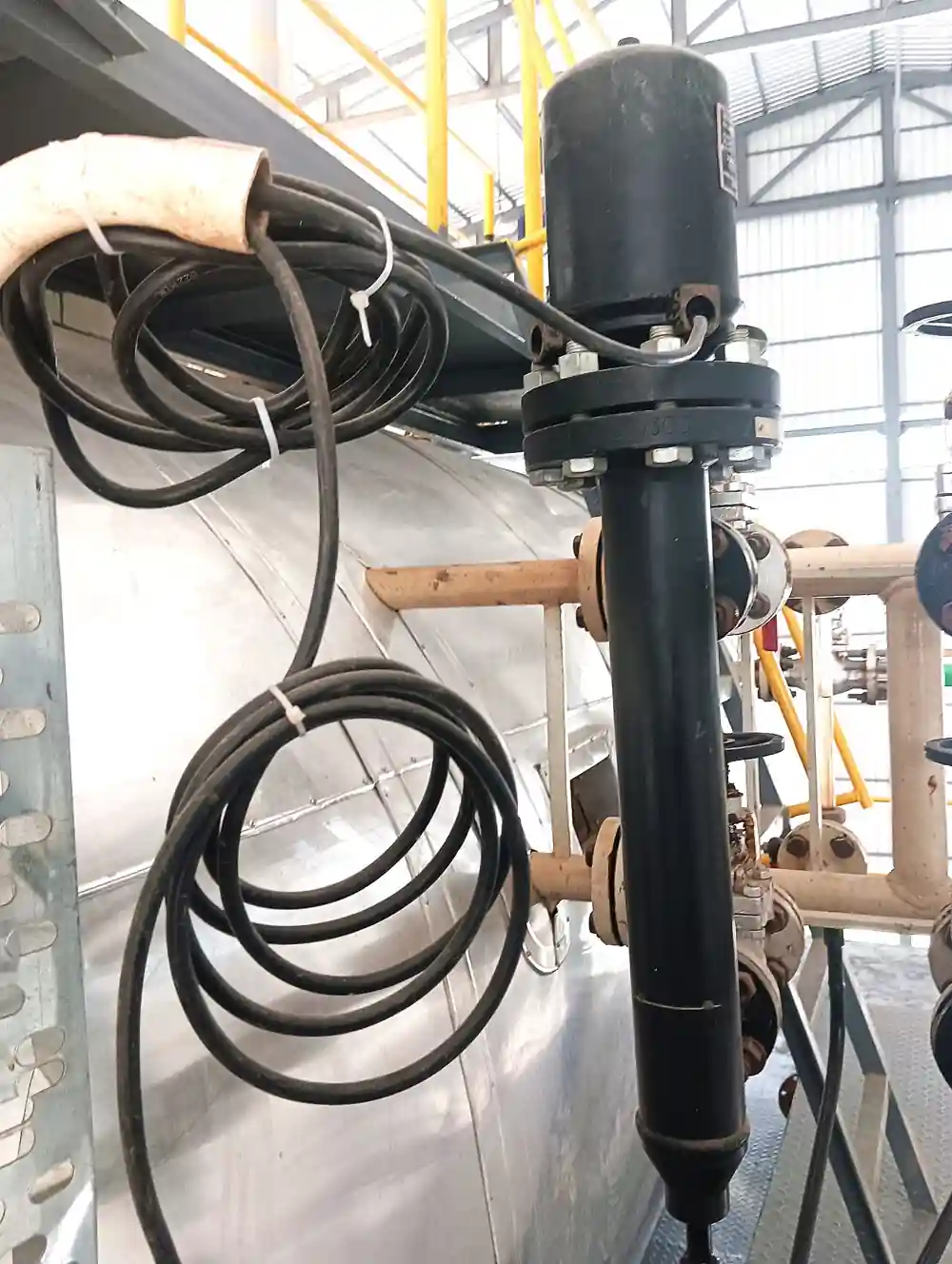
A rotary paddle level switch is an electromechanical point level detector for bulk solids. A small geared motor turns a shaft-mounted paddle that protrudes through a silo roof or wall into the stored material, rotating slowly at roughly 1 to 10 rpm. While the material level is below the paddle, the blade turns freely in the gas space. When rising product buries the blade, rotation stalls, drive torque rises, and a microswitch or an inductive rotation sensor converts that stall into a dry contact change for the alarm or interlock circuit. The principle is reserved for solids, powder, grain, pellet, flake, chip, and granulate, never for liquids, and it mounts through the silo roof with rigid or cable suspended extensions reaching 20 m or more into tall silos.
Procurement engineers meet these switches as high level overfill alarms on grain, flour, and plastic pellet silos, as empty protection on day bins feeding extruders, mills, and screw conveyors, and as demand alarms on cement, fly ash, detergent powder, and wood chip storage. The decision this page settles is narrow and practical: whether the point detection duty belongs to a rotating paddle rather than to another principle, which paddle geometry and which extension style suit the material, which density floor the chosen blade carries, and which approvals the dust hazard and the local silo safety rules demand. The answer lands as an RFQ line set, one function, one mount, one paddle, one density rating, one output and certificate package, and every chapter below feeds that line set so the alarm is bought, not improvised.
This page treats the rotary paddle level switch as a purchasing object: how stall torque becomes a switching decision, what density floors and paddle geometries the physics permits, which construction and approvals match which duty, and how failure modes, installation practice, and proof testing belong in the specification. It is written for engineers who issue purchase documents, not for readers who want a brochure summary.
Chapter 1 / 06
What a Rotary Paddle Level Switch Is and What Is Being Decided
A rotary paddle level switch is deliberately a low information instrument, and that is its virtue. It reports one bit at one elevation, material present or material absent, with a dry contact that changes state seconds after burial and resets when the product falls away. It does not trend, does not interpolate, and does not know how much material sits above or below the paddle. What it does is hold a single switching decision against time, dust, vibration, and electrical noise, which is exactly what a silo overfill alarm or an empty bin interlock needs. The purchase problem is therefore not sensitivity but survival: the device must still stall, trip, and reset correctly after years of abrasive dust, thermal cycling, and falling material, and the specification must force the supplier to prove that in advance.
The boundary against continuous instruments must be drawn first, because level is two purchases. A level transmitter reports the full band as a 4 to 20 mA or bus signal and serves inventory, trending, and control. A level switch guards one line and serves alarms and interlocks. Mature plant practice deliberately splits the two functions across different measurement principles, so a silo may carry a continuous inventory instrument on one physics and an independent switch for the overfill demand alarm on another. The paddle's entire role is the second function, and wherever a specification asks a paddle to behave like a continuous gauge, the specification is wrong, not the instrument. The same logic puts one switch per elevation: a vessel needing three answers buys three switches.
What is being decided at RFQ stage is a short list with long consequences. First the function: high level overfill demand alarm, low level empty protection, or both, one paddle per elevation. Second the geometry: roof mount with extension or side wall mount, chosen against silo height, nozzle position, and where the material line actually sits, with rigid shaft extensions serving insertions of about 3 to 6 m and cable suspended paddles hanging deeper, to 20 m and beyond. Third the envelope: minimum bulk density of the product, particle size, abrasiveness, and temperature at the switching point, which gate the paddle style and the motor rating. Fourth the paperwork: dust hazardous area certification, CE or UL acceptance, and overfill prevention evidence per the local silo safety rules. Fifth the electrical interface, contact rating, and fail-safe direction into the control system. A datasheet that answers all five receives firm quotations; one that answers three receives a site visit.
Four approval families organize the datasheet. Dust hazardous area versions are certified under the EN IEC 60079 series through the ATEX and IECEx schemes, with the certificate naming the zones, 20, 21, or 22, and the dust temperature class; grain, flour, and finely divided organic powders make this the normal case rather than the exception. Electrical acceptance in North America rides on a UL or cUL listing for the supply voltage and enclosure rating. Overfill prevention on silos is enforced by local silo safety rules, plant codes, and insurer audit practice rather than by one international product standard, so the RFQ should name the applicable plant code and demand the maker's conformity statement against it. A datasheet quoting none of these is a price tag, not a specification.
Chapter 2 / 06
How the Paddle Detects Material by Torque
The drive train is a small motor geared down through a worm or planetary stage to a shaft speed of roughly 1 to 10 rpm. Supply ranges span 24 to 240 V AC or DC depending on the build, and the motor is either a synchronous type, which holds speed until it cannot, or a torque motor, which is designed to stall indefinitely against a blocked shaft without overheating. In free air the paddle spins at shaft speed against almost no load, and the drive delivers only friction torque. There is nothing to calibrate in the gas space: the healthy state is a motor that runs, and the entire measurement is the transition from running to stalled.
Burial creates the transition. Rising product packs against the blade faces, the resisting moment at the shaft climbs above what the drive can deliver, and the shaft stops within a fraction of a turn. Three detection mechanisms are in common service. Mechanical builds translate the torque rise through a spring loaded tension disc and lever onto a microswitch, with the spring pretension setting the trip torque, which is why density ratings and spring settings are coupled in the catalog. Electronic builds fit an inductive or magnetic rotation sensor on an internal gear and trip when the pulses stop, which separates the sensing contact from the load current. Some designs monitor motor current, which rises at stall. The output in all three cases is a dry contact, typically SPDT, rated 5 to 15 A at 250 V AC resistive, derated for inductive loads exactly like any other switching contact in the panel.
The density floor falls straight out of the torque balance. A blade of given area buried in a powder experiences a resisting moment that scales with the bulk density and the depth of burial, so light products need larger blades or softer springs. Manufacturer catalogs quote the limit as a vendor-typical figure tied to the paddle part number: wide light material paddles are rated from about 0.1 to 0.2 g per cubic centimeter for fine powders, roughly 150 to 200 kg per cubic meter, while standard blades assume heavier granulates above that class. Those numbers, not the brochure photograph, are the first selection gate, and the RFQ must state the actual loose and compacted bulk density of the product so the vendor selects and proves the blade rather than shipping a default.
Switching dynamics are slow by instrument standards and fast by process standards. Trip latency from burial to contact change is a few seconds, most catalogs quoting under 5 s, because the shaft must decelerate and the detector must confirm the stop. Reset is governed by the material falling away: the stalled drive restarts within seconds once the blade is free, and the switching differential corresponds to the burial depth, a few centimeters of level change for a typical blade. Time delays can be added in the alarm logic, and overfill alarms on slowly filling silos tolerate long filters, while empty protection feeding a conveyor interlock wants the shortest honest delay the material flow allows, the same compromise a flow switch faces in pump protection duty elsewhere in the plant.
Extensions move the paddle from the housing to the material. Rigid shaft extensions serve insertions of roughly 3 to 6 m, carried in a protection tube that shields the shaft from the side loads of falling material in top filled silos. Below those depths, and for tall silos to 20 m and more, the paddle hangs on a cable or chain suspension from the roof mount, with the blade and a suspension weight keeping the assembly taut and vertical. The protection tube, the suspension hardware, and the roof nozzle load are part of the purchase: a bent shaft or a twisted off cable under an avalanche of grain is a mechanical failure written into the installation, not a random defect, and chapter 6 returns to it.
The economics of the principle explain why it survives in a market full of newer physics. The switch carries one motor, one gear train, one blade, and one contact, and every one of those parts can be inspected, adjusted, or replaced by a millwright with standard tools. There is no calibration against product dielectric properties, no echo analysis, and no software between the material and the contact. What the buyer gives up is speed, any continuous information, and immunity to mechanical wear, and those trades are exactly the decisions the selection chapter walks through.
Chapter 3 / 06
Types, Construction, and Duty Boundaries
Catalog format follows the mounting economics. Roof mounts dominate: the housing bolts or screws onto a nozzle on the silo roof, the shaft or cable extension drops to the switching elevation, and one switch guards one level. Side wall mounts thread or flange into the silo wall at the elevation of interest, with a short rigid paddle, and suit shallow bins and chutes where the level line sits a few centimeters from the wall. The housings are aluminum or stainless, carry the terminal compartment and cable entries, and are offered in dust rated enclosures for the hazardous area versions. What changes between formats is reach and accessibility, not the stall physics.
Paddle style is the real selection axis. The wide flat blade presents the largest area to the product and trips on the lightest powders, down to the vendor-typical 0.1 to 0.2 g per cubic centimeter class. The rectangular paddle, the catalog default, trades area for mechanical strength and suits medium granulates, pellets, and grains. The crescent or rat tail paddle, a curved vane or short blade on a heavy shaft, presents minimal area to falling material, sheds buildup, and survives heavy, abrasive, or sticky products. Blades are replaceable consumables on most builds, and the RFQ should price spare paddles with the switch, because the blade is the part that meets the cement.
Two construction schools divide the output stage. Mechanical builds put the microswitch inside the housing, switched by the tension lever, simple and serviceable, but contact life is finite and dust ingress into the terminal side is the aging mechanism. Electronic builds use an inductive rotation sensor with a relay or transistor output, remove the sensing contact from the torque path, and add fault reporting: a motor that stops because the shaft broke looks like a trip, and designs that time the difference between burial and breakage can signal a fault state instead. For a demand alarm that trips protective action, the fault reporting path matters as much as the trip path, and the wiring practice in chapter 6 assumes it is available.
Wetted materials and envelopes follow silo duty. Shafts and paddles are 304 or 316 class stainless steel, housings aluminum or 316, with seals chosen against the product temperature. Standard builds carry process temperatures from about minus 40 to plus 80 deg C, and high temperature builds with thermal stand-offs reach roughly 200 deg C, vendor-typical. Silo duty is near atmospheric, and the rated process pressure on standard builds is a few bar at most, derated with temperature. Example product lines that anchor the catalog space are the Emerson Rosemount 2501 rotating paddle series and the Endress+Hauser paddle switch lines, both represented in the sources below; the numbers in this chapter are catalog-typical rather than tied to one maker.
The boundaries deserve blunt statements. The paddle is a solids instrument and never a liquid one. A product below the blade's density floor will not trip the switch no matter how deeply it buries the shaft. An abrasive mineral flow wears the blade to a stub between inspections. A hygroscopic, sticky powder can bridge over the paddle and hold it buried, or cake on the blade and never free it. And an instrument with a name like this one is easily confused on paper with an entirely different device, the paddle wheel flow meter, which is a flow instrument with a spinning wheel in a full pipe; the selection chapter returns to that distinction. The table below maps common duties to the construction that survives them and the construction that generates callbacks.
Service
Construction to specify
Construction to avoid
Grain or pellet silo high level overfill alarm
Roof mount, rigid extension, rectangular paddle, protection tube, 250 V AC microswitch output
Side wall paddle in the filling stream impact zone
Standard industrial housing without a dust certificate
Pellet day silo empty protection feeding an extruder
Roof mount at the cone, crescent paddle, delayed interlock output
Wide flat blade that pellets bridge over in the outlet region
Cement, fly ash, or lime, abrasive powder
Rat tail or crescent paddle on a heavy shaft, spare blades quoted
Thin rectangular blade with no wear margin
Very light filler or insulation powder
Wide light material paddle with written density proof
Standard blade rated only for heavier products
Hygroscopic detergent or sticky powder
Crescent paddle, high torque drive option, inspection access
Root pockets and flat blades that cake over
Deep silo, 15 m insertion
Cable suspended paddle with tension weight and roof load check
Rigid shaft beyond its supported length
Chapter 4 / 06
Key Specification Parameters
The table below decodes the datasheet lines that decide whether a quoted switch matches the duty. Each row is purchase defining; the paragraphs after the table explain what to demand and what a weak answer looks like.
Attribute
Typical range or options
What it decides
Supply voltage
24 to 240 V AC or DC, vendor options
Motor and electronics envelope, panel compatibility
Shaft speed
1 to 10 rpm at the paddle
Trip latency and blade wear rate
Drive type
Synchronous motor or torque motor rated to stall
Survival of indefinite burial without burnout
Output
SPDT microswitch or relay, 5 to 15 A at 250 V AC resistive
Alarm and interlock loading, inductive derate
Minimum bulk density
0.1 to 0.2 g/cm3 light paddles; heavier class standard blades
Whether the product can trip the switch at all
Insertion
Rigid extension to about 3 to 6 m; cable suspended to 20 m or more
Reach, roof load, and shaft survivability
Paddle style
Flat, rectangular, crescent, or rat tail, replaceable
Density floor, buildup shedding, abrasion life
Wetted materials
304 or 316 stainless shaft and blade, aluminum or 316 housing
Corrosion envelope and product contamination
Process temperature
minus 40 to plus 80 deg C standard; about 200 deg C high temp builds
Seal and bearing selection, stand-off need
Enclosure and Ex
IP6x housing; ATEX or IECEx dust per IEC 60079, zones 20 to 22
Hazardous area acceptance and dust ingress life
Three rows deserve the hardest questions at quotation review. The density row must be answered against the actual product, in writing, with the paddle part number stated: a vendor-typical floor quoted without a blade selection is marketing, and a gap between the lightest paddle rating and the product density is grounds for rejection. The drive row must state that the motor tolerates continuous stall, because a buried high level paddle sits stalled for weeks between fills, and a motor without that rating burns out on the first long outage. The output row must state the resistive rating and the expected inductive derate, because the contact that starts a conveyor or closes a valve carries several times its resistive load at break, and an undersized contact welds shut exactly when the alarm must trip.
The paddle style decision compresses into the comparison below, stated as the selection axis the vendor actually prices.
Paddle style
Best served products
Caution
Wide flat blade
Fine light powders near the density floor, 0.1 to 0.2 g/cm3 class
Low mechanical strength, cakes in sticky product
Rectangular blade
Grains, pellets, and granulates of medium density
Standard density floor applies, not for very light powders
Crescent paddle
Heavy, abrasive, or moderately sticky products
Higher density floor, more drive torque needed to trip
Rat tail paddle
Heavy chips, shavings, lumpy or hot material
Minimal blade area, heaviest products only
Cable suspended paddle
Deep silos, roughly 6 to 20 m insertion
Roof load and twist-off risk under avalanche loads
The certificate rows close the specification. Demand the ATEX or IECEx dust certificate with the zone and temperature class, the CE declaration, and the UL or cUL listing where the site requires it, and demand them named on the quotation, not implied by a logo on a brochure. Demand the response time at the stated density and the reset behavior, the maximum extension length with the protection tube, and the spare parts listing for blades and shaft seals. A quotation that quotes the housing and leaves the blade as an exercise is incomplete at any price.
Chapter 5 / 06
Selection Decision Factors and RFQ Language
The decision sequence is short enough to run as a checklist in a specification meeting, and each step eliminates a class of quotations before price comparisons begin.
Confirm the duty is point detection, one elevation, one bit; continuous inventory belongs to other instruments and other pages.
State the product honestly: loose and compacted bulk density, particle size, moisture, abrasiveness, and hygroscopic behavior; these decide the blade, not brochure chemistry.
Fix the function and the mount: high or low alarm, roof or wall, and the true switching elevation taken from drawings, not from memory.
Choose the paddle style against the density floor table in chapter 4, and have the vendor confirm the pairing in writing.
Set the envelope: temperature at the point, dust zone if any, and the roof nozzle load for long extensions.
Wire the output deliberately: contact rating against the actual load, time delay against material behavior, and the fail-safe direction of the alarm circuit.
Fix the verification evidence: density proof at the stated density, stall survival statement, response time, and the certificate set.
Against neighboring principles, the comparison a specifier actually needs runs as follows, and it belongs here rather than in the page title. The tuning fork level switch in its solids vibrating rod form has no motor, responds faster, and ignores density above its own floor near 80 g per liter, but the paddle still wins on very light or sticky products, on particle sizes that would bridge a rod, on high temperature silo duty, and on cost per point, which is why it remains the bulk solids workhorse. The RF admittance level switch and the capacitance family sense dielectric properties rather than mechanical resistance, suit sticky service where a coated probe can be compensated, and offer no moving parts, but their setpoints depend on product electrical properties that shift with moisture. For continuous duty the radar level meter, the guided wave radar level probe, and the ultrasonic level meter carry solids inventory trending, the capacitance level transmitter and the hydrostatic level transmitter, the latter often delivered through a pressure transmitter at a nozzle, cover other profiles, and on liquid service the magnetostrictive level transmitter, the displacer level transmitter, and the magnetic level gauge carry the trend. Plant practice of splitting principles means a paddle alarm plus a continuous gauge on one silo is a deliberate pairing, not redundancy. One caution on names: the paddle wheel flow meter is an unrelated flow instrument with a wheel in a full pipe, not a level device, and it must not appear in a level specification by confusion.
The application map below turns the comparison into a table the project file can carry.
Application
Construction to specify
Check before order
Grain or pellet silo overfill demand alarm
Roof mount, rectangular blade, protection tube, dust Ex certificate
Blade proof at compacted density; roof load for the extension
Flour, starch, or gluten silo in zone 21
ATEX or IECEx certified build, flat light blade
Certificate zone and temperature class; response time
Day bin empty protection feeding a mill
Cable suspended crescent paddle at the cone, fault reporting output
Reset behavior when the cone empties unevenly
Cement, fly ash, or lime service
Rat tail or crescent paddle, hardened, spare blades quoted
Wear life expectation; inspection access at shutdown
Light filler powder near 0.15 g/cm3
Wide light material paddle with written density proof
Vendor test evidence at the stated density, not a catalog default
Sticky hygroscopic detergent
Crescent paddle with high torque drive option, access flange
Buildup behavior evidence from comparable duty
The RFQ block should be written once and reused. A complete block reads: quantity and function, high, low, or both; mount and insertion length with the silo drawing reference; paddle style by name with the vendor part number pairing; product with loose and compacted bulk density, particle size, and moisture; temperature and pressure at the point; dust zone and certificate demanded; output format with contact rating and the actual load stated; time delay and fail-safe direction of the alarm circuit; extension type, protection tube, and roof load calculation; and the certificate and evidence set, density proof, stall survival, response time, and the spare blade listing. A quotation returned without the density pairing or the stall statement is incomplete at any price, exactly as a valve quotation without a capacity table would be.
Chapter 6 / 06
Installation, Standards, Failure Modes, and Maintenance
Installation quality decides whether the paddle reaches its catalog life. Mount the switch where the blade sees the general material level, not the filling stream: a top fill cone that pours directly onto the extension loads the shaft and buries the blade early, so roof nozzles sit off the fill axis, and side entry paddles avoid the impact zone for the same reason. Keep rigid extensions within their supported length, inside their protection tube, and plumb. Cable suspended assemblies hang free with their tension weight, and the roof nozzle carries the assembly load, which belongs in the silo structural check. Seal the process connection dust tight, because a silo that breathes pushes fine powder through any gap, and set the cable entries facing down so condensation and washdown stay out of the terminals.
Wiring practice follows alarm discipline. Wire the trip so the de-energized state is the safe state: an overfill demand alarm de-energizes to trip, so a broken wire, a dead motor, or a lost supply produces the alarm rather than hiding it. Protect the contact against inductive loads with an RC network or a suitably rated interposing relay when the switch operates a starter circuit, because the 5 to 15 A at 250 V AC resistive rating shrinks several fold on inductive duty. Where the instrument offers fault reporting against shaft breakage, wire it to a distinct input, and treat the alarm and the fault as different events in the logic, the same discipline a flow switch or a pressure switch trip receives anywhere else in the plant. Where a pressure transmitter or another analog instrument shares the panel, keep the switch wiring separated and labeled so the trip circuit survives panel rewiring years later.
The standards frame is honest about what exists and what does not. Dust hazardous area certification runs under the EN IEC 60079 series through ATEX and IECEx, and the certificate names the protection concept, the zones, and the dust temperature class. There is no separate international performance standard for paddle switches, so switching point repeatability and response figures are vendor data, best compared through the maker's own type test evidence. Electrical acceptance rides on CE in Europe and UL or cUL listing in North America. Overfill prevention on silos is governed by local silo safety rules, plant codes, and insurer audit practice, and the specification should name the applicable rule and demand the conformity statement against it. This is a thinner standardization landscape than valves or pumps enjoy, and the RFQ discipline in chapter 5 exists precisely to compensate for it.
Failure modes in service follow a short and predictable list. Bearing wear: shaft friction rises until the drive stalls in free air and the switch false trips high; detected by a motor current trend or a manual rotation check at shutdown. Bent shaft: a material avalanche or the filling stream deflects a rigid extension, the blade binds in the housing bearing, and the same false trip follows. Buildup and bridging: sticky product cakes on the blade or bridges the paddle in the settled mass, holding it buried after the level drops, so the alarm never resets; crescent paddles and periodic inspection are the countermeasures. Cable twist off: in deep silos a shock loaded suspension cable parts and drops the paddle into the product. Rat holing: cohesive powders flow through a channel that leaves the paddle buried in static material, so the switch truthfully reports a level that no longer exists. Contact erosion closes the list, and it is the only one an electronics build eliminates outright.
Maintenance scales with the product. Commission every switch by witnessing a real fill and a real emptying to the trip point, and record the burial depth, response time, and reset behavior as the baseline. Schedule internal inspection at silo entry shutdowns: blade wear measurement, bearing condition, seal and gland integrity, and cable suspension condition for deep mounts. Stock spare blades and shaft seals from day one, because the blade is a consumable in abrasive duty. Trend motor current where the electronics offer it, since a rising free air current precedes the bearing failure by months. And audit the alarm circuit annually with the rigor applied to any demand rated trip, because an overfill alarm that has never been proven is a decoration, not a protection.
FAQ
What is the minimum bulk density for a rotary paddle level switch?
Manufacturer catalogs quote vendor-typical floors tied to the paddle part number. Wide light material paddles trip reliably from about 0.1 to 0.2 g per cubic centimeter, roughly 150 to 200 kg per cubic meter, while standard rectangular blades assume medium density granulates above that class. State the loose and compacted bulk density of the actual product in the RFQ and demand that the vendor confirm the blade pairing in writing, because a product below the floor buries the paddle without ever tripping the contact.
When should a paddle be chosen instead of a vibrating rod?
The vibrating rod form of the tuning fork level switch has no drive motor and responds faster, with density floors near 80 g per liter in solids builds. The paddle still earns its place on very light or sticky products, on particle sizes that would bridge a rod, on high temperature silo duty, and wherever cost per point matters. Both are point instruments, and neither replaces a continuous gauge for inventory duty.
Can a rotary paddle level switch detect liquids?
No. The principle depends on a free flowing bulk solid packing against a slowly rotating blade and stalling it; a liquid wets and passes the blade without generating the resisting torque the drive is tuned to detect. Liquid point detection belongs to float switches, tuning forks, conductive and capacitance probes, and optical or ultrasonic gap sensors. Specifying a paddle for liquid service is a category error that no spring adjustment or paddle swap can rescue.
How deep into the silo can the paddle reach?
Rigid shaft extensions serve insertions of roughly 3 to 6 m, carried in a protection tube against the side loads of falling material. Deeper duties, to 20 m and beyond, use cable or chain suspended paddles that hang from the roof mount with a tension weight. The roof nozzle carries the assembly load either way, and the RFQ should include the extension mass and the avalanche loads in the silo structural check.
What causes false trips and how do I prevent them?
Four mechanisms dominate: bearing wear that stalls the shaft in free air, a bent extension from the filling stream or an avalanche, sticky product bridging over the blade so it never resets, and rat holing in cohesive powders that leaves the paddle buried in static material. Prevention is mechanical and procedural: mount off the fill axis, keep extensions in their protection tubes, choose crescent paddles for sticky duty, and witness a real fill at commissioning.
What approvals does a grain or flour silo demand?
Finely divided organic dust puts grain, flour, and starch silos into dust hazardous area zones, so the switch needs ATEX or IECEx certification under the IEC 60079 series, with the certificate naming the zone, 20, 21, or 22, and the dust temperature class. Electrical acceptance adds CE in Europe and UL or cUL listing in North America, and local silo safety rules govern the overfill prevention evidence the plant must keep on file.
How should the alarm output be wired?
Wire the trip so the de-energized state is the safe state: an overfill alarm de-energizes to trip, so a lost supply, a dead motor, or a broken conductor raises the alarm instead of hiding it. The contact rating of 5 to 15 A at 250 V AC is resistive; fit an RC snubber or an interposing relay for starter circuits and other inductive loads. Where fault reporting exists, wire it to a separate input from the trip.