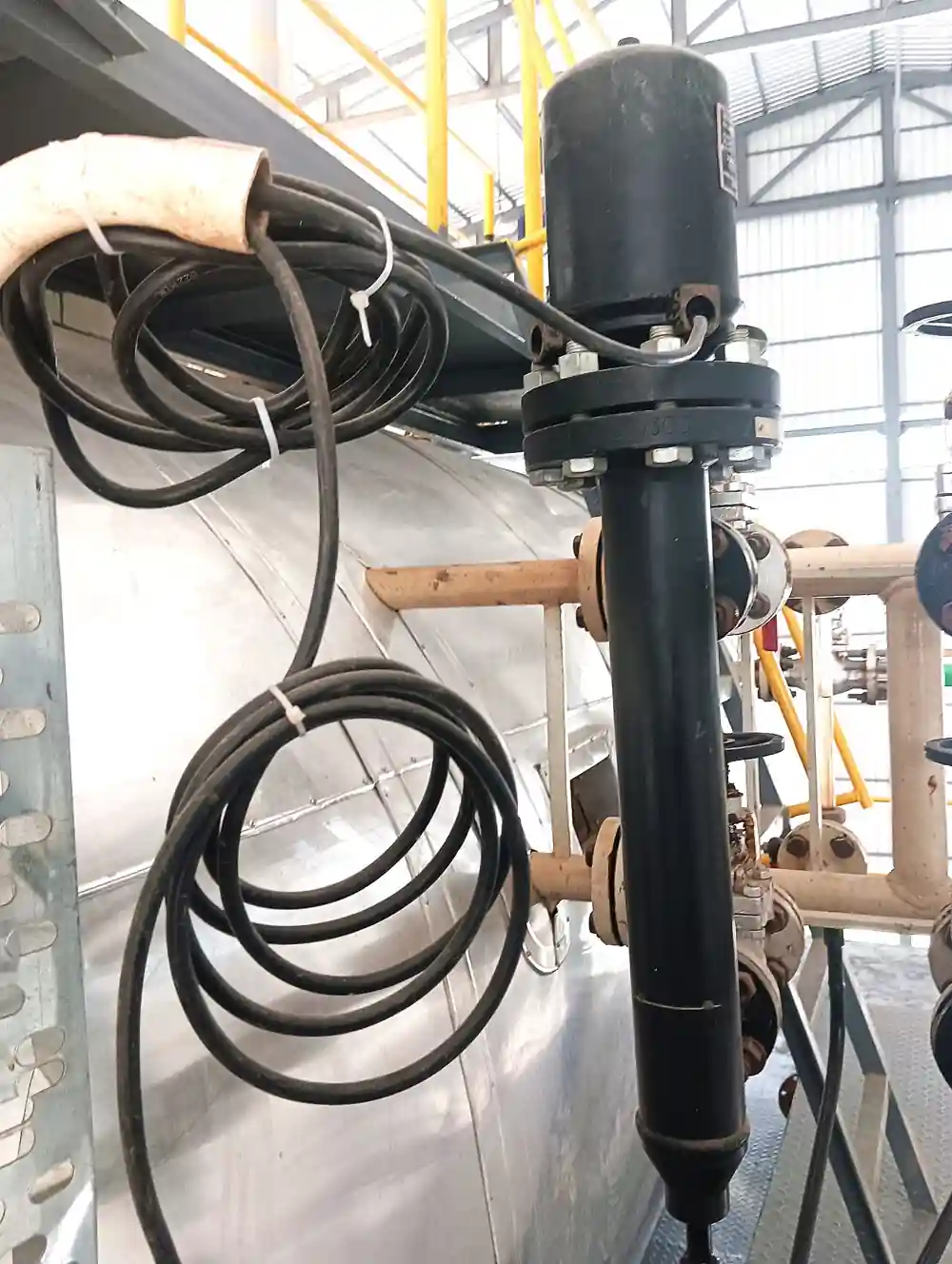
A flow switch is the binary citizen of flow instrumentation: it answers one question, is there enough flow or is there not, and it answers it with a dry contact that a PLC input, an industrial relay, or a safety chain can read directly. Where a flowmeter grades the continuous quantity for monitoring and accounting, the flow switch trips at a threshold, and its entire engineering content is the honesty of that trip: the setpoint the element actually switches at, the hysteresis between make and break, and the survivability of the mechanism in the liquid it swims in. It is the protection component of the mechanical plant, fitted by the million on pump discharges against dry running, on heat exchanger and chiller loops against flow loss, on lubrication lines against oil starvation, and in air ducts for fan proving, and its failures are expensive precisely because everything upstream trusts its one bit.
Specifying one is four linked decisions: the sensing physics for the medium and velocity, paddle or piston for ordinary liquids at honest velocities, thermal dispersion for low flows, gases, and no-moving-parts demands, differential pressure elements for pipes already carrying them; the setpoint and hysteresis arithmetic, the switch must trip below the damaging condition and release above the normal one, with the deadband wide enough that turbulence does not chatter it; the wetted construction, materials and pressure and temperature against the liquid; and the electrical interface, contact rating and configuration for the chain it feeds, with hazardous-area versions where the zone demands. This page works each decision with catalog numbers and closes with the RFQ lines that make flow switch quotes comparable at engineering level.
This page treats the flow switch as a protection instrument that earns its keep in one bit: paddle and piston mechanics, thermal dispersion physics, setpoint and hysteresis arithmetic, dry-run and heat-protection duty patterns, the boundary against continuous flowmeters, and the RFQ lines that carry the specification.
Chapter 1 / 06
What a Flow Switch Is and What Is Being Decided
The instrument is a threshold detector with a contact. Its sensing element converts the presence of flow into a force or a heat transfer difference, a spring or an electronics threshold decides when that quantity means enough, and the output closes or opens a switch: single-pole double-throw, SPDT, the standard form, giving both flow-present and flow-absent terminals, with reed, microswitch, and transistor or relay variants behind it. The entire measurement chain is one bit wide, and that is the point: the protection logic wants yes or now, wants it cheap, wants it at a hundred locations, and wants the answer in a form a relay coil has understood for a century.
What is being decided at purchase is whether that one bit will be honest for a decade. First, the physics against the medium: liquid or gas, clean or scaling, the velocity at the trip condition, and the velocity at normal operation, because the element must live between them with margin. Second, the trip arithmetic: the damaging condition to protect against, dry pump, starved heat exchanger, unproven fan, translates into a velocity or a flow value, the setpoint sits below the damage and above the noise, and the hysteresis, the gap between switching on rising and falling flow, decides whether the contact chatters at the threshold all season. Third, the wetted build: brass, stainless, or polymer bodies, the pressure class, the temperature window, the gasket and elastomer chemistry, and the fouling tolerance of the element in the actual liquid. Fourth, the electrical and environmental frame: contact rating for the load, enclosure IP for the plant, Ex certification where the zone demands it, and the failsafe wiring convention, so that a broken wire reads as no-flow and trips the protection rather than freezing it.
The competitive frame keeps the selection honest. Against the continuous flowmeter families, the electromagnetic flowmeter and its siblings, the ultrasonic flowmeter with its clamp-on convenience and the vortex flowmeter with its clean-line discipline, the flow switch wins by an order of magnitude on price and simplicity wherever the question is binary: it loses, and does not try, wherever the process needs a value, a total, or a trend. The wider discrete-sensor family shares the same logic: the proximity sensor and the photoelectric sensor answer presence questions on the machine side exactly as the flow switch answers presence on the fluid side, one bit each into the same PLC input card. Against the level switch and the pressure switch, its siblings in the binary protection family, there is no contest because the quantities differ: the level switch watches a tank, the pressure switch watches a line's static energy, the flow switch watches the movement, and the dry-run protection of a pump often carries all three in one skid because each catches a different failure. Against the thermal mass flowmeter used as a switch, the thermal dispersion switch is the same physics stripped to the bit, and it prices accordingly. Against an ultrasonic clamp-on used for proving, the switch wins on price and loses on diagnostics. The selection question is never which device is better; it is what the protection chain needs to know, and the honest answer is usually one bit.
One positioning note: this page is the single-product page for the binary flow device. The flowmeter families, electromagnetic, ultrasonic, vortex, thermal mass, each have their own pages for the continuous question; the level switch and pressure switch pages carry their quantities; here the assumption is a protection or proving duty answered by a contact, and every number that follows is chosen for that world.
Chapter 2 / 06
How Paddle, Piston, and Thermal Elements Detect Flow
The paddle switch is a leaf spring in the stream. Flow at velocity bends the paddle, the displacement through a lever or magnet reaches a microswitch or reed, and when the velocity falls below the trip point the spring returns the paddle and the contact changes state: the essence is a calibrated spring fighting a drag force, so the setpoint is a velocity, adjustable by spring pretension on adjustable models or fixed by the paddle geometry on fixed types. Paddles serve liquids at honest velocities, trip points from roughly 0.1 to 0.3 meters per second by design, in pipe sizes from a small threaded unit to large flanged bodies with trimmable paddles; their truths are mechanical, they need a straight run to see undeformed flow, they dislike severe water hammer, which bends paddles, and scaling liquids, which weight them, and their hysteresis is a spring property the datasheet states in velocity terms.
The piston and rotor switches are variable-area kinematics with a contact. A shaped piston or a rotor-and-screw sits in a tapered bore or a shaped cavity; rising flow lifts or drives it, and a magnet coupled through the wall trips a reed switch at a defined position, adjustable on many models by moving the reed carrier or swapping the spring. They serve small clean liquid lines at low flows, trip points down to a few liters per minute by design, with in-line bodies in brass and stainless, and their virtues are repeatability and a visible setpoint screw; their limits are the same as any close-tolerance wetted mechanism, solids and scale are its enemies, and orientation matters because gravity is part of the spring system.
The thermal dispersion switch is heat transfer physics with no moving parts. Two temperature elements sit in the probe tip, one heated, one reference; flowing liquid or gas carries heat away, and the temperature difference between the elements is a function of velocity: at the setpoint, typically 0.01 to 0.1 meters per second in liquids and down to centimeters per second in gases, the electronics trips the contact. The virtues are the low-velocity sensitivity no paddle can match, the absence of anything to bend or jam, tolerance of dirty liquids that defeat pistons, and a stability that makes it the modern default for dry-run protection of pumps; the prices are a probe that must be immersed to its marked depth, a response time of seconds rather than milliseconds, and a sensitivity to bubbles and coatings, gas Blanketing the heated element reads as flow loss, and a scaled tip reads as flow presence, so the liquid's honesty is part of the specification. Compact all-welded versions, the temperature-and-flow probes of the modern catalogs, package the element in a stub that fits a small threaded boss.
Element
Typical trip window
Media and virtues
Hard boundary
Paddle, spring loaded
0.1 to 0.3 m/s liquids by design
Pipes to DN200+, cheap, visible
Hammer bends, scale weights
Piston or rotor, magnetic
a few L/min small lines
Repeatable, adjustable screw
Solids, scale, orientation
Thermal dispersion
0.01 to 0.1 m/s, gases lower
No moving parts, low flow, dirty liquids
Bubbles and coatings mislead
Differential pressure on element
by orifice or venturi sizing
Pipes already carrying DP hardware
Impulse plumbing maintenance
Vane for air ducts
about 2 to 20 m/s air
HVAC fan proving
Not for liquids
The trip arithmetic deserves its own paragraph because chatter is the failure nobody specifies against. Between the make-point and the break-point of any switch lies the hysteresis, expressed in velocity or flow terms, commonly a fraction of the setpoint: a paddle with a 0.15 meters per second make and a 0.08 break will hold its contact through turbulence around 0.1, while a tight-reed design might chatter at the same duty. The engineering rule: place the setpoint at or below the minimum safe flow of the protected process, verify the make-point sits comfortably below the normal operating velocity so the switch is not riding its threshold in ordinary running, and check the hysteresis against the process's own slow oscillations, a level-controlled pump that cycles a tank will sweep the switch through its band twice per cycle and the band must be wide enough to say one word per sweep. Time delay, electronic or thermal, buys chatter immunity at the price of response, and the protection question, how fast does the pump damage, prices that trade honestly.
The electrical contact is the last physics. A microswitch carries amperes honestly, a reed contact carries milliamperes and wants the PLC input or a sealed relay as its load, and the inrush of a solenoid or contactor coil through a contact rated only for its holding current is the classic welded-contact service call. The specification states the contact form, SPDT the default, the electrical rating at the actual load, and the failsafe convention, wired so that the healthy flow-present state is the energized or closed state the logic must see continuously and any wire break reads as the trip, a convention the hazard review owns rather than the electrician's habit.
Chapter 3 / 06
Types, Construction, and Duty Boundaries
Construction follows the wetted world. Brass bodies with stainless or beryllium copper paddles serve water and neutral liquids at moderate pressure, the economy of the HVAC and pump-protection world. Stainless 316 bodies and elements serve chemistry, food washdown, and higher pressure and temperature windows, commonly to PN40 and 100 or 150 deg C class by design. Polymer and composite bodies serve the low-pressure irrigation and water-treatment economy. Flanged bodies carry the large-diameter paddles for water mains and cooling circuits, with trimmable paddle lengths cut to the pipe bore on installation. The thermal probes are all-welded stainless with the electronics in an aluminum or polymer head, explosion-proof and intrinsically safe versions carrying their certificates for the classified zones. Enclosures ladder from IP54 terminal covers to IP66 and 67 heads; the electrical entry is the gland or connector the plant standard names; and the adjustment, where it exists, is a screw under a cover with a scale in approximate velocity or arbitrary units that the commissioning proves against the real line.
The accessory forms complete the family. Fixed-setpoint units sealed at the factory serve the OEM skid market by the million, cheap and tamper-proof; adjustable units with external scales serve the plant market where the process tunes. Dial-reading variable-area bodies with a switch on the side combine a local indication with the trip. Compact insertion thermal switches with a one-wrench boss serve pump and machine builders. The duct vane switches, sail and vane patterns, prove airflow in HVAC and smoke-control duty, and their failures, the sail fouled with dust, are an HVAC maintenance genre of their own. At the top end, the thermal switches with programmable electronics, setpoint and delay set digitally, bring diagnostics and analog repeaters, effectively one-bit flow computers, and price accordingly.
Build
Typical envelope
Duty where it wins
Hard boundary
Threaded paddle, brass
DN15 to DN50, PN25 class
Pump and exchanger protection, water
Scale and hammer over years
Flanged paddle, trimmable
DN65 to DN200+
Water mains, cooling circuits
Installation cutting discipline
In-line piston, stainless
small flows, clean liquids
Lube and dosing lines
Solids, orientation
Thermal compact, all-welded
wide by maker
Dry-run protection, low flow, gases
Bubble and coating sensitivity
Thermal programmable
with delay and diagnostics
Machines and skids OEM-fitted
Price step
Duct vane or sail
2 to 20 m/s air
Fan and smoke-control proving
Dust fouling maintenance
Ex certified variants
flameproof or I.S.
Classified zones
Certificate governs wiring
Duty boundaries, sentence by sentence. Dry-run protection of a centrifugal pump: the thermal dispersion switch is the modern default, sensitive at the trickle a starved pump still passes, no paddle to snap, and the setpoint at the minimum continuous stable flow the pump maker publishes. Flow proving on a heat exchanger, chiller, or compressor cooler: the paddle in larger lines and the compact thermal in small, with the setpoint at the exchanger's minimum velocity, commonly around 0.3 to 0.5 meters per second for tube protection, and the trip wired to the burner or compressor interlock. Lubrication oil proving on a gearbox or screw compressor: the piston or thermal switch in the small line, wired to stop the driver before the bearing pays the bill. Air proving in HVAC and smoke control: the duct vane, maintained, or the thermal air switch for the low velocities. Severe scaling and slurry service: no mechanical element survives honestly, and the answer is a Doppler or DP arrangement, or protection by proxy, a pressure switch on the pump discharge with the system curve in mind. Continuous monitoring or accounting: not this device's job, the flowmeter families own the question. Safety-instrumented functions at SIL ratings: switches with certificates exist and the loop's logic owns the integrity arithmetic. Each boundary is a physics-and-maintenance statement, and Chapter 5 turns each into an RFQ line.
Chapter 4 / 06
Key Specification Parameters
The decode table is the datasheet skeleton. Every row is an RFQ line, and the two right columns are what each row decides and what it costs to leave blank.
The setpoint row is the one that separates protection from decoration. State the protected condition as a number: the pump's minimum continuous flow, the exchanger's minimum velocity, the fan's proved volume, and require the switch's adjustable range to bracket that number in its middle third, because a switch set at the edge of its range is a switch that drifts out of the conversation. The commissioning proof belongs in the RFQ as a line: the trip demonstrated at the real installation by a controlled flow reduction, recorded, and the setpoint locked or lead-sealed where the process is audited.
The hysteresis and response rows are the ones that decide the winter of the contact. The deadband between trip and release must exceed the process's normal wander at the threshold or the contact chatters, and chatter through an inductive load welds contacts; where the process wanders widely, the electronic delay versions buy the filter, and the price of seconds of delay is priced against the damage clock of the protected machine, a dry pump damages in tens of seconds, an unproven fan start damages nothing yet. The repeatability row carries the protection into year five: mechanical elements drift with spring set and scale, thermal elements with coating, and the periodic proof test, annual as a default, is the maintenance line that keeps the one bit honest.
The materials and envelope rows price the decade in the liquid. Scaling water weights paddles and blankets thermal tips; the honest answers are element choice by the liquid's behavior, the stainless and hard-coated builds, and the proof test schedule that catches drift. The elastomer and gasket list belongs whole in the RFQ wherever the chemistry is more than water, and the food and potable approvals where the audit reads them. The electrical rows close the loop: contact form, rating at the actual load, the enclosure IP against the washdown reality, and the Ex certificate where the zone demands, with the wiring method the certificate dictates. The certificate stack, calibration or conformity evidence, Ex files, and the material declarations, is the delivery ticket; a quote missing the stack is not cheaper, it is later.
Chapter 5 / 06
Selection Decision Factors and RFQ Language
The decision sequence runs from the protected machine outward, because every later step prices the earlier one.
Name the protected condition as a number: minimum continuous stable flow of the pump, minimum exchanger velocity, proved fan volume, lubrication flow at the bearing, and the damage clock, how fast the absence of flow hurts, which prices the response time.
Write the medium contract: liquid or gas, clean or scaling, solids, bubbles, temperature and pressure extremes, and the chemistry that picks the wetted materials list.
Choose the element by physics: paddle for honest velocities in clean-ish liquids and large lines, piston for small clean lines, thermal for low flows, gases, dirty liquids, and dry-run duty, DP where the pipe already carries the element, duct vane for air proving.
Place the setpoint and deadband: trip below the damage, release above the normal wander, band wider than the process's own oscillation, delay sized to the damage clock.
Fix the electrical interface: SPDT, rating at the real load, failsafe convention wired so the broken lead reads as the trip, and the PLC input or relay the contact actually drives.
Match the environment: enclosure IP to the plant's washdown and weather, Ex to the zone schedule, mounting access for the proof test the maintenance plan schedules.
Close with the commercial lines: setpoint range bracketing stated, repeatability and drift statement, proof-test procedure, certificates, and the spare element or complete-unit posture for critical services.
The cost comparison is protection economics. A flow switch prices a few percent of the smallest continuous flowmeter, and the protection duty needs the bit, not the curve: buying an electromagnetic flowmeter to close a relay is paying a hundredfold for resolution the interlock discards. The reverse error is the real one, the switch bought as if free, no setpoint discipline, no failsafe wiring, no proof test, its bit trusted for a decade without evidence; the honest economics table the switch at its total cost, purchase plus the annual proof plus the occasional element, against the machine it protects, and the ratio is so small that doing it properly is the cheapest insurance in the plant. Fleet standardization across the level switch and pressure switch families of the same maker usually prices favorably and simplifies the stores, one contact type, one enclosure gland, one certificate file to audit.
Duty
Configuration to specify
Watch line
Pump dry-run protection
Compact thermal, set at minimum stable flow
bubbles at suction, delay sizing
Exchanger and chiller proving
Paddle or thermal by line size
trip below minimum tube velocity
Lube oil interlock
Piston or thermal in small line
orientation and repeatability
HVAC and smoke fan proving
Duct vane or thermal air switch
dust maintenance schedule
Scaling water service
Thermal with proof-test regime
coating drift evidence
Classified zone
Ex certified thermal or reed unit
certificate wiring method
The RFQ language that makes quotes comparable, written as the datasheet lines a vendor must answer with numbers: element type; adjustable range and the setpoint delivered; hysteresis and response time; repeatability and the drift statement; wetted materials including every elastomer; pressure and temperature envelope; process connection; contact form and rating at the declared load; enclosure IP and Ex file; the proof-test procedure the maker supports; and the certificates. A quotation answering those lines is a protection instrument with a price; anything else is a contact in a pipe.
Chapter 6 / 06
Installation, Standards, Failure Modes, and Maintenance
Installation earns the honesty the datasheet promises. Mechanical elements want undeformed flow: five diameters of straight run upstream as the discipline, the paddle's hinge axis vertical in horizontal lines so gravity does not bias the leaf, and the arrow obeyed on in-line bodies whose calibrations assume a direction. Thermal probes go to their marked depth, not to the bottom of the pipe, and in the upward-flow vertical or the horizontal that their maker's table permits, because the probe's convection assumptions live in that geometry. Duct vanes face the airflow with the sail free of the duct wall and the mounting sealed. Electrically, the gland, the IP-rated lid, and the failsafe convention are installed as drawn: the protection contact wired so that flow-present is the state the logic must see and every failure mode, broken wire, dead supply, welded contact found at the proof test, reads as the trip or is caught by the test. The commissioning proof is the last installation act: reduce the flow through the installed switch until it trips, record the value and the time, restore flow, and sign the tag.
The standards frame is the binary instrument world's own. Enclosures and safety answer the general electrical standards of the plant's jurisdiction; the Ex versions carry ATEX or IECEx certificates that govern every wire and gland in the loop; the potable and food contact versions carry the jurisdiction's approvals for their wetted materials; and where the switch feeds a safety-instrumented function, the functional-safety standard's loop arithmetic, demand rates and proof intervals, owns the reliability numbers, with the switch's certified failure-rate data as its input. None of this is exotic; the failure mode is the switch bought as a commodity and wired as an afterthought, discovered as a document gap at the audit or as a welded contact at the outage.
Failure modes arrive in a predictable order, and each has a specification answer. Paddle bending or loss to water hammer shows as a switch that never trips or always trips: the answer is hammer discipline in the hydraulic design and the paddle material honestly chosen, with the annual proof catching the drift. Scale weighting a paddle or blanking a thermal tip shows as setpoint migration, the classic winter complaint on hard water: the answer is the thermal element for scaling service, the proof test at a period the scaling rate sets, and cleaning access in the installation. Bubbles at a thermal element show as false flow or false no-flow depending on their residence: the answer is the mounting position away from the suction vortex and the vendor's bubble behavior honestly asked at purchase. Reed contact chatter and welding show as spurious trips or frozen states: the answer is the rating at the real load, the delay version where the process wanders, and the failsafe convention catching the failure at the next test. Corrosion of the wetted parts shows as weeping first and failure later: the answer is the materials list taken seriously at purchase, not the brass economy on a line that carries chemistry. Frozen proof testing shows as a fleet of unverified bits, the quiet failure of the whole protection culture: the answer is the test on the maintenance calendar with the record kept against the tag.
Maintenance is a proof-test calendar. Annually, or at the interval the loop's integrity arithmetic sets for safety functions: the controlled flow reduction through each installed switch, the trip value and time recorded against the commissioning baseline, the contact action verified at the actual load, and the element inspected for scale and wear wherever the process allows. The element or complete-unit spare posture for critical services: one shelf unit per critical tag or per fleet-fraction, because the device prices so little that the stores argument is shorter than the downtime argument. The records close the loop: one page per tag, commissioning trip, annual trips, setpoint changes with cause, and the element replacements, a history that turns the fleet's drift into a maintenance forecast instead of a surprise.
The commissioning record is the same page begun: as-built element and range, the proved trip and release values with the line's flow reference named, the delay setting, the wiring convention verified, and the certificates filed. Plants that keep it trust their bits; plants that do not discover, at the worst hour, that they never really knew what the switch was saying.
FAQ
Flow switch or flowmeter for pump protection?
If the question is only is there flow, the switch wins by an order of magnitude on price and answers the interlock directly with a contact. A continuous flowmeter earns its cost when the process needs the value, trending, or totalization as well. Many plants run both: a meter on the line for operations and a switch wired failsafe for the protection chain, because the meter's analog output is a worse citizen in a trip circuit than a dry contact.
Which element for hard or scaling water?
Thermal dispersion, with a proof-test regime: it has no paddle to weight and no close-tolerance bore to bridge, and its annual controlled-flow proof catches coating drift before the protection point walks away. Paddles serve scaling water only with scheduled cleaning access and drift records; piston types are the wrong instrument for anything that deposits.
How do I stop the contact chattering at the setpoint?
Widen the effective deadband: verify the process's normal velocity wander at the threshold, place the make-point comfortably below normal running, and choose the hysteresis or an electronic time delay so the switch says one word per flow excursion, not a burst. Chatter through an inductive load welds contacts, so the delay also protects the contact itself, at the price of seconds the damage clock prices.
What setpoint should I order for dry-run protection?
Set it just below the pump maker's minimum continuous stable flow, not at zero: a starved pump still passes a trickle, and the protection must trip while stopping is still cheap. Compact thermal switches sense down to the 0.01 to 0.1 meter per second class, which is why they own the duty. Prove the installed trip by a controlled flow reduction and record it before the tag goes live.
Can one switch satisfy a safety-instrumented function?
Only within the loop's arithmetic: certified switches publish failure-rate data, and the integrity level comes from the demand rate, proof-test interval, and architecture the function's assessment sets, often redundant channels or diverse measurements, flow plus pressure, to reach the target. The switch is one element of the loop; the certificate, the proof regime, and the failsafe wiring carry the safety claim, and the ordinary commercial switch carries none of it.
Paddle or thermal for a DN100 cooling line?
Paddle at that size in clean water is the economical default, flanged with the blade trimmed to bore, trip set below the exchanger's minimum tube velocity around 0.3 to 0.5 meters per second. Choose thermal instead when the water is dirty or scaling, when the trip point is low, or when the no-moving-parts and no-hammer arguments matter more than the price step. Both want the annual controlled-flow proof.
What does the annual proof test involve?
A controlled flow reduction through the installed switch until it trips, the trip value and response time recorded against the commissioning baseline, the contact verified at its real load, and the element inspected for scale or wear where access allows. It takes minutes per tag with a valve and a flow reference, and it is the only thing standing between the plant and a fleet of unverified bits. Schedule it on the maintenance calendar with the record kept against each tag.