A TDLAS analyzer, a tunable diode laser absorption spectroscopy analyzer, is the process or stack gas instrument that measures a single target species, oxygen, carbon monoxide, carbon dioxide, water vapor, ammonia, hydrogen chloride, hydrogen sulfide, or methane among others, by tuning a semiconductor laser across one narrow absorption line of that molecule and reading how much light the gas removes across a path. The laser's wavelength scans a fraction of a nanometer across the line at kilohertz rates, and the depth of the absorption dip, interpreted with the Beer-Lambert law against the line's known strength, returns the species concentration along the path. The measurement is inherently fast, seconds not minutes, immune to cross-sensitivities that plague broader band sensors because the laser addresses one isolated line, and available in in-situ form, cross-stack or probe, measuring directly in the flue or duct without a sample system, as well as extractive form for conditioned streams.
Procurement engineers meet this analyzer on combustion optimization and trim control on boilers and heaters, on ammonia slip monitoring downstream of selective catalytic reduction, on hydrogen chloride and other acid gas stack measurements, on process tunable laser oxygen in metallurgy and glass, and on safety related methane and hydrogen sulfide duties where speed matters. The decision this page settles is narrow and practical: which species at what range and on what path, in-situ cross-stack, probe, or extractive, how dust loading, alignment, and purge constrain the installation, and how calibration, outputs, and hazardous area requirements are specified. The answer lands as an RFQ line set: species and range, configuration, path length, process conditions, calibration basis, and outputs. Every chapter below feeds that line set so the laser instrument is bought on spectroscopy and service data, not on a datasheet photograph.
This page treats the TDLAS analyzer as a purchasing object: what tunable diode laser absorption actually measures and with what selectivity, how in-situ cross-stack, probe, and extractive configurations divide the duty, how path length, dust, and purge set the installation envelope, and how calibration, outputs, and area classification combine into a defensible RFQ. It is written for engineers who issue purchase specifications, not for readers who want a brochure summary.
Chapter 1 / 06
What a TDLAS Analyzer Is and What Is Being Decided
The instrument earns its place with three properties that no neighboring technology combines. Selectivity: the diode laser addresses a single rotational-vibrational absorption line of the target molecule, isolated from the lines of co-present gases, so a TDLAS oxygen reading does not drift when carbon dioxide or water moves, the way paramagnetic and some electrochemical cells historically did. Speed: the line scan repeats many times per second and the reported value updates in seconds, which makes the analyzer a control instrument, not just a compliance monitor, closing combustion trim loops that an extractive system's transport delay would destabilize. And specificity of installation: in-situ configurations measure the gas where it lives, in the duct at process temperature, with no probe filter to plug and no transport line to delay, which is precisely why the technology took over hard duties, hot, dusty, corrosive, that extractive analyzers served poorly.
What is actually being decided in this purchase is a match between one molecule's spectroscopy and one plant's flue. The buyer commits to a species and range, a measurement configuration, and an installation envelope, and each commitment follows from the others: ammonia slip below 3 parts per million needs a long path and a clean line choice; hydrogen chloride at stack conditions pushes toward in-situ to survive the acid; oxygen for combustion trim on a cement kiln wants the rugged cross-stack form. The decision is narrow, technical, and rewarding when done on the process data: the analyzer that matches its duty runs for years between services, and the one mismatched spends its life alarming on alignment or choking on dust.
The family context matters because the gas analysis bench is crowded, and the TDLAS instrument is a specialist among generalists. The gas-analyzer page on this site is the umbrella: it surveys the measurement principles, infrared, ultraviolet, paramagnetic, electrochemical, and laser among them, exactly as it surveys zirconia for oxygen, and this page is the dedicated leaf for the laser branch, standing to that umbrella as the dedicated zirconia-oxygen-analyzer page stands for its branch. The zirconia instrument measures oxygen with a heated Nernst cell, in-situ probe form, rugged and specific to oxygen; TDLAS measures its chosen line, oxygen included, with the laser's selectivity and a longer list of species. The combustible-gas-detector is a safety device sensing flammability, not a process concentration instrument. The ammonia-analyzer in wet chemistry form measures aqueous ammonia in water, a different duty from flue gas slip. And where a sample must be conditioned before any analyzer sees it, the sample-conditioning-system page governs that hardware; a properly selected TDLAS often eliminates the sample system entirely, which is half its value.
Standards and practice organize the datasheet. Continuous emission monitoring in the United States runs under the Environmental Protection Agency's performance specifications, with TDLAS systems qualified under the relevant PS for the species, and European practice runs under the EN 15267 certification scheme with QAL procedures for calibration and surveillance, the regime most international plants reference. Process duty on combustion control leans on the instrument's own validation features, sealed reference cells and line locking, plus the plant's calibration gas protocol. Hazardous area installations carry ATEX or IECEx on the electronics and the appropriate protection concept for the location. A datasheet that names no certification route is a price tag, not a specification.
The RFQ should also name the plant environment, because the analyzer lives in it. Stack or duct size fixes the path; gas temperature, pressure, and dust loading fix the optics and purge budget; weather enclosures and heating fix the outdoor survival; and the signal architecture, 4 to 20 milliamp loops, Modbus, or industrial Ethernet, fixes the integration cost. The plant's instrument bench surrounds the analyzer in practice: a dew point transmitter or a pressure transmitter and pressure gauge at the process taps, a flow meter on the stack, a temperature transmitter in the same flue, and on the process safety side the flame arrester, safety relief valve, and tank blanketing valve hardware of a nitrogen generator fed blanketing system, all coexist with the laser measurement in the same control narrative. Plants running special atmospheres add their species lists, and the industrial-gas context page surveys those gases as commodities. Stating these in the RFQ lets one supplier quote the instrument, its mounting, and its interface in a single pass instead of four arguments at delivery.
Chapter 2 / 06
How the Laser Measures the Molecule
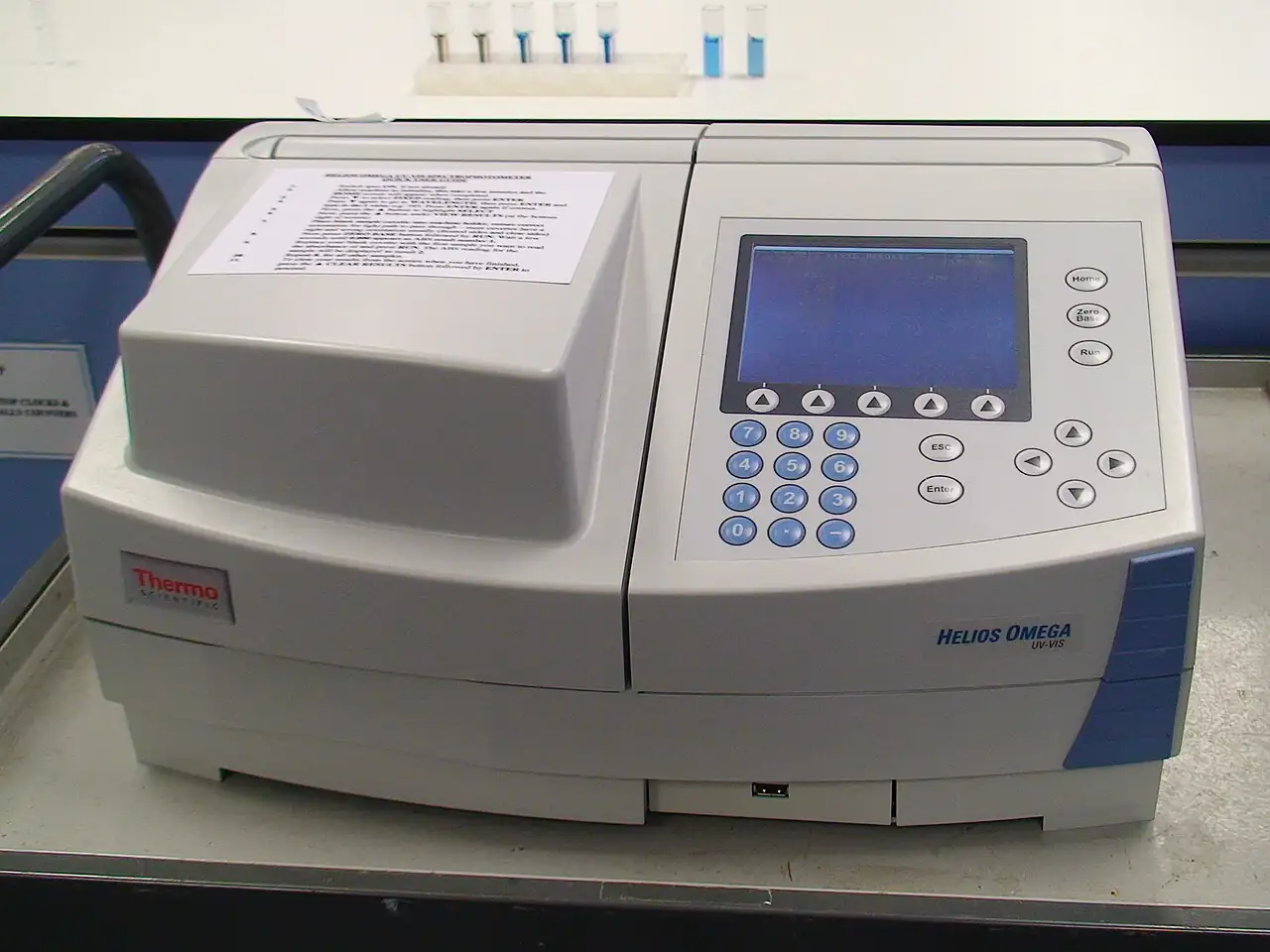
The physics is the Beer-Lambert law wearing a laser. Light of intensity I zero passes through a gas column; the molecules absorb at their characteristic wavelengths and the transmitted intensity I falls; the ratio follows the exponential of the product of absorber concentration, path length, and line strength at the scanned wavelength. A bench spectrophotometer applies the same law with a broadband source and a cuvette; the tunable diode laser's contribution is that its emission wavelength can be swept, by modulating current and temperature, across one selected absorption line with a bandwidth narrower than the line itself: the instrument scans the line's whole shape, fits it, and computes concentration from the fitted depth. Scanning the full line rather than sampling one point is what buys the immunity to broadband attenuation, dust and window fouling shift the baseline, not the line shape, and modern instruments recover the line depth even as transmission drops to a few percent.
Wavelength selection is where the species decision becomes spectroscopy. Each candidate molecule has absorption lines in the near and mid infrared; diode lasers for field instruments live mostly in the near infrared, 1.3 to 2.5 micrometers region, where telecom-descended diodes are mature and fiber delivery is practical, and a few species are served from interband cascade and quantum cascade lasers deeper in the mid infrared. The instrument picks a line that is strong enough for the required range and low enough not to saturate, isolated from neighbors of water and carbon dioxide, and reachable by the available laser. This is why the species list of any TDLAS datasheet is short and specific: the instrument is born knowing one or two molecules, and the buyer picks from the list rather than asking the laser to learn.
Path length trades directly with sensitivity. Concentration times path length sets the absorption signal: a 1 meter probe and a 10 meter cross-stack span differ by a factor of ten in detectable concentration at the same optics, and low range duties, ammonia slip in the low parts per million, hydrogen chloride at stack limits, want the long path. Some instruments extend the effective path with multipass or resonant arrangements inside a cell; extractive TDLAS units do exactly this, folding meters of path into a compact heated cell for conditioned streams. The buyer's arithmetic is simple: required minimum detection against available path against the laser's line strength, and the supplier's job is to show that arithmetic in the offer.
Calibration and validation follow from the line locking. The laser's absolute wavelength is stabilized against a sealed reference cell containing the target gas, so the scan stays on the selected line over years and temperature swings; this internal reference is the basis of the factory calibration and of the instrument's claim to long calibration intervals. Field validation adds certified calibration gas, introduced into the path or a sealed verification cell, on the schedule the certification scheme demands, and the validation record is what the auditor reads. Instruments also report diagnostic numbers, received light level, line fit residual, that function as the health channel: a rising residual or falling transmission is the early voice of window fouling or misalignment, and the maintenance chapter returns to it.
Two verification numbers decide whether the installed analyzer performs. The first is the validation result at the commissioning gas concentration, the zero and span checks that anchor the instrument to its certification. The second is the diagnostic transmission level in service at commissioning, which becomes the baseline for the fouling trend. Both numbers belong in the commissioning file, and both keep paying for themselves every time a drift accusation needs an answer.
Chapter 3 / 06
In-Situ, Probe, and Extractive Configurations
Three configurations divide the market, and the division is by installation philosophy. The cross-stack in-situ analyzer launches the laser across the duct from a transmitter on one side to a receiver on the other: the beam measures the gas directly at process temperature and pressure, response is seconds, and there is no sample system to maintain; the price is the alignment across the span, the purge air that keeps both windows clean, and the discipline that the duct's dust and vibration impose. The probe in-situ analyzer builds the path inside a probe inserted into the gas, sometimes with an open measuring path, sometimes with a sintered or filter-shielded measurement section: shorter effective path than cross-stack, but a single flange mounting, easier alignment, and better tolerance on small ducts and retrofit installs. The extractive TDLAS analyzer draws a sample through a heated line into a multipass cell in an enclosure: the sample conditioning burden returns, transport delay returns, but the cell concentrates path length, the environment is controlled, and duties with extreme dust or inaccessible ducts are served.
Construction follows the configuration. Cross-stack pairs ship as matched transmitter and receiver with flanged process connections, purge connections, and usually an alignment mechanism; probes ship as a single inserted assembly with the electronics local or remote; extractive systems ship as cabinet analyzers with the cell, laser module, and sample handling inside. The laser and detector modules themselves are the heart: distributed feedback diodes in thermally managed packages, photodiode detection, and the modulation and fitting electronics that turn the scan into a concentration. Enclosures follow the plant, weather protection and heating outdoors, hazardous area certification where the location demands it, and the display and interface that commissioning and operations actually touch.
The purge and window system is the difference between years of service and months. Process gas must never reach the optics: purge air or nitrogen flows across the window faces, keeping dust and condensables off the optical surfaces, and the purge budget, flow and pressure, is a utility the plant supplies. Window fouling still progresses with time on dirty duties, transmission falls, and the diagnostic channel reads the trend; the maintenance interval is set by that trend, not by a calendar guess. Alignment behaves the same way: cross-stack spans drift with structural movement and temperature, the received light level is the tell, and the alignment service is a defined procedure with defined acceptance, which is why the installation chapter gives it a paragraph of its own.
The duty map below consolidates the configuration choice into one table a specifier can scan before writing the RFQ; it pairs common services with the arrangement that serves them.
Service
Suitable configuration
Notes on the choice
Combustion O2 or CO trim on a boiler or heater
Cross-stack in-situ, fast loop response
Seconds of lag versus extractive transport
Ammonia slip after SCR
Cross-stack with long path, low range class
Line choice clear of water neighbors
HCl stack monitoring
In-situ cross-stack or probe, corrosion-minded
Avoiding a heated extractive acid run
Cement kiln or glass tank oxygen
Rugged cross-stack with high dust purge
Dust budget and transmission trend discipline
Small duct retrofit measurement
Probe type in-situ, single flange
Shorter path traded for installation ease
Extreme dust or inaccessible duct
Extractive TDLAS with multipass cell
Sample handling and delay accepted
Boundaries are worth stating bluntly. This analyzer is not the umbrella gas-analyzer: that page surveys the principles and this leaf is one dedicated instrument, exactly as the zirconia page is one oxygen instrument among the possibilities. It is not a combustible gas safety detector: the combustible-gas-detector is a protection device with its own certification logic, and the TDLAS is a measuring instrument, though laser methane monitors exist as a specialized safety adjacent class. It is not a zirconia replacement by default: the zirconia-oxygen-analyzer remains the classic in-situ oxygen probe, and TDLAS oxygen earns its place where its speed, selectivity, or multi-species potential is wanted. And it is not extractive by preference: the sample-conditioning-system that an extractive train requires is a cost and a delay, and choosing in-situ well is precisely how that cost is avoided.
Chapter 4 / 06
Key Specification Parameters
The table below decodes the datasheet lines that decide whether a quoted analyzer matches the duty. Each row is a purchase defining parameter; the paragraphs after the table explain what to demand and what a weak answer looks like.
Attribute
Typical range or options
What it decides
Target species
O2, CO, CO2, H2O, NH3, HCl, H2S, CH4, HF, O2 fast trim
The instrument is born to one or two lines
Measurement range
Percent class for O2 and CO2; ppm class for NH3, HCl
Instrument air or nitrogen, stated flow and pressure
Utility provisioning at the installation
Outputs and interface
4 to 20 mA, Modbus, Ethernet, diagnostics channel
Integration cost and health visibility
Area classification
General purpose, ATEX or IECEx variants
Legality of the electronics in the location
Certification route
EPA PS, EN 15267 with QAL, process validation
Acceptance by the permit or the control narrative
The species and range row deserves its own paragraph because it is the row that cannot be changed later. The laser, the optics, and the line fit are fixed at manufacture around the chosen absorption line, and an instrument bought for percent-level oxygen does not become a parts-per-million ammonia monitor by reconfiguration. Specify the species, the range, and the required detection limit together, and ask the supplier to show the line choice: which absorption line, what interfering neighbors were considered, and what water and carbon dioxide cross-sensitivity remains at the extremes. The honest answer names the line; the brochure answer says high selectivity and means ask us.
The configuration table is the second argument in every TDLAS meeting, and the compressed form below is the one a specification file can carry. It pairs each configuration with the duty where it earns its cost.
Configuration
Path class
Where it earns its cost
Cross-stack in-situ
Several meters across the duct
Fast trim control, low ppm slip, hot dirty flues
Probe in-situ
Around a meter inside the probe
Small ducts, retrofits, single flange installs
Extractive with multipass cell
Folded meters in a heated cell
Extreme dust, remote ducts, conditioned samples
Open path fence line, specialized
Long open spans
Perimeter methane and fugitive monitoring
The diagnostics and interface rows close the specification. The transmission and line fit residual channels are the instrument's honest self report, and they belong on the control room trend list from day one, because fouling and alignment announce themselves there weeks before the concentration reads wrong. The concentration output itself rides the plant's chosen protocol, with most installations keeping at least one 4 to 20 milliamp loop for the controller and adding Modbus or Ethernet for the diagnostics and configuration. Calibration gas provisions, a zero and span protocol the certification accepts, complete the package. The quotation that prices the instrument and leaves the diagnostics integration as an exercise is not a complete quotation.
Chapter 5 / 06
Selection Decision Factors and RFQ Language
The decision sequence is short enough to run as a checklist in a specification meeting, and each step eliminates a class of quotations before price comparisons begin.
Fix the measurement purpose: control loop or compliance monitoring, and the response time that follows from the purpose.
Fix the species, range, and detection limit from the process or the permit, with the operating extremes named.
Survey the installation: duct size and access, gas temperature, pressure, dust loading, and the weather and area classification at the mounting.
Choose the configuration against that survey: cross-stack for long path and speed, probe for small ducts and retrofits, extractive for extreme dust or remote streams.
Verify the spectroscopy with the supplier: the chosen line, its strength, the interference analysis, and the detection limit at the offered path.
Plan the utilities: purge air or nitrogen with flow and pressure, power, and the signal architecture from the analyzer to the control room.
Fix the calibration and validation regime: internal reference basis, certified gas protocol, and the certification route the plant must satisfy.
Fix the diagnostics integration: transmission and residual channels trended, alarm thresholds set at commissioning.
Fix the evidence package: certification documents for the route chosen, the line selection data, performance references, and the commissioning validation procedure.
Against neighboring technologies the comparison a specifier actually needs runs as follows, and it belongs in this selection chapter rather than in the page title. The zirconia probe remains the reference in-situ oxygen instrument, simple and rugged, and TDLAS oxygen is chosen when its speed, its freedom from the zirconia cell's temperature constraints, or a second species on the same installation tips the balance. Extractive infrared and ultraviolet analyzers, surveyed on the umbrella gas-analyzer page, measure conditioned samples with broad species coverage and the sample system's costs; TDLAS avoids the sample system and its delay but covers one or two species per instrument. Where a laboratory-grade multicomponent answer is the alternative, a gas chromatograph separates the whole mixture in minutes where the laser returns its single species in seconds, and the control loop votes for the laser every time. The chemiluminescence and wet chemistry ammonia analyzers measure aqueous streams; flue gas slip is the laser's home field. On conditioned extractive trains, a moisture analyzer or the dew point transmitter beside it tracks the water that the line selection had to account for. Choose the instrument the molecule and the duct agree on, and let the line selection data, not the supplier's stock list, decide the model.
The application map below turns that logic into a table the project file can carry.
Application
Construction to specify
Check before order
Boiler combustion trim, O2 and CO
Cross-stack in-situ, fast outputs to the controller
Response time in the loop, not the lab
SCR ammonia slip monitoring
Long path cross-stack, low ppm class
Water interference margin at stack moisture
Waste incineration HCl compliance
In-situ on the duct, corrosion-resistant materials
The RFQ block should be written once and reused. A complete block reads: measurement purpose and required response time; target species with measurement range and detection limit; process conditions at the measurement plane, temperature, pressure, dust loading, moisture; duct dimensions and the available path; configuration offered and effective path length; the supplier's line selection statement with interference analysis; purge gas type, flow, and pressure with the utility's availability; power supply and enclosure class, outdoor and area requirements; output protocol and diagnostics channels with alarm philosophy; calibration and validation regime with the certification route, EPA performance specification or EN 15267 and QAL as applicable; materials at the wetted and window surfaces for corrosive duty; and the documentation set, certificates, line data, commissioning validation procedure, and spares list including laser module and windows. A quotation returned without the line selection statement or the certification route is incomplete at any price.
Chapter 6 / 06
Installation, Standards, Failure Modes, and Maintenance
Installation quality decides whether the optics survive the plant. Cross-stack pairs mount on opposite flanges with the beam perpendicular to flow where the duct is representative, and the alignment procedure follows the manufacturer's steps to its stated acceptance; the purge connections land on a clean, dry instrument air or nitrogen supply at the specified pressure, because a starved purge is a fouled window on a schedule. Probes insert on a single flange with the measuring section in the flow, extractive systems get their heated line runs and the sample system's own disciplines, and every analyzer's electronics live in the enclosure class the location demands, heated outdoors, certified where classified. Signal and diagnostics wiring lands with the trend list already defined, so the transmission channel is history from hour one.
Commissioning practice protects the certification. Perform the zero and span validation with certified gas and file the results as the anchor; record the diagnostic transmission and residual baselines; verify the response the control narrative assumed, with the loop in manual the first time. Where the certification scheme requires it, the QAL or performance specification procedures run at this stage with their own documentation. Train the operations team on the two trends that matter, concentration and transmission, because a falling transmission with steady concentration is a window asking for service, and the analyzer that gets that service runs for years.
The standards set the verification frame. United States emission monitoring runs under the EPA performance specifications for continuous monitoring systems; the European regime is EN 15267 certification with QAL 2 and QAL 3 calibration and surveillance procedures, and most international permits reference one or the other by name. Hazardous area conformity carries ATEX or IECEx documentation. Process duty without a permit leans on the manufacturer's validation features plus the plant's gas protocol, and the audit trail is whatever the specification demanded, which is why it demanded one. A specification that cites the route by name transfers the burden of proof to the supplier, which is where it belongs.
Failure modes in service follow a short and predictable list. Window fouling: dust and condensables coat the optical surfaces despite the purge, transmission falls, and the diagnostic channel announces it long before the reading suffers; the service is window cleaning on the trend's schedule, not the calendar's. Alignment drift: structural movement, thermal cycling, or a bumped platform walks the beam off the receiver, received light drops, and the re-alignment procedure with its acceptance number restores it. Purge failure: a compressor outage or a closed valve starves the purge, and fouling accelerates from months to days; interlocking or at least alarming purge pressure converts the surprise into a work order. Laser module aging: output declines over years, the diagnostics track it, and the module replacement is a defined service with the spares shelf behind it. Calibration gas issues: a wrong concentration certificate or a wet regulator corrupts the validation, and the gas protocol's discipline is the defense. Electronics and interface faults: the ordinary instrument world's failures, served by the ordinary spares list.
Maintenance intervals scale with the duty's severity. A clean gas combustion analyzer may need window service at annual or longer intervals, with validation gas on the certification calendar; a high dust cement duty cleans windows quarterly and watches the transmission trend weekly. Every check produces numbers, transmission percentage, validation results, and those numbers are the real condition monitor for the instrument. None of these checks costs a tenth of one failed compliance test or one unstable trim loop, and every one of them feeds the next RFQ with plant-specific evidence, which is how a purchasing file gets smarter instead of just older.
FAQ
What species can a TDLAS analyzer measure?
The list is fixed by spectroscopy: oxygen, carbon monoxide, carbon dioxide, water vapor, ammonia, hydrogen chloride, hydrogen fluoride, hydrogen sulfide, and methane are the common process species, each from its own selected absorption line. The instrument is born to one or two species and cannot be re-targeted in the field. Specify the species, range, and detection limit together at purchase, and ask the supplier to name the chosen line and its interference analysis, because that line choice is the engineering content behind the selectivity claim.
Should I choose in-situ or extractive configuration?
In-situ, cross-stack or probe, measures the gas in the duct with seconds of response and no sample system to maintain, and it wins wherever the duct allows it and the duty wants speed. Extractive TDLAS, with a heated multipass cell, wins where dust is extreme, the duct is inaccessible, or the sample needs conditioning anyway; it accepts transport delay and sample handling cost. Most combustion and stack duties are best served in-situ, and avoiding the sample-conditioning-system hardware is half the laser's economic case.
How does TDLAS compare with a zirconia oxygen analyzer?
The zirconia probe is the classic in-situ oxygen instrument: a heated Nernst cell, rugged, simple, and specific to oxygen. TDLAS oxygen brings faster response, selectivity independent of the cell's chemistry, and multi-species potential on one installation, at higher cost. For pure oxygen trim on a friendly boiler, zirconia often remains the economical answer; where speed, extreme conditions, or a second laser species matter, the TDLAS earns its premium. The two coexist in most plants' vocabulary precisely because the trade is real.
What limits detection sensitivity?
Concentration times path length sets the absorption signal, so the available path is the sensitivity lever: a 10 meter cross-stack span reads lower concentrations than a 1 meter probe, and extractive multipass cells fold many meters into a compact volume. Line strength and the optics' noise floor complete the arithmetic. State the required detection limit in the RFQ and demand the offer show the path and line basis for it; a sensitivity quoted without a path is a laboratory number, not an installation guarantee.
How often does the analyzer need calibration?
Less often than extractive tradition suggests, and the reason is the sealed reference cell: the laser stays locked to the selected line internally, which is the basis for long calibration intervals. The certification scheme still demands its validation protocol, zero and span with certified gas on the QAL or performance specification calendar, and the audit reads those records. Between validations, the diagnostics, transmission and line fit residual, are the daily evidence that the instrument is healthy, and they cost nothing to trend.
What maintenance does a high dust installation need?
Window and purge attention, driven by the transmission trend. Dust works past any purge eventually on severe duties, transmission falls, and the diagnostic channel schedules the cleaning before the measurement suffers: quarterly service is common on cement-class dust, annual or longer on clean gas. Purge supply health is the companion check, since a starved purge converts months of margin into days of fouling. Trend the transmission from commissioning and let the trend, not a calendar guess, call the service.
Can one TDLAS analyzer measure two species?
Some instruments carry two laser modules and report two species from the same path, a common pairing on combustion duty such as oxygen with carbon monoxide, or water with another line in range of the optics. The pairing is decided at manufacture with the optics and fitting software, not a field upgrade. If the control narrative wants two species, specify both at purchase with their ranges and let the offer state the module arrangement and each line's selection.