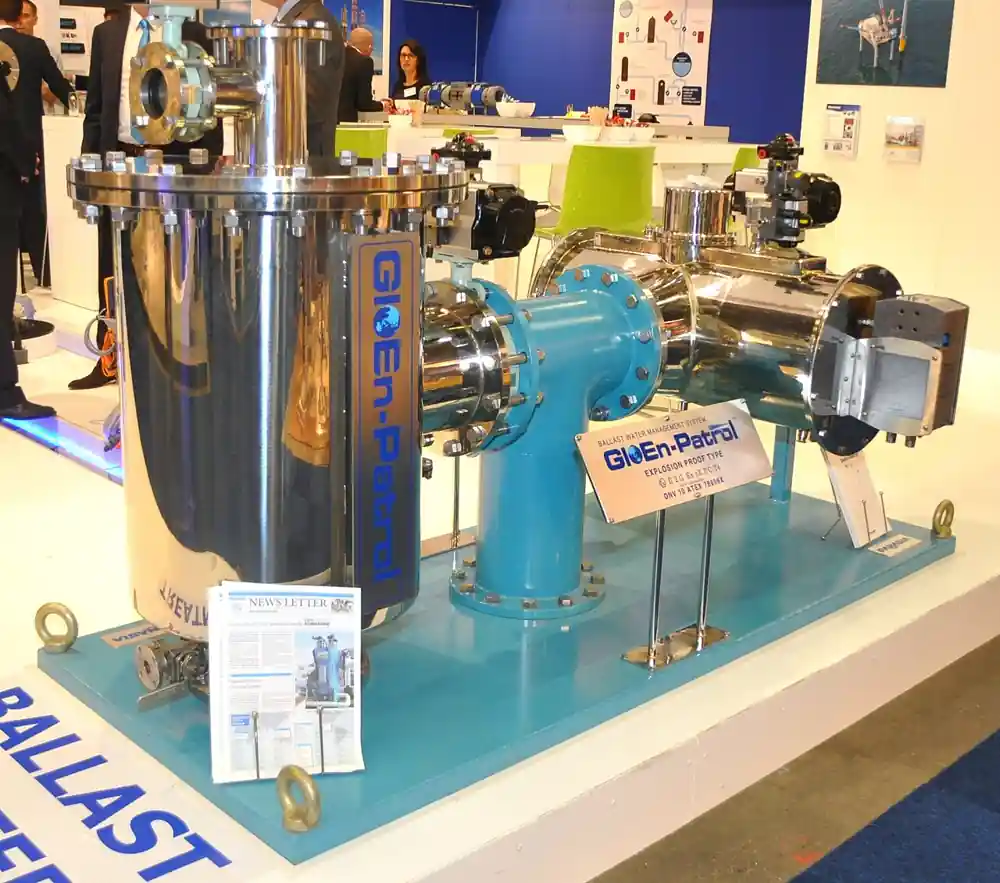
A UV sterilizer, in industrial water treatment terms a UV disinfection reactor, is the pressure vessel or open channel in which water flows past ultraviolet lamps while a validated dose of germicidal radiation, dominated by the 254 nanometer mercury line in conventional lamps, passes through the water and damages the DNA and RNA of microorganisms so they can no longer replicate or infect. The machine is bought as a package: reactor body, lamp assemblies in quartz sleeves, power and lamp drivers, intensity sensors, and either automatic sleeve wiping or a cleaning regime, because the dose is only as good as the clean quartz and the calibrated sensor behind it. Sizes run from a small DN 50 closed-vessel unit treating a few cubic meters per hour to open channel arrays rated for hundreds of thousands of cubic meters per day at a municipal plant.
Procurement engineers meet this reactor in drinking water disinfection, in wastewater reuse trains, in ballast water management, in food and beverage process water, and in ultrapure water loops where the alternative chemistry is unwelcome. The decision this page settles is narrow and practical: which reactor style and lamp technology fit the flow and water quality, what validated dose the target organisms require under the applicable protocol, how transmittance, sleeve fouling, and lamp aging eat into that dose, and how sensors and wiping keep the delivered dose provable. The answer lands as an RFQ line set: flow and transmittance, dose and validation protocol, reactor and lamp type, sensor and wiping arrangements. Every chapter below feeds that line set so the disinfection asset is bought on validation data, not on wattage claims.
This page treats the UV sterilizer as a purchasing object: what a validated dose means under the EPA ultraviolet disinfection guidance and its international counterparts, how lamp technologies and reactor styles divide the market, how transmittance and sleeve fouling are budgeted in the sizing, and how sensors, wiping, and dose monitoring combine into a defensible RFQ. It is written for engineers who issue purchase specifications, not for readers who want a brochure summary.
Chapter 1 / 06
What a UV Sterilizer Is and What Is Being Decided
Ultraviolet disinfection is a physical act with a chemical free residue. Photons in the germicidal band, roughly 200 to 300 nanometers with the 254 nanometer line carrying most of the output in mercury lamps, are absorbed by nucleic acids, and the resulting lesions stop replication. Nothing is added to the water: no disinfection byproduct formation, no taste, no residual. That last absence cuts both ways, and every specifier holds it in mind from the first sketch: a distribution network still needs a chemical residual downstream, so a UV plant almost always hands over to chlorine based finishing, monitored by a residual chlorine analyzer, exactly as an ozone train does.
What is actually being decided in this purchase is the credibility of a delivered dose. A reactor that looks identical in a photograph can deliver twice or half the dose of its neighbor depending on lamp placement, hydraulics, sleeve condition, and the sensor calibration that proves it. The industry's answer is validation: a third party or manufacturer's test campaign, per the EPA Ultraviolet Disinfection Guidance Manual, UVDGM, in the United States or the German DVGW and Austrian ONORM protocols elsewhere, which measures inactivation of a challenge organism across flows and transmittances and reduces the whole reactor to a dose versus condition equation, the reduction equivalent dose, RED. The buyer is therefore purchasing a validated operating envelope, and the machine must be run inside that envelope, with the sensors and lamp maintenance that keep the validation meaningful.
The water context fixes everything else. Ultraviolet transmittance, UVT, at 254 nanometers is the master variable: a water transmitting 90 percent of the germicidal band over one centimeter lets a reactor run at high flow per lamp, while 70 percent transmittance roughly halves the reach of the photons and demands more lamp power or more reactor volume for the same dose. Iron and hardness foul the quartz sleeves, and turbidity shields organisms, so upstream treatment, an industrial-filter or precision-filter stage, membrane filtration, or coagulation, is part of the disinfection design, not a courtesy to the water department. The specifier collects transmittance statistics across seasons, iron and hardness analyses, and turbidity records from a turbidity meter before the first supplier conversation, because those numbers, more than the flow number, decide the price of the reactor.
Family context matters because the water plant already owns several instruments and machines with ultraviolet in their names, and the reactor must not be confused with them. A UV radiometer is a measurement instrument, a meter that quantifies ultraviolet irradiance for process or validation work; it measures the sterilizer's world, it is not the sterilizer. An online water analyzer or a residual chlorine analyzer monitors quality and disinfectant; a toc-analyzer or cod-analyzer quantifies organics upstream of advanced oxidation. On the generation side, the ozone generator described on its own page manufactures an oxidant from air or oxygen; ultraviolet inactivates directly, and the two pair naturally in advanced oxidation and in treatment trains that first oxidize then disinfect. The reactor is the only member of this family whose function is validated inactivation of organisms in flowing water, and the RFQ should keep it distinct from every meter and generator around it.
Standards organize the datasheet. In the United States, the UVDGM governs validation and dose assignment for drinking water, and the NSF and state acceptance frameworks sit behind equipment certification; DVGW W294 in Germany and ONORM M5873 in Austria govern much of the international market with their own validation regimes, and NSF 55 covers small residential scale units. The International Ultraviolet Association publishes guidance that harmonizes terminology and good practice across these frameworks. Electrical conformity, pressure vessel codes on closed reactors, and the water approvals for wetted materials complete the frame. A datasheet that names no validation protocol is a price tag, not a specification.
Chapter 2 / 06
How the Dose Is Delivered and Verified
Dose is fluence, millijoules per square centimeter of germicidal energy delivered to the organism as it passes the lamps, and it is the product of irradiance and exposure time shaped by the reactor's hydraulics. Irradiance falls off with distance from the lamp, is absorbed by the water between lamp and organism in proportion to transmittance, and is further cut by whatever has deposited on the quartz sleeve. Exposure time follows the plug flow behavior of the reactor: well designed reactors keep the water moving uniformly past the lamp field, while poorly designed ones let shortcutting flow exit under-dosed. This is why two reactors of equal lamp power do not deliver equal doses, and why the validation framework reduces hydraulics to a measured number instead of an argument.
The reduction equivalent dose is the industry's honest currency. A validation campaign runs a challenge organism, often a surrogate like MS2 bacteriophage with a known ultraviolet response, through the reactor across a matrix of flows, transmittances, and power settings, measures the log inactivation achieved, and converts it to an equivalent dose using the organism's dose response curve. The published result is a set of operating equations or tables: at this flow and this transmittance, with lamps at this power, the reactor is credited with that RED. Design margins then apply, aging factors for lamps at end of life, fouling allowances for sleeves between wipings, and uncertainty factors from the validation statistics, so the specified dose, for example 40 millijoules per square centimeter for many reuse permits, is delivered even at end of lamp life and worst case transmittance.
The lamp factor shapes every number above. Conventional low pressure lamps emit almost monochromatically at 254 nanometers and convert power to germicidal photons efficiently, but their output per lamp is limited; low pressure high output, LPHO, and amalgam lamps raise the output per lamp while keeping the efficiency, and they dominate drinking water and reuse duty. Medium pressure lamps emit a polychromatic spectrum across the germicidal band, pack far more power per lamp, suit very high flow per reactor and challenging transmittance, and carry higher power draw and more delicate sleeve management. Ultraviolet LEDs emit at tunable wavelengths, start instantly without mercury, and are winning point-of-use and small flow duties, with output and cost per watt still climbing; their time to dominate large municipal duty is measured in years, not months. Mercury lamp regulations in various jurisdictions are part of the lamp decision, and a mercury free option is a legitimate line in the RFQ where law or policy demands it.
Verification in service runs through the sensors. A duty UV sensor, calibrated against a reference, reads the irradiance at a defined point in the reactor; the control loop compares that reading against the validation's allowable minimum at the current flow and transmittance, and trims lamp power or alarms. Sleeves foul, lamps age, and the sensor is the instrument that sees both: a falling sensor reading at constant conditions means quartz deposits or lamp end of life, and the wiping or cleaning frequency is tuned against exactly that trend. Many reactors add a second reference sensor that the duty sensor is ratioed against, and hand-held validation instruments, in the UV radiometer class, appear at commissioning and audit time. A reactor without a credible sensor and calibration chain is a box of lamps with an opinion.
Two verification numbers decide whether the installed system performs. The first is the dose monitoring set point: the flow, transmittance, and power conditions at which the unit alarms, which should trace back to the validation report line by line. The second is the sleeve fouling rate, measured as sensor trend between wipings, which sets the cleaning interval and, with lamp aging, feeds the lamp replacement schedule. Both numbers appear in a competent commissioning file, and both continue to pay for their instruments for the life of the plant.
Chapter 3 / 06
Reactor Styles, Lamp Technologies, and Construction
Two reactor architectures divide the market by hydraulics. The closed-vessel reactor is a pressure vessel, usually stainless steel, installed in-line like a piece of process piping: lamps sit in quartz sleeves across or along the flow, the vessel carries flanged or grooved ends, and the unit suits pressurized systems from building water to reuse trains. The open-channel system is a bank of lamp modules lowered into a channel: it suits gravity flow at municipal wastewater scale, allows modular banks that lift out for maintenance, and trades pressure containment for level control and hydraulic design of the channel itself. The selection is decided by the hydraulic grade line and the scale, not by preference: a pressurized reuse plant wants closed vessels, a gravity wastewater outfall wants channels, and the crossover sits where pumping economics and reactor counts meet.
Within closed vessels, construction separates along lamp orientation and count. Axial arrangements align one or a few lamps with the flow for small and medium units, keeping the pressure drop trivial and the hydraulics predictable; cross-flow arrangements mount many sleeves across the vessel for high output, with baffle work that makes the dose uniform. Sleeve and seal materials are quartz for the sleeve and perfluoroelastomer or PTFE classes for the wetted seals, and the vessel's wetted materials carry drinking water approvals where the service is potable. Automatic wipers, a mechanical ring that travels the sleeve on a programmed or differential-triggered cycle, are standard on medium pressure and most wastewater duty, while small clean-water units may rely on manual cleaning intervals because fouling in clean water is slow.
The power and control layer completes the machine. Lamp drivers, ballasts in the older vocabulary, run at high frequency with power modulation so the control loop can trim output to the dose line; the control cabinet integrates flow and transmittance inputs, calculates the operating point against the validation equations, and drives power or alarms accordingly. A transmittance monitor on the inlet feeds the loop continuously where the water varies, and a flow meter or the signal from the plant's existing flow-meter installation supplies the hydraulic side. Redundancy practice, duty plus standby reactor in parallel with a changeover, or lamp banks with spare capacity, belongs to the reliability chapter of the process design and shows up in the RFQ as a configuration line, not an afterthought.
The duty map below consolidates the architecture choice into one table a specifier can scan before writing the RFQ; it pairs common duties with the reactor and lamp arrangement that serves them.
Duty
Suitable arrangement
Notes on the choice
Drinking water at a surface plant
Closed vessel, LPHO or amalgam lamps, validated per UVDGM or DVGW
Dose credit and sensor calibration chain are the purchase
Reuse and reclamation train
Closed vessels in series or parallel, automatic wiping
40 mJ/cm2 class permits; fouling allowances honest
Municipal wastewater effluent
Open channel lamp banks, level control, modular lifting
Gravity hydraulics; channel design shares the duty
Ballast water management
Closed vessel, high power in compact footprint, marine type approval
Validation and approval per marine rules
Food, beverage, and process water
Closed vessel, LPHO, sanitary connections
Cleanability and approvals on wetted parts
Point of use and small pure loops
UV LED or small amalgam unit
Instant start and mercury free options earn the premium
Boundaries are worth stating bluntly. This reactor is not a meter: measuring irradiance is the UV radiometer's job, and conflating the two buys the wrong product with a familiar name. It is not an oxidant generator: the ozone generator makes a chemical that persists long enough to be measured as a residual, while ultraviolet acts in the reactor and nowhere else. It does not remove anything: turbidity, iron, and organics pass through, and the pretreatment train carries the removal duty. And it is not a chemical residual provider for distribution: finished water still needs chlorine based residual maintenance, with a residual chlorine analyzer at the point of compliance, and the ultraviolet reactor's job ends where the clearwell begins.
Chapter 4 / 06
Key Specification Parameters
The table below decodes the datasheet lines that decide whether a quoted reactor matches the duty. Each row is a purchase defining parameter; the paragraphs after the table explain what to demand and what a weak answer looks like.
Output per lamp, efficiency, spectrum, power quality
Lamp life and aging
8,000 to 14,000 h typical to end-of-life factor
End-of-life dose margin and replacement economics
Sleeve cleaning
Automatic wiper, chemical clean in place, manual
Fouling allowance, maintenance labor, uptime
Sensing
Duty UV sensor, reference sensor, UVT monitor
Dose monitoring credibility and calibration chain
Materials
316L or duplex vessel, quartz sleeves, approved seals
Corrosion, approvals, cleanability
Power and control
Modulating high frequency drivers, PLC integration
Energy trim against dose line, plant interface
Configuration
Duty, duty plus standby, modular banks
Redundancy and turndown across load swings
The transmittance row deserves its own paragraph because it is the row most often fudged. A quotation sized at 90 percent transmittance against a water that spends spring runoff at 72 percent is a quotation for a different plant, and the gap appears exactly when the permit is on the line. Specify the worst credible transmittance with its duration, size against it, and let the control loop take back energy when the water clears. The dose row pairs with it: the required RED comes from the permit or the pathogen table in the applicable protocol, and the honest offer states the achieved RED at worst case transmittance, end of lamp life, and with the fouling allowance applied, not at any single best-case corner.
The lamp table is the second argument in every meeting, and the compressed form below is the one a specification file can carry. It pairs each technology with the duty where it earns its cost so the choice can be made on process grounds.
Lamp technology
Character
Where it earns its cost
Low pressure high output, amalgam
Monochromatic 254 nm, high efficiency, long life
Drinking water, reuse, most closed-vessel duty
Medium pressure
Polychromatic, very high power per lamp
Very high flows, low UVT, compact footprints
UV LED
Tunable wavelength, instant on, mercury free
Point of use, small flows, regulated mercury sites
Standard low pressure
Simple, efficient, low output per lamp
Small clean water units, niche low flow
The sensing rows close the specification. The duty sensor with its calibration certificate is the process evidence chain, the reference sensor guards the duty sensor's drift, and the transmittance monitor closes the loop input so the dose calculation runs on live water rather than an assumption. Wiping, automatic or scheduled, is budgeted as a fouling allowance in the sizing, and the maintenance plan states the sleeve cleaning and lamp replacement intervals with the sensor trend that triggers them. The quotation that prices the vessel and lamps and leaves sensing and wiping as an exercise is not a complete quotation.
Chapter 5 / 06
Selection Decision Factors and RFQ Language
The decision sequence is short enough to run as a checklist in a specification meeting, and each step eliminates a class of quotations before price comparisons begin.
Fix the duty and its dose: pathogen target, log inactivation credit, and the protocol that will assign it, UVDGM, DVGW, ONORM, or marine type approval.
Fix the water honestly: worst case transmittance with duration, iron and hardness for fouling, turbidity for shielding, and the pretreatment that precedes the reactors.
Choose the architecture on hydraulics: closed vessel for pressurized systems, open channel for gravity at scale, and the module count from turndown range.
Choose the lamp technology on process economics: output needed, transmittance to beat, power quality, and mercury policy where it applies.
Demand the validated envelope: achieved RED at worst case UVT, end of life lamps, and fouling allowance, traced to the validation report.
Specify the sensing chain: duty and reference sensors, transmittance monitor, calibration intervals, and the alarm set points against the validation equations; where the train injects chemicals, a ph meter and orp meter belong on the same cabinet record, and where side stream injection serves the process, its static mixer is part of the hydraulic basis.
Set the cleaning regime: automatic wiping or scheduled chemical cleaning, sized against the fouling rate the water analysis predicts.
Fix redundancy and turndown: duty and standby configuration, lamp bank staging, and behavior across the load curve.
Fix the evidence package: validation report reference, materials approvals, factory and site acceptance tests, and the energy figure at design and turndown points.
Against neighboring disinfection options the comparison a specifier actually needs runs as follows, and it belongs in this selection chapter rather than in the page title. Chlorination is the persistent residual and the distribution protection, cheap in chemical and rich in byproduct risk, and it finishes most ultraviolet plants; the ozone generator attacks parasites and organics by oxidation and pairs with ultraviolet in advanced oxidation trains; the UV sterilizer itself adds nothing, forms nothing, and works only inside its validated envelope, which is exactly why food, reuse, and pure water processes prefer it at the point of use. Pretreatment belongs to filtration, an industrial-filter or precision-filter stage upstream, and post-treatment residual belongs to chlorine chemistry. Choose the barrier the permit asks for, and let the validation arithmetic, not the supplier's stock list, decide the reactor count.
The application map below turns that logic into a table the project file can carry.
Closed vessels with automatic wipers, duty plus standby
Fouling allowance against iron and TSS
Wastewater effluent, gravity channel
Open channel modular banks with level control
Channel hydraulics and module lift-out access
Ballast water management
Compact high power closed vessel, marine approval
Type approval certificate and challenge conditions
Beverage process water
Sanitary closed vessel, LPHO, clean in place
Wetted approvals and drainability
Ultrapure and point of use
UV LED or small amalgam unit
Mercury policy and certified dose for small units
The RFQ block should be written once and reused. A complete block reads: quantity and configuration with redundancy stated; design, average, and minimum flows; worst case UV transmittance at 254 nanometers with its duration; water quality, iron, hardness, suspended solids, and turbidity basis; target organisms and required log inactivation; required RED under the named protocol; reactor style and end connections; lamp technology with lamp life and end of life output factor; sleeve material and cleaning arrangement; sensing package with calibration certificates and alarm philosophy; control interface to plant systems, inputs from flow meter and transmittance monitor, outputs to SCADA; electrical supply and power quality details; materials and wetted approvals; validation report reference for the offered reactor; and the acceptance test protocol, dose verification at commissioning against the validation equations, sensor calibration checks, and energy at two operating points. A quotation returned without the validated RED at worst case conditions or without the sensing calibration chain is incomplete at any price.
Chapter 6 / 06
Installation, Standards, Failure Modes, and Maintenance
Installation quality decides whether the validated envelope survives contact with the field. Closed vessels mount in line with the flow direction the validation assumed, with isolating valves and a bypass arranged so sleeves can be serviced without shutting the plant, and with pressure ratings matched to the system. Open channels need the hydraulic design the validation prescribes: approach and exit conditions, level control over the lamp bank within tolerance, and drain-down provision. Electrical rooms for lamp drivers stay cool and clean, because driver life is a temperature story, and the control cabinet's inputs, flow, transmittance, and sensor signals, are landed and ranged at commissioning rather than assumed. Interlocks that prevent lamp operation with the vessel empty or dewatered protect both sleeves and people from uncooled lamps.
Commissioning practice protects the credit. Verify sensor calibration against the certified reference before the first week of operation, record the operating point table from the validation report into the control system, and walk the reactor across its envelope: several flows, real transmittance, and the alarm behavior at the dose line. Establish the sleeve fouling baseline early, because the first months of sensor trend set the wiping interval the plant will live with. Lamp hour counters start at zero and the replacement schedule is written against the end of life factor, not against failure. File the whole set as the baseline for audits, because the validation is a document, and the plant's job is to keep operating inside it.
The standards set the verification frame. The UVDGM governs United States drinking water validation and dose assignment; DVGW W294 and ONORM M5873 govern the Central European market with their own test regimes; marine ballast installations follow their type approval conventions; and NSF standards cover small unit certification and materials. The International Ultraviolet Association guidance documents harmonize the vocabulary and practice across these frames. Electrical and pressure conformity apply as usual, and wetted materials carry potable approvals where the service demands them. A specification that cites the protocol by name transfers the burden of proof to the supplier, which is where it belongs.
Failure modes in service follow a short and predictable list. Sleeve fouling: iron and hardness films cut transmission, the duty sensor reads low at constant conditions, and the fix is wiping frequency or chemical cleaning, with the trend deciding which. Lamp aging: output decays over the rated hours, and the end of life factor in the sizing exists so the dose survives it; running lamps past their hours to save replacement cost spends the validation margin. Sensor drift: the duty sensor ages, and the reference sensor or a scheduled calibration catches it; an uncalibrated sensor eventually misreports the dose in whichever direction drifts. Hydraulic excursion: flows above validation range or channel levels out of tolerance take the reactor outside its equations, and the control system's flow interlock is the protection. Ballast or driver failure: the electrical layer fails before the lamps do, and a spare driver on the shelf is the difference between a shift and a week. Seal and O-ring leaks: perfluoroelastomer parts age in hot vessels, and scheduled replacement beats unplanned dewatering.
Maintenance intervals scale with water quality and utilization. Clean water closed vessels earn annual sleeve inspection and cleaning, sensor calibration at the manufacturer's interval, and lamp replacement on hours. Reuse and wastewater duty with automatic wipers wipe daily or on differential trigger, clean sleeves chemically at intervals the fouling trend sets, and calibrate sensors more often because fouling finds sensors too. Open channel banks add module lift-out and seal service at the channel maintenance schedule. Every intervention produces numbers, sensor readings, fouling rates, lamp hours, and energy per cubic meter, and those numbers are the real condition monitor for the system. None of these checks costs a tenth of one failed bioassay or permit excursion, and every one of them feeds the next RFQ with plant-specific evidence, which is how a purchasing file gets smarter instead of just older.
FAQ
What UV dose does my application need?
The dose is set by the target organisms and the governing protocol, not by preference. Many reuse permits specify 40 millijoules per square centimeter; drinking water dose requirements follow the pathogen credit tables of the applicable validation framework such as the UVDGM; ballast water and food applications carry their own convention. The number that matters in the offer is the validated reduction equivalent dose at worst case transmittance and end of lamp life, with the fouling allowance applied, because a dose quoted at best case conditions is a laboratory number, not a plant guarantee.
Why does UV transmittance matter so much?
Transmittance at 254 nanometers fixes how far germicidal photons penetrate the water, and dose falls roughly in step with it. A reactor validated at 90 percent transmittance may deliver barely half the dose at 70 percent, so the sizing must use the worst credible water, spring runoff or storm events included, with its duration stated. An online transmittance monitor feeding the control loop lets the plant trim power back when the water clears, which is where the energy savings of a well specified system actually come from.
Which lamp technology should I choose?
Amalgam and low pressure high output lamps are the efficient default for most closed-vessel duties: near 254 nanometer output, long life, good power conversion. Medium pressure lamps pack far more power per lamp and suit very high flows, low transmittance water, and compact footprints, at higher power draw and more attention to sleeve cooling and fouling. UV LEDs are the right choice for point of use, small flows, and mercury restricted sites, with output and cost per watt still improving. Choose on the validated envelope and lifecycle energy, not on wattage alone.
What is a reduction equivalent dose?
It is the dose a reactor is credited with after a validation campaign: a challenge organism is passed through the reactor across a matrix of flows, transmittances, and power settings, the measured log inactivation is converted to dose through the organism's dose response curve, and the result is published as an operating equation or table. The plant runs inside that envelope, and the control system's alarm set points trace back to it line by line. Two reactors with identical lamp power can carry very different validated doses, which is why the validation report, not the kilowatt count, is the specification anchor.
How often do sleeves need cleaning?
Fouling rate decides, and the duty sensor trend measures it. Clean water units may need only annual cleaning, while reuse and wastewater reactors with iron and hardness present wipe automatically on a daily or differential-triggered cycle and chemically clean on a longer interval. The sizing carries a fouling allowance between cleanings, so the interval is not cosmetic: stretch it too far and the delivered dose eats into its margin. Write the wiping frequency into the maintenance plan from the first months of sensor trend, not from the brochure.
Do I still need chlorine if I install UV?
For a distribution network, almost always. Ultraviolet disinfects only where the light is and leaves no residual, so water stored and piped afterwards is unprotected; plants therefore finish with a chlorine based residual, monitored by a residual chlorine analyzer at the compliance point. In process and reuse applications at the point of delivery, the no residual property is an advantage, and the answer can legitimately be no. The question is decided by what happens to the water after the reactor, not by the reactor itself.
How is the system verified after installation?
By commissioning against the validation record: sensor calibration verified against the certified reference, the operating point table entered into the control system, alarm behavior walked at the dose line, and the sleeve fouling baseline logged in the first months. Periodic verification continues with sensor calibration at the manufacturer's interval and lamp hour tracking against the end of life factor. Where the permit requires it, an on-site bioassay re-check against the original validation closes the loop, and plants that keep the trend data make that check a formality.