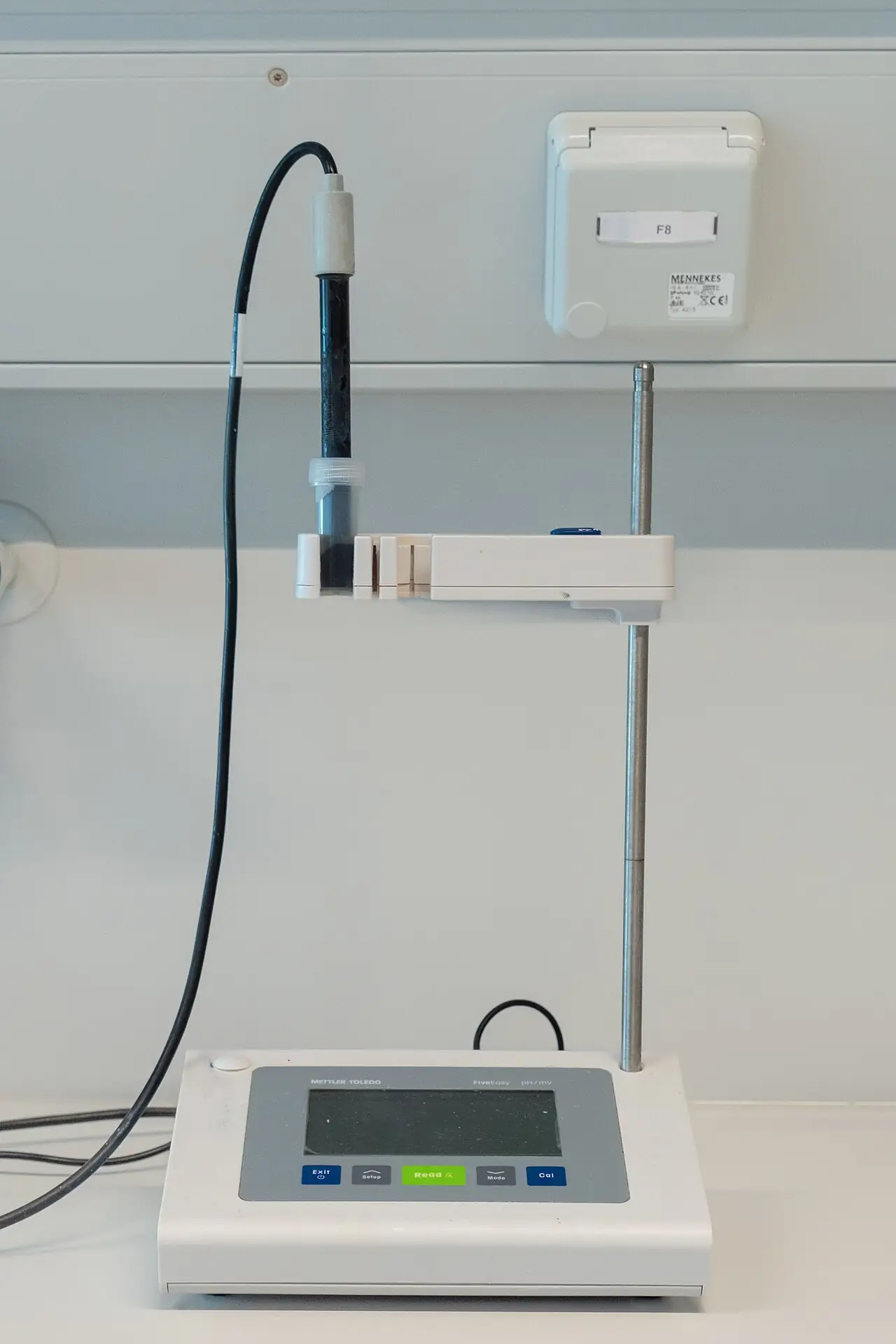
A residual chlorine analyzer continuously measures the disinfectant chlorine remaining in treated water, reported in milligrams per liter as Cl2. Sold across the industry as a chlorine analyzer or chlorine monitor, and in its most common single species form as a free chlorine analyzer, the instrument exists in two method families: amperometric sensors, membrane covered or bare electrode, in which chlorine diffuses to a cathode and the reduction current is proportional to concentration, and DPD colorimetric cabinets, in which the sample is dosed with N,N-diethyl-p-phenylenediamine reagent and a photometer reads the pink complex at about 515 nm on a 2.5 minute cycle. Which species is measured, free chlorine, total chlorine, or both, is the first line of the specification.
Procurement engineers meet these analyzers at four duties: drinking water disinfection control, where CT credit arithmetic and a distribution residual are the compliance product; wastewater effluent permits, typically written in a 0.02 to 2 mg/L band with dechlorination control downstream; cooling tower biocide programs; and process sanitation loops. The decision this page settles is which method survives the matrix, which species the permit actually names, what the reagent and membrane logistics cost per year, and how the analyzer closes the loop with the chemical dosing system. The answer lands as an RFQ line set: species, range, method, sample conditions, reagent logistics, outputs, and the method standards the measurement traces to.
This page treats the residual chlorine analyzer as a purchasing object: the amperometric and DPD colorimetric methods behind the number, the free and total chlorine species and the pH chemistry that moves between them, the honest ranges and cycle times of each family, what the sample chain must hold constant, and how the whole decision is written into an RFQ that controls disinfection rather than merely reporting it. It is written for engineers who issue purchase specifications, not for readers who want a brochure summary.
Chapter 1 / 06
What a Residual Chlorine Analyzer Is and What Is Being Decided
The instrument guards a chemical boundary condition. Chlorine dosed into water does not stay as one substance: it hydrolyzes to hypochlorous acid, HOCl, which dissociates to hypochlorite, OCl-, with the split governed by pH through a pKa of about 7.5 at 25 deg C; it reacts with ammonia to form chloramines, the combined chlorine fraction; and it is consumed by organic demand, iron, and sulfide on the way to doing its disinfecting work. What remains, the residual, is the number the plant controls. Too little and the disinfection credit fails; too much and the discharge permit, the corrosion budget, or the taste and odor complaint file fails. The analyzer converts that residual into a continuous signal that a dosing loop or an operator can act on.
The measurement earns its cost through compliance and through chemical savings. On the compliance side, disinfection credit for surface water treatment is built on CT arithmetic, residual concentration times contact time, with a minimum detectable residual entering the distribution system commonly policed at a 0.2 mg/L class floor, and the online analyzer is the instrument of record for that residual. On the process side, wastewater plants chlorinating effluent and then dechlorinating with sodium bisulfite run two analyzers, one before dosing to trim the chlorine feed and one after to trim the bisulfite feed through a metering pump, because overfeeding bisulfite consumes dissolved oxygen and turns a disinfection problem into a toxicity problem. Cooling towers hold free chlorine inside a 0.1 to 1.0 mg/L band for continuous programs or shock higher, and food and beverage sanitation loops hold residuals that prove the rinse and clean in place chemistry did its work.
What is being decided in this purchase is five commitments at once. First, the species commitment: free chlorine, total chlorine, or both on one cabinet, and for chloraminating plants the monochloramine and free ammonia picture beside them. Second, the method commitment: amperometric or DPD colorimetric, a choice the matrix makes, turbidity and oils pushing toward DPD, maintenance appetite and reagent tolerance pushing toward amperometric. Third, the pH commitment: because the HOCl fraction swings from roughly three quarters at pH 7 to about one quarter at pH 8, either the method must be pH compensated or a pH meter must sit on the same panel feeding the correction. Fourth, the sample chain commitment: both methods demand constant head, constant flow, and a live fresh stream, since chlorine decays in stagnant lines. Fifth, the operations commitment: reagent bottles and their monthly replacement, membrane and electrolyte service, calibration against DPD grab checks, and the drift discipline that keeps the number defensible. A quotation that answers only the range line is a box price, not a control loop.
The instrument lives among the water chemistry siblings, and the RFQ should name the boundaries so nobody expects one box to do another instrument's work. A pH meter is not a neighbor so much as a prerequisite: the same chemistry that shifts HOCl into OCl- shifts the amperometric reading, so the pH signal feeds the compensation, and the two instruments ship on one panel in practice. An ORP meter is the cheap redox proxy some plants run instead of speciated chlorine, and it gives a millivolt trend without telling free from combined, which is exactly the information a CT calculation needs. A conductivity meter carries the general treatment state and neither substitutes nor competes. A dissolved oxygen meter guards aeration basins and the dechlorination oxygen budget, downstream business. A turbidity meter reads the suspended solids that interfere with photometry and consume demand, which is why its signal explains some DPD outliers. A gas analyzer belongs to an entirely different matrix: it detects chlorine gas leaks in air around storage and dosing rooms, a safety instrument, not a water quality one. In the laboratory, the spectrophotometer is the referee, running the same DPD chemistry on a bench for calibration and dispute resolution, and a densitometer closes density accounting elsewhere in the plant. None of them substitutes for a continuous speciated residual.
Three method standards organize the datasheet. ISO 7393-2 fixes the DPD colorimetric determination of free and total chlorine. Standard Methods 4500-Cl carries the family by letter, variant G for DPD colorimetric and variant D for the amperometric procedure, which is the language permits and procedure manuals cite. EPA 334.0 governs the online determination of free chlorine with DPD calibration checks, the method record many drinking water analyzers are validated against. A datasheet that cites none of these is describing a sensor, not a measurement.
Compressed to one sentence, the decision is whether the plant buys a defensible continuous residual as a system, species and method matched to the matrix, pH compensation matched to the chemistry, sample chain matched to the tap, and reagent logistics matched to site reality, or a cabinet part number connected to the nearest convenient line. The chapters that follow supply the electrochemistry and the photometry, the hardware families, the datasheet rows, the selection logic, and the failure modes needed to write it the first way.
Chapter 2 / 06
How Amperometric and DPD Colorimetric Measurements Work
The amperometric membrane sensor is an electrochemical cell in a flow cell. A permeable membrane, typically a hydrophobic polymer, covers a cathode, commonly gold or platinum, behind it an electrolyte and a counter or reference electrode pair. Free chlorine, chiefly HOCl, diffuses through the membrane in proportion to its concentration in the sample and is reduced at the cathode under an applied potential; the resulting current, per the Faraday relation, is proportional to the diffusion rate and therefore to concentration. The membrane excludes ionic interferents and turbidity, which is why the method survives matrices that blind bare electrodes; its characteristic cost is that everything the membrane rejects it also slowly fouls with. Response is continuous, with 90 percent response in the 1 to 2 minute class, so the signal tracks the process in real time rather than in batches.
Bare electrode amperometric sensors drop the membrane and expose the electrode set directly to a fast flowing sample, measuring at constant flow velocity so the diffusion layer stays defined. Their strength is fewer consumables and faster response; their weakness is that the raw current responds to the HOCl fraction and to pH swings, so they demand either a buffered reagent or an active pH compensation input, and they are the design most exposed to direct interference from surfactants, iron, and sample chemistry changes. Established families split roughly here: membrane covered sensors such as the Hach 9184sc class dominate clean drinking water duty, while bare and reagent buffered electrode systems hold ground where their maintenance model suits the site.
The DPD colorimetric method is batch chemistry on a clock. A measured sample is dosed with DPD reagent, N,N-diethyl-p-phenylenediamine; free chlorine oxidizes the reagent to a pink magenta species, and a photometer reads the absorbance at about 515 nm and converts it through calibration to mg/L. For total chlorine, a second dosing adds potassium iodide with an acid buffer: the iodide is oxidized by the full oxidant pool, combined chloramines included, and the liberated iodine drives the same color development. A free and total cabinet, the Hach CL17 and CL17sc class and the Endress+Hauser CA80CL class, runs the sequence every 2.5 minutes, auto-zeroing the photometer on plain sample each cycle, and reports free and total with the difference yielding combined chlorine. Batch chemistry shrugs off turbidity and moderate color far better than a bare electrode tolerates fouling, at the price of a monthly reagent supply chain.
Total chlorine duty extends the same chemistry family to harder streams. Analyzers built specifically for total residual chlorine on wastewater and chloraminated systems, the Emerson Rosemount TCL class running its variant amine colorimetric chemistry, exist because dechlorinated effluents hold chloramines and trace oxidants that a free chlorine reading undercounts, and because a permit written in total residual chlorine needs the total number continuously. Plants with chloramination programs track the same split deliberately: free chlorine after the primary dose, monochloramine after the ammonia dose, and combined chlorine through the distribution reach, since nitrification trouble announces itself as free ammonia and a falling residual long before it becomes a coliform event.
The pH chemistry deserves its own paragraph because it is the physics every selection argument reduces to. With a pKa of about 7.5 at 25 deg C, the HOCl fraction of free chlorine falls from roughly 75 to 80 percent at pH 7 to about 50 percent at pH 7.5 to about 20 to 25 percent at pH 8, and it keeps falling as pH rises. Disinfecting power concentrates in HOCl, so CT arithmetic is pH sensitive even at constant residual. Amperometric membrane sensors respond chiefly to HOCl, so without pH compensation a perfectly stable residual reads low as pH climbs; DPD reacts with both HOCl and OCl-, so the photometric total free reading is speciation blind, which is robust for residual reporting and useless for speciation. Either way, the pH meter beside the analyzer is part of the measurement, not decoration, and the RFQ should state which instrument carries the compensation.
Performance spans are family wide. Amperometric sensors cover 0.01 to 20 mg/L class spans with resolution suited to control loops, continuous response, and monthly to quarterly electrolyte and membrane service. DPD cabinets cover switchable spans in the 0 to 2 and 0 to 5 mg/L class with accuracy around 5 percent or a small fixed offset at the bottom, a 2.5 minute cycle, and a monthly reagent set. Calibration layers are shared: DPD photometers auto-zero each cycle and take full calibration and grab kit comparisons on a schedule; amperometric sensors take a zero and a span adjustment against a DPD grab or a standard, with drift checked monthly. No family holds its stated class through a fouled membrane or an exhausted reagent bottle, which is why the maintenance chapter is as long as this one.
Chapter 3 / 06
Analyzer Types, Construction, and Duty Boundaries
The membrane amperometric package is the drinking water standard: a sensor in a flow cell, a constant head sample supply, a transmitter or controller converting current to concentration with temperature and pH compensation, and 4 to 20 mA plus Modbus out. The Hach 9184sc class is the reference construction, and the family spans simple panel systems through distributed sensor ecosystems where the chlorine sensor sits beside pH and flow sensors on one conditioned stream. Its virtues are continuity, low consumable weight, and tolerance of clean matrices; its boundary is fouling service, where membranes coat and under-read, and matrices carrying oils, surfactants, and heavy biofilm, where the DPD cabinet takes over.
The DPD colorimetric cabinet is the dirty water and speciation workhorse. The CL17 and CL17sc class and the CA80CL class dose reagent and buffer monthly, run free and total alternately on one optical bench, auto-zero every cycle, and survive turbidity and color that defeat electrodes. Reagent logistics are the operating budget: a monthly bottle set per cabinet, per the manufacturer schedule, planned like a utility rather than discovered like a failure. The cabinet form factor, IP54 to IP65 wall mount, 100 to 240 VAC, integral display and alarm relays, installs in instrument rooms and filter galleries, and the sample drain runs continuous to waste.
Total chlorine and multi species analyzers complete the wet chemistry family. The Rosemount TCL class serves total residual chlorine duty on wastewater outfalls and chloraminated systems with its colorimetric chemistry and sample handling built for effluent matrices. Multi stream versions sequence several sample points through one optics bench on a solenoid valve manifold, the same arithmetic every sequenced analyzer carries: four streams on a 2.5 minute free plus total cycle update each point every 10 minutes, fast enough for trend control and slow for a flash event. Bare electrode flow-through systems remain in service where sites prefer scheduled electrode service to reagent supply chains, and a grab DPD kit, the field colorimeter and powder pillows, remains the cross-check every one of these families is calibrated and audited against.
Construction is shared and worth reading once. The sample enters a constant head overflow assembly or a pressure regulator with fast loop bypass, passes a rotameter or flow switch, and reaches the measurement section, membrane flow cell or dosing and photometry bench, at a controlled 0.2 to 1 L/min sample supply with the analyzer consuming its slip. A solenoid valve at the inlet gives positive isolation for service, and per stream on sequenced units. Wetted materials are PVC, CPVC, PTFE, glass or quartz optics, 316L where metallic, and Viton or EPDM elastomers, with the material list carrying real weight on aggressive or hot service. Outputs are 4 to 20 mA per species plus Modbus RTU or TCP, with relays or digital alarms for sample fault, reagent low, out of range, and calibration due, and the dosing interlock expectations of the plant wired to them.
The comparison table compresses the families into the form a specification meeting argues from; values are the common spans of the established families and must be confirmed against the model datasheet before order.
Clean drinking water control loops, plant wide sensor ecosystems
Bare electrode flow-through
Direct amperometric with buffered or compensated sample
0.01 to 10 mg/L class
Sites preferring electrode service over reagent logistics
DPD colorimetric cabinet
515 nm photometry, free and total by reagent sequence, 2.5 min cycle
0 to 2 and 0 to 5 mg/L switchable class
Dirty water, speciation, and permit record duty
Total chlorine analyzer
Variant amine colorimetric chemistry for total residual
Low microgram to mg/L spans on effluent
Wastewater outfall permits, chloraminated systems
Grab DPD field kit
Manual colorimetry on a handheld photometer
0.02 to 5 mg/L typical kit spans
Calibration cross-check and field verification, never continuous
Duty boundaries keep the families honest against each other. The membrane sensor wins clean water on continuity and cost per year and loses in fouling service, where it under-reads silently until a grab check catches it. The DPD cabinet wins dirty and speciated duty and loses on reagent logistics and cycle latency. The total chlorine analyzer wins the permit written in total residual and is redundant where only free chlorine is controlled. And every family needs the grab kit behind it: the five minute field check is what converts a trending number into a defensible one.
Chapter 4 / 06
Key Specification Parameters
The datasheet rows below decide whether a quoted analyzer matches the duty; values are stated as the common industrial spans of the established families and must be confirmed against the model datasheet before order.
Attribute
Typical range or options
What it decides
Species measured
Free chlorine; total chlorine; free and total on one bench; monochloramine variants
Whether the permit or the control loop gets the number it is written in
Method
Membrane amperometric; bare electrode; DPD colorimetric at 515 nm
Survival in the matrix, consumable model, and response character
Range
0.01 to 20 mg/L amperometric; 0 to 2 and 0 to 5 mg/L DPD switchable
Control band coverage with resolution at the low end
Accuracy
About 5 percent or a small fixed offset class at the bottom
Margin against permit floor and dosing deadband
Response or cycle
Continuous, 90 percent in 1 to 2 min; DPD 2.5 min cycle
Loop speed for dosing control and event capture
pH compensation
Internal input, or external pH meter signal into the controller
Reading honesty across the 7 to 8 pH speciation swing
Sample supply
0.2 to 1 L/min, constant head, 0 to 50 deg C window
Conditioning skid sizing and flow switch design
Reagent or consumable set
Monthly DPD bottle set; membrane and electrolyte monthly to quarterly
Annual consumable budget and service calendar
Outputs and protocol
4 to 20 mA per species, Modbus RTU or TCP, alarm relays
DCS and dosing interlock integration
Wetted materials
PVC, CPVC, PTFE, glass or quartz, 316L, EPDM or Viton
Chemical compatibility on aggressive and hot service
The species and pH rows deserve a paragraph because they are where quotations quietly diverge from the duty. A permit written in total residual chlorine is not satisfied by a free chlorine reading on a chloraminated effluent, and a CT calculation wants the free species at the contact point, so the species line is a compliance line, not a preference. The pH line is the physics from chapter 2: an uncompensated membrane sensor on a plant whose pH swings 7.0 to 8.0 through the day will report a falling residual that is partly chemistry, partly measurement, and the compensation input, internal or from the panel pH meter, must be named in the RFQ with the compensation range stated. Where the plant already runs ORP monitoring, that signal is complementary, not a substitute: it senses the redox environment without separating free from combined chlorine.
The sample conditioning system in front of the analyzer decides uptime more than the analyzer does, and the table below states the practical spans with the logic that connects them.
Sample chain parameter
Practical span
Logic
Fast loop supply
0.2 to 1 L/min, constant head or regulated bypass
Residual decays in stagnation; the analyzer must see a live stream
Sample temperature
0 to 50 deg C window, stable
Membrane permeability and chemistry are temperature sensitive
Transport delay
Short insulated runs from the dose point
Control loops die on dead time; dose changes must reach the sensor
Flow verification
Flow switch plus local indication on the slip stream
A starved sample reads old water, not process water
Coarse strainer only; no carbon or media that consumes chlorine
The conditioning hardware must not eat the measurand
Waste drain
Continuous, reagent bearing, routed per site rules
Spent DPD and buffer leave the cabinet continuously
Integration rows close the specification. Each species carries its own 4 to 20 mA output or a mapped Modbus register, and the diagnostic states, sample fault, reagent low, calibration due, page the same operators the measurement does, because a flatlined chlorine signal is a safety event, not an inconvenience. Companion signals belong on the same panel: a temperature transmitter on the conditioned line supports the compensation record, a pressure transmitter on the supply confirms the fast loop is alive, and a flow meter with local indication catches the silent starvation that turns a control record into fiction. For the plant water balance, an electromagnetic flowmeter on the treated main converts the residual trend into the mass arithmetic a dosing audit actually checks, milligrams per liter times cubic meters per day is kilograms per day of chlorine consumed, and on the analyzer skid itself a paddle wheel flow meter on the fast loop gives the cheap local flow proof operators glance at daily. On chlorination and dechlorination trains, the analyzer output closes into the metering pump controller, and the interlock expectations, fail state on signal loss, dosing inhibit on fault, belong in the specification rather than in a commissioning argument.
Chapter 5 / 06
Selection Decision Factors and RFQ Language
The selection sequence runs as a checklist, and each line eliminates a class of quotations before price comparison begins.
Fix the species the permit or the control objective names: free chlorine, total residual, or both, and for chloraminating systems the monochloramine and free ammonia measurements beside them.
Characterize the matrix honestly: turbidity, color, iron and manganese, oils and surfactants, ammonia, and pH swing, because the matrix selects the method before any catalog does.
Choose the method against the matrix: membrane amperometric on clean water, DPD colorimetric on dirty or speciated duty, total chlorine chemistry where the outfall permit is written in total residual.
Fix the pH compensation path, internal or from the panel pH meter, with the compensation range stated against the plant's real pH swing.
Specify the sample chain at each tap: constant head supply, fast loop, temperature window, transport delay from the dose point, and materials that do not consume chlorine.
Fix the consumable logistics: DPD bottle set schedule, membrane and electrolyte intervals, calibration standard stock, and the delivery cadence the site can sustain.
Fix calibration and validation: auto-zero behavior, grab DPD comparison cadence, drift check interval, and who signs the record.
Fix the integration: outputs, protocol, alarm routing, interlock behavior into the metering pump controller, and data logging for the compliance file.
Against the neighboring measurements the residual chlorine analyzer holds specific ground, and the comparison belongs here in the selection chapter rather than in a page title. An ORP meter is the cheapest continuous proxy for disinfecting conditions and some plants run it deliberately, but a millivolt trend cannot separate free chlorine from chloramines, cannot feed CT arithmetic, and drifts with every redox couple in the water, so it complements rather than replaces a speciated analyzer. The pH meter is a working partner, feeding the HOCl compensation and standing guard on the coagulation and corrosion control it already owns. A conductivity meter tracks the general treatment state. A dissolved oxygen meter belongs to aeration and to the dechlorination oxygen budget, a different variable in the same effluent. A turbidity meter explains photometric outliers and demand events but measures a different fraction. A gas analyzer does its work in air, leak detection around chlorine storage and dosing rooms, a safety system beside a process system. In the laboratory, the spectrophotometer is the referee whose DPD and standard additions work anchors the online calibration, and a densitometer closes density accounting elsewhere. On the hydraulic side, an electromagnetic flowmeter on the monitored main converts residual into chlorine mass consumed, the number a chemical budget audit actually reads.
The application map below compresses the practice into the form a project file carries.
Application
Construction to specify
Check before order
Drinking water disinfection and CT credit
Membrane amperometric free chlorine, pH compensated, on the clearwell outlet
Compensation range against pH swing; grab check cadence; low end resolution at the 0.2 mg/L class floor
Wastewater chlorination and dechlorination
Total residual analyzer before the outfall, DPD or variant amine chemistry, paired with bisulfite dosing
Permit species and band, 0.02 to 2 mg/L typical; interlock into the metering pump controller
Chloramination program
Free and total DPD cabinet plus monochloramine tracking through the dose train
Combined chlorine arithmetic; free ammonia monitoring for nitrification warning
Cooling tower biocide program
Membrane sensor on the basin or header within the 0.1 to 1.0 mg/L band
Fouling service reality; shock cycle handling; grab kit cross-check schedule
Process sanitation and CIP loops
Amperometric sensor with fast flush housing on the return line
Wetted materials against the cleaning chemistry; stagnation purge logic
The RFQ block should be written once and reused: quantity and family; species by name with ranges per species; method and detection principle; accuracy and resolution at the control floor; response or cycle time; pH compensation path and range; sample conditions at each tap, temperature, pressure, available flow, distance from the dose point, and the conditioning hardware offered; reagent and consumable schedule with monthly cost estimate; calibration regime with grab DPD comparison cadence and drift limits; outputs, protocol, alarm routing, interlock behavior with the metering pump system, and data logging; wetted materials list; and the method standards cited, ISO 7393-2, Standard Methods 4500-Cl by letter, EPA 334.0 as applicable, with the validation documentation the permit authority expects. A quotation returned without the species named or the consumable schedule answered is incomplete at any price.
Chapter 6 / 06
Installation, Standards, Failure Modes, and Maintenance
Installation is a conditioning exercise before it is an instrument exercise. The sample conditioning system begins at the process tap with a fast loop that keeps the line live, because chlorine decays in stagnant tubing and a slow line reports yesterday's residual with today's timestamp. The analyzer receives a constant head supply, 0.2 to 1 L/min through the overflow assembly or regulated bypass, inside the 0 to 50 deg C window, through materials that do not consume chlorine, PVC, CPVC, PTFE, and 316L, never carbon media or aged rubber hose. The transport delay from dose point to sensor belongs in the commissioning record, since a control loop tuned against a minute of dead time behaves badly with five. A solenoid valve at the inlet isolates the cabinet for service, the drain runs continuous and reagent bearing, and the paddle wheel flow meter on the fast loop gives the daily glance proof that the stream is alive.
Commissioning earns the trust the datasheet claims. Zero and span the instrument against a fresh DPD grab, log the temperature transmitter and pressure transmitter readings so the conditioning evidence starts with the measurement evidence, and record the pH at the sensor against the panel pH meter, because that pairing carries the compensation. Verify every alarm path, sample fault, reagent low, out of range, calibration due, by forcing it once, and verify the 4 to 20 mA scaling end to end into the controller or DCS. Exercise the interlock into the metering pump controller deliberately: break the analyzer signal and confirm dosing goes to its defined fail state, not to full feed. On sequenced units confirm the rinse between streams. A commissioning record with those six lines turns the first audit into a formality.
The standards frame is method based and should be cited together in the RFQ. ISO 7393-2 fixes the DPD colorimetric determination of free and total chlorine in water. Standard Methods 4500-Cl, variant G for DPD colorimetric and variant D for amperometric, is the family language permits and procedure manuals reference. EPA 334.0 governs online free chlorine determination using DPD calibration checks and is the method record many drinking water analyzers validate against. Sampling practice decides as much as the method: the tap must sit where the residual is representative, downstream of complete mixing at the contact point, and the transport and conditioning must not consume the measurand, which is why the materials list and the fast loop discipline are part of the method, not the plumbing.
Failure modes follow a short and predictable list. Membrane fouling is the silent under-read: the membrane sensor keeps reporting a plausible falling residual while the true value holds, and only the scheduled grab check catches it, which is why the grab kit cadence is a compliance control and not a suggestion. Reagent exhaustion on DPD cabinets is the flatline: the photometer keeps cycling on spent chemistry and the trend goes suspiciously quiet, so reagent low alarms must be enabled, wired, and taken seriously. pH interference on bare and uncompensated electrodes masquerades as process drift; the cure is the compensation input and a hard look at the pH trend beside every chlorine excursion. Turbidity and bubbles in the DPD cell produce spikes and failed determinations; the remedies are bubble traps, vertical runs, and a strainer upstream that does not consume chlorine. Photometer lamp drift is caught by the per cycle auto-zero on established families and surfaces as a diagnostic alarm. Overnight stagnation is the classic morning low reading: biofilm in sample lines consumes residual while the plant sleeps, so the fast loop never stops flowing, and Monday's first grab check is scheduled before the first compliance report. On dechlorination trains, sulfite carryover after the analyzer fouls membranes and starves the effluent of oxygen, a failure of the loop the analyzer exists to prevent.
Maintenance is deliberately boring and budgeted in consumables. Weekly: reagent level and alarm review, flow check on the fast loop, and a grab DPD comparison logged beside the online value. Monthly: DPD bottle set replacement, membrane inspection and cleaning on amperometric sensors, photometer cell cleaning, and a zero and span verification against fresh standards. Quarterly: electrolyte and membrane replacement by family schedule, tubing and check valve service, and a full calibration with the drift record signed. Spares held on site: one reagent set, one membrane and electrolyte kit, one tubing kit, one set of DPD grab kit reagents, and one flow switch. The flow meter on the conditioned line is read weekly like a gauge, because a starving analyzer still reports. The throughline of this page is that an online residual chlorine monitor is a small chemical plant that produces a control signal: fed with a live sample, fresh reagent or a clean membrane, and a grab check schedule, it holds its stated class for years, and starved of any of the three it produces numbers that look exactly as authoritative as good ones.
FAQ
What is the difference between free chlorine, combined chlorine, and total chlorine?
Free chlorine is the disinfectant pool available to work: hypochlorous acid, HOCl, and hypochlorite, OCl-, with the split set by pH. Combined chlorine is chlorine bound to ammonia as chloramines, weaker disinfectants that persist in distribution. Total chlorine is their sum, and a free plus total cabinet reports combined as the difference. Permits and control objectives name the species they mean, so the species line in the RFQ is a compliance line, not a preference.
Should I choose an amperometric sensor or a DPD colorimetric analyzer?
Let the matrix decide. Membrane amperometric sensors give continuous readings, low consumable weight, and happy service on clean drinking water, but they foul and silently under-read in oily, surfactant bearing, or high biofilm service. DPD colorimetric cabinets run batch chemistry every 2.5 minutes, survive dirty water, and report free and total species, at the cost of a monthly reagent supply chain. Fouling service and speciation duty buy DPD; clean control loops buy amperometric.
Why does pH matter so much to a chlorine reading?
Because the disinfectant itself speciates with pH. With a pKa near 7.5 at 25 deg C, the hypochlorous acid fraction falls from roughly three quarters at pH 7 to about a quarter at pH 8. Amperometric membrane sensors respond chiefly to HOCl, so an uncompensated sensor reads a stable residual as falling when pH climbs, and compensation from an internal input or the panel pH meter must carry the correction. DPD reacts with both species, so the photometric free chlorine total is speciation blind.
How is the analyzer calibrated on site?
Layered, like every wet chemistry instrument. DPD photometers auto-zero on plain sample every cycle and take full calibration plus scheduled grab kit comparisons. Amperometric sensors take a zero in chlorine free water and a span adjustment against a fresh DPD grab or a standard solution, with drift verified monthly against the field kit. The grab DPD check is the referee that keeps the online number defensible, and its cadence, weekly to monthly by duty, belongs in the specification with a named owner.
How much reagent and consumable budget should I plan?
For a DPD cabinet, plan one bottle set per month per the manufacturer schedule, so twelve or more sets per year plus grab kit reagents and calibration standards. For a membrane amperometric sensor, plan membrane and electrolyte service monthly to quarterly with cleaning between, plus a spare membrane kit on the shelf. Either way, demand the monthly consumable estimate in the quotation at your cycle rate; over five years consumables routinely rival the analyzer price.
What are the signs of membrane fouling on an amperometric sensor?
The signature failure is the silent under-read: the online trend drifts down while grab checks hold steady, and the divergence grows week by week. Other signs include slow response after dose changes, a span adjustment that will not hold, and visible coating or biofilm on the membrane at inspection. The scheduled grab comparison is the control that catches it, and the fix is cleaning or membrane replacement on the family schedule, not recalibration against a fouled sensor.
How does the analyzer support CT compliance and dechlorination control?
For CT, the continuous free chlorine residual at the contact point feeds the concentration times contact time arithmetic that disinfection credit is built on, with a low end resolution that must resolve the 0.2 mg/L class floor the distribution record polices. For dechlorination, a second analyzer after the bisulfite dose closes the loop into the metering pump controller, trimming sulfite feed against the effluent permit band, typically 0.02 to 2 mg/L, and preventing the oxygen starvation that overfed bisulfite causes.