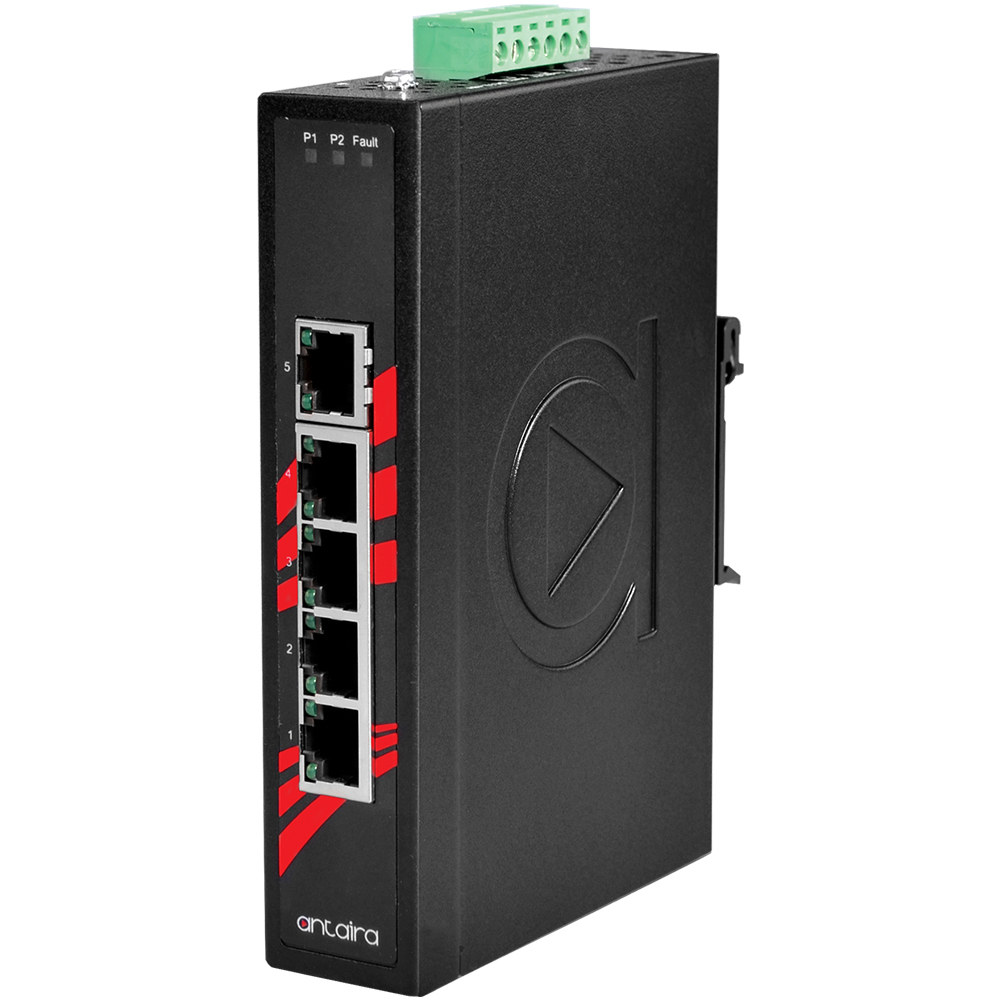
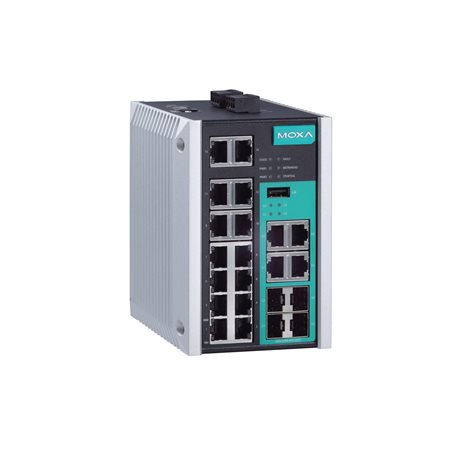
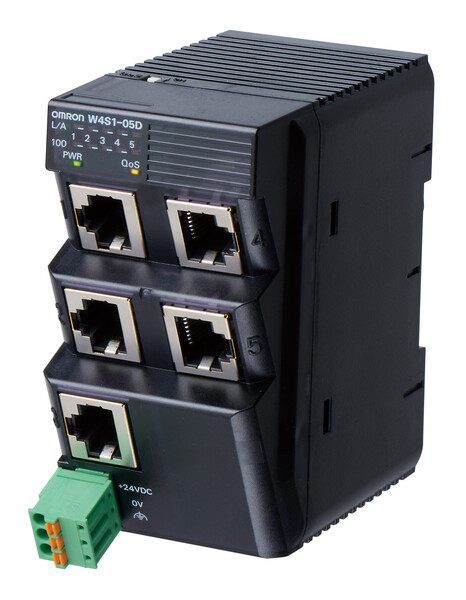
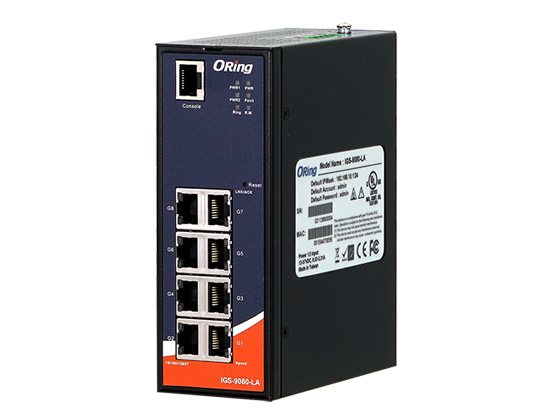
An industrial Ethernet switch is a hardened network device that forwards Ethernet frames between field devices, controllers, and the plant backbone while surviving the temperature, vibration, electrical noise, and continuous duty of a factory floor or substation. It performs the same MAC-address learning and frame switching as an office switch, but is packaged for DIN-rail or wall mounting, fed from a 12 to 48 VDC industrial supply, and tested to immunity standards that commercial equipment never meets.
The category splits along two axes that drive most of the buying decision: managed versus unmanaged, and the redundancy protocol the switch can run. Both determine whether a single cable break stops a production line or self-heals in milliseconds. This guide decodes the spec sheet so a procurement engineer can map a network requirement to a specific switch class, port count, and certification set.
This guide is written for industrial purchasing engineers and design engineers. It covers 6 chapters from definition and history, through managed versus unmanaged classification, ring redundancy protocols, port and PoE specifications, environmental and EMC ratings, to a structured selection decision, with 7 FAQs and verified manufacturer references. All parameters trace to public standards including IEEE 802.3, IEEE 802.1D and 802.1Q, IEC 62439-2 and 62439-3, IEC 61850-3, IEEE 1613, EN 50155, and IEC 61000-6-2.
Chapter 1 / 06
What is an Industrial Ethernet Switch
An industrial Ethernet switch is a Layer 2 (and optionally Layer 3) network device that receives Ethernet frames on one port and forwards them only to the port where the destination device lives, building and maintaining a MAC address table to do so. Functionally it is identical to a commercial switch. The difference is the operating envelope: an industrial switch is built to run continuously in cabinets that reach 60 degrees C, on machines that vibrate, near drives and contactors that inject electrical transients, and on a low-voltage DC supply rather than a 230 VAC mains adapter.
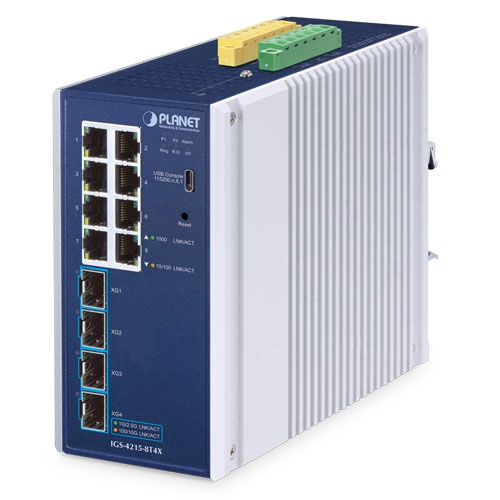
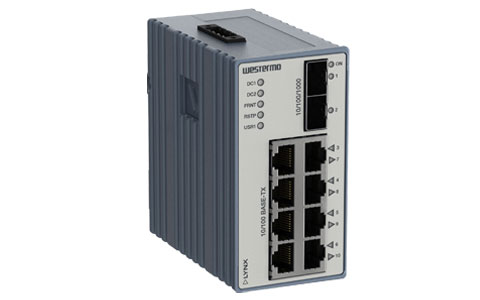
Three packaging and electrical traits separate an industrial switch from its office counterpart. First, mounting: a DIN-rail or panel-mount metal housing replaces the desktop or rack chassis, and there is no fan, because a fan is a moving part that fails. Heat is dissipated through the metal enclosure by convection. Second, power: input is typically 12, 24, or 48 VDC, often dual redundant so one supply failure does not drop the network, with a relay or digital output that signals a power fault. Third, immunity: the electronics are tested to the IEC 61000-4 series for electrostatic discharge, fast transients, surge, and radiated fields, at levels far above what a home or office switch tolerates.
The historical driver was the migration of factory networks from proprietary fieldbuses to Ethernet. Through the 1990s, control networks ran on PROFIBUS, Modbus, DeviceNet, and dozens of incompatible buses, each at low speed over shielded twisted pair. Around 2000, industrial Ethernet protocols such as PROFINET, EtherNet/IP, EtherCAT, and Modbus TCP standardized on the IEEE 802.3 physical layer while adding the real-time scheduling and redundancy that bare Ethernet lacked. That migration created demand for switches that spoke standard Ethernet but survived an industrial environment, and the industrial switch became a distinct product category.
The scale of deployment is large and growing. A single automotive body shop or a water-treatment plant can contain hundreds of switches, each anchoring a cell of PLCs, drives, robots, vision systems, and IO. As plants converge IT and OT networks under Industry 4.0, the switch is no longer a passive cable concentrator: it enforces VLAN segmentation, prioritizes control traffic over video, provides cybersecurity boundaries, and reports its own health to the maintenance system. Selecting the wrong switch class therefore affects availability, determinism, and security, not just connectivity.
Four engineering attributes determine an industrial switch's fitness for a given network: management level (does it need VLANs, QoS, and diagnostics), redundancy capability (how fast a fault heals), environmental rating (temperature, ingress, and EMC class), and port profile (count, speed, media, and PoE). The chapters that follow take each in turn, because, as with most field instruments, no single switch is optimal for every application, and the essence of selection is matching the network requirement to the right class.
Chapter 2 / 06
Managed, Unmanaged, and Layer Classification
The first fork in selection is whether the switch is managed or unmanaged, and if managed, whether it operates at Layer 2 or Layer 3. This single decision sets the feature ceiling and roughly the price tier. Unmanaged switches are plug-and-play with no configuration, no VLANs, no QoS, and no ring redundancy. Managed switches add a configuration interface and the full set of traffic-control and diagnostic features. The table below summarizes the practical differences.
Class
Configuration
VLAN / QoS
Ring Redundancy
Typical Use
Unmanaged
None (plug and play)
No
No
Small isolated machine cells
Managed Layer 2
Web / CLI / SNMP
Yes (802.1Q / 802.1p)
Yes (RSTP, MRP, vendor ring)
Plant networks, PLC and SCADA
Managed Layer 3
Web / CLI / SNMP
Yes + IP routing
Yes
Routing between subnets, large backbones
Lightly managed
Limited web UI
Basic VLAN / QoS
Limited or none
Cost-sensitive small networks
Unmanaged switches learn MAC addresses and forward frames automatically with no user-configurable options. They are transparent to the network, require no commissioning, and cost the least. The trade-off is that they offer no VLAN segmentation, no traffic prioritization, no port mirroring for diagnostics, and crucially no ring redundancy, so they cannot participate in a self-healing topology. They suit a small, self-contained cell of a handful of devices where a brief outage is tolerable and the network never needs to be partitioned or diagnosed remotely.
Managed Layer 2 switches are the workhorse of plant-wide industrial Ethernet. A management interface, reachable by web GUI, command-line, and SNMP, exposes 802.1Q tagged VLANs to isolate traffic, 802.1p and DSCP QoS to prioritize control frames over video or file transfers, IGMP snooping to contain multicast flooding (important for EtherNet/IP producer-consumer traffic), link aggregation, port mirroring, and the redundancy protocols covered in Chapter 3. These are standard whenever a network connects multiple PLCs, drives, HMIs, and a SCADA or DCS layer.
Managed Layer 3 switches add IP routing on top of Layer 2 switching, forwarding between subnets in hardware. They appear at the boundary between cell networks and the plant backbone, or where the network is large enough that broadcast domains must be split into routed segments. Static routes cover most industrial cases; some models add dynamic routing such as OSPF. Layer 3 capability raises cost and commissioning effort, so it is specified only when routing is genuinely required rather than reflexively.
One more distinction matters for latency-sensitive networks: forwarding mode. Store-and-forward switches buffer the whole frame, check its CRC, then forward it, dropping corrupted frames at the cost of slightly higher latency. Cut-through switches start forwarding as soon as the destination address is read, minimizing and stabilizing latency but passing errored frames along. Most managed industrial switches use store-and-forward because frame integrity matters more than microseconds in process control; cut-through is reserved for motion control and other strictly deterministic duties.
Chapter 3 / 06
Ring Redundancy Protocols
In an industrial network, a single cable break or switch failure must not stop production, so redundancy is engineered into the topology. The dominant pattern is the ring: switches are wired in a closed loop, one logical link is held open to prevent a broadcast storm, and when a fault is detected the standby link activates to restore connectivity. What differentiates the protocols is recovery time, the worst-case window during which traffic is lost. The table below compares the mainstream options.
RSTP (Rapid Spanning Tree Protocol), defined in IEEE 802.1D-2004, is the open standard that prevents loops in any mesh or ring of standard switches by negotiating a loop-free tree and re-converging after a failure. It is universal and interoperable across vendors, but convergence is non-deterministic, typically 1 to 2 seconds, because every switch must reconverge hop by hop; careful tuning can reach roughly 100 ms. RSTP is adequate for IT-grade availability but too slow for fast control loops.
MRP (Media Redundancy Protocol), standardized as IEC 62439-2 and the redundancy backbone of PROFINET, is the direct evolution of Hirschmann's 1990s HiPER-Ring. Because one switch acts as the Media Redundancy Manager that owns the ring and the others only need to detect link state, MRP gives a deterministic worst-case recovery of 500 ms, 200 ms, 30 ms, or 10 ms depending on configured ring size, with typical times under 80 ms. ERPS (Ethernet Ring Protection Switching), ITU-T G.8032, is the carrier-grade equivalent offering deterministic sub-50 ms recovery, and is widely implemented by Cisco, Hirschmann, Belden, and Moxa for utility rings.
Vendor ring protocols predate and parallel the open standards because early industrial users needed sub-second recovery before MRP and ERPS existed. Moxa Turbo Ring and Turbo Chain recover in under 20 ms on Fast Ethernet and under 50 ms on Gigabit, supporting rings of up to 250 nodes; Cisco REP, ORing O-Ring and O-Chain, and others sit in the 20 to 40 ms band. They are fast and proven but lock the ring to one vendor's switches, so they are best where a single supplier furnishes the whole network.
DLR (Device Level Ring) is unique because it lives in the EtherNet/IP end devices themselves, such as Allen-Bradley drives and IO blocks, rather than in external switches, and needs only a ring supervisor to coordinate. It recovers in under 3 ms for rings up to about 50 devices. PRP and HSR (IEC 62439-3) go further still: instead of healing a topology, they duplicate every frame across two independent networks (PRP) or both directions of a ring (HSR), so a single failure causes zero recovery time and zero lost frames. PRP and HSR are the choice for the most critical substation and process duties, at the cost of doubled cabling or specialized redundancy boxes.
Chapter 4 / 06
Ports, PoE, and Physical Media
The port profile is the most visible part of a switch specification: how many ports, at what speed, over which physical medium, and whether they deliver Power over Ethernet. Industrial switches mix copper and fiber ports, often with modular SFP (Small Form-factor Pluggable) cages so the same chassis can take copper, multimode, or single-mode fiber transceivers. The choice between copper and fiber turns on distance and electrical environment, and PoE turns on whether end devices should draw power from the data cable.
Copper ports use RJ45 in clean cabinets or rugged M12 connectors (X-coded for Gigabit, D-coded for Fast Ethernet) where vibration and washdown demand a screw-locked, sealed mate. Copper Ethernet is limited to 100 m per segment per IEEE 802.3 and conducts ground potential differences and electrical noise, which is why drives and welding cells often isolate cells with fiber. Fiber ports, via SFP transceivers, carry traffic over multimode fiber for a few hundred meters or single-mode fiber for tens of kilometers, immune to electromagnetic interference and ground loops, making them the default for inter-building links and EMC-heavy areas.
Power over Ethernet lets a switch power downstream devices, IP cameras, wireless access points, VoIP phones, IO-Link masters, over the same cable that carries their data, eliminating a separate power run. Three IEEE standards define the power levels. The table below lists the source and device power for each, which is the figure that sets how many powered devices a given switch budget can feed.
PoE Standard
Common Name
Power at Source
Power at Device
IEEE 802.3af
PoE
15.4 W
12.95 W
IEEE 802.3at
PoE+
30 W
25.5 W
IEEE 802.3bt Type 3
PoE++ / 4PPoE
60 W
51 W
IEEE 802.3bt Type 4
PoE++ / 4PPoE
90 W
71.3 W
When specifying PoE, the trap is the total power budget, not the per-port rating. A switch advertised as 8-port PoE+ at 30 W per port rarely sources 240 W; its budget might be 120 to 180 W, enough to fully power only half the ports. Always sum the actual loads of the connected devices, add margin, and confirm the input supply can feed that budget, including at the upper end of the rated temperature range where some units derate. Industrial PoE switches commonly accept a wide 48 to 57 VDC input precisely to meet 802.3bt voltage requirements.
Switching capacity and forwarding rate quantify whether the backplane can move traffic without dropping frames. Switching capacity (in Gbit/s) should at least equal twice the sum of all port speeds (full duplex), and the packet-forwarding rate (in million packets per second, Mpps) should support all ports at line rate with minimum-size frames. A non-blocking switch satisfies both; an oversubscribed switch can drop frames under peak load, which surfaces as intermittent control faults that are hard to diagnose. For a full-Gigabit 16-port switch, non-blocking implies roughly 32 Gbit/s capacity and about 23.8 Mpps.
Chapter 5 / 06
Key Specification Parameters
Beyond ports and protocols, the rest of the spec sheet describes how the switch survives its environment and how it is powered and certified. The same switch family may list 30 or more parameters, but eight drive most selection decisions: operating temperature, input voltage and redundancy, ingress protection, EMC and environmental certification, MTBF, latency, security features, and management interface. Each is explained below.
Operating temperature is the single most quoted hardening metric. Standard industrial models run -10 to +60 degrees C; extended-temperature ("T" suffix) models run -40 to +75 degrees C or wider, achieved with conformally coated boards and industrial-grade components. IEC 61850-3 defines a normal range around -10 to +55 degrees C with extended ranges by agreement, while EN 50155 rolling-stock and many extended models reach -40 to +70 degrees C. Specify the cabinet's worst-case internal temperature, not the ambient room temperature, because a sealed enclosure near a motor runs far hotter than the plant air.
Input voltage and power redundancy matter because the switch shares the cabinet's control supply. Most accept 12, 24, or 48 VDC, frequently over a wide range such as 9.6 to 60 VDC, with dual redundant power inputs so one feed can fail without dropping the network. A power-fault relay or digital output lets the PLC or SCADA detect a failed supply before the second one quits. Ingress protection follows IEC 60529: cabinet switches are typically IP30 or IP40, while field-mounted units on machines or outdoors are IP65, IP67, or higher, usually with M12 connectors to maintain the seal.
EMC and environmental certification separates a true industrial switch from a relabeled office unit. Generic industrial immunity follows EN/IEC 61000-6-2, with the underlying tests in the IEC 61000-4 series: ESD (61000-4-2), radiated immunity (61000-4-3), fast transient burst (61000-4-4), and surge (61000-4-5). Application-specific hardening adds substation standards (IEC 61850-3 and IEEE 1613), railway standards (EN 50155, EN 50121), and mechanical robustness via shock (IEC 60068-2-27) and vibration (IEC 60068-2-6). Buy the certification your industry mandates rather than a vague "industrial grade" claim.
MTBF (Mean Time Between Failures), computed per Telcordia SR-332 or MIL-HDBK-217, expresses statistical reliability, often quoted in the hundreds of thousands of hours; higher is better and reflects component grade and thermal design. Latency matters for motion control: store-and-forward Gigabit switches add a few microseconds, which is negligible for most process loops but relevant when chaining many switches in a deterministic line. The table earlier in this guide already contrasted forwarding modes that drive this figure.
Cybersecurity and management features increasingly appear on the spec sheet as IT and OT networks converge. Look for secure management transport (HTTPS and SSH instead of HTTP and Telnet), SNMPv3, 802.1X port authentication, access control lists, and increasingly compliance with the IEC 62443 industrial security framework. The management interface itself, web GUI, CLI, SNMP, and often a vendor configuration tool, determines commissioning effort and how the switch integrates with the plant's monitoring system, so confirm it fits the team's existing toolchain.
Chapter 6 / 06
Selection Decision Factors
To convert the preceding chapters into a specific model, follow the decision sequence below. As with most field hardware, the costly mistakes come not from a single wrong number but from deciding port count before deciding management level, or buying redundancy the application never needed. These nine steps work as a fixed RFQ template.
Management level: Decide unmanaged, managed Layer 2, or managed Layer 3 first, because it sets the feature ceiling and price tier. Default to managed Layer 2 whenever the network spans more than one controller or needs VLANs, QoS, or diagnostics.
Redundancy requirement: Map the maximum tolerable outage to a protocol: RSTP for IT-grade seconds, MRP or ERPS for sub-200 ms deterministic rings, vendor rings for sub-20 ms, DLR for EtherNet/IP device rings, PRP or HSR for zero recovery time. Confirm every switch in the ring supports the same protocol.
Port count, speed, and media: Count end devices, add 20 to 30 percent spare ports, reserve two for ring or uplink. Use copper RJ45 or M12 under 100 m and fiber SFP uplinks for distance, isolation, or EMC-heavy areas. Decide Fast Ethernet versus full Gigabit per device need.
PoE budget: If powering cameras, access points, or IO-Link masters, choose 802.3af, at, or bt by device draw, then size the switch's total power budget to the sum of loads plus margin, verified at the top of the temperature range.
Environmental rating: Specify the cabinet's worst-case internal temperature (not room ambient), the ingress protection the mounting demands (IP30 cabinet versus IP67 field), and the shock and vibration class for the machine or vehicle.
Certifications: Specify the standard your industry mandates: IEC 61850-3 and IEEE 1613 for substations, EN 50155 and EN 50121 for rail, generic EN/IEC 61000-6-2 for factories, plus protocol certification (PROFINET via PI, EtherNet/IP via ODVA) where the controller needs switch diagnostics.
Power supply and redundancy: Match input voltage to the cabinet supply (commonly 24 VDC), require dual redundant inputs and a power-fault relay for critical loops, and confirm the supply can feed any PoE budget.
Cybersecurity: For IT/OT converged networks, require HTTPS and SSH management, SNMPv3, 802.1X, ACLs, and ideally IEC 62443 conformance. Disable unused services and default credentials at commissioning.
Total cost of ownership (TCO): Purchase price plus commissioning, spares, and the downtime cost of a slow or failed recovery. An unmanaged switch that saves money upfront but cannot self-heal can cost a single shift of lost production that dwarfs the difference.
One last dimension is commonly overlooked: manufacturer serviceability and ecosystem, meaning local stock for fast replacement, configuration-file portability across firmware versions, long-term firmware and security-patch support, and a configuration tool the maintenance team already knows. These look irrelevant at purchase but decide repair response time years into a line's life. Moxa, Hirschmann (Belden), Siemens, Phoenix Contact, Cisco, Westermo, Weidmuller, WAGO, and Advantech maintain mature support channels, while suppliers such as 3onedata and ORing offer IEC 61850-3 and EN 50155 hardened models at lower cost for less critical loops.
FAQ
What is the difference between a managed and an unmanaged industrial switch?
An unmanaged switch is plug-and-play: it learns MAC addresses and forwards frames automatically with no user-configurable options, no VLANs, no QoS, and no ring redundancy. A managed switch adds a configuration interface (web GUI, CLI, and SNMP) plus 802.1Q VLANs, 802.1p and DSCP QoS, IGMP snooping, port mirroring, and ring redundancy protocols such as RSTP, MRP, or a vendor ring. Unmanaged units suit small isolated cells of a few devices; managed units are standard whenever the network spans multiple PLCs, drives, and a SCADA or DCS layer that needs traffic prioritization and diagnostics.
How fast does ring redundancy recover after a cable break?
Recovery time depends on the protocol. Standard RSTP (IEEE 802.1D-2004) typically converges in 1 to 2 seconds, though tuned rings can reach about 100 ms. MRP (IEC 62439-2) guarantees a deterministic worst case of 500 ms, 200 ms, 30 ms, or 10 ms depending on ring size, with typical times under 80 ms. ERPS (ITU-T G.8032) delivers sub-50 ms. Vendor rings such as Moxa Turbo Ring recover in under 20 ms on Fast Ethernet and under 50 ms on Gigabit. For zero recovery time and zero lost frames, PRP and HSR (IEC 62439-3) duplicate every frame instead of healing a topology.
What do EN 50155, IEC 61850-3, and IEEE 1613 mean for a switch?
These are application-specific hardening standards. EN 50155 (current edition EN 50155:2021) covers electronic equipment on rolling stock, including shock, vibration, supply interruptions, and a typical -40 to +70 degrees C range, and works alongside the railway EMC standard EN 50121 and the fire-protection standard EN 45545. IEC 61850-3 defines environmental and EMC requirements for communication equipment inside electrical substations, and IEEE 1613 is the North American substation equivalent covering ratings, environmental performance, and testing. A switch certified to IEC 61850-3 and IEEE 1613 tolerates the strong electromagnetic transients of high-voltage switching. Specify the standard your industry mandates, not just a generic industrial label.
When do I need PoE, and which standard should I choose?
Use Power over Ethernet when end devices such as IP cameras, wireless access points, VoIP phones, or IO-Link masters should draw power from the data cable instead of a separate supply. IEEE 802.3af (PoE) delivers up to 15.4 W at the source and 12.95 W at the device. IEEE 802.3at (PoE+) delivers 30 W at the source and 25.5 W at the device. IEEE 802.3bt (PoE++, Type 3 and Type 4) reaches up to 90 W at the source and about 71 W at the device. Size the switch power budget to the sum of connected loads plus margin, and confirm the input supply can feed that budget across the rated temperature range.
What is the difference between store-and-forward and cut-through switching?
Store-and-forward buffers the entire frame, verifies its CRC checksum, then forwards it, so corrupted frames are dropped at the cost of slightly higher latency. Cut-through begins forwarding as soon as the destination MAC address is read, giving lower and more deterministic latency but passing along errored frames. Most managed industrial switches use store-and-forward because data integrity outweighs microseconds of latency in process control. Cut-through and special low-latency modes appear in motion-control and high-frequency-trading switches where every microsecond of deterministic delay matters.
How do I size port count, speed, and uplinks?
Count the end devices in the cell, add 20 to 30 percent spare ports for future expansion, and keep at least two ports free for ring or uplink connections. Use copper RJ45 or M12 for runs under 100 m and fiber SFP uplinks for longer distances, electrical isolation, or EMC-heavy environments. Mixed networks commonly run Fast Ethernet (100 Mbit/s) to field devices and Gigabit uplinks to the backbone, while new installations increasingly standardize on full Gigabit. Verify the switching capacity and packet-forwarding rate exceed the aggregate of all ports running at line rate simultaneously.
Do I need a switch that explicitly supports PROFINET or EtherNet/IP?
For non-deterministic traffic any compliant Ethernet switch works, but real-time industrial protocols benefit from protocol-aware switches. PROFINET RT and IRT need switches with proper VLAN and priority handling, and IRT requires hardware time synchronization. EtherNet/IP with Device Level Ring (DLR) needs DLR-capable nodes and a ring supervisor, recovering in under 3 ms for rings up to 50 devices. A certified switch carries a GSDML or EDS file, exposes the protocol diagnostics to the engineering tool, and is listed by PROFIBUS and PROFINET International or ODVA. Generic switches still carry the frames but stay invisible to the controller diagnostics.
Industrial Ethernet Switch Manufacturers
Source-backed product routes. Open a company dossier for procurement scope and cited evidence.
Westermo Network Technologies AB documents Westermo MCW-211-MM-SC2 industrial Ethernet media converter as an industrial fiber media converter offering.
Published product fact
Westermo MCW-211-MM-SC2 industrial Ethernet media converter