Tower cranes span 5 to 100 tonnes of lifting capacity, 40 to 80 m of jib length, and up to 250 m+ of hook height, with hoist speeds between 36 and 100 m/min across the four main types [S3].
Working range collapses to roughly 18 tonnes at 70 m reach for a typical high-rise unit, so the crane must be matched to both the heaviest lift and the longest radius the project demands, not to a single headline number [S2][S5].
Four Crane Types and Where Each Spec Wins
Hammerhead, flat top, luffing jib, and self-erecting are the four structural families, and each trades a different combination of headroom, jib reach, and capacity [S2]. A hammerhead (saddle jib) uses a fixed horizontal jib with a trolley and tower-top pendant lines, suiting open sites with high lifting demand; a flat top removes the tower-top cap and pendants for a lower head profile that lets several cranes share airspace on congested jobs; a luffing jib raises and lowers its arm to shorten the working radius, which is why it is the standard pick for tight urban cores where oversail must be controlled; a self-erecting unit hydraulically unfolds its own mast and jib and trades raw capacity for setup speed on short residential or low-rise work [S2][S3].
The four-way comparison on three decision criteria is clearest in this block: hammerhead gives the highest reach and capacity per dollar but needs airspace, flat top gives the simplest multi-crane airspace, luffing gives the smallest swing radius in dense cities, and self-erecting gives the fastest mobilization at the lowest capacity class [S2][S3].
Jib Length, Radius, and the Capacity Chart Trade-off
Jib length on production tower cranes runs 40 to 80 m, and capacity at the tip collapses sharply with radius, so the same machine might lift 20 t at 20 m radius and only 2 t at 60 m radius on its published chart [S3][S4]. Designers balance three load-chart limits: structural capacity (mast and jib stresses), stability capacity (slewing ring overturning moment), and mechanical capacity (hoist or trolley motor torque), and ISO 4301-3:2021 provides the load-spectrum classification that lets engineers pick slew bearings, hoist winches, and wire-rope diameters sized for decades of cyclic duty [S4]. Counterweight is the lever that shifts the curve: counter-jib ballast, trolley travel, and jib geometry are tuned together so the resulting envelope fits the project's heaviest pick at its worst radius [S4].
A typical reference unit lists 70 m maximum reach, 80 m maximum unsupported height, 18 t maximum lift, and 16.3 t of counterweight, with the 18 t figure only available close to the mast and falling to a much lower value at the jib tip [S5]. For a foundation anchor on a high-rise slab, the crane also climbs by adding mast sections and tying into the building frame, which lets hook height extend well past the 80 m free-standing limit once wall ties engage [S1][S5].
Height Limits: Free-Standing vs Tied to the Structure
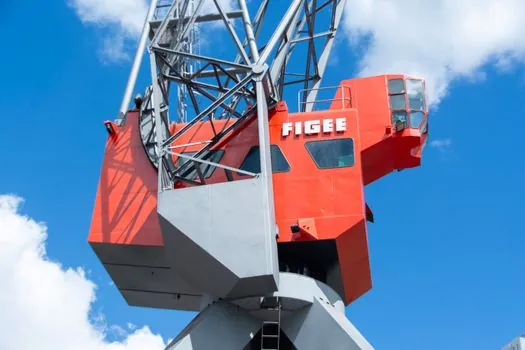
Free-standing tower height is capped at roughly 80 m on most models, and above that the crane must be tied into the building structure or climbed, which is the standard practice on towers and tall industrial builds [S5][S6]. Hook height on modern high-rise units exceeds 250 m when the crane is properly tied and climbed with the structure, with the upper end driven by hoist rope drum capacity, reeving, and the structural tie spacing the engineer specifies [S3].
The driving limit at the top is not the mast steel but wind: ASME B30.3 requires the structure to withstand design gusts in operation and a free-rotation "out-of-service" condition up to about 20 m/s (45 mph) before shutdown, which is why anemometer interlocks and beacon lights are mandatory above the operator's cab on most jurisdictions [S4]. For practical spec work, that means any tower over 80 m free-standing, or any crane sited where neighbouring structures create wind funnel effects, should be reviewed against the wind class in the manufacturer's chart before the radius envelope is finalized [S4][S6].
Selection Criteria: Height, Load, Site, and Budget
Step one is to lock the heaviest pick and the longest reach, not the headline capacity: a slab pour at 15+ floors points to a flat top or hammerhead, a tight-access rooftop points to a luffing jib, and any single lift above 50 t on a hammerhead typically forces an extended-jib configuration [S3]. Step two is site geometry: in urban congestion, flat top or luffing jib keeps the swing radius inside the property line, and overlapping crane airspaces are deconflicted by choosing flat tops so jibs do not clash at height [S3]. Foundation limits push the spec toward internal or climbing-type units that take load through the building's core rather than a large ground pad [S3].
Step three is duration economics: projects under one year are normally rented, while multi-year high-rise portfolios usually justify purchase, and on either path, the non-negotiable spec items are LMI / SLI / ACD load monitoring, anti-collision zoning for multi-crane sites, redundant e-stops on hoist, trolley, and slew, and an anemometer tied into the shutdown logic [S3][S4]. For broader context on how spec discipline pays off on industrial sites, see PID loop audit findings: oscillation sources and retuning priorities and Control Cabinet Cooling: Heat Load Calculation and Sizing Rules, both of which reward the same front-loaded data approach that a good crane spec requires.
Hoist, Slew, and Drive Specs That Move the Spec Sheet
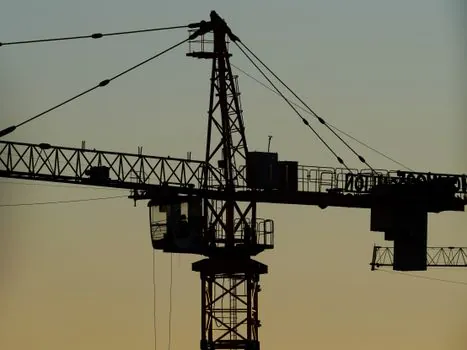
Hoist speed on production units runs 36 to 100 m/min, which is the single biggest driver of cycle time on a rebar or formwork-heavy slab [S3]. Rotary-platform machines typically lift up to 25 t, and fixed-tower heavy models can lift up to 75 t, so the structural configuration, not just the chart number, decides which class the spec falls into [S7]. Critical fasteners are usually 10.9 or 12.9 alloy bolts with traceable certificates, pins and slew bearings are induction-hardened for wear, and mast sections are hot-dip galvanized or epoxy-coated high-strength steel to survive decades of cyclic loading in outdoor service [S4].
For urban projects where multiple cranes share airspace, spec the anti-collision zoning and SLI / ACD load-monitoring interfaces up front, since retrofitting them after erection is far more expensive than buying the option at order [S3]. Reference design ranges worth carrying into a spec: 5 to 100 t capacity envelope, 40 to 80 m jib length, up to 250 m+ hook height with tying, 36 to 100 m/min hoist speed, 20 m/s (45 mph) wind class per ASME B30.3, and a 60-month major inspection interval that may include slew-ring NDT [S3][S4].
Failure Modes and Limits You Plan Around
Overload at radius is the headline failure: the chart limit exists because the slewing ring moment, not the hoist motor, is usually the binding constraint at long radius, so a pick that looks fine on capacity becomes a tipover risk if radius is misread by the operator [S4][S5]. Wind is the second headline: out-of-service wind with the jib free to weathervane is the worst loading on the slewing ring and anchorage, and 20 m/s (45 mph) is the standard design trigger for shutdown per ASME B30.3 [S4]. Foundation settlement is the silent third: a poorly cured or undersized pad lets the mast rack, which over many cycles cracks the slewing ring race and shows up as a slew bearing replacement well before the structural steel is fatigued.
Erection and climbing are the fourth risk window, and the design must allow a self-climbing frame to jack new mast sections through the turntable without dismantling the jib, so street closure time on urban sites stays inside the permit window [S4]. Finally, operator visibility and signal discipline at radius beyond 60 m become a planning input, not a procedural one, which is why spec sheets now routinely call for tower crane cabs with video aids and load-moment lockouts wired to the checking and testing apparatus on the LMI chain [S1][S4].
Standards, Inspection, and Sourcing Discipline

Two standards govern the spec sheet: ISO 4301-3:2021 for load-spectrum and duty classification, and ASME B30.3 for safety requirements including the 60-month major inspection cycle, which may include dismantling slew rings and running NDT on critical welds [S4]. Sourcing discipline is the same as the rest of the spec: lock the load chart against the project's heaviest pick at its worst radius, lock the wind class against the site's exposure, lock the tie-in pattern against the structural engineer's slab cycle, and require documented MTRs for mast sections and 10.9 / 12.9 bolt certificates before the crane is released for production lifts [S4].
Two trackable signals to watch for on the next spec cycle: manufacturer publication of extended wind-class charts for luffing jibs above 200 m hook height, and broader adoption of ACD (Anti-Collision Detection) zoning on mid-range flat top units, both of which will shift the cost-per-tonne curve on dense urban high-rise work over the next procurement cycle [S2][S3][S4].
For component-level specifications, see height gauge.