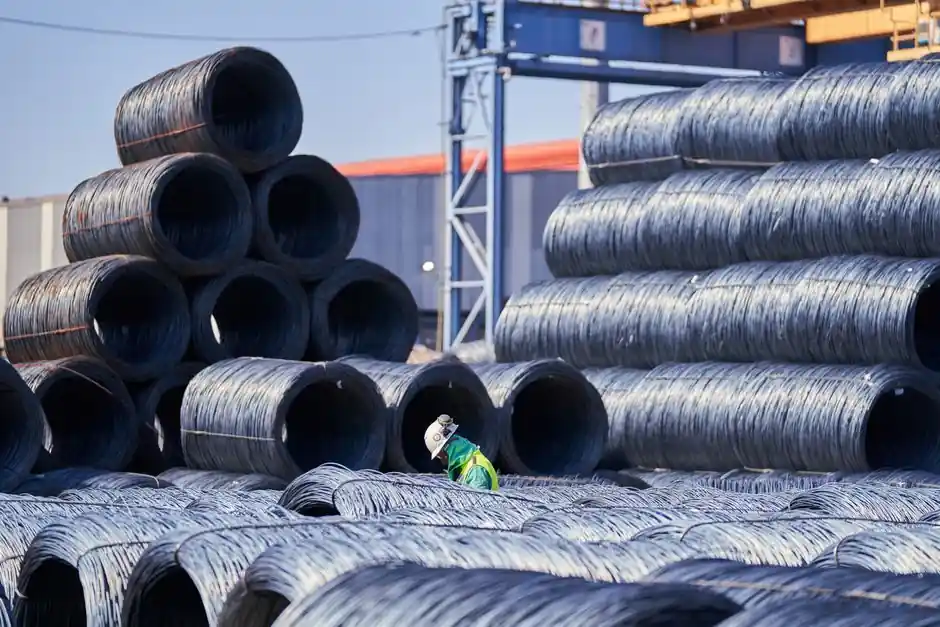
The headline difference between the two strand sizes used in pretensioned and post-tensioned concrete is small in diameter but meaningful in steel area: a 15.2 mm (0.6 in) seven-wire strand has a nominal cross-section of 140 mm² and a Grade 270 minimum breaking strength of 58,600 lbf (26,581 kgf, ~260.7 kN) per ASTM A416, while a 15.7 mm (0.62 in) compacted strand carries about 150 mm² at the same 1860 MPa grade, lifting the minimum breaking load by roughly 7% to ~279 kN [S4][S6].
For most bridge, building, and heavy precast applications the 15.2 mm strand remains the global default, with 15.7 mm treated as a higher-capacity variant for post-tensioning tendons and for replacing legacy 1/2 in (12.7 mm) layouts strand-for-strand at lower count [S1][S3]. Specifying engineers should treat the two as different sections, not interchangeable sizes, and pin the choice to a standard rather than a supplier catalog line.
Cross-Sectional Area and Weight per Meter
The 15.2 mm strand is defined in ASTM A416 with a nominal area of 0.217 in², equal to 140.00 mm², and a nominal mass of 1.102 kg/m (740 lb per 1000 ft) [S4]. This is the same value carried in manufacturer data sheets for the 1×7 SWRH82B product: 1.101 kg/m at 15.24 mm nominal diameter, low-relaxation, with tensile strength rated 1860 to 2000 MPa [S3].
The 15.7 mm (0.62 in) compacted strand does not appear as a discrete ASTM A416 row, but is documented at 150 mm² nominal area with a characteristic tensile strength of 1860 MPa, the format used for post-tensioning tendons where a fatter, denser cross-section is preferred for anchorage bearing and duct fill [S6]. Mass scales roughly with area: 1.181 kg/m versus 1.102 kg/m, a ~7% increase that the design must absorb in self-weight and tendon profile.
Minimum Breaking Strength and Working Force
At Grade 270, 15.2 mm strand delivers 58,600 lbf (26,581 kgf) minimum breaking strength and 52,740 lbf (23,922 kgf) minimum yield at 1% extension, equivalent to roughly 260.7 kN ultimate and 234.6 kN yield in SI units [S4]. The 15.7 mm compacted strand, computed at the same 1860 MPa characteristic on a 150 mm² section, lands near 279 kN ultimate, with jacking force proportionally higher if the 70% initial-load rule is preserved [S6].
Relaxation is governed identically for both: initial load must not exceed 70% of the guaranteed ultimate tensile strength (G.U.T.S.), and relaxation at 1000 hours must stay below 2.5% at the 70% level (3.5% at 80%) per the low-relaxation table in ASTM A416 [S4]. Elongation at a 24 in gauge must be at least 3.5% for both diameters, so ductility demand on the supplier is the same even as the steel cross-section grows [S4].
Standards Bodies and Diameter Conventions
ASTM A416 standardizes the 0.6 in (15.2 mm) row inside a 1×7 seven-wire low-relaxation table, alongside 9.5 mm, 11.1 mm, 12.7 mm, 13.2 mm, and 14.3 mm; 15.7 mm is not its own line, but is the customary US post-tensioning size covered by ASTM A416/A416M companion provisions for compacted strand [S4]. Chinese GB/T 5224 lists 15.2 mm and 15.7 mm as distinct nominal sizes in a 1×7 family that also includes 9.5, 11.1, 12.7, 17.8, and 21.6 mm, the same diameter set echoed by JIS G3536 and BS5896 [S3].
Grade convention is also stable: Grade 270 ksi (1860 MPa) is the industry default in ACI 318-14 and AASHTO LRFD, with Grade 300 ksi (2070 MPa) reserved for higher-strength pretensioned applications whose transfer and development lengths are not yet fully validated by the empirical equations in those codes [S5]. For most specifiers the 15.2 mm strand is therefore the safe path of least resistance, and 15.7 mm is taken only when post-tensioning hardware, duct fill, or strand-count reduction forces the issue.
Selection Criteria: When 15.2 mm Beats 15.7 mm, and Vice Versa
Use 15.2 mm when the design follows ACI 318-14 / AASHTO LRFD with Grade 270 strand, when the project standard (GB/T 5224, JIS G3536, BS5896) lists it as a stocked size, or when transfer-length and development-length formulas have to be applied without modification; the empirical equations in those codes were calibrated on 15.2 mm-class strand, and switching to a larger diameter changes the db term in the transfer and development length equations [S5].
Use 15.7 mm when the tendon is post-tensioned with multistrand anchors sized for 0.62 in button heads, when the design needs about 7% more jacking force per strand without adding a strand to the duct, or when compacting a legacy 1/2 in (12.7 mm) layout into a single tendon at lower count [S6]. The trade-off is real: every additional square millimeter of steel brings a matching demand on duct diameter, anchor bearing plate, concrete burst reinforcement, and tendon profile radius, so the specifier should not switch diameters for a marginal prestress gain.
Three quick checks before locking the size: confirm the supplier's mill cert lists the diameter as 15.24 mm (0.6 in) or 15.7 mm (0.62 in) explicitly, with the matching nominal area in mm² and a relaxation class statement; confirm the post-tensioning anchor is rated for the chosen size (most PT anchors are dual-rated 15.2/15.7 but not all); and confirm the design software's transfer and development length is run with the db value that matches the strand actually shipped, not a generic 0.5 in or 0.6 in placeholder [S4][S5].
Common Pitfalls and Failure Modes
Substituting 15.7 mm for 15.2 mm in an ACI 318 transfer-length check without rerunning the equation is a frequent spec error: the larger db increases the calculated transfer and development length proportionally, and anchorage zone reinforcement that worked for 15.2 mm may be marginal at 15.7 mm [S5].
Another pitfall is mixing diameter and grade in the same tendon. A 15.2 mm Grade 270 strand and a 15.7 mm Grade 1860 compacted strand can both be labelled "1860 MPa" on paper, but their guaranteed breaking loads differ by roughly 18 kN per strand, so force calculations that assume a single ultimate value will be wrong on at least one row of the stressing record. The fix is the same as for any prestressing strand order: pin diameter in mm, area in mm², and grade in MPa in the purchase specification, then verify the mill cert against all three before stressing.
Finally, do not equate low-relaxation with zero relaxation. The 2.5% loss at 1000 h is a guarantee, not a measurement, and the working value typically used in long-term loss calculations sits above 2.5% once temperature, concrete creep, and anchorage set are folded in. The 15.7 mm strand does not improve relaxation behavior; it only lifts the absolute force level that gets relaxed.
Specification Language to Write Into the Purchase Order
For ASTM A416 work: "1×7 low-relaxation prestressing strand per ASTM A416/A416M, Grade 270 (1860 MPa), nominal diameter 15.2 mm (0.6 in), nominal area 140 mm², minimum breaking strength 260.7 kN, minimum yield at 1% extension 234.6 kN, minimum elongation 3.5% in 24 in, relaxation ≤2.5% at 1000 h and 70% G.U.T.S." [S4].
For post-tensioning work with compacted strand: "1×7 compacted low-relaxation prestressing strand, Grade 1860, nominal diameter 15.7 mm (0.62 in), nominal area 150 mm², minimum breaking strength 279 kN, relaxation class 2 per ASTM A416/A416M low-relaxation table" [S6]. Both lines should reference the matching steel strand data sheet so the supplier cannot quietly ship a different diameter under the same grade call-out.
Trackable signals worth watching: any ACI 318 / AASHTO LRFD revision that updates transfer and development length equations for diameters above 15.2 mm (the current equations are calibrated on 15.2 mm-class data) [S5], and any update to ASTM A416/A416M that adds an explicit 15.7 mm row to the Grade 270 table rather than leaving it as a post-tensioning convention. Either event would shift the practical recommendation above.
The underlying component specifications are covered under variable area flowmeter.
See also our earlier report, Servo Drive Spec Checklist: Current Rating and Encoder Feedback Type.