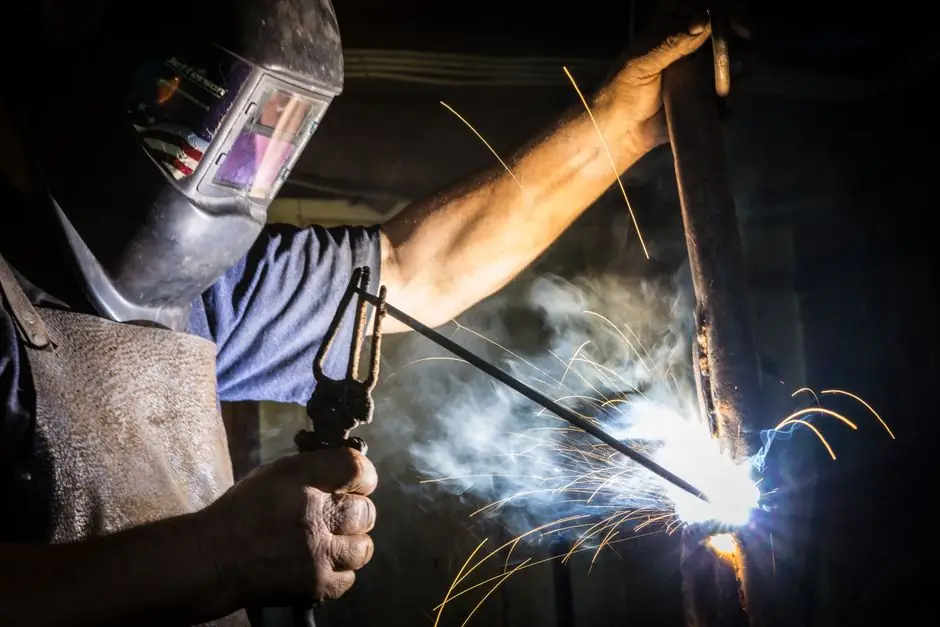
For DC electrode-negative welding on carbon steel, stainless, nickel and titanium above 150 A, AWS-classified 2% thoriated (EWTh-2, red tip) remains the workhorse: Diamond Ground's electrode guidebook attributes roughly 20% higher current-carrying capacity to thoriated over pure tungsten, a gain that comes from the thermionic emission of the thoria (ThO2) addition [S2]. For low-amp DC, AC and orbital tube welding, 2% ceriated (grey/orange) is the practical default, with a 1.8–2.2% cerium-oxide addition that drops the work function and sharpens arc-starting at lower currents [S5].
Composition is the easiest place to lock the two down. EWTh-2 is 97.30% tungsten with roughly 2% thorium, trace-balance impurities, color-coded red under the AWS A5.12 scheme [S3]. 2% ceriated sits at 97.3% tungsten minimum with 1.8–2.2% cerium per the same classification family [S5]. Both are non-consumable in the GTAW sense, but their oxide dopants behave very differently once the arc is struck.
Composition and AWS Classification
2% thoriated tungsten is AWS classification EWTh-2, drawn at 97.30% W with approximately 2% thorium oxide and a red identifier band; the rare EWTh-1 sits at roughly 1% ThO2 and is the red-coded variant's lean sibling [S3]. 2% ceriated carries a minimum 97.3% W with a 1.8–2.2% cerium range and is grey/orange-coded under the AWS A5.12M system, a tighter tolerance window that reflects cerium's stronger effect on the work function per percentage point added [S5].
The dopant chemistry is the whole reason these two exist. ThO2 and CeO2 both lower tungsten's effective work function so electrons leave the tip more easily at a given temperature, but thoria is a slow, high-temperature emitter while ceria is a fast, low-temperature emitter, which is why the practical current windows diverge so sharply. A red-band EWTh-2 will sit comfortably at 150–400 A DC-EN on a 3/32 in or 1/8 in diameter, while a 2% ceriated of the same diameter wants to live in the 20–130 A range, especially on orbital and micro-TIG work heads.
Current Range, Arc-Starting and Polarity Behavior
Thoriated's 20% current-capacity edge over pure tungsten is the single most-cited performance number, and it is what keeps EWTh-2 specified on heavy DC fabrication and plasma welding where the weld is run hot and fast [S2]. Bench-and-shop comparisons also credit thoriated with better arc-starting and arc stability on plasma applications, plus the ability in some cases to run travel speeds higher than pure W on equivalent amperage [S5].
Ceriated is the inverse story. It is favored for its superior arc-starting at low current, a property that becomes decisive in mechanized orbital tube welding and micro-TIG where the arc has to strike cleanly at 1–50 A without burning the tip. Morgani Tech explicitly recommends ceriated over thoriated for AMI and Magnatech weld heads at 110/220 V supplies, citing easier tip-shaping, longer electrode life inside the weld head, and cleaner arc behavior in a closed, inert envelope [S5]. Ceriated is also the more forgiving choice on AC aluminum work at low current, although 2% zirconiated remains the dedicated AC aluminum electrode in most spec sheets.
Weld Process and Material Fit
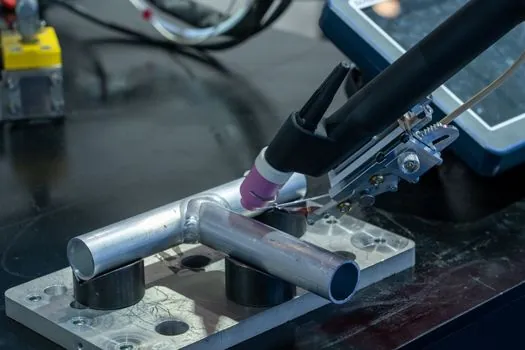
2% thoriated is the right call for DC-EN welding of carbon steel, stainless steel, nickel alloys and titanium in the typical fabrication current band, plus most plasma welding of those same materials where higher electron output and stable current-carrying matter more than low-amp arc-starting behavior [S5]. Diamond Ground's guidebook maps the same electrode to orbital pipe welds in the 125–300 A range for nuclear, pharmaceutical and chemical-processing X-ray work, where consistent arc voltage and a stable, repeatable tip geometry are mandatory [S2].
2% ceriated fits the opposite jobs: orbital tube welding, micro-TIG, low-amp DC on thin-wall stainless and instrumentation tubing, and AC work at modest current levels where the operator wants a soft, easy-to-start arc without running a radioactive oxide [S5]. When selecting a TIG welder for these low-amp orbital or thin-wall jobs, the electrode choice usually matters more than the power source brand, because the arc-stability window is set by the dopant chemistry and the tip grind, not the inverter topology.
Radioactivity, MSDS and Workshop Handling
Thoriated tungsten contains low levels of radioactivity from the thorium-232 decay chain, and the MSDS for any 2% ThO2 rod will call this out as a health risk if the electrode is ground, dropped or handled outside manufacturer guidance [S5]. Thorium-bearing dust from grinding tips, plus contamination of work surfaces and shared grinding wheels, is the actual shop-floor concern, not the unground rod sitting in a sealed package, and the contamination problem is the reason orbital-equipment vendors instruct their customers to switch to ceriated [S5].
Ceriated has no comparable radioactive-decay issue, which is why it is the safer default in pharmaceutical, semiconductor and food-grade stainless tube welding where any cross-contamination of the inside-bore surface is unacceptable. Grinder isolation, dedicated ceriated wheels and tip-dedication by alloy are still good practice, but the regulatory and PPE burden is materially lower than for thoriated, and many quality systems will not let a 2% ThO2 rod onto the shop floor at all.
Tip Preparation, Diameter and Re-Grind Cost

Both electrodes want a longitudinally ground, concentric tip on a fine, dedicated diamond wheel; radial runout and asymmetric grind marks are the dominant cause of arc wander in both chemistries [S2]. Thoriated holds a sharp point longer at high DC amperage because of its higher recrystallization and creep resistance, which is part of why heavy fabrication shops re-grind red-band rods less often than ceriated rods in a low-amp orbital cell [S2].
Ceriated is easier to shape and polish to a fine point, which is a real advantage in mechanized orbital heads where the tip geometry has to land inside a tight concentricity spec every cycle [S5]. Standard diameters are 1/16 in (1.6 mm), 3/32 in (2.4 mm) and 1/8 in (3.2 mm), with 1/16 in ceriated common on micro-TIG and 3/32 in or 1/8 in thoriated common on pipe and plate work; 7 in cut-to-length blanks are typical for manual torches, while orbital heads demand cut-to-length sticks matched to the head's collet [S2].
Decision Matrix: When to Pick Which
Use this four-criterion comparison when the call between red and orange/grey is not obvious on the print: current range, polarity/material, weld process, and shop safety/regulatory load. Thoriated wins on current range (roughly 20% above pure W, comfortable above 150 A DC-EN) and on plasma duty, while ceriated wins on low-amp arc-starting, AC capability and the absence of thorium-decay handling overhead [S2][S5].
Concrete selection rule for a process engineer: if the WPS is DC-EN on carbon/stainless/nickel/titanium above 150 A, or if the cell runs plasma welding, specify 2% thoriated (EWTh-2) and accept the MSDS/grinder-isolation overhead. If the WPS is orbital tube, micro-TIG, thin-wall stainless instrumentation, or any AC work where low-amp arc-starting and tip longevity inside a weld head matter more than raw current, specify 2% ceriated in the AWS 1.8–2.2% CeO2 window. Mixed shops that also need a pressure transmitter calibration weld or a sanitary flow meter body weld in the same cell should standardize on ceriated to keep one MSDS, one grinder, and one set of handling rules across the bay. For facilities that already run heavy plate fabrication, red-band EWTh-2 stays on the floor, and a dedicated ceriated inventory is added only for the orbital and micro-TIG cells.
Track two signals over the next planning cycle: vendor-published AWS A5.12M updates that may tighten the CeO2 tolerance band, and any shop-level push to phase thoriated out of food, pharma and semiconductor cells in favor of ceriated or 1.5% lanthanated. Standardizing on a single low-amp electrode per cell, rather than mixing red and orange rods in the same drawer, remains the cheapest way to remove electrode choice as a process variable on the WPS.
See also our earlier report, Thermocouple vs Bimetal vs Liquid-in-Glass: How the Three Sensors Actually Differ.