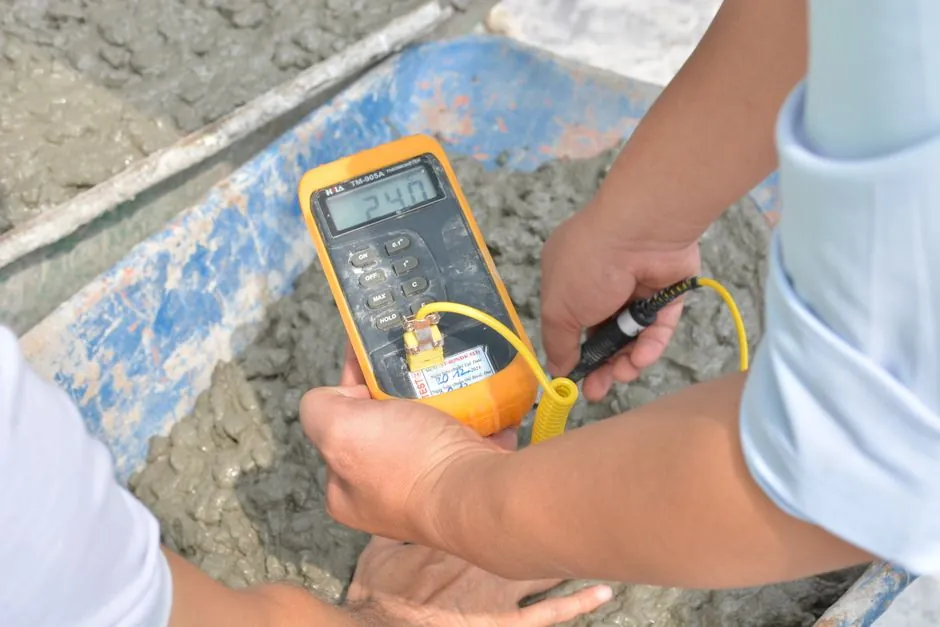
A thermocouple is not a rival species to a bimetallic dial or a liquid-in-glass thermometer, it is a different physical class of sensor: it generates a voltage from a thermal gradient instead of moving a needle or a fluid column, which is why the three rarely substitute for one another in a real panel.
The choice is usually driven by four numbers the spec sheet will not argue with: temperature range, required output (local indication vs 4-20 mA vs wireless), accuracy class, and environment. Industrial selection guides published through 2025 and 2026 keep coming back to the same ranking: thermocouples win on range and speed, bimetals win on ruggedness and zero-power local reading, liquid-in-glass wins on lab-grade simplicity and lowest cost [S7].
Sensing Principle: Thermoelectric Effect vs Differential Thermal Expansion
A thermocouple is built from two dissimilar conductors joined at the measuring (hot) junction; the open (cold) ends sit at a reference temperature, and the Seebeck effect produces a net emf proportional to the temperature difference, typically a few microvolts per degree Celsius [S1]. NIST calibrations on these devices cover -196 °C to 2100 °C, and the standard reference table for the eight common letter types (B, E, J, K, N, R, S, T) is held in ASTM E230 [S1].
A bimetallic sensor uses two strips of metal with different expansion coefficients, commonly brass paired with Invar, bonded together and formed into a coil or helix; the differential expansion converts temperature into a rotation that drives a pointer through a mechanical linkage [S2][S3]. A liquid-in-glass thermometer relies on the volumetric expansion of a confined fluid (historically mercury, now often an organic liquid or a safe alternative) inside a calibrated capillary, so temperature is read as column height against an etched or printed scale [S4]. In all three cases the underlying phenomenon is thermal expansion, but only the thermocouple converts that expansion into electricity; the other two convert it into a position.
Range, Resolution, and Output Signal
Thermocouples cover the widest span of any contact sensor, -270 °C to 1372 °C for type K and up to 1820 °C for type B, with the practical upper limit set by wire metallurgy rather than electronics [S1]. Resolution depends on the class: about 1 °C for base-metal types, 0.1 °C for noble-metal types, and 0.01 °C for pure-metal types, all limited by the small signal level of a few microvolts per degree [S1]. The output is a low-level millivolt (or microvolt) signal, so a thermocouple is always paired with cold-junction compensation and either a transmitter or a table lookup.
Bimetallic and liquid-in-glass thermometers give a direct visual readout on a dial or capillary and have no electrical output at all [S3][S4]. Typical industrial bimetallic dial ranges sit roughly between -50 °C and 500 °C depending on coil material and case fill, while mercury-in-glass units historically span about -38 °C to 357 °C and organic-liquid (often colored alcohol) fills push the lower end near -200 °C [S2][S4]. Accuracy for an industrial bimetallic dial is commonly in the ±1 % to ±2 % of full-scale band, and a well-made liquid-in-glass reference thermometer can resolve 0.01 °C to 0.1 °C because the column position itself is the readout [S3][S4].
Response Time, Stability, and Calibration Drift

Thermocouple response is dominated by the junction geometry, with bare-wire bead junctions reacting in well under a second in still air, while sheathed probes with thermowells stretch into 10-60 second time constants depending on sheath diameter and immersion depth. Their known weakness is drift: above roughly 500 °C, base-metal types such as K and J undergo chemical and physical changes (grain growth, oxidation, chromium migration) that shift the emf curve, so NIST flags recalibration for use above 200 °C in base-metal units as difficult [S1].
Liquid-in-glass thermometers have no electronics to drift, but the glass itself is the failure surface. Repeated thermal cycling can permanently change the bulb volume or capillary dimensions, which is exactly why a 2026 PatSnap comparison study treats long-term stability as the central trade-off between glass and thermocouple [S6]. Bimetallic coils fatigue mechanically over very high cycle counts, and the welded or brazed joint between the two strips can work-harden, which shows up as a slow accuracy loss rather than a step change. Practical guidance from NIST and Omega treats the bimetallic dial as a robust but uncalibrated-after-impact device that should be bench-checked against a reference if it is dropped [S1][S3].
Comparison: Three Sensors Against Six Decision Criteria
The cleanest way to choose is to score the three on the same axes. A useful baseline table for a specifier looks like this (numbers grounded in [S1] and [S3] for the thermocouple, [S3] and [S4] for the other two):
Temperature range: thermocouple -270 °C to 2100 °C (type-dependent) [S1]; bimetallic dial roughly -50 °C to 500 °C [S3]; liquid-in-glass -38 °C to 357 °C for mercury fills, with organic fills reaching about -200 °C at the low end [S2][S4]. Output signal: thermocouple microvolt-level emf needing cold-junction compensation; bimetallic and liquid-in-glass give a direct mechanical / visual indication with no electrical output [S1][S3][S4]. Accuracy class: thermocouple 0.01 °C to 1 °C resolution depending on class, but reference-grade units need a calibrated ice point or electronic CJC [S1]; bimetallic dial typically ±1 % to ±2 % of full scale [S3]; liquid-in-glass reference thermometer 0.01 °C to 0.1 °C [S4]. Response time: thermocouple sub-second for bare bead, multi-second for sheathed; bimetallic moderate, governed by coil mass; liquid-in-glass slow because the glass bulb must warm the liquid column. Power requirement: thermocouple passive but the readout needs supply; bimetallic and liquid-in-glass need no power at all [S1][S3][S4]. Environment fit: thermocouple survives the harshest, including cryogenic, vacuum, and high-vibration plants [S1]; bimetallic tolerates shock and vibration well, common on compressors and HVAC ductwork [S3]; liquid-in-glass is fragile and is now restricted in many regions because of mercury content [S4].
For a quick rule of thumb: specify a thermocouple when the application exceeds 500 °C, needs electrical transmission, or sits in a hazardous area with intrinsic-safety constraints; specify a bimetallic dial when the operator must read the value locally, the loop has no power, and accuracy near ±1 % of span is acceptable; specify a liquid-in-glass unit only for laboratory references, low-cost spot checks, or where regulations still permit a mercury fill.
Failure Modes, Hazardous Areas, and Reference Compensation

The dominant failure mode for a thermocouple is open circuit: a broken thermoelement reads as a high or low out-of-range emf, not zero, so a smart transmitter will flag a burnout condition. Drift is the secondary failure, and it is why periodic comparison against a reference (fixed-point cell, stirred bath, or dry-block calibrator) is the standard maintenance step [S5]. Cold-junction compensation is non-negotiable: if the reference end of the thermocouple wires sits at the transmitter terminal block rather than at 0 °C, the reported temperature will be off by the terminal block temperature, so modern head-mount transmitters with built-in CJC are now the default in new installations.
Bimetallic dials fail by mechanical wear, pointer sticking, or case fill loss, and a sheared capillary in a liquid-in-glass thermometer renders the unit unusable; both classes are effectively immune to electrical noise and do not need surge protection. For hazardous-area service, the thermocouple has the cleanest path because its small signal pairs naturally with intrinsically safe barriers; bimetallic and liquid-in-glass units are simpler to certify since they are non-electrical, but they cannot be read remotely without adding a camera or a mechanical-to-electrical converter. For deeper context on how a thermocouple feeds a control loop, the practical differences between a temperature transmitter and a temperature indicator come down to exactly this electrical-output question, and a related process-instrument primer on how a piezoelectric accelerometer turns vibration into a measurable charge shows the same thermoelectric / piezo pattern of passive sensing element plus external conditioning. Background reading on the underlying metals is also useful: the bimetal thermometer entry describes the differential-expansion coil in more detail, and the canonical thermocouple reference lists the full ASTM E230 type table, while the infrared thermometer page covers the non-contact cousin that comes into play whenever a contact sensor cannot survive the process.
Selection Workflow and Trackable Signals
A spec-first workflow for new industrial builds runs in this order: pin the required temperature range and accuracy class, decide whether the readout must be local or remote, then check environment (vibration, hazardous area classification, mercury restrictions), and only then pick the sensor. Procurement teams running this workflow in 2026 should watch three trackable signals: (1) the steady phase-out of mercury-in-glass units under Minamata Convention and EU RoHS-aligned rules, which keeps pushing the lab reference role toward organic-liquid and digital substitutes [S4]; (2) tighter drift specifications on type K and type N probes in heat-treatment service, driven by ASTM E230 revisions and ISO 17025 calibration intervals; (3) the spread of head-mount transmitters with on-board CJC, which makes a thermocouple loop behave like a 4-20 mA sensor without changing the field wiring, an evolution documented in 2025 industrial-thermometer buying guides [S7].
Next nodes worth tracking: the next ASTM E230 maintenance cycle for thermocouple reference functions, the IEC 60584 update for tolerances, and any regional guidance on mercury-in-glass decommissioning. If those three move, the comparison above will tilt further toward thermocouples for high-temperature and remote-reading service, and toward bimetallic or digital replacements for the low-temperature local-indication niche.