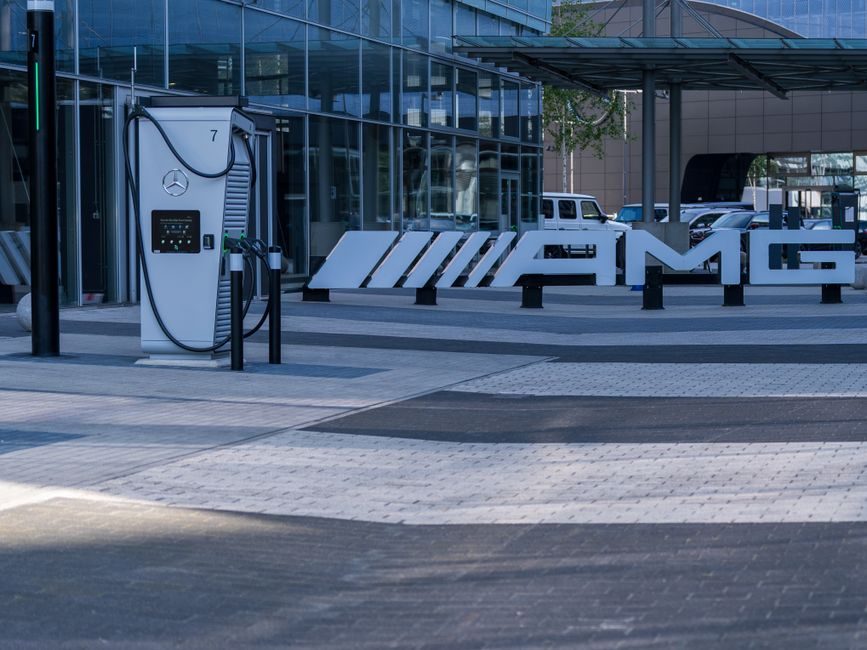
As of mid-2026, the DC fast-charger supply base splits into three identifiable tiers: global Tier-1 OEMs (ABB E-mobility, Siemens, Schneider Electric, Tesla Supercharger V4), Chinese volume manufacturers (Hardhitter, EAST Group, TELD, Star Charge, Shenzhen-based assemblers), and regional system integrators that bundle a 60 kW–5 MW DC stack with OCPP back-office software [S1][S3].
Buyer-side data from Made-in-China lists 649 suppliers offering 1,947 DC-charger SKUs, with Wuhan/Hubei and Shenzhen as the dominant manufacturing clusters and many vendors holding ISO9001:2015, ISO14001 and ISO45001:2018 certifications [S2]. Pricing on the same index starts around US$153–158 for entry-level wallbox-format units and climbs past US$2,000 for liquid-cooled highway pedestals [S7].
Power-Band Tiers and What They Map To
ABB's Terra family spans 20 kW (Terra 24) to 180 kW (Terra 184), with the Terra 54 singled out as the most deployed SKU in the catalog and modular architecture that lets a single cabinet serve up to three EVs simultaneously [S1].
Hardhitter Electric publishes a 60 kW to 5 MW commercial range, the upper end built around an Intelligent Power Scheduling Charging System that coordinates load across multiple dispensers and supports staged cost-down hardware swaps after initial deployment [S3]. EAST Group's Atlas 80–160 kW pedestal adds parallel design for capacity upgrades, 53-fold electrical protection, and ≤65 dB acoustic operation, with the cabinet rated to CCS1, CCS2, and CHAdeMO [S4].
The 150–350 kW bracket is the highway-corridor sweet spot in 2026; above 350 kW, liquid-cooled cables (e.g. ChaoJi/GB/T 27930 paths) and 800 V vehicle architectures become hard prerequisites rather than options.
Connector Coverage and Protocol Stack
Every credible 2026 supplier supports CCS2 (IEC 62196-3, the EU default), with CCS1, CHAdeMO 1.2/2.0, and GB/T 27930 offered as multi-standard configurations on the same enclosure [S4]. The Terra 54 is marketed as a multi-standard unit, meaning one SKU can be ordered with any combination of CCS/CHAdeMO/GB/T cables from the factory [S1].
Network-side protocol is OCPP 1.6J or 2.0.1 for the back office, with ISO 15118-2 / -20 Plug & Charge riding on top of CCS for auto-authentication and value-added services like V2G; vendors that omit ISO 15118 support are being delisted from an increasing share of European public tenders. Power-conversion inside the dispenser is typically built on IGBT or SiC MOSFET modules fed from a 400 V AC three-phase grid, with active front-end rectification and an isolated DC-DC stage — the same topology modelled in MathWorks' DC fast-charging reference example [S6].
Selection Criteria a Buyer Should Lock Down Before Quoting
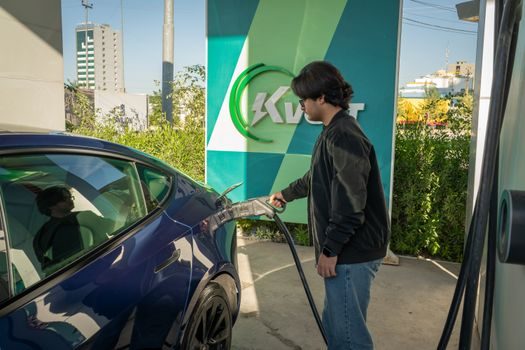
Engineers tend to over-spec power and under-spec grid-side constraints; the binding limits are almost always upstream. The minimum locked-down list: peak DC power (kW), continuous DC power (kW at 40 °C ambient), max grid input current and any demand-response headroom, connector mix, cable length (3.5 m for parking, 5 m for pull-through, 7+ m for truck), IP/IK rating (IP54/IK10 minimum for outdoor), acoustic rating (≤65 dB is a common planning-consent line [S4]), operating temperature window, and OCPP/ISO 15118 compliance for the target network.
Beyond those, three commercial filters consistently separate winners from trouble: (1) certified type-test reports rather than just CE/UL stickers, (2) a published MTBF and a 5-year or 10,000-cycle warranty, and (3) remote diagnostics with OTA firmware update — Atlas explicitly markets both as a maintenance differentiator [S4]. Chinese supply-chain platforms can compress unit pricing to roughly US$153 per 11 kW wallbox or US$2,657 per higher-power pedestal on a 1-piece MOQ, but lead time, type-test depth, and spare-parts logistics should be weighted against that headline number [S2][S7].
Supplier Comparison at a Glance
ABB Terra 54 vs Hardhitter 60 kW–5 MW stack vs EAST Atlas 80–160 kW on the four decision axes a spec engineer will defend in a meeting: ABB's Terra 54 is the most-deployed mid-power SKU globally with Tier-1 service depth; Hardhitter dominates the high-power 350 kW–5 MW megawatt-charging niche with load-scheduling intelligence; EAST Atlas 80–160 kW offers the strongest price/feature ratio out of China with parallel upgradability and CCS1/CCS2/CHAdeMO in one box [S1][S3][S4].
Across the three, connector count is roughly equivalent (3 standard protocols each), IP54 is a baseline across all outdoor SKUs, acoustic spec is ≤65 dB for Atlas and is not published for Terra 54, and warranty terms are published only on EAST's data sheet (5-year on power modules being the industry norm).
Use-Case Mapping: Who Each Vendor Is For
Fleet depots and last-mile delivery hubs with mixed makes: ABB Terra 54 or Hardhitter 60–120 kW — both share the cabinet with three-EV simultaneous-charge logic, cutting the number of grid tie-ins per site [S1][S3].
Highway corridor and trunk-route sites: any of the three (Terra 184 at 180 kW, Hardhitter 180–360 kW, Atlas 160 kW paralleled) paired with liquid-cooled cable preparation for future 800 V trucks. Urban retail and workplace: an 11–30 kW DC wallbox sourced via Made-in-China aggregators at US$153–US$160 per unit, with the caveats above on type-test depth [S7].
Megawatt-class depots for electric trucks and buses — effectively a different product category — sit only with Hardhitter and a handful of larger Chinese vendors in the 5 MW range [S3]. For the upstream power-conversion architecture itself, the DC power supply topology and DC-DC converter topology converge on the same IGBT/SiC rectifier + isolated DC-DC stack regardless of vendor branding.
Limits, Failure Modes, and What the Datasheets Don't Say
Three failure modes recur in 2026 field reports and are worth building into the spec: connector-pin overheating at sustained >200 kW without liquid cooling, fan and filter clogging in dusty highway environments that derate output silently, and OCPP version drift that breaks the network-management contract mid-life. [S2]
Two non-technical limits are equally binding: grid-interconnect queue times (6–18 months in many EU/US jurisdictions) and demand-charge tariff exposure, which can dwarf the hardware amortization if the charger can be peak-shaved — a deliberate reason Hardhitter markets its Intelligent Power Scheduling product as a differentiator, not a feature [S3]. Buyers should also confirm the supplier's regional type-test (CE-RED, UL 2202, GB/T 18487.1, IEC 61851-1) and the firmware update policy before signing.
Sourcing Channels and the 2026 Pricing Floor
Outside direct OEM channels, the Made-in-China aggregator remains the broadest index with 649 active DC-charger vendors and 1,947 SKUs, dominated by Hubei- and Guangdong-based factories, many of which publish ODM/OEM R&D capacity and offer fast delivery within 15 working days [S2][S7].
Typical 2026 floor pricing from that channel: US$153–158 for an 11 kW wallbox-format EVSE, US$2,000+ for highway-format pedestals, and US$2,657 for higher-power integrated units at 1-piece MOQ [S2][S7]. Tier-1 OEM direct quotes sit roughly 2–3× above those numbers but bundle type-test certification, longer warranty, and global service — for context on total-cost calculation across a charger fleet's life, see this single girder crane TCO breakdown, which uses the same life-cycle cost methodology that procurement teams should apply to a 10-year DC-charger rollout. The adjacent galvanised-steel material and MOQ guide is also worth reading because cabinet steel grade and zinc-coating mass are the two specs that quietly decide charger outdoor lifetime.
Track the next 90 days on three signals: the rollout of 800 V native vehicles (which moves the 350 kW sweet spot into mainstream retail demand), the publication of revised IEC 61851-23/-24 amendment text covering higher-power DC, and the number of new suppliers entering the 5 MW truck class on the Made-in-China index beyond the current 649 [S2][S6].
Spec-level background on the components involved: pressure transmitter.