The global abrasives market was estimated at $65.38 billion in 2024 and is forecast to grow from $69.35 billion in 2025 to $124.92 billion by 2035, a 6.06% CAGR over 2025–2035, per the September 15, 2026 update of Market Research Future report MRFR/CnM/3948-CR [S2].
The field is split between diversified multinationals (3M, Saint-Gobain, Norton Abrasives, Klingspor, Carborundum Universal, Abrasive Technology, Sia Abrasives, Mirka, Tyrolit) and specialised regional producers of engineered superabrasives and grinding wheels, with the metalworking application segment holding the largest revenue share and automotive recording the fastest growth [S2].
Market Size and Segment Structure
The September 15, 2026 MRFR revision pegs 2024 market value at $65.38 billion and the 2035 forecast at $124.92 billion, implying roughly $59.6 billion of incremental revenue over a ten-year window at a 6.06% CAGR [S2]. Segmentation is defined across source (natural, synthetic), type (bonded, coated, super, others) and application (automotive, metalworking, machinery, electrical & electronics, construction, others), with metalworking listed as the dominant revenue contributor and automotive as the fastest-growing slice [S2].
Geographically, North America remains the largest regional market on the back of its manufacturing and construction base, while Asia-Pacific is identified as the fastest-growing region due to industrialisation and urbanisation [S2]. The report flags three structural demand drivers: rising automotive output, a shift toward eco-friendly products, and accelerating automation in manufacturing cells that consume coated and bonded wheels at higher rates [S2].
Named Competitors and Where They Sit
MRFR lists nine "key players": 3M (US), Saint-Gobain (FR), Norton Abrasives (US), Klingspor (DE), Carborundum Universal (IN), Abrasive Technology (US), Sia Abrasives (CH), Mirka (FI) and Tyrolit (AT) [S2]. Of these, 3M, Saint-Gobain and Klingspor are positioned as the dominant incumbents with broad product portfolios, while Norton Abrasives and Carborundum Universal anchor the bonded/industrial grinding wheel lines, and Abrasive Technology sits in the engineered superabrasives niche.
On the superabrasive and grinding-machine side, PatSnap Eureka's June 11, 2026 report notes that next-generation abrasive materials are being advanced by firms including Sumitomo Electric Industries and specialised manufacturers such as Dongguan Golden Sun Abrasives, alongside multinational grinding-machine OEMs, indicating a tier of regional Asian players competing on CBN and synthetic-diamond grain technology for high-precision grinding [S3]. The same report frames technology maturity as bimodal: conventional aluminum-oxide and silicon-carbide abrasives are at full commercialisation, while cubic-boron-nitride and synthetic-diamond products are still moving up the maturity curve [S3].
Raw-Material Side: USGS Mineral Commodity Summaries 2026
The USGS Mineral Commodity Summaries 2026 (Version 1.3, May 2026; manuscript approved February 6, 2026) covers the abrasives chapter alongside roughly 90 other mineral commodities, anchoring the raw-material supply side of the competitive picture [S1]. Synthetic abrasives based on aluminum oxide, silicon carbide and boron nitride compete on cost-performance with bauxite-derived fused-alumina grain, and the USGS chapter tracks U.S. and global production, price, and apparent consumption for the natural and synthetic abrasive minerals [S1].
For procurement teams, the USGS table is the reference point for fused aluminum oxide (regular and high-purity), silicon carbide (black and green), garnet, emery, tripoli, and specialty grains; USGS also reports that domestic production data for some abrasive minerals is withheld to avoid disclosing proprietary company information, a recurring limitation that buyers have to factor into independent supply-risk models [S1].
Technology and Process Trends Driving the 2026 Mix
PatSnap's June 11, 2026 grinding report defines the technical frontier as the systematic matching of grain properties (toughness, thermal stability, chemical compatibility with the workpiece) to bonding systems, wheel structure and dressing regimes, replacing the older trial-and-error selection logic with computational modelling plus experimental validation [S3]. The report's four headline KPIs for an optimised abrasive spec are wheel-life extension, consistent cutting ability over the wheel's life, reduced dressing frequency, and cost-per-part reduction; CBN and synthetic diamond are called out as the materials enabling the largest jumps on those KPIs for hardened-steel and aerospace-alloy work [S3].
On the macro side, MRFR's September 15, 2026 update lists three named trends: sustainability initiatives (recycled grain, reduced-binder or binder-free products, lower-VOC resin systems), technological advancements (precision-shaped grains, structured abrasive belts, engineered porosity), and automation in manufacturing (robotic cells feeding finishing stations with predictable wheel-wear curves) [S2]. The same report tags growing construction activity and automotive demand as the two largest end-market tailwinds through 2035 [S2].
Selection Criteria Buyers Should Apply in 2026
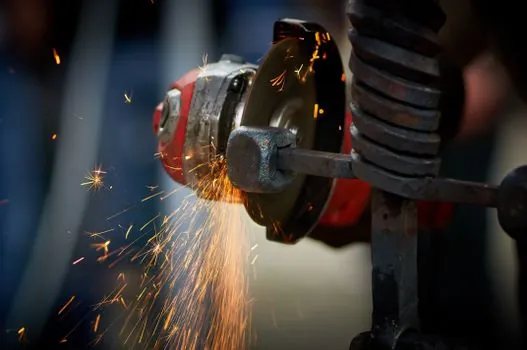
For a procurement engineer comparing vendors, the practical axes are: (1) grain type, where conventional Al<sub>2</sub>O<sub>3</sub> and SiC dominate cost-sensitive ferrous and non-ferrous work, and CBN or synthetic diamond is required for hardened-steel, aerospace nickel alloys, and carbide grinding [S3]; (2) bond system, with vitrified bonds holding the largest share in precision grinding and resin bonds dominating high-stock-removal cut-off and snagging wheels [S2]; (3) form factor, where coated belts and discs lead in finishing and surface-conditioning, bonded wheels in material removal, and superabrasive wheels in precision cylindrical, surface, and tool-and-cutter grinding; and (4) regional supply resilience, where Asia-Pacific capacity growth is shifting lead-time economics [S2].
The same decision framework makes the trade-off explicit: a 3M or Saint-Gobain catalogue offers the broadest SKU coverage and global logistics but at premium pricing; Klingspor and Mirka compete on coated-product depth for wood and automotive finishing; Norton Abrasives and Carborundum Universal anchor Indian and US bonded-wheel supply; Abrasive Technology, Sumitomo Electric and regional Asian players compete in CBN and diamond wheels where the wear-life vs. purchase-price ratio drives the spec [S2][S3]. In practice, CNC grinding cells for EV driveline, aerospace turbine, and bearing-race production are the segments where superabrasive wheel vendors are winning share against conventional abrasive incumbents in 2026 [S2][S3].
Limits, Open Data Gaps, and What to Watch
Two real data gaps bite at the 2026 competitive picture. First, USGS withholds some production and price data for specific abrasive mineral categories to avoid disclosing proprietary company information, so independent country-level supply tracking for those minerals has to lean on trade data and producer disclosures [S1]. Second, neither the MRFR nor the PatSnap report publishes market-share percentages by player; both describe 3M, Saint-Gobain and Klingspor as dominant and identify Sumitomo Electric and regional Asian manufacturers as advancing in next-generation materials, without assigning quantitative share [S2][S3].
Trackable signals for the rest of 2026 include the next USGS MCS revision (the May 2026 release was Version 1.3), any MRFR mid-year update to the 6.06% CAGR, and the pace of CBN and synthetic-diamond capacity announcements from Sumitomo Electric and the regional Asian wheel manufacturers named in PatSnap's June 11, 2026 report [S1][S2][S3]. Buyers using a flow meter on abrasive slurry lines or specifying a pressure transmitter on coolant skids should expect slurry-handling OEMs to mirror the same shift toward CBN and diamond wheels as precision grinding capacity expands through 2026 [S3].
For component-level specifications, see industrial valve.
Background reading: Sorting System Selection for Apparel Distribution: A 2026 Spec Map.