Additive manufacturing (AM) consolidates seven process families under ISO/ASTM 52900 — VAT photopolymerisation, material jetting, binder jetting, material extrusion, powder bed fusion, directed energy deposition, and sheet lamination — each with a distinct resolution, build envelope, and material envelope.
The 2026 production landscape is shaped by three concurrent shifts: Altair's integration into Siemens' industrial-software stack for AM simulation [S3], Renishaw's continued roll-out of metal powder-bed platforms [S6], and Additive Industries' launch of the MetalFab 420K kilowatt-class laser system for serial metal parts [S5]. The supply-chain effect of these moves is moderate but positive, per a 2025 multi-firm expert study [S2].
Process Family Comparison: Tolerance, Throughput, Material Range
Powder bed fusion (PBF) in metals delivers layer thickness in the 20–80 µm range and is the dominant route for serial production of Ti-6Al-4V, Inconel 718, and 316L parts, with build envelopes typically 250 × 250 × 350 mm on mid-platform machines and up to 420 × 420 × 1000 mm on the MetalFab 420K [S5].
Directed energy deposition (DED) trades surface finish for deposition rate — multi-kilowatt laser or wire-arc DED routinely reaches 0.5–2 kg/h metal deposition versus 10–40 g/h on a single-laser PBF platform, and is preferred for large structural repairs and hybrid mill-additive cells.
Binder jetting bypasses the energy-density bottleneck by selectively depositing binder into metal or sand powder, then sintering; the post-sintering shrink of 12–20 % must be compensated in scan strategies and is the chief reason binder jet is not a drop-in for as-printed PBF tolerances.
Material extrusion (FFF/FDM) remains the highest-volume polymer route for non-critical parts with 0.1–0.4 mm layer thickness, while VAT photopolymerisation (SLA/DLP) hits 25–50 µm feature resolution and is the specifier's choice for jigs, dental patterns, and high-finish investment-cast wax patterns.
For an engineering buyer, the practical ranking on four decision axes reads: PBF-DMLS (best all-round metal accuracy), DED (best deposition rate and large-part capability), binder jetting (best batch throughput on small metal parts), VAT photopolymerisation (best polymer surface finish).
Metal Production Stack: Powders, Atmospheres, Parameters
Metal PBF chambers run under argon or nitrogen with O2 typically held below 100 ppm to mitigate oxidation of reactive alloys such as Ti-6Al-4V and AlSi10Mg; the Renishaw RenAM 500 series and Additive Industries MetalFab family both publish closed-loop oxygen monitoring as a standard build-chamber feature [S5][S6].
Layer thickness is set by the build-plate recoater and laser spot size — common production settings are 30 µm or 60 µm for laser PBF, with 60 µm chosen for parts where build time dominates cost and 30 µm reserved for thin walls below 0.3 mm and fine lattices.
Polymer Production Stack: Thermoplastics, Resins, Composites
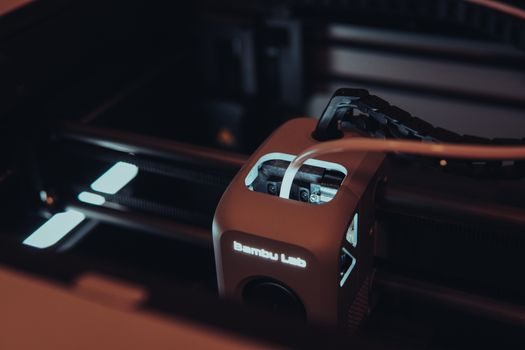
Material extrusion of engineering thermoplastics — PA12, PA6/66, PEEK, ULTEM (PEI) — requires chamber temperatures of 90–200 °C and bed temperatures of 100–250 °C to suppress warpage on long fibre-reinforced compounds; warpage is the dominant scrap mode, not extruder failure. [S1]
Material jetting (PolyJet/MJF) competes with SLA on surface finish and delivers multi-material parts in a single build, with build speeds roughly 3–10× faster than SLA for the same part volume at the cost of higher consumable price per kilogram.
Production polymer AM is gated less by the printer and more by upstream CAD: parts must be designed with self-supporting angles under 45° from the build plate or budgeted for support structures, otherwise post-processing labour erodes the per-part cost advantage over injection moulding at volumes above 5,000–10,000 parts [S2].
Software, Simulation, and the 2026 Toolchain
Altair's acquisition by Siemens (closed into the Siemens Xcelerator portfolio) folds Altair's Inspire Print3D and physics solvers into the Siemens NX Additive Manufacturing and Simcenter 3D chain, giving a single environment for lattice generation, build-simulation, and residual-stress prediction [S3].
Build-simulation packages (ANSYS Additive, Simcenter 3D, Altair Inspire) predict distortion to within 10–20 % of measured values for laser PBF when the input powder size distribution and scan strategy are correctly characterised — good enough to drive compensation scaling factors into scan paths, but not yet good enough to skip a first-article CT scan on safety-critical aerospace parts [S3].
Process parameter development now leans on Design of Experiments (DoE) plus high-performance computing: a single-parameter full-factorial DoE on a metal PBF machine can exceed 200 coupons per alloy/parameter set, so lab automation and DOE-driven workflows are the bottleneck, not printer throughput [S3].
Post-Processing, Standards, and Inspection
ASTM F3091 / F3091M for powder bed fusion process specification and ISO/ASTM 52920 for AM data formats are the reference documents auditors ask for; end-use standards (ASTM F3055 for aerospace, ASTM F3301 for medical) sit on top and dictate powder chemistry, density, and mechanical property documentation per build.
Hot isostatic pressing (HIP) at 100–200 MPa and 1100–1250 °C for superalloys closes internal porosity below 0.1 vol % and is often a contractual requirement for aerospace rotating components, but adds 8–24 h of cycle time and 5–15 % to part cost.
Cost, Lead Time, and Where AM Wins vs Conventional
AM's economic crossover against CNC or casting is most often reached when part count is low (under ~500 units), geometry is complex (lattices, internal channels, consolidated assemblies), and lead time is compressed (days, not weeks); for plain prismatic parts above 5,000 units, injection moulding or die casting almost always wins on unit cost [S2].
The 2025 supply-chain study covering heterogeneous expert respondents rated AM's resilience effect as "moderate," with the largest gains concentrated in spare-parts inventory reduction, on-demand local production, and design-to-print time compression, and the smallest gains in raw-material cost and high-volume throughput [S2].
For operations integrating AM into a brownfield plant, additive manufacturing material selection ties into existing MES the same way CNC tool tables do, but powder lot traceability and chamber-atmosphere logging are the two data streams MES teams frequently underestimate.
Specifying AM alongside conventional process control instrumentation is increasingly common — a serial AM cell that feeds a regulated process line still uses pressure transmitters, flow meters, and PLC I/O for upstream gas and coolant management, so AM work-cells do not exempt a plant from standard ISA- or IEC-rated instrumentation practice.
Limitations, Failure Modes, and the "Not For" List
AM is the wrong tool for: high-volume parts above ~10,000 units where injection moulding unit cost drops below the AM unit cost, large monolithic parts exceeding 800 mm in any axis for metal PBF, optical-grade transparent components without post-polishing, and any application where a qualified wrought or cast material is mandated by an end-customer specification [S2].
Recurring failure modes in serial metal AM: lack-of-fusion porosity from under-set laser energy density, keyhole porosity from over-set energy density, balling from excessive oxygen ingress, residual-stress distortion exceeding scan-compensation limits, and powder contamination from cross-alloy carry-over in multi-machine shops.
For plants weighing AM against investment in a new industrial valve machining cell, the honest answer is that the two serve different jobs — AM captures geometric complexity, while a dedicated valve cell captures throughput on a known-geometry family.
A practical reference for the production-engineering context is the Wind Turbine Production Technology Explained: From Blades to 8 MW Nacelles brief, which lays out how a comparable metal-intensive industry has integrated serial additive and conventional lines.
Trackable signals for the next 6–12 months: Siemens-Altair Xcelerator roll-out milestones for AM simulation modules [S3]; the first field reports from MetalFab 420K production users [S5]; and any new reimbursement pathway decision under the European 3D-printing medical-device framework noted in 3D ADEPT Media's June 18, 2026 dossier on reimbursement pathways [S1]. Powder spot price, alloy availability, and post-processing automation throughput will be the leading indicators of whether serial AM continues compressing the cost crossover against conventional manufacturing.