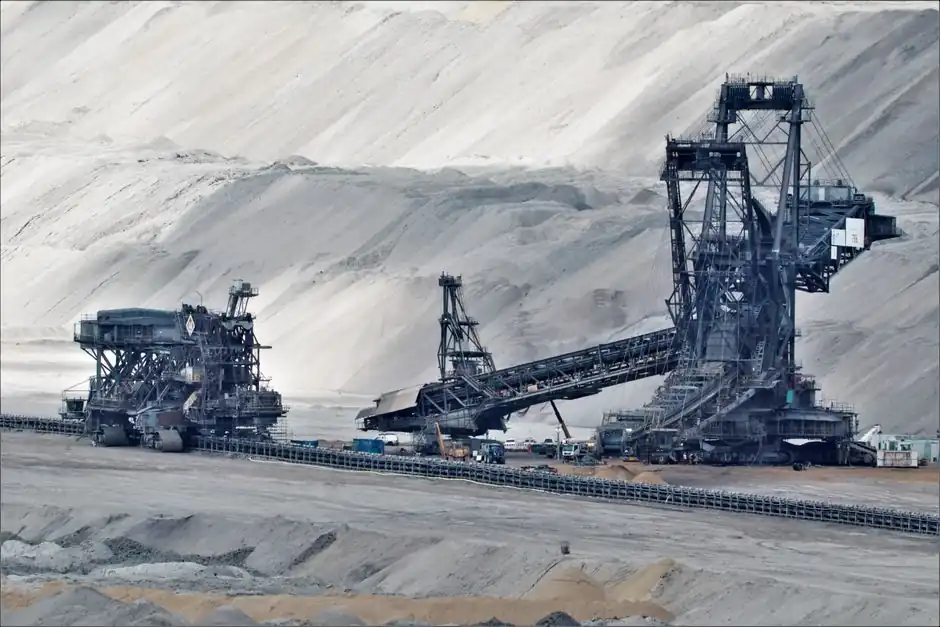
For quarry work, crawler crane models with extendable tracks are rated at 85% of the maximum load-chart capacity, a derating that reflects uneven pad-soil pressure under partial bearing extension [S1]. Heavy-lift lattice-boom crawlers span lifting capacities from 40 t to 330 t with operating weights in the 80,000–200,000 lb (36–90 t) range and engine power of 250–600 hp [S8].
Quarry duty differs from construction lift work: the crane typically travels loaded between bench faces, slews through abrasive dust, and re-positions multiple times per shift. That operating pattern drives the spec toward crawler crane machines with reinforced track frames, multi-piece lattice booms, and hoist packages rated for a high number of cycles per hour rather than maximum single-line pull. In an aggregate pit, a 200 t class machine with a 3,500 mm transport width and 47 t minimum transport weight, such as the Liebherr HS 8200 duty-cycle crawler, is closer to the practical quarry benchmark than a 300 t construction crane [S5].
Load-chart derating and what 85% really means on quarry ground
The 85% rule for extendable-track crawlers is not a fudge factor; it is the published rating the OEM uses when the track gauge is widened beyond the narrow shipping position [S1]. The derating compensates for asymmetric pad bearing when one track is set wider than the other, a common quarry setup to lower ground bearing pressure on fractured rock fill.
For a 100 t maximum chart, expect 85 t net on extended tracks. Crawlers without extending tracks run at the full chart value because the bearing footprint is fixed. SANY's quarry-targeted lattice-boom line lists a 100 t maximum lifting capacity and 65 m main-boom length in the same envelope family that scales to 90+ m booms and 2,380 t·m lifting moments at the top of the range [S2]. Picking between a fixed-gauge machine and an extendable-gauge one is therefore a ground-condition decision, not a capacity decision.
Ground-bearing pressure for a 200 t class machine on standard pads lands in the 80–110 kPa range, low enough for most quarry benches but still too high for uncompacted backfill. SENNEBOGEN's 50 t class 1100 G runs 129 kW diesel power and 51 m hook height, useful for smaller aggregate yards where the load, not the reach, is the constraint [S3].
Quarry vs construction vs duty-cycle crawlers: a four-axis comparison
Quarry-spec crawlers split into three working families, and matching the family to the pit matters more than chasing peak tonnage.
On lifting capacity, construction lattice crawlers top out at 300–330 t, while dedicated quarry duty-cycle crawlers cluster at 50–200 t, sized for repeated 80–90% of maximum load picks rather than one-off heavy lifts [S8][S3]. On boom reach, quarry machines run 40–65 m main boom with short jib extensions, versus 90+ m on the heavy-lift side [S2]. On transport envelope, duty-cycle crawlers like the HS 8200 ship at 3,500 mm width, 3,450 mm height, and 47 t minimum transport weight so they can move between pit faces without full disassembly [S5]. On cycle rating, SENNEBOGEN specifies its crawler line for safe travel at up to 90% of maximum load capacity, a tell that the design intent is loaded repositioning, not stationary pick-and-set [S3].
The practical choice matrix: 50 t class with 50 m boom for precast or aggregate handling yards, 200 t class with 60 m boom for primary crusher feed and shot-rock loading, 300+ t class with 90+ m boom for quarry expansion capital projects where a mobile crane cannot reach over the bench.
Selection criteria specific to quarry floors
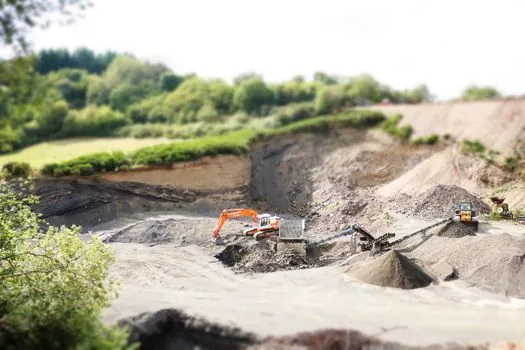
Quarry floors punish undercarriages, so track-pad hardness, ground-pressure rating, and slew-ring protection outrank hoist line speed. The HS 8300.2, the larger sibling of the HS 8200, is engineered for material handling at scale with reinforced upper-structure guarding [S7].
Dust ingress is the second filter: open-construction lattice-boom machines breathe freely but require daily greasing; enclosed cabs with positive-pressure filtration are worth the premium in cement-quarry and limestone-quarry dust. Engine power scales with hydraulic demand, not just lift class. The HS 8200's 750 kW rating supports high-cycle duty, while a 50 t machine running 129 kW is sized for intermittent duty, not two-shift aggregate loading [S5][S3].
Travel-with-load capability separates quarry-spec crawlers from general construction crawlers. SENNEBOGEN publishes the 90% loaded-travel figure as a feature, not a derate, because the undercarriage is designed for that envelope [S3]. A standard construction lattice crawler can pick-and-carry, but at lower percentages and slower speeds.
Standardization, compliance, and load-chart documentation
Three documentation items separate a quarry-spec crawler from a generic lattice crane: a duty-cycle load chart, a ground-pressure chart for variable track extensions, and a pick-and-carry chart. Each chart is a separate OEM publication, and the operating weight, counterweight configuration, and boom length must match the exact configuration in service [S1].
Operators should also verify the OEM's stated maximum lifting capacity on outriggers vs tracks, the SAE J1057 or ISO 4305 lift-class category, and the EN 13000 crane safety standard. Older 200 t class units are commonly recertified to current standards with structural-nde reports on the boom pins, slew ring, and track frames; the recertification cost is a real procurement variable for used units.
Where crawlers lose to specialized machines
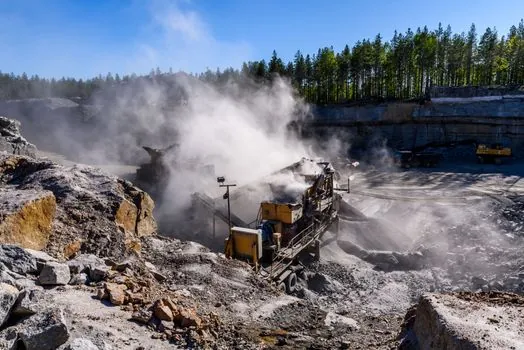
A crawler crane is the wrong tool for high-volume stockpile stacking, where a stacker crane or wheel loader outperforms it on cycle cost. It is also the wrong pick for confined urban quarry access roads where a gantry crane on rails is a better fit. [S2]
For vertical-aggregate-bin loading, a tower crane with a smaller footprint and a higher hook height may serve better if the quarry has fixed feedstock positions. Crawlers win on mobility and on-the-ground stability, not on height or stacking density.
Sourcing notes and field signals to track
Track the OEM's published maximum lifting capacity, maximum hook height, and minimum transport weight together, because each constrains the quarry site envelope differently. Also watch the Liebherr HS series updates, the SANY SCC catalogue, and SENNEBOGEN's 1100 G / 2200 G family for revised duty-cycle charts, since 2025 saw duty-cycle crawler development led by the HS 8300.2 platform [S7]. Related reading on crane subsystem maintenance can be found in the Truck Crane Spare Parts spec-driven guide.