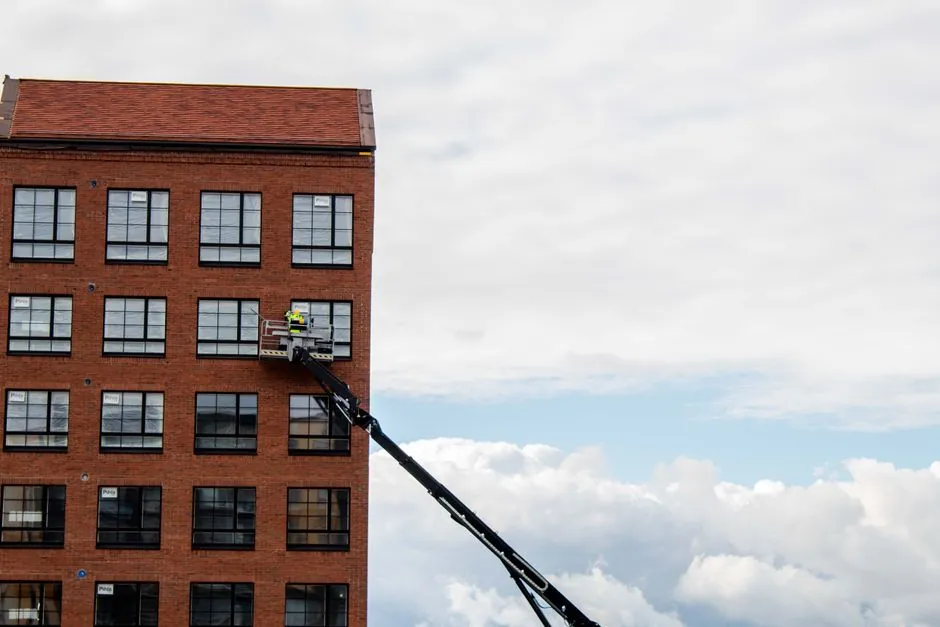
An aerial work platform (AWP) is a mechanized, mobile lifting device that raises a guarded work platform, along with workers, tools, and materials, to elevated job positions, replacing ladders and fixed scaffolding in most modern height-access tasks [S1][S3].
The category covers anything from a 4 m warehouse order picker to a 54 m tracked spider lift, with operational heights typically spanning 5 to 55 m depending on configuration [S1][S4]. Governing standards include EN 280 in Europe, ISO 16368 internationally, and the ANSI A92 series plus OSHA 1910.67/1926.453 in North America [S1][S5]. For a foundational definition, see the aerial work platform encyclopedia entry.
Core working principle: hydraulic and electric drive, mechanical structure, controlled lift
At the heart of every AWP is a prime mover (diesel engine, battery pack, or hybrid system) coupled to a hydraulic pump, which feeds hydraulic cylinders that physically extend the lifting structure; on smaller indoor units the prime mover is a battery-driven electric motor and a single acting cylinder [S4][S5].
The lifting structure itself determines the machine class: scissor stacks (crossed steel arms pinned at the centre, driven by one or more vertical cylinders) give strictly vertical lift; telescopic booms (nested steel sections pushed by sequential hydraulic cylinders) extend straight outwards and up; articulating booms (multiple pinned sections rotated by hydraulic actuators) reach up and over obstacles; vertical masts (single or twin aluminium/steel columns, sometimes chain- or screw-driven) lift a small basket in narrow aisles [S3][S4][S5].
For tracked spider and crawler lifts, the same hydraulic circuit also powers outrigger legs and track extension, which is why those machines can level themselves on slopes and operate on soft ground that would refuse a wheeled scissor lift [S1][S6]. A useful cross-reference for similar chassis-stability engineering is the maintenance workflow described in tunneling skid steer maintenance: daily checks, interlock safety, and contamination.
Component anatomy: chassis, extending structure, platform, controls
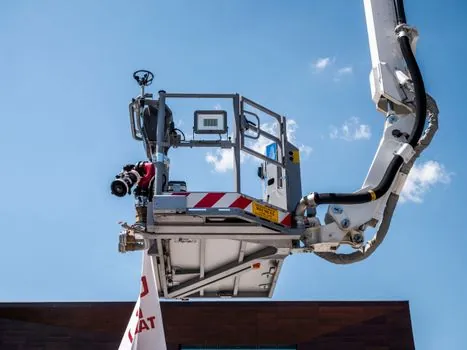
An AWP is built from four functional blocks: a base structure (usually a wheeled or tracked chassis, occasionally a trailer mount), an extending structure (scissor stack, boom, mast, or combination), a flat working platform or basket with guardrails and a kick plate, and the operator controls [S3][S5].
For commercial units, typical working-height bands are 5 to 14 m for electric scissor lifts, 8 to 18 m for diesel scissor lifts, 11 to 25 m for articulating booms, 14 to 55 m for telescopic booms, and 6 to 14 m for vertical mast lifts; Haulotte's current North American range covers 13 to 138 ft (roughly 4 to 42 m) across these families [S4]. Spider lifts from manufacturers such as Platform Basket reach up to 54 m of working height, with outrigger footprints sized to keep ground bearing pressure within the limits of finished floors and graded terrain [S1].
Control systems are dual-channel by regulation: a ground-level control panel for setup, stow, and emergency lowering, plus a platform-mounted upper control box with enable/hold-to-run logic, tilt sensor interlock, and overload cutoff [S1][S8]. Most modern AWPs also include a load-sensing cell in the platform floor; a related engineering walkthrough of that sensing decision is in choosing a load cell for pharmaceutical batch weighing: specs, materials, and trade-offs.
Stability, outriggers, and ground conditions: the actual constraint that drives selection
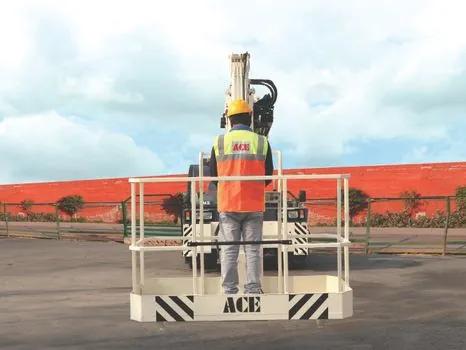
An AWP is only as stable as the surface it sits on, and the platform's centre of gravity rises as the lift extends, which is why OSHA, EN 280, and ISO 16368 all require automatic tilt cutout (typically around 4 to 5 degrees from level) and full outrigger deployment before the platform can be raised [S1][S6][S8].
On slopes, a wheeled scissor lift is generally restricted to gradients of 1 to 3 degrees unless fitted with self-levelling outriggers; tracked spider lifts trade travel speed (often limited to 1 to 4 km/h) for a far lower ground bearing pressure, on the order of 30 to 50 kPa, which lets them work on pavers, soft soil, and even interior slabs with restricted floor-loading [S1][S6]. Ground-condition assessment, not reach height, is usually the deciding factor on a real job, since a 12 m scissor on solid concrete outperforms a 30 m boom on a wet grass slope every time [S6].
Type-by-type comparison: how the working principle differs
Scissor lifts use a single multi-stage scissor stack driven by one or two hydraulic cylinders: simple, robust, vertically only, with platform sizes around 2 to 4 m by 1 to 1.5 m, and the widest deck in the industry for two-person plus material loads [S3]. Articulating booms use a multi-section knuckle arm; the first section luffs, the second articulates, and a jib at the bucket adds fine positioning, which is what lets them reach up and over pipework, parapets, and tree canopies [S3][S4]. Telescopic booms use 3 to 5 nested sections extended by sequenced hydraulic cylinders for the longest straight-line outreach at height, the configuration of choice for shipbuilding, bridge inspection, and large structural steel [S4]. Vertical mast lifts use a single aluminium mast (sometimes with a chain or lead-screw drive) carrying a 0.7 to 1.0 m wide basket, which is why they fit through standard doorways and single-rack warehouse aisles [S3][S5]. Spider lifts combine a compact boom (telescopic or articulating) with extendable tracks and independently adjustable outriggers, trading speed and capacity for terrain flexibility [S1].
On a 2 to 4 criterion basis, scissor lifts score high on platform area and cost-per-metre but low on outreach; telescopic booms score high on outreach and reach but low on manoeuvrability; articulating booms score high on obstacle negotiation but lower on straight-line reach than telescopic units; spider lifts score high on terrain access but low on travel speed and payload [S3][S4].
Drives, power sources, and indoor versus outdoor operation
Electric scissor and mast lifts use deep-cycle lead-acid or lithium-ion batteries (commonly 24 V, 48 V, or 80 V packs) feeding a silent AC or DC traction motor plus a dedicated hydraulic pump; this is the only configuration allowed indoors where diesel exhaust would be unacceptable [S3][S5].
Diesel or dual-fuel boom lifts use a small diesel engine (often a 3-cylinder, around 18 to 36 kW) driving a fixed-displacement hydraulic pump; hybrid and all-electric boom variants (e.g. lithium battery packs with on-board generators) are increasingly common in urban jobsites subject to low-emission zones [S4]. The lift speed of a typical scissor is on the order of 30 to 60 s from ground to full height, while booms slew at 0 to 1 rpm and extend at 0.3 to 0.8 m/s, so cycle time, not just working height, is the real productivity number on repetitive tasks [S4].
Safety systems and operator requirements: the part that decides who may use the machine
Regulatory frameworks (EN 280, ISO 16368, ANSI A92.20, OSHA 1910.67 and 1926.453) require pre-use inspection, mandatory operator training, fall-arrest harness use above 1.8 to 2.0 m platform height, load-chart adherence, and a rescue plan before any lift occurs [S1][S5][S8].
Mandatory on-board safety devices include: a tilt sensor that locks out lift and drive above the rated angle; an overload sensor that disables the up-function when platform load exceeds the charted limit; pothole protection or outrigger interlocks that prevent driving when stabilisers are not deployed; an emergency descent valve (manual or gravity) to lower the platform if power is lost; and an upper-control enable switch that requires continuous pressure to move the machine [S1][S8]. Cornell EHS and similar programmes treat operator certification, daily inspection logs, and a documented ground-condition check as the three non-negotiables for AWP use on a controlled site [S8].
Selection workflow: matching the principle to the job
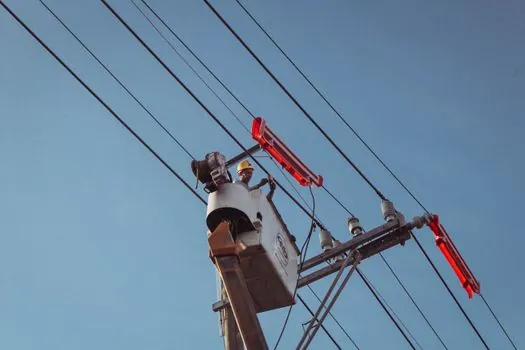
The decision sequence that holds up on most industrial and construction sites is: (1) determine the working height and outreach required, with at least 1 to 2 m safety margin; (2) map the ground conditions and slope; (3) confirm whether the work area is indoor (electric only) or outdoor (electric, diesel, or hybrid acceptable); (4) calculate platform load from worker mass plus tools and materials, typically capped at 200 to 450 kg for most AWPs; (5) check overhead and lateral obstructions; (6) match the result to the right structural type per the comparison above [S3][S4][S9].
For working heights under 14 m on level indoor floors, electric scissor or mast lifts are the default; for heights of 14 to 30 m with horizontal reach needed, articulating booms dominate; for straight outreach beyond 20 m, telescopic booms are the only practical option; for soft, uneven, or sensitive ground, tracked spider lifts with outriggers are specified even at higher rental cost [S1][S3][S9]. A related design-side decision on crane-class equipment and duty cycle appears in quarry crawler crane specs: load charts, ground pressure, and duty-cycle trade-offs, which uses the same ground-pressure and stability logic.
Track the next spec movement in three signals: (a) EN 280 and ISO 16368 revision activity and any new requirement for secondary guarding or load-sensing interlocks; (b) wider OEM rollout of lithium-electric boom lifts in the 16 to 25 m class, replacing diesel on low-emission urban sites; (c) the share of telematics-equipped rental fleets (e.g. Haulotte's SHERPAL or equivalent) that can remotely enforce geo-fencing and overload lockout, since that is where operator-side compliance is being pushed in 2026.
Component reference pages worth checking: aerial work truck, and platform scale.