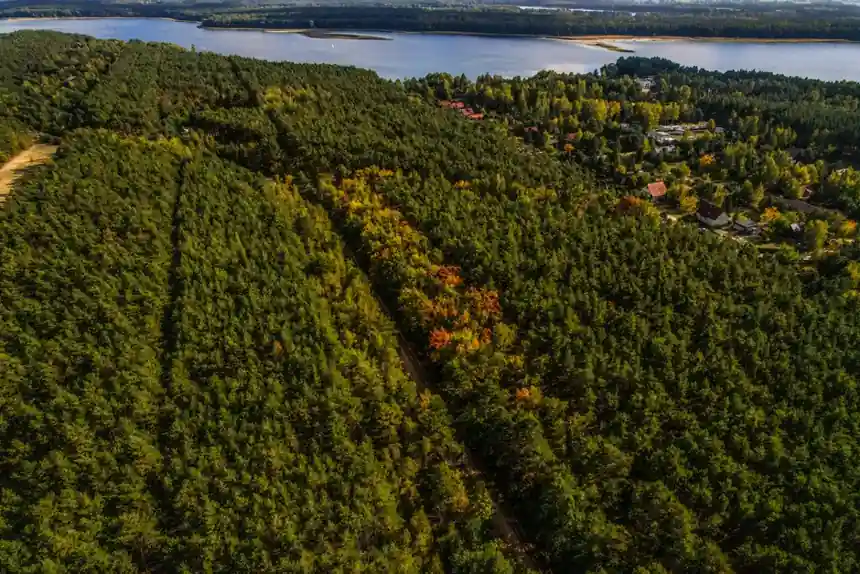
Forestry is one of the few off-road industries where the aerial work platform fleet has to do two contradictory things at once: reach 15 to 40 m into a live or partially felled canopy, and sit on ground that is wet, root-crossed, and unable to take a hard-tyre machine. Standard indoor slab scissor lifts and straight-deck truck mounts are excluded for that reason [S1][S3].
Selection is therefore driven by three coupled parameters: required working height, ground-bearing pressure, and horizontal outreach into the crown. Electric-drive indoor AWPs, vertical mast lifts, and narrow-aisle models drop out of the shortlist as soon as the site is unpaved, while aerial work truck platforms on a 4x2 chassis are generally limited to roadside line-clearance work on sealed verges [S1][S6].
Forestry AWP Classes: Articulating Boom, Telescopic Boom, and Spider Lift
Articulating booms with 14 to 25 m platform height are the most common forestry AWP, because the multi-jointed arm can be folded over a fence, a hedge row, or a low branch and then extended vertically into the upper canopy without re-levelling the truck [S1][S3]. Forestry-rated articulated booms in the 16 m class typically offer 8 to 11 m of horizontal outreach from the slew centre, which is the dimension that actually controls whether a pruner can reach a 60 cm stem 9 m off the ground at a 4 m stand-off [S1].
Telescopic booms give straight-line outreach: forestry-grade 25 to 43 m straight booms are used for timber-stand tending, cable-yarding access, and emergency fire-line work, where the operator needs to push the basket straight up and over a windrow rather than around it [S3][S5]. Compared with articulators, telescopic platforms have a larger footprint, weigh 12 to 22 tonnes, and demand wider outrigger pads.
Spider lifts, also called tracked articulating booms, are the third forestry-specific class: a compact rubber-track chassis, four individually set outriggers, and an articulated arm up to about 30 to 52 m working height on premium models [S5]. The tracked undercarriage spreads the machine's mass over a footprint of roughly 1.5 to 2.0 m x 3.5 to 5.0 m, so ground pressure is in the 30 to 50 kPa range, well below the 80 to 120 kPa typical of a 4-wheeled boom on turf [S5]. For a procurement decision, the rule of thumb that 9 times out of 10 holds is: orchard, roadside, and park pruning = 14 to 18 m articulated on a 4x4 truck; selective felling and rigging in mature stands = 25 to 43 m telescopic or spider; arborist work on a private estate = 18 to 30 m spider on outriggers.
Matching Drivetrain, Tyres or Tracks, and Outriggers to the Site
Forestry sites run on soft, often saturated soil, so drivetrain and undercarriage selection has more impact on uptime than boom geometry. A 4x4 diesel with rough-terrain tyres and active differential lock is the minimum for any forestry AWP above 16 m; a 4x2 is reserved for sealed-surface orchards and municipal verges [S1][S6].
Track versus wheel is the next decision. The trade-off is speed: tracked forestry AWPs typically walk at 2 to 5 km/h and must be towed or trailered between distant blocks, whereas a 4x4 rough-terrain boom can road-drive at 25 to 35 km/h [S1].
Outrigger pad size and levelling system are the third leg of the spec. Self-levelling hydraulic outriggers with load-sensing pads are now standard on forestry spider lifts, and the platform's automatic envelope control will derate outreach if a pad senses float or low bearing pressure; budget models still use manual jacks, which on a slope of more than 5 degrees will simply refuse to level. For an aerial work platform working on root-matted, undulating terrain, specify a machine whose envelope control is tied to each individual outrigger, not averaged across the chassis.
Height, Outreach, and Basket Capacity: Numbers That Matter
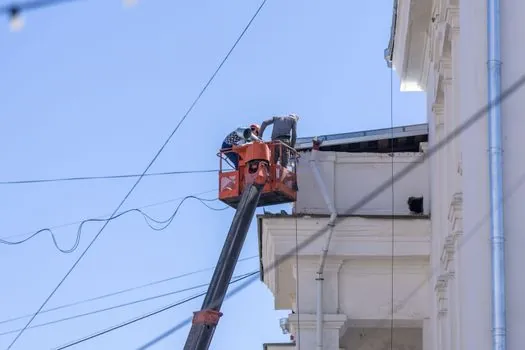
The published platform height is not the working height. AWP manufacturers follow the international convention of stating platform height plus 2.0 m to give working height, which is roughly the height of an average operator's feet when standing in the basket [S7][S8]. So a forestry AWP marketed as "20 m working height" has a platform floor at about 18 m, which is the number to use when sizing against the tallest tree in the stand.
Outreach at a given platform height is the figure that gets misread most often. A 20 m articulating boom will typically have 9 to 12 m of outreach at 8 to 10 m platform height, but only 4 to 6 m at full platform height, and zero usable outreach with the basket at the upper guard-rail limit [S1]. For pruning a roadside mature oak whose lowest limb is 6 m off the ground, that means a 14 m platform is enough; for a 25 m pine with the first live branch at 14 m, a 25 to 28 m boom with at least 6 m outreach at platform height is the realistic minimum.
Basket capacity is the other frequently overlooked spec. Unrestricted forestry AWPs carry 200 to 250 kg (two workers with chainsaws), while a single-occupant chipper-feed or pruning platform is often derated to 120 to 150 kg to keep the chassis narrow and light. For a saw team with a chipper on the ground, always size to the heavier 200 kg class.
Stability, Slope, and Wind: Operating Envelope Rules
Forestry is one of the few AWP applications where the limiting environmental factor is often wind, not slope. AS 1418.10 and the equivalent ANSI A92.6 framework in the US grade aerial platforms for in-service wind up to 12.5 m/s, and most forestry-rated articulated booms are restricted to that envelope with the basket at full height [S7]. Above 12.5 m/s the boom is typically lowered or stowed; above 17 to 20 m/s work must stop entirely, which in a tall-stand silviculture block can close operations for 30 to 60 days a year.
Chassis slope rating is the second envelope limit. 4x4 forestry booms are usually rated for 5 degrees of chassis level on full outreach; tracked spider lifts with individual outrigger levelling can work on slopes of 10 to 15 degrees provided the outrigger pads sit on competent ground. Anything above 15 degrees generally requires repositioning, not just re-levelling. A useful pre-flight check: with the boom stowed, set the outriggers, then look at the automatic envelope display; if the controller reports more than 3 to 4 degrees of pad-to-pad differential, the ground is not consistent enough to take the full outreach load.
Comparison: Articulating Boom vs Telescopic Boom vs Spider Lift for Forestry
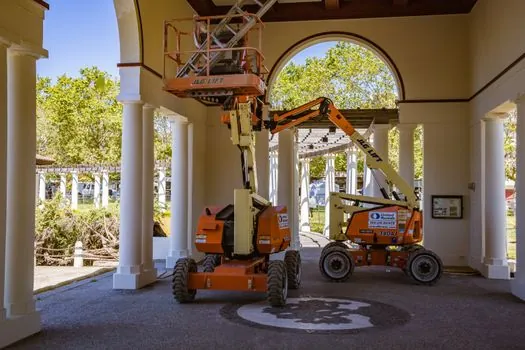
Below is the at-a-glance comparison a procurement engineer should walk into a dealer with. Numbers are typical for current forestry-rated production machines, not the outliers on either end of the range [S1][S3][S5].
Articulating boom on 4x4 truck chassis: 14 to 25 m working height, 8 to 11 m outreach at mid-height, 200 to 250 kg basket, road-driveable at up to 35 km/h, ground pressure 80 to 120 kPa on turf, lowest capital cost in the forestry AWP class, best for orchards, municipal tree work, and roadside pruning on sealed verges.
Telescopic boom on 4x4 truck chassis: 25 to 43 m working height, 12 to 22 m straight-line outreach at mid-height, 200 to 450 kg basket, road-driveable, ground pressure 90 to 130 kPa, higher capital cost, best for selective felling, fire-line access, and cable-yarding in mature timber.
Tracked spider lift with outriggers: 18 to 52 m working height, 8 to 16 m outreach, 200 to 250 kg basket, must be trailered between sites at 2 to 5 km/h, ground pressure 30 to 50 kPa, highest capital cost, best for arborist work, estate pruning, ecologically sensitive ground, and sites inaccessible to a wheeled chassis.
Across the three, the spider lift wins on ground-pressure and slope tolerance, the telescopic boom wins on raw height and outreach, and the truck-mounted articulating boom wins on mobility and unit cost. For an estate or contractor that moves between blocks daily, the truck-mounted articulator is almost always the right first machine; for a silviculture crew working one block for a season, the spider lift is the better tool.
OSHA, EN 280, and the Compliance Layer
Forestry AWPs in the US fall under OSHA 29 CFR 1910.67 and 1926.453 for vehicle-mounted aerial platforms, plus ANSI A92.6 for the equipment standard; in the EU and UK the harmonised standard is EN 280, with category 3 (outdoor, severe wind) being the relevant forestry variant for machines working above 12.5 m/s gusts [S6]. Daily pre-use checks, fall-arrest harness attachment to the basket anchor point, and a documented weekly inspection are non-negotiable under both frameworks, and most insurers will not cover an AWP that has not been thorough-examined within the past 6 to 12 months.
Operator training is the second compliance pillar. IPAF in the EU and ANSI in the US both require category-specific operator cards: an IPAF 3a (mobile boom) card covers truck-mounted articulating and telescopic booms, an IPAF 3b (self-propelled boom) card covers spider lifts, and the categories are not interchangeable. For a forestry contractor running mixed fleets, the practical implication is that the operator pool must hold both cards, or two operators must be scheduled for mixed-fleet days.
What a Forestry AWP Procurement Specification Should Lock Down
A defensible forestry spec should pin down, in order, working height, horizontal outreach at that height, basket capacity, ground-bearing pressure on saturated soil, drivetrain (4x4 diesel, hybrid-electric, or full battery-electric), outrigger type and pad area, and wind/slope envelope. Add a clause on whole-machine ground pressure rather than per-tyre load, because a soft-soil site can fail under a 4x4 boom long before any individual tyre is overloaded. Reference the suspended platform alternative only if the work is genuinely façade-style work on a fixed structure, which forestry almost never is. [S1]
Finally, plan for the trailered support kit: a tracked forestry AWP is useless without a low-loader capable of taking its 6 to 12 tonne operating weight, and a 4x4 truck boom is only economical if the fleet can absorb the road-speed cycles between sites. A useful cross-reference for fleet planners who also run earthmoving equipment is the forestry bulldozer selection decision map, since the same soft-ground, low-ground-pressure logic that picks an LGP dozer also picks the undercarriage of a forestry spider lift.
Trackable Signals in the Forestry AWP Market
Two near-term signals to watch: hybrid-electric and full battery-electric forestry AWPs in the 18 to 25 m class are entering fleet trials in 2026, driven by EU Stage V noise limits and Tier 4 Final emissions rules that make diesel operation in urban parks and residential estates increasingly restricted [S5]. Second, the integration of automatic envelope control with per-outrigger load sensing is migrating from premium spiders down to mid-range truck-mounted booms, which over the next 12 to 24 months should reduce the manual jack-and-pack workload on forestry jobs.