Forklift snow plows in the 10 ft to 14 ft width band weigh 1,300 to 1,600 lb and require a minimum 50 to 85 hp host machine, per Pro-Tech's FT10F, FT12F, and FT14F spec sheets [S2]. Each unit slides directly onto Class II or III carriage forks through two 4 in x 12 in moldboard cutouts, so the operator keeps the forks mounted and adds a containment plow in minutes [S2].
The use case is narrower than it looks: a forklift carrying a containment pusher is a backup machine for parking lots, loading docks, and lane ways, not a primary sidewalk or highway tool. Pro-Tech's own copy calls the FT series "a great backup" for when a contractor cannot make a call, and the 10 year structural warranty on the chassis is positioned against occasional, not daily, service [S2].
Three sizes, one chassis: 10 ft / 12 ft / 14 ft mapping
Pro-Tech rates the FT10F at 10 ft wide, 1,300 lb, 50 hp minimum, with a 9 yd snow capacity at a 36 in moldboard and 36 in x 36 in side plates, priced from $5,899 [S2]. The FT12F steps to 12 ft, 1,450 lb, 70 hp, and 11 yd, at $6,399; the FT14F reaches 14 ft, 1,600 lb, 85 hp, and 13 yd, at $6,899 [S2]. All three share the same backhoe-derived chassis and the same SBR rubber edge, so the only real engineering choice is width versus host forklift rating.
Width drives snow capacity almost linearly. Going from the 10 ft to the 14 ft unit adds 4 ft of moldboard and 4 yd of theoretical capacity, a 44% jump, but the host forklift horsepower requirement climbs 70% from 50 to 85 hp, and attachment weight rises 23% from 1,300 to 1,600 lb [S2]. For a 5,000 lb capacity cushion-tire forklift with a stock mast, the 10 ft FT10F is the safe pairing; the 14 ft FT14F is a telehandler-class load, not an LP-gas cushion job.
Cutting edge and moldboard: SBR rubber at 65 durometer, 2,000 PSI tensile
The wear surface on the FT series is SBR extruded rubber, specified at 65 durometer (Shore A) and 2,000 PSI tensile strength, bonded to the moldboard bottom [S2]. That blend is the standard containment-plow squeegee geometry: hard enough to scrape packed snow, soft enough to glide over expansion joints and speed bumps without chipping concrete. DENIOS confirms the same construction pattern in its winter-safety line, citing high-quality steel with a powder coat finish, replaceable cutting blades, and floating pads as the typical build [S1].
Two 4 in x 12 in fork openings in the moldboard are the defining detail [S2]. They let the operator leave the forks engaged, drive forward into the plow, and lift it into work position with the mast, instead of dismounting to pin a dedicated quick coupler. The trade-off is no float beyond what the mast allows, so on uneven asphalt the operator has to manage tip-angle manually rather than rely on a swivel head.
Host forklift minimums: 50 to 85 hp, 4,400 to 12,000 lb class
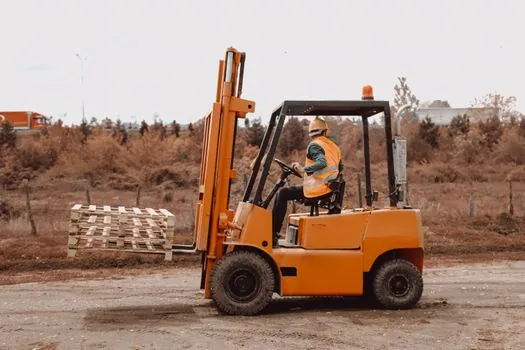
Pro-Tech's published minimums are 50, 70, and 85 hp for the 10, 12, and 14 ft units, respectively [S2]. Industry reference data for telehandlers (the closest comparable host) puts typical lifting capacity at 4,400 to 12,000 lb, with light material buckets holding over 3 cu yd, roughly 4,000 lb of snow at 1,200 lb per cubic yard [S3]. A standard 5,000 lb LP-gas forklift is at the lower edge of telehandler range and is comfortable with the FT10F only; a 7,000 to 10,000 lb rough-terrain diesel telehandler handles the FT12F and FT14F without derating.
For outdoor snow work, the rough terrain forklift category is the natural fit: 4-wheel drive, higher ground clearance, and diesel power plants that meet the 70 to 85 hp minimum for the larger pushers. A cushion-tire indoor forklift should not be specified for a 1,600 lb pusher even if the rated capacity is high; tire grip on snow and ice is the limiter, not the load chart.
Selection criteria and a direct comparison
Four decision criteria separate the three Pro-Tech sizes: width, host horsepower, attachment weight, and snow capacity. The numbers below come straight from the FT10F / FT12F / FT14F spec table [S2].
Width vs host power: 10 ft at 50 hp, 12 ft at 70 hp, 14 ft at 85 hp. Width vs attachment weight: 1,300 / 1,450 / 1,600 lb. Width vs capacity: 9 / 11 / 13 yd. The dollar gap is $5,899 to $6,899, only $1,000 across the three sizes, so the deciding factor should be host forklift horsepower, not budget [S2].
For applications outside the FT family, names like Blue Diamond, Vestil, and Weha show up in distributor catalogs across V-blade, multipurpose, and high-capacity configurations [S4]. DENIOS independently lists quick-connection designs, universal mounting systems, and adjustable plowing heights on its line, which means the competitive set uses the same fork-pocket or quick-coupler interface as the Pro-Tech chassis [S1].
Forklift vs telehandler vs dedicated plow truck: when the forklift wins
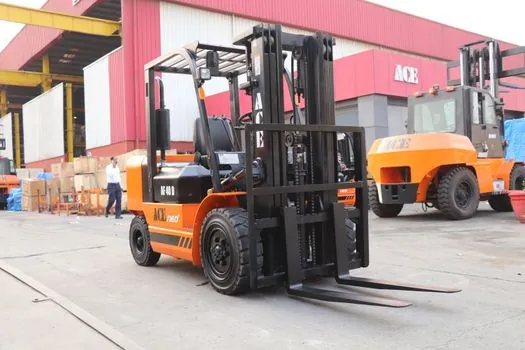
A forklift pusher makes sense in three specific scenarios, and loses in the rest. First, sites that already own a 5,000 lb plus outdoor forklift and want to redeploy it for an 8 to 24 hour storm window without buying a dedicated truck. Second, narrow lots and loading-dock aprons where a 10 to 14 ft box plow is the right tool and a 22 ft municipal truck is overkill. Third, contractor backup duty, which is exactly the use case Pro-Tech publishes the FT series against [S2].
It loses on sustained municipal routes, where a 40 km/h (24.8 mph) travel speed matters: a telehandler can do that, a forklift typically cannot [S3]. It also loses on fuel economy over a full shift, since telehandler fuel use rivals tractors and backhoes per the Caterpillar performance handbook reference, and a forklift is built for short lift cycles, not continuous ground engagement [S3]. For fleet planning, see how a similar sizing logic plays out in wheel loader selection for snow removal, where host horsepower, traction, and attachment class follow the same trade-off curve.
Limitations and failure modes engineers should plan for
Three constraints bound this product class. First, no float mechanism beyond the mast: on uneven pavement, expect operator fatigue and uneven scraping because the 4 in x 12 in fork pockets fix the angle relative to the carriage [S2]. Second, no integral hydraulics: the FT series is passive, so direction changes, pile pushing, and back-dragging all depend on the host forklift's forward-reverse-shuttle speed, not on plow actuation. Third, the 65 durometer SBR edge will wear; specify replacement edges as a stocked spare, because a worn edge drops scraping efficiency and increases host-machine strain.
Standard winter-safety attachments from full-line suppliers add features that the basic FT chassis omits: replaceable cutting blades, floating pads, and adjustable plowing heights are listed as standard options on the broader DENIOS snowplow range, with powder-coat steel construction for corrosion resistance in road-salt environments [S1]. If a site is coastal, on a chemical-handling pad, or sees heavy chloride de-icer use, the powder-coat specification is the one to insist on in writing.
Standards, sourcing, and what to verify before purchase
No ISO or ANSI standard governs forklift snow plows directly; the relevant safety frame is the host forklift's own compliance with ANSI/ITSDF B56.1 (the consensus standard for industrial truck safety), and operator training under OSHA 1910.178(l). For outdoor units on uneven or slippery ground, the rough terrain forklift category, with its dedicated stability test, is the more defensible specification basis than a converted indoor truck. [S1]
Verifiable signals to track: the 10 ft FT10F SKU FT10F was listed as backordered at New Hydraulics as of the September 2026 product page update, which is a real lead-time indicator for buyers planning a Q4 2026 deployment [S5]. Separately, the FT series chassis carries a 10 year structural warranty, an unusually long commitment for an attachment class where 1 to 3 years is more common [S2]. Both are concrete, dated, and worth recording in a purchase specification.
Spec-level background on the components involved: pressure transmitter.