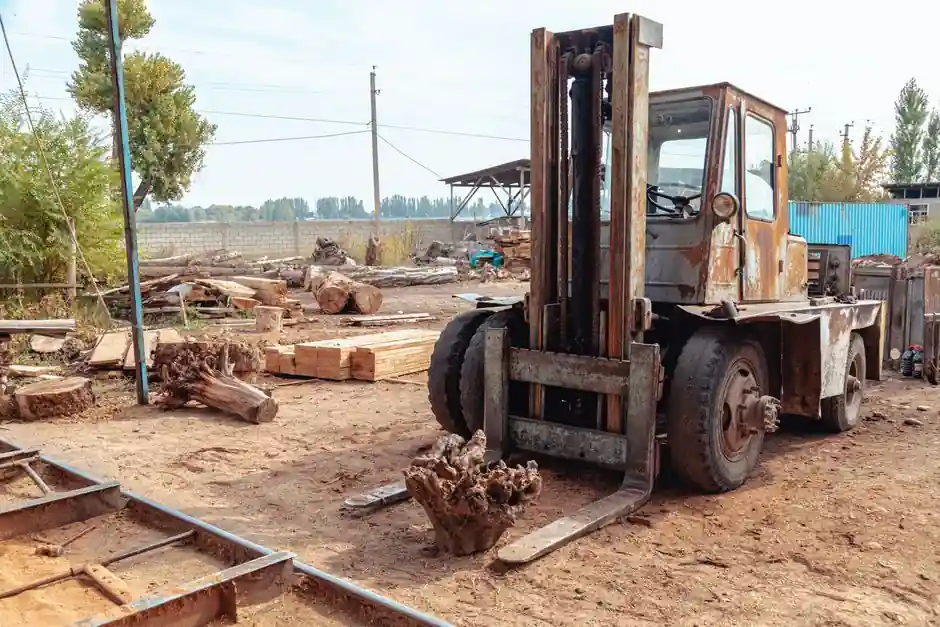
Demolition sites need a rough terrain forklift rated 3.0 to 10.0 tons with full-time 4WD, an articulated frame, and at least 250 mm of ground clearance to cross broken slab, rebar mat, and soft backfill without high-centering [S2]. The current production sweet spot for structural tear-down work is the 3.5 t class with a 500 mm load center, a 3.0 to 6.0 m duplex or triplex mast, and a Weichai or Cummins diesel rated 36.8 to 110 kW that already meets EPA Tier 4 final or Euro V emission tiers [S2].
Demolition is not a warehouse: a 2WD cushion-tire lift truck will bottom out on the first rut and lose traction on mixed rubble, so the rough terrain class is the baseline, not an upgrade [S2]. A correctly sized unit can replace one excavator, one skid-steer, and one telehandler on small-to-medium structural tear-downs, with attachments that turn the same chassis into a sorter, loader, and hoist [S2][S4].
Site Failure Modes the Spec Has to Cover First
A demolition site is a moving hazard map, and the spec has to address three failure modes before it touches capacity: surface, debris, and gradient [S2]. On broken concrete, compacted soil, and rebar-strewn mud, 12-ply 405 mm flotation tires inflated to a maximum 350 kPa keep the contact patch wide enough to avoid cuts while carrying the rated load [S2]. Ground clearance has to clear rebar chairs, slab edges, and trench lips, and 250 mm is the common OEM minimum for the 3.5 t class, with overall height held near 2,700 mm so the unit can pass under standard site hoarding and through 3 m gates [S2]. Travel speed matters less than tractive effort, but a 30 to 40 km/h loaded/unloaded maximum lets the operator reposition between drop zones without a low-bed trailer [S2].
For site safety planning, the ORNL SOW template for a controlled building demolition lists forklift operations that must be performed within 10 ft of electrical infrastructure as an item that requires selection of appropriate control measures before mobilization [S1]. That is the kind of clearance and proximity constraint that disqualifies a standard warehouse chassis and forces the rough terrain class into the bid.
Capacity, Mast Height, and Load-Center Math
Rated capacity is stated at a 500 mm load center, the ASTM/ISO convention for forklift nameplates, and the JAC CPCD35J publishes 3,500 kg at 500 mm LC with a 3,000 mm two-stage mast as the baseline configuration [S2]. For demolition, add a 3-stage full-free-lift mast so the operator can unload inside low clearances (basements, containerized sorting bays) without tilting the load into the overhead guard [S2][S3].
For sorting mixed C&D debris, a 3.5 t unit with forks sized 50 x 125 x 1,070 mm (or the heavier 1,220 x 120 x 45 mm pattern on articulated 4x4 chassis) handles a standard masonry pallet, while 5.0 to 10.0 t chassis are reserved for steel beam lifts, concrete panel extraction, and bulk aggregate reloads [S2]. Mast tilting of 10 degrees forward and 10 degrees rear on the JAC platform, or 8 degrees forward and 11 degrees rear on the Luken articulated chassis, lets the operator self-level loads on a 5 to 8 percent cross-slope without a second banksman [S2].
Driveline, Engine, and Emission Tier
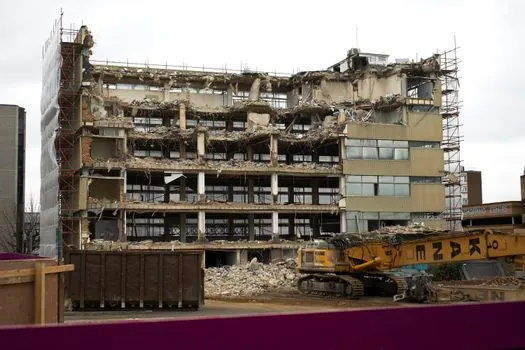
Full-time 4WD with a split two-speed gearbox and an automatic differential lock is the standard pattern; the 3.5 t class uses a YunNei 490 CN-4 diesel at 42 kW, while the 6.0 t class climbs to 110 kW with a Weichai or Cummins option [S2]. For urban demolition near occupied buildings, EPA Tier 4 final and Euro V are the documented compliance tiers, and they are met by the current Weichai and Cummins calibrations offered as OEM options [S2].
Hydraulic capacity drives attachment performance, and 80 L hydraulic tank paired with an 80 L diesel tank on the 3.5 t articulated unit is typical, enough to run a hydraulic breaker, grapple, or auger continuously through a demolition shift without thermal cut-out [S2]. For interior strip-out and concrete cutting, an electric counterbalance forklift with lithium-ion opportunity charging is the documented low-emission option, while diesel remains the baseline for outdoor concrete demolition and tunnel work with exhaust management [S3]. For a deeper breakdown of the 4WD articulated class itself, the Rough Terrain Forklift Class VII selection map lines subtypes against four spec criteria, and a cross-check on forklift baseline configuration anchors the load-center and mast conventions used in demolition bids.
Drive-Type Decision Matrix for Demolition
Three drive types are commonly offered on demolition-rated chassis, and the bid should pin the choice to the work envelope rather than the sticker price. Electric units are locally emission-free and quiet, which suits strip-out and concrete cutting inside occupied buildings, but require charging infrastructure, battery management, and IP-rated enclosures for damp or dusty zones [S3]. Diesel units deliver high continuous output for outdoor concrete demolition, special deconstruction, and rock or tunnel excavation, and require particulate and noise control plus adequate ventilation in semi-enclosed cuts [S3]. LPG sits between the two as a flexible intermediate for semi-open areas with moderate emissions, with cylinder handling and leak checks as the documented safety overhead [S3].
Across a typical demolition fleet, the rough terrain forklift plays the material-handling role that an excavator or skid-steer cannot: palletized masonry, sorted reinforcement, containerized C&D debris, and repositioning of hydraulic power packs and demolition shears between work faces [S3]. The general forklift class reference covers the counterweight, mast, and sideshift functions that any demolition chassis inherits, while the rough terrain forklift page covers the 4WD, flotation-tire, and ground-clearance additions that qualify a chassis for broken-slab work.
Attachments, Attachments, Attachments
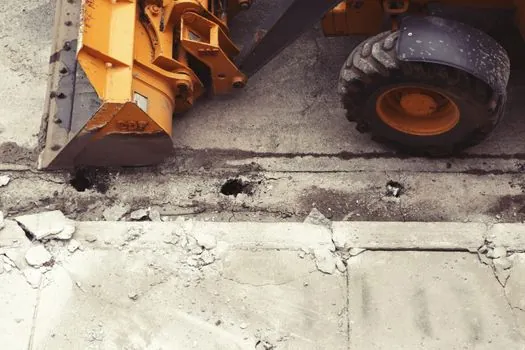
Versatility is the documented productivity lever on demolition equipment, and a rough terrain forklift earns its keep by swapping tools on the same carriage [S4]. Buckets, grapple buckets, hydraulic hammers, brooms, thumbs, and shears all run on a quick coupler, and the 80 L/min hydraulic reservoir on a 3.5 t articulated unit is sized to keep a breaker, grapple, or auger working through a full shift without thermal cut-out [S2][S4]. The chassis can also carry concrete demolition shears, rock and concrete splitters, and Darda hydraulic power units directly to the work face, and reposition them between cuts without a second support vehicle [S3].
For a more specific comparison of demolition production equipment, the wheel loader selection guide covers the bucket match logic that overlaps with forklift bucket work, and the asphalt paver selection guide covers the undercarriage and automation choices that show up on a paver-fed demolition access road.
What NOT to Specify on a Demolition Chassis
Two-wheel-drive cushion-tire chassis are not a demolition tool, regardless of capacity: they will high-center on broken slab and lose traction on rebar-strewn mud, which is why the rough terrain class is the baseline spec, not an upgrade [S2]. Pneumatic-shape industrial tires inflated above 350 kPa will cut on the first rebar mat, so 12-ply flotation tires at or below that ceiling are the documented minimum [S2]. A two-stage mast without full free lift cannot unload inside a containerized sorting bay without tilting the load into the overhead guard, so a 3-stage full-free-lift mast is the documented minimum for interior demolition [S2][S3].
Bid reviewers should also reject any chassis whose nameplate does not state the 500 mm load center, the mast tilt range, and the 4WD engagement mode (full-time versus on-demand), because all three figures are part of the ASTM/ISO nameplate convention and any omission signals a non-conforming build [S2][S3]. For demolition near live electrical infrastructure, the SOW template requires a documented control-measure selection step before any forklift operates within 10 ft of energized lines, so the chassis spec has to land before that review, not after [S1].
Trackable signals to watch over the next two bid cycles: (1) whether more OEMs publish EPA Tier 4 final calibrations on the 3.5 t articulated chassis, since the current YunNei 490 CN-4 at 42 kW is a China-domestic option and Tier 4 final coverage on that exact platform is still spotty per the 2026-08-31 spec path [S2]; (2) whether lithium-ion opportunity-charging electric rough terrain chassis move from strip-out duty into outdoor C&D sorting, which would shift the diesel-vs-electric mix on urban jobs.
Spec-level background on the components involved: demolition hammer.