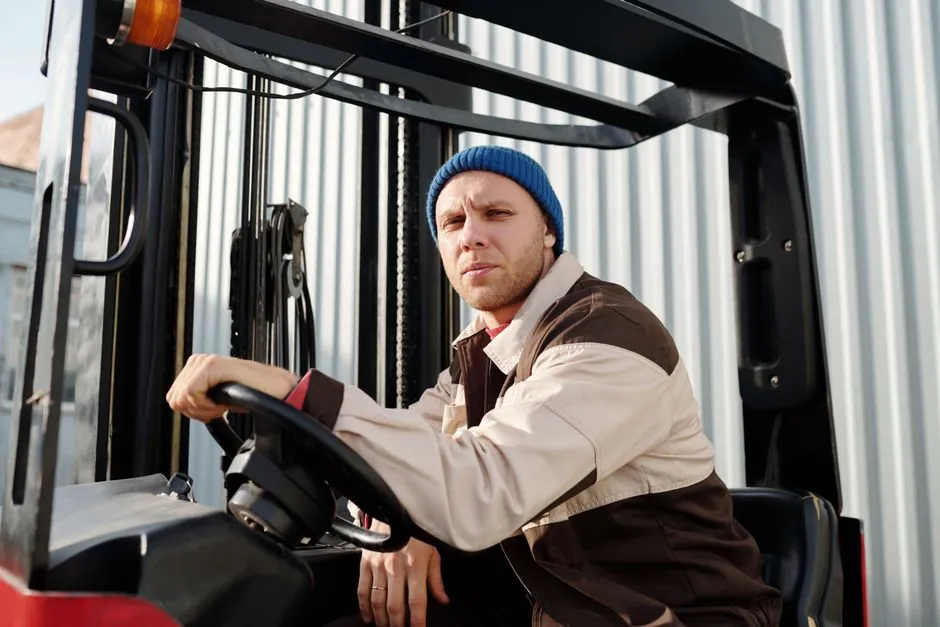
Forestry work splits into two material-handling environments: a paved sawmill floor with stacked lumber, and an unpaved logging site with mud, snow, and freshly cut logs. Each environment calls for a different forklift class, and specifying the wrong one is the single most common procurement mistake on this kind of project [S1][S2].
Rough-terrain forklifts for forestry sites typically offer 12 inches (305 mm) or more of ground clearance, about 4 times the ~4 in clearance of a standard warehouse forklift, and run 4WD with articulating axles that absorb up to a 7 degree lateral change in elevation between tires [S4]. Standard counterbalance forklifts, by contrast, are limited to smooth surfaces and lose stability once the surface tilts or softens [S2].
Terrain Class Drives Chassis Choice
Rough-terrain forklifts pair traditional lift functions with tractor-class running gear, allowing them to climb embankments and cross muddy, rocky, or snow-covered ground without getting high-centered or losing a drive tire [S4]. Their off-road tires are roughly 2 times the diameter of warehouse-forklift pneumatic tires, with deep lugs that increase contact area and bite on loose surfaces [S4].
For work that stays on a concrete pad, in a kiln hall, or inside a finished-lumber warehouse, a standard diesel, LPG, or electric counterbalance forklift remains the cost-effective choice and is widely offered by OEMs in capacities from 1.8 t up to 55,000 lb (about 25 t) classes [S3]. The decision rule: any surface that is unpaved, uneven, or weather-affected belongs in the rough-terrain class, and the reference page on rough terrain forklifts outlines the chassis subtypes and spec boundaries that matter.
Capacity Bands and Engine Options for Forestry Use
For site-side log handling, the 4WD rough-terrain class typically sits in the 1.8-3.5 t capacity window, with lift heights up to 7,000 mm and engine options spanning Isuzu, Yanmar, Cummins, and Chinese-build diesels [S1]. This band is the practical sweet spot for feeding a portable saw, sorting pulpwood, or staging small-diameter logs.
For sawmill infeed and heavier timber stacks, the 5-10 t heavy-duty diesel forklift covers the common production range, again with lift heights to 7,000 mm and Isuzu or Cummins engines [S1]. Above that, 28-32 t heavy-duty forklifts with Cummins power are used for full-log handling at large mills, where the load unit is the entire stem rather than a cut board [S1]. Long timber, where the length of the load starts to govern the spec, is where a sideloader or a telehandler with specialized forks takes over, and the basic forklift class definitions are worth reviewing before committing to a single platform.
Attachments: Clamps, Side Shifters, and Long Forks
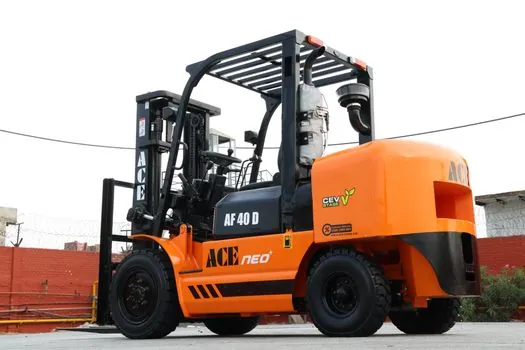
Specialized attachments, including log clamps, rotating clamps, side shifters, and extended forks, are what convert a stock counterbalance truck into a forestry-capable machine, allowing it to grip non-palletized, irregularly shaped timber without manual handling [S2]. A sideloader with 300-6,000 kg capacity, paired with a deck that runs parallel to the load, sidesteps the capacity loss that comes from extending standard forks, where longer forks directly reduce rated lift capacity [S1].
For operations that need both vertical lift and forward reach into a log pile, telehandlers with lift heights up to 55 ft and capacities up to 50,000 lb, paired with clamp, bucket, specialized fork, or man-basket attachments, are commonly specified [S3]. Boom lifts and scissor lifts, both electric and rough-terrain variants, then cover the mill maintenance envelope rather than the log-handling envelope, a boundary worth respecting when writing a spec [S3].
Power Source: Diesel, LPG, Electric, Hybrid
Forestry environments are predominantly diesel, both for the higher torque needed to move a loaded chassis through soft ground and for the absence of battery-range concerns on long outdoor shifts [S3]. LPG units appear on sawmill floors where exhaust ventilation is good and indoor emissions rules allow combustion engines, while electric and hybrid forklifts are gaining ground on finished-lumber lines where noise, fumes, and indoor air quality are monitored [S3].
Telematics, including hour meters, load-event logs, and GPS-based geofencing, are now standard on most new LPG, diesel, and electric units from major OEMs, giving fleet managers the data needed to enforce operator-certification rules on rough terrain [S3]. Operator training itself is non-optional: handling long, heavy, awkward loads in a forestry yard is one of the higher-risk routine tasks in materials handling, and untrained operators are the leading root cause of tip-over and dropped-load incidents on this kind of site [S1].
Limitations and Failure Modes to Spec Against
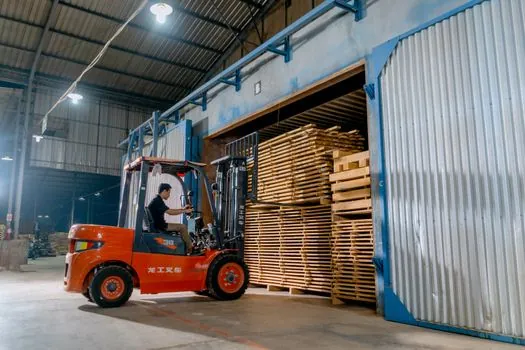
Standard forklifts lose traction on rain-soaked ground and can see hydraulic performance drop in extreme cold, conditions that show up several times a year in temperate and boreal forestry belts, and they are not a safe substitute for a rough-terrain unit on the same site [S2]. A rough-terrain unit, conversely, is overkill on a finished-lumber warehouse floor, where its higher center of gravity and larger tires reduce stacking density and aisle maneuverability compared to a slim-mast electric counterbalance [S2].
The single most common spec error is pairing long forks with a chassis that has no compensating counterweight, which produces a unit that physically can lift a long log but is below its rated stability curve, a configuration that fails the ANSI/ITSDF B56.1 stability test in practice even if the nameplate numbers look acceptable [S1]. For projects where log handling and yard loading overlap with snow or mud, the comparison published in wheel loader selection for snow removal gives a useful cross-check on tire, traction, and attachment sizing logic. For larger, more demanding forestry fleets, forestry wheel loader selection maps the heavier weight and reach class that takes over once payload exceeds roughly 5 t per pass.
Selection Criteria and Comparison Matrix
A practical four-criterion filter for a forestry forklift purchase is: surface type (paved vs unpaved), primary load (long log, short log, finished lumber, packaged product), required lift height (3 m stacking vs 7 m bin filling), and power-source constraint (indoor emissions rule, cold-start duty cycle, fueling logistics). The first two criteria alone eliminate roughly half the catalog in a single pass. [S1]
Applied to the main options, the matrix reads: 1.8-3.5 t rough-terrain diesel (4WD, ~305 mm clearance) handles unpaved log-handling and short-distance mill feed; 5-10 t heavy-duty diesel counterbalance handles paved-yard and sawmill infeed; sideloaders (300-6,000 kg) handle long timber on paved surfaces; telehandlers (up to 50,000 lb, 55 ft) handle reach-based log and lumber placement; 28-32 t heavy-duty forklifts handle full-log mill infeed [S1][S3]. For a unit that must work both inside and outside, a hybrid or electric rough-terrain platform is now offered by several major OEMs and is the fastest-growing spec request on multi-zone mill sites [S3].
Trackable signals worth monitoring over the next procurement cycle: OEM telematics-standardization announcements, the share of hybrid and electric units entering forestry OEM price lists, and any update to operator-certification rules that would shift the cost balance between in-house training and outsourced contract handling. These three indicators together will tell procurement whether the current rough-terrain-diesel default is about to be displaced on indoor-outdoor forestry sites.
Spec-level background on the components involved: pressure transmitter.