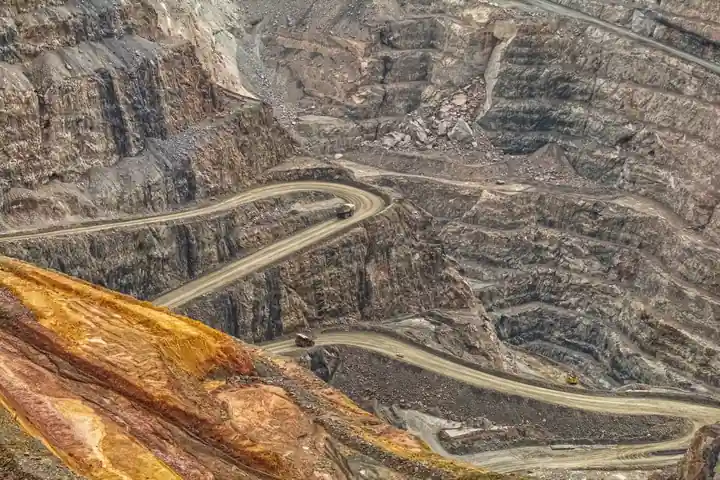
Mining maintenance crews need mobile elevating work platforms sized to the actual task: haul-truck tire changes, conveyor head-pulley replacement, crusher-house lighting, and stockpile reclaim all impose different platform height, deck-load, and drivetrain demands.
Rental fleets supplying the sector now publish working heights from 5 m electric scissor units to 16 m+ self-propelled articulated booms, with 4-wheel-drive diesel and electric-drive options listed side by side [S1][S2]. The selection question is therefore not whether a platform is available, but which configuration survives the pit floor.
Drivetrain and ground-pressure choice
Diesel 4x4 articulated boom lifts remain the default for outdoor pit and process-plant work because they deliver 40-45% gradeability on unpaved haul roads and carry 200-450 kg unrestricted deck capacity, against the 300 kg typical of a 10 m battery scissor platform [S1][S2]. For non-marking, zero-emission zones inside conveyor tunnels or crusher houses, fully electric scissor lifts with zero hydraulic components eliminate drip contamination of ore and lower fire load [S1].
Tire choice matters as much as motor type: foam-filled or non-marking solid tires are specced for indoor slabs, while high-flotation rough-terrain tires are required on pit-floor mud; mis-speccing either is the most common cause of immobilized platforms on mine sites. Fleet operators report 14 countries and 60 depots supporting a 20,000-unit rental pool, which lets mine maintenance planners swap a failed unit rather than wait for a repair [S1].
Platform type matched to mining duty
Articulated boom lifts (typical 12-16 m platform height, 360-degree turret rotation) are the workhorse for shovel-side and haul-truck maintenance because the articulating jib reaches over truck trays and into dump-body cavities [S1][S2]. Telescopic booms trade jib articulation for straight outreach, useful where a linear approach is possible, such as conveyor-stringer access.
Scissor platforms deliver larger deck area at lower working height, fitting two technicians and a parts tray for crusher-house panel work and lighting replacement. Spider lifts add outrigger-stabilized narrow-track access for cramped process-plant aisles where a standard boom will not fit. A 10 m height / 300 kg / 24 V battery aerial work platform is a representative small-electric scissor SKU [S2], while 12 m double-mast aluminum units and 16 m electric articulated booms sit one tier up [S2].
Height, reach, and deck-load envelope
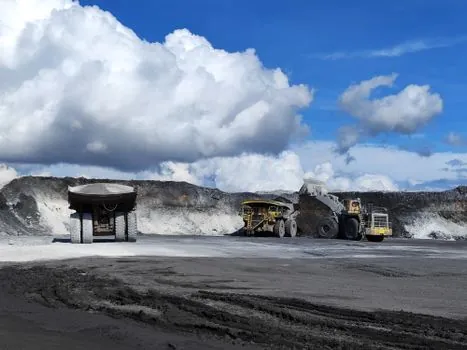
Standard mining working heights cluster at 8 m, 10 m, 12 m, and 16 m; the 8 m aluminum vertical mast lift and 10 m self-propelled vertical mast lift cover most lighting and instrument-stand tasks [S2]. 12 m double-mast and 16 m articulated booms cover truck-tire, conveyor idler, and stockpile-stack work [S2].
Deck load drives crew composition: a 300 kg scissor deck accepts two technicians with hand tools; boom platforms in the 200-450 kg class accept a third person plus a parts crate, which collapses tire-change cycle time. Aluminum-alloy masts keep unladen mass low enough for trailer-mounted units to be towed between faces, an option relevant to contract maintenance crews moving between small pits [S2].
Operator certification and safety compliance
IPAF and PASMA training cards are the accepted operator-competency currency for mobile elevating work platforms in most regulated mining jurisdictions, and rental suppliers bundle operator training with the rental contract [S1]. Mine sites additionally require site-specific induction covering barricading, lockout-tagout of the host machine (truck, conveyor, crusher), and overspeed-load limits.
Pre-use inspection must verify the platform's rated capacity plate against the actual tool and crew mass, the function of the emergency lowering system, and outrigger setting on soft ground. Failure to match platform class to the inspection regime is a more frequent audit finding than a pure equipment defect, based on the standard pre-shift checklists that major rental operators publish [S1].
Selection criteria for the maintenance planner
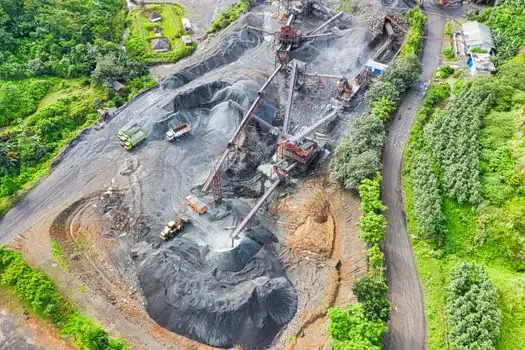
Four questions lock down the spec: indoor or outdoor use, working height needed, deck load required (1-2 vs 2-3 persons plus parts), and ground condition (slab, gravel, mud). If the answer is indoor lighting or instrument work, a 10 m / 300 kg / 24 V electric scissor or an 8 m aluminum vertical mast is the right pick [S2]. For outdoor truck or shovel work above 12 m, the shortlist is a 4x4 diesel or electric articulated boom with 200-450 kg deck rating and rough-terrain tires [S1][S2].
Planners also weigh rental vs purchase: a 20,000-unit regional rental fleet with 60 depots and cross-border offices in India and Qatar gives mining operators a redundancy that an owned single-unit fleet cannot match [S1]. For long-life, single-site deployments with predictable duty cycles, purchase of a 12-16 m self-propelled unit from a manufacturer with documented quality control is competitive [S2][S3].
Limits, failure modes, and what to avoid
Electric scissor platforms are not rated for the puddling, dust, and uneven surfaces found on active pit floors, and any indoor-only unit deployed outside voids its structural certification. Conversely, diesel booms are excluded from underground workings where diesel particulate regulations apply, and from indoor zones where non-marking tires and zero hydraulic leakage are required [S1].
Trailer-mounted and truck-mounted aerial lifts fill a niche but impose transport logistics that fixed-fleet rental avoids. Single-mast and one-man lifts are personnel-only, so any parts-handling task pushes the spec back to a scissor or boom. The most common spec error on mining sites remains oversizing working height while under-spec'ing deck load, which then forces technicians to leave tools on the ground and slows the job. For broader work-at-height planning across a site, a truck-mounted aerial platform reference clarifies the chassis-mounted variant, while a mining dump truck cross-reference helps align platform reach to the host machine being serviced.
Track the next OEM technical bulletin on rough-terrain electric boom platforms (battery energy density is the gating parameter), and watch for any 2026 revision to MSHA or equivalent operator-competency guidance affecting rental-pool acceptance on mine sites.
The underlying component specifications are covered under aerial work platform.
Related analysis: Air Solenoid Valve Sizing and Selection Guide for Compressed-Air Duty.