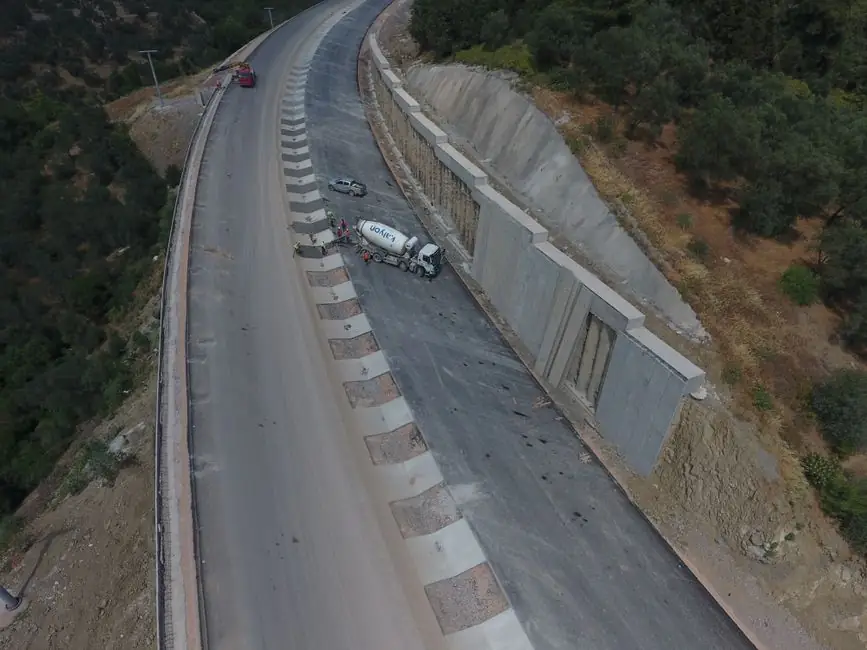
Road construction crews that need elevated access across dispersed jobs, from overhead sign installation to bridge pier inspection and streetlight servicing, generally land on truck-mounted aerial platforms in the 12-28 m working-height band, paired with a Class 3 commercial chassis in the 230-340 hp range and a four-outrigger hydraulic stabiliser system [S1][S3].
Truck-mounted platforms pair the lifting mechanism with road-going mobility, while towable boom lifts and self-propelled scissor or articulating booms cover different mobility and reach envelopes [S1][S3]. On paving or earthworks corridors where lane closures are short and the lift point moves frequently, the chassis that drives to the next work zone, sets its outriggers, and lifts in under 10 minutes is usually the cheapest option per productive hour [S3].
Working-Height and Reach Envelope by Road Task
Working height, not platform height, is the number to size against: for single-lane overhead sign and gantry work, 14-18 m straight telescopic booms are the common pick; for bridge soffit and pier-cap access, 20-28 m articulating booms with negative-reach jibs add the up-and-over geometry that straight booms cannot deliver [S1]. The bucket, or platform, typically carries 200-450 kg of crew plus tooling on road-build units, which suits two-person crews with a tools-and-fasteners load but rules out heavier module lifts [S1].
Bucket trucks used in the utility segment, the same family that overlaps with road construction lighting and CCTV work, usually spec a lower 10-16 m working height and a smaller 136-200 kg platform capacity, which is enough for one technician and a tool bag but is the wrong machine for bridge structural repair [S2][S3].
Truck-Mounted vs Towable vs Self-Propelled
Comparing the three common families on the four criteria that drive road-project selection: deployment time, between-site mobility, unit cost, and reach envelope, truck-mounted platforms win on mobility and reach, towable boom lifts win on acquisition cost, and self-propelled articulating booms win on rough-terrain manoeuvrability [S3].
The trade-off that road contractors most often underestimate is towing logistics: a towable boom lift requires a separate truck, a hitch-rated driver, and a second parking footprint on constrained corridor sites, costs that erode the unit-price saving once a crew runs more than one site per day [S3]. For the same logic, a dump truck on the same corridor pairs naturally with a truck-mounted boom because the crew, the chassis, and the stabilised work zone all share one truck [S3].
Chassis, Outriggers, and Hydraulics
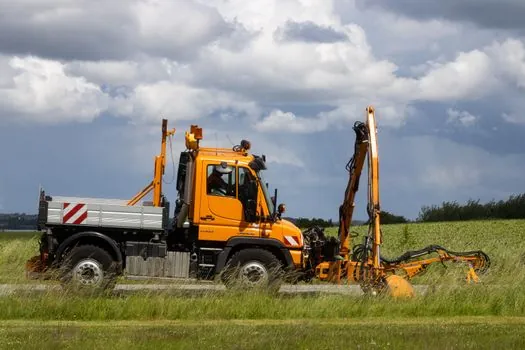
Most road-going aerial work trucks are built on 4x2 or 6x4 commercial chassis in the 7,500-26,000 kg GVW band, with diesel power in the 230-340 hp range and a torque figure that matters more than peak horsepower for off-pavement approach climbs [S1]. The aerial device itself runs off a separate hydraulic system fed by a PTO or dedicated engine, with a four-outrigger jack pattern (H-type or A-type) that is the single biggest contributor to tip-over stability on uneven subgrade [S1].
Platform levelling is handled by a parallel-linkage or hydraulic self-levelling system that keeps the bucket within roughly 5 degrees of horizontal through the full lift arc, which is what allows two-person crews to work comfortably on bridge piers and sign gantries without constant manual re-levelling [S1]. The bucket itself is usually rated to insulation standards for live-line work, with fibreglass booms and dielectric platforms specified where the road project overlaps with adjacent overhead conductors [S1].
Safety Systems and Operator Controls
Standard safety systems on road-going boom trucks include automatic overload protection that interlocks lift motion above the rated platform capacity, anti-tilt interlocks that lock elevation if an outrigger loses load, and emergency-descent systems that lower the platform under gravity or auxiliary power if the main hydraulics fail [S4]. Modern units increasingly add wind-speed sensors, operator-presence interlocks, and remote telemetry for fleet-level utilisation tracking [S4].
Anti-tilt stabilisation and overload cut-out are not optional on public road sites: most regional transport authorities require the unit to carry a current load-chart certificate and an annual thorough-examination record before it can be deployed inside a live traffic-management plan [S2]. The practical effect is that a five-year-old unit without a documented electronic-safety retrofit is usually refused on permit-restricted sites even if the steel and hydraulics are sound [S2].
Electrification and Smart-Controls Direction
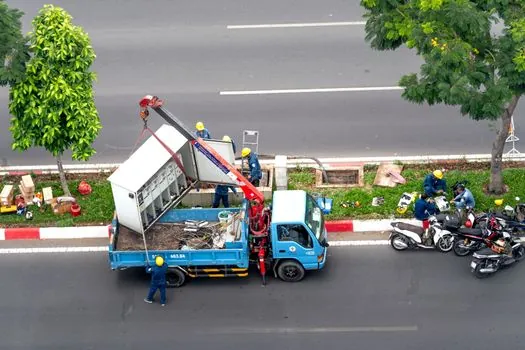
Electrification is the most visible shift in the segment, with diesel-only road-going platforms being progressively replaced or supplemented by lithium-battery or hybrid drivelines, especially for night-shift urban work where noise and emissions restrictions bite hardest [S4]. A typical shift on a road corridor: a 14-18 m truck-mounted boom running an 8-hour shift burns 15-25 L of diesel on a conventional PTO system, against roughly 30-50 kWh on a battery-electric equivalent [S4].
Smart control and IoT integration is moving from a premium option to a fleet standard, with sensors reporting real-time load, tilt, wind exposure, and outrigger contact pressure back to a fleet dashboard, which in turn feeds predictive maintenance intervals based on accumulated cycle count rather than fixed hours [S4]. For road contractors running 10 or more boom trucks, that data layer is what separates a per-machine maintenance budget from a per-cycle one [S4].
Selection Logic for a Road Construction Fleet
The shortest path to a defensible spec: pick working height from the tallest routine task plus 1.5-2 m of margin, pick boom geometry (straight telescopic for reach, articulating for up-and-over) from the access geometry at the worst-case site, and pick the chassis from the gross vehicle weight the operator's licence class can carry on public roads [S1][S3]. For a 14-18 m bucket truck on a 12-tonne 4x2 chassis, the all-in operating weight with crew, tooling, and a half-tank of hydraulic fluid is typically 11-13 tonnes, leaving 1-1.5 tonnes of headroom for the optional second work basket, generator, or compressed-air reel [S1].
For crews that already run articulated booms inside a broader fleet, the same selection logic that drives aerial work platform and aerial work truck choices on a stationary site applies on the road, the difference is the chassis and the permit window. The on-road unit is the right call when the average distance between consecutive work points is above roughly 15 km; below that, a self-propelled articulating boom on site cuts mobilisation cost per shift [S1][S3].
Track for the next planning cycle: (1) the 2026 shift of municipal road contracts toward electrified or hybrid boom trucks on night-shift urban corridors, driven by emissions restrictions rather than operator demand, and (2) the slow convergence of predictive-maintenance data standards across major OEMs, which is the precondition for mixed-brand fleets to run on a single telematics platform. A working road roller on the same corridor closes the paving loop, but it is the boom truck that owns the air-rights work.
See also our earlier report, Slewing Drive Selection for Material Handling: Load, Ratio, and Sealing Logic.