A mining dump truck is a 40-100+ ton off-highway hauler engineered for haul roads, not plowed city streets; the snow-removal use case almost always points back to a standard rigid, heavy-duty, or articulated dump truck with a front plow and rear salter/spreader [S2][S5].
Per the Skidsteers.com guide, snow removal creates seasonal demand for trucks with front-mounted plows and spreaders, transforming standard dump trucks into winter service vehicles rather than repurposing dedicated off-highway mining trucks [S2]. The four primary categories typically used in winter service are standard, heavy-duty, mining, and articulated dump trucks, each with distinct payload, chassis, and driveline profiles [S5].
Dump Truck Type Comparison for Snow Duty
Standard rigid dump trucks run 4x2, 6x4, and 8x4 configurations on a conventional chassis, with the simplest hydraulics and the lowest acquisition cost in the lineup, which is why most municipal fleets anchor winter operations here [S5]. Heavy-duty rigid dump trucks step up to engines in the 300-600+ hp range with torque output commonly exceeding 2,000 Nm, paired with reinforced chassis for higher payloads and longer duty cycles [S5]. For a full type breakdown, the dump truck encyclopedia entry lays out the chassis and hydraulic fundamentals common to all four classes.
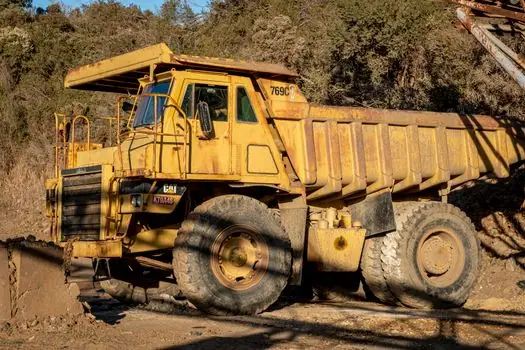
Mining dump trucks (off-highway) are designed for pit haul roads with payloads in the 40-100+ ton band and dual rear axles, which puts them at the top of the payload hierarchy but at the bottom for road legality in most jurisdictions [S5]. Articulated dump trucks (ADTs) use a pivot joint between tractor and trailer, with 6x6 all-wheel drive, low-pressure tires, and full-frame oscillation engineered for mud, steep grades, and severe off-road conditions, which is why they are the default in remote mine access and ski-resort service roads [S2][S5]. A mining dump truck is purpose-built for high-tonnage off-road haul, not for navigating suburban cul-de-sacs at posted speeds.
Snow Plow Mounting Window and Regulatory Frame
Massachusetts General Laws c. 90, section 19K restricts vehicle plow mounting to the period from October 15 through May 15 for snow-removal purposes, with specific exceptions outside that window [S1]. 105 CMR 410.260 places clearing responsibility on landlords for walk and stairs, and 780 CMR 1001.2.1 (building code 10th edition) requires exterior stairways and fire escapes to be kept free of snow and ice, which keeps demand for plowed auxiliary vehicles high in dense northeastern municipalities [S1].
Where chemicals are applied, 310 CMR 22.21(2) regulates wellhead protection and the storage of snow and ice removal chemicals to prevent groundwater contamination, and MGL c. 85, section 7A forbids storing those chemicals in a way that risks water-supply contamination [S1]. State-highway disposal is governed by MGL c. 85, section 7B, which controls depositing snow on state highways and effectively limits where plowed loads can be dumped, another reason truck selection must consider body type and tip direction, not just plow bracket strength [S1].
Why Most Operators Skip the Mining Class for Snow Work
Off-highway mining trucks are designed for sustained, full-throttle haul cycles on private mine roads; their width, axle loads, and ungoverned top speed typically violate public-road vehicle codes outside gated mine property [S5]. The CLW International guide lists mining dump truck limitations alongside standard chassis limits, including the inability to operate on public highways without permits and trailers, which is the gating constraint for any winter-service use [S5].
Standard dump trucks are not ideal for extreme, uncompacted off-road terrain, and that same class is what most snow-removal contractors already own, with the body swapped for a front plow and rear spreader [S2][S5]. The Skidsteers.com "Tip" notes that choosing the right dump truck configuration is about balancing capacity with stability, with standard steel beds best for demolition waste and aluminum beds capable of adding up to 4,000 lb of legal payload, a useful offset when adding plow, salter, and brine-tank weight [S2].
Operator Pay and Crew Reality for Plow vs Dump Work
ZipRecruiter distinguishes snow plow drivers, who focus on winter snow removal, from dump truck drivers, who handle year-round material hauling, with the two roles commonly overlapping in construction and municipal fleets [S3]. Indeed listings from August 2026 show snow plow operator pay at $31.57-$33.09 an hour and tandem/single-axle road maintenance and snow removal operators at $25-$29 an hour, which sets the labor cost band that any truck selection has to clear economically [S4].
The seasonal pay spread reflects two different jobs on the same chassis: a dump-truck driver runs aggregate, asphalt, or demolition year-round, while a plow operator runs the same truck from October 15 to May 15 in Massachusetts and similar windows elsewhere [S1][S3]. Crews in mixed-fleet operations are typically cross-trained between the two, which is why a reach truck or specialized plow-only rig is rarely a substitute for a dump chassis that already plows in winter and hauls in summer.
When a Mining Truck Actually Does Touch Snow Duty
In oil sands, coal, and large copper/iron operations, off-highway mining trucks do operate year-round in snow and ice, but on private haul roads with their own speed limits, lighting, and traffic rules, not on public ways [S5]. The articulated dump truck is the crossover choice: 6x6 AWD, oscillating frame, and low ground pressure let ADTs move through snowed-in access roads, tailings dam crests, and remote pit ramps that standard rigs bog in [S2][S5].
For an underground-equipment or heavy-mining-adjacent spec discussion, the related mining slewing drive selection piece covers the gear-train side of large tonnage machines, and the climbing formwork selection for bridge piers article maps heavy-lift selection logic in cold-climate concrete work. Liner choice also matters once the truck is in winter service: wet salt, sand, and brine accelerate carry-back and corrosion, so HDPE or AR-grade steel liners are typically specified to reduce carry-back and to survive the brine chemistry that truck liners see through a winter [S7].
Decision Criteria: Standard vs Heavy-Duty vs ADT vs Mining
On public roads, the spec shortlist is standard rigid and heavy-duty rigid, with the choice driven by plow-and-salter gross vehicle weight, highway axle limits, and engine torque class [S5]. On gated industrial sites and remote access roads, ADTs out-pull both because the pivot joint and 6x6 AWD keep the truck moving where a rigid chassis would high-center in snow ruts [S2].
Mining dump trucks (off-highway) only enter the picture when the haul road is private, the payload is in the 40-100+ ton band, and the operator is moving overburden or ore rather than plowed lane miles, which is the spec niche covered in the mining dump truck encyclopedia entry [S5]. For plowed municipal lots and arterials, a 6x4 heavy-duty with a front plow and rear spreader remains the default spec, not a 100-ton off-highway hauler [S2][S5].
Limitations and Failure Modes in Cold-Weather Use
Hydraulic seals, plow-lift rams, and spreader-chain drives are the cold-soak failure points that drive winter downtime; the hydraulic system that lifts a dump body is the same architecture that powers most front plow lifts, so cold-rated hydraulic fluid and seal kits are a baseline spec, not an upgrade [S2]. Truck liners see accelerated wear from wet salt and brine because wet material behaves differently on release, which is why properly selected liners reduce carry-back and support smoother dumping in freezing conditions [S7].
Outside the October 15 to May 15 Massachusetts window, attaching a plow is restricted, and storing de-icing chemicals in a way that risks groundwater contamination is prohibited under MGL c. 85, section 7A, so off-season truck storage and chemical-handling layout have to be factored into yard design [S1]. Aluminum bodies buy payload but add susceptibility to road-salt pitting at weld seams, a trade-off buyers should weigh against the up-to-4,000 lb payload gain cited for aluminum dump bodies [S2].
Trackable signals for the next 6 months: (1) any change to MGL c. 90, section 19K that would extend the plow-mount window, since that defines the working season for every chassis on this list [S1]; (2) revisions to 780 CMR 1001.2.1 that would tighten exterior-stair and fire-escape clearance language, which feeds back into contractor fleet demand [S1]; (3) brine-and-belt-spreader adoption rates, which determine whether heavy-duty 6x4 chassis with front plows keep gaining share over dedicated single-axle plow trucks in mixed municipal fleets [S2][S4].