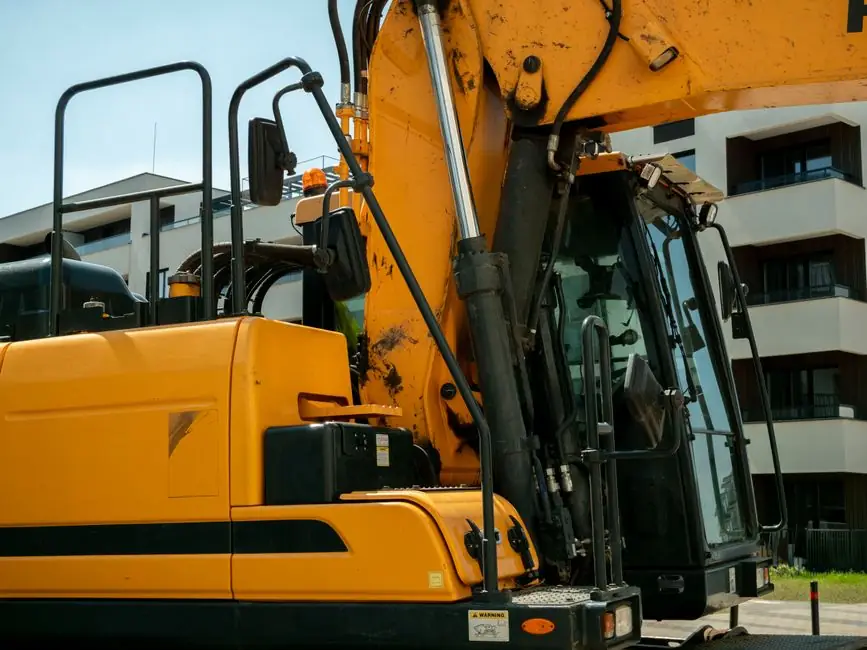
A slewing drive is an integrated gearbox-and-bearing module: a ball or roller slewing ring, a worm or spur gear stage, and an enclosed housing that mounts a hydraulic or electric motor, with max torque up to 450 kNm and tilting moment capacity up to 1,200 kNm at raceway diameters near 1,000 mm [S1].
For material handling, selection starts with what actually rotates: crane booms, conveyor turrets, stacker-reclaimer slewing rings, and indexing tables all share the same load taxonomy (axial, radial, overturning) but place very different demands on ratio, backlash, and sealing. The five parameters that decide a pass/fail spec are tilting moment, output torque, gear ratio, slewing speed, and IP class.
Load Taxonomy: Axial, Radial, and Tilting Moment
For horizontal slewing drives, axial load capacity commonly spans 5 kN to 2,000 kN and overturning moment runs 0.5 kNm to 500 kNm, with ring deflection or seizure as the immediate failure if either is underspecified [S6]. Tilting moment, not weight alone, is the deciding number for most material-handling skids because the centre of gravity of the lifted or rotated load rarely sits over the slewing axis.
For a tower crane in operation, the slewing drive must simultaneously carry jib gravity, lifted payload, wind load on the boom, and inertial force during slewing acceleration, so rolling elements and raceways are typically built from high-strength through-hardened or case-hardened bearing steel [S2]. In contrast, a small automated line-side transfer table tolerates 0.5 kNm class overturning moments and is better served by a compact unit with reduced mass and faster indexing.
For background on how a slewing bearing carries these combined loads, the raceway geometry and ball-pass frequency define the L10 life calculation; an undersized moment rating is the most common cause of premature raceway brinelling in skids that handle off-centre pallet loads.
Worm Gear vs Spur Gear Slew Drive
Worm gear slew drives give high torque density, smooth motion, and inherent self-locking (the load cannot back-drive the motor), which is the safety baseline for lifting, tilting, and aerial work platforms; spur gear slew drives run at higher efficiency and faster rotational speed but lack self-locking, fitting continuous-rotation indexing tables and conveyor turrets instead [S4].
Material-handling selection rule of thumb: if the rotated structure can free-fall under gravity when power is removed (a crane jib, a tilt table, a man-lift basket), specify a worm gear; if the structure is intrinsically stable when stopped (a pallet turntable, an indexing dial), a spur gear unit saves energy and heat.
Hydraulic vs Electric Slew Drive
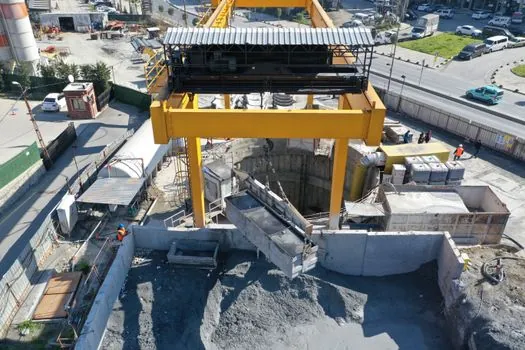
A hydraulic slewing drive combines a radial-piston or orbit motor, a spring-applied hydraulic-release holding brake, a planetary or worm gear stage with ratios commonly between 10:1 and 100:1, and a slewing ring with internal or external teeth [S3]. The hydraulic version keeps the motor package small relative to output torque, which is why a 20-ton excavator upper structure can swing on a single integrated unit rather than a separate slew ring and gearbox.
Electric slew drives accept standard IEC or NEMA frame motors and are often supplied motor-ready with a machined mounting flange, giving clean, quiet, and easily controllable motion for indoor conveyors, packaging lines, and solar tracking [S4][S6]. For material handling cells in classified or washdown zones, electric units also simplify EMC and IP sealing; see the parallel spec map for Slewing Drive Selection for Packaging Lines for indexer-side requirements.
Backlash, Ratio, and Positioning Accuracy
Standard worm slew drives ship with measurable backlash (often a few arc-minutes) suitable for conveyor slews and crane booms; zero-backlash or preloaded variants are specified when a CNC rotary table, a laser-cutting head indexer, or a precision palletiser must hold arc-second class repeatability [S4]. Backlash below 1 arc-minute typically requires a two-stage worm or a harmonic-style reducer, which raises cost and length.
For packaging and pick-and-place skids, a useful cross-read is the Slewing Drive Selection for Packaging Lines torque-ratio-sealing logic; the same ratio envelope (10:1 to 100:1) applies, but the IP and food-grade seal requirements dominate the BOM. For dusty aggregate or cement environments, the cement-plant spec map at Slewing Drive Selection for Cement Plants covers IP65, dust-purgeable seal stacks, and higher torque margins.
Sealing, Lubrication, and IP Class for Harsh Environments

Multi-lip seals retain lubricant and exclude water, dust, and ice, while grease fittings on the raceway, worm gear, and worm-shaft support bearings allow re-lubrication; tapped or clearance holes on the rings accept mounting bolts directly into the structure [S5]. In washdown or outdoor material handling, specify IP65 minimum, with IP66 or IP67 where steam cleaning or immersion is expected.
For slewing drive and bearing lubrication intervals, the operating environment dictates grease choice: high dust load pushes shorter re-lube intervals, while cold stores (-30 deg C and below) require synthetic grease with a low-temperature base oil to keep the worm gear within its efficiency window. The slewing ring should be filled with EP2 or equivalent lithium-complex grease unless the OEM specifies otherwise.
Selection Checklist and Sizing Workflow
A reliable sizing workflow runs: (1) compute the rotating mass and its centre of gravity, (2) derive axial load = m*g and tilting moment = m*g*e, where e is the eccentricity from the slewing axis, (3) add a 1.5 to 2.0 service factor for dynamic and wind loads, (4) pick a worm or spur unit whose rated tilting moment and torque meet the factored values, and (5) verify ratio and IP against the duty cycle [S3][S6].
Use the table below to shortlist by application.
Application, drive type, typical torque, ratio, IP target. Tower crane jib slew, worm gear, 50 to 450 kNm, 50:1 to 100:1, IP55 to IP65. Stacker-reclaimer, worm gear, 20 to 150 kNm, 40:1 to 80:1, IP65 to IP66. Indexing turntable, spur gear, 0.5 to 10 kNm, 10:1 to 30:1, IP54. Indoor palletiser, electric worm, 1 to 15 kNm, 30:1 to 60:1, IP65. Excavator upper, hydraulic worm, 30 to 200 kNm, 60:1 to 100:1, IP66 to IP67. Solar tracker, worm gear, 1 to 8 kNm, 60:1 to 100:1, IP65.
Background reading on the drivetrain that feeds the slew drive: a slewing drive usually pairs with a drive motor selected for the same duty cycle, and the slewing ring bearing inside the unit is the structural element that actually carries the load path.
Limits, Failure Modes, and What Underspec Looks Like

Three failure modes dominate slewing-drive warranty returns: brinelled raceways from impact or moment overload, fatigue spalling from undersized L10 life, and seal failure that contaminates the grease [S3][S6]. In worm units, a fourth mode is backlash growth from wear, which presents as lost indexing accuracy long before the bearing itself fails.
A practical warning: do not size a slewing drive by output torque alone. A 50 kNm drive with a 100 kNm tilting moment rating is not interchangeable with a 50 kNm drive rated for 250 kNm tilting moment, because moment capacity is governed by the ball-pass geometry in the slewing ring bearing, not by the gear stage.
Trackable next nodes: (1) confirm whether the unit ships with a holding brake matched to the maximum loading moment, and (2) request the OEM's L10 life calculation at your factored load spectrum before issuing a PO. Sealing and storage-handling practice on the receiving dock also drives early-life failures; for that side, see the storage handling guidance on greased-bearing shelf life and re-lube before commissioning.