
A new aerial work truck (a bucket or aerial work platform mounted on a Class 6–8 chassis) typically carries a 5–7 year total cost of ownership where the chassis purchase price is only 25–40% of the lifecycle bill, while fuel, maintenance, insurance, and aerial-device inspections consume the remaining 60–75% [S5][S9].
For fleet planning purposes, treat the chassis and the aerial device as two separate TCO stacks that age at different rates: the chassis follows a vocational-truck curve (depreciation heavy in year 1, maintenance heavy in year 4–5), while the boom, outriggers, hydraulic system, and fiberglass boom follow an ANSI A92.2 inspection cadence that adds a fixed annual line item independent of miles driven [S1][S2].
The 8 Cost Categories That Drive Aerial Work Truck TCO
A defensible aerial work truck TCO model aggregates 8 cost categories over the analysis period and nets them against estimated residual value: acquisition + financing, fuel + DEF, maintenance parts + labor, tires, insurance, registration and compliance, telematics/fleet tech, and aerial-device inspection + boom certification, with downtime cost folded into the maintenance and labor lines [S4][S5].
Fuel + DEF is typically 25–35% of 5-year TCO across vocational trucks, and aerial work trucks sit at the upper end of that band because idling at the work site is part of the job: PTO-driven hydraulic pumps, on-board compressors for dielectric units, and cab A/C or heat all burn diesel with the truck stationary [S5]. Maintenance parts + labor typically runs 15–25% of 5-year TCO, weighted heavily to years 3–5 once the chassis leaves powertrain warranty, but the aerial-device side (boom lubrication, hydraulic hose replacement, outrigger pad replacement, fiberglass section repair) is a flat $2K–$6K per year regardless of mileage, and rises sharply after year 6 [S1][S4].
Per-Mile Reality: 2026 Benchmarks for Vocational and Class 8 Chassis
For 2026 fleet planning, the credible per-mile benchmarks sit in a narrow band: ATRI's 2025 industry sample reported $2.336 per mile all-in for Class 8 tractors across 178,091 units and 14.08 billion miles, and Oxmaint's 2026 framework places Class 8 TCO at approximately $0.62–$0.82 per mile for variable operating cost at 100,000 miles per year, depending on fuel price and maintenance program discipline [S5][S9].
Argonne's AFLEET analysis treats vocational trucks, refuse trucks, and transit buses as a high per-mile TCO class because of maintenance and insurance, with labor dominating the operating side and fuel the second-largest line, and aerial work trucks behave more like a refuse or utility truck than a long-haul tractor because of high idling fraction, frequent low-speed maneuvering, and on-site work cycles [S1]. The practical implication: an aerial work truck running 25,000–40,000 miles per year (typical for utility fleets) carries an annual operating cost in the $40K–$80K range before residual credit, and a 7-year lifecycle TCO commonly lands between $350K and $700K depending on chassis class and aerial-device size [S5][S9].
Acquisition vs. Leasing: The Hidden-Cost Math
On a per-mile basis, ownership cost averages $0.80 per mile versus $0.65 per mile for a full-service lease in the Ryder dataset, a 19% per-mile delta, but the lease number folds in substitute vehicles during boom or chassis downtime, which is the real economic argument for an aerial work truck lease: when a 50-foot bucket unit is down for boom recertification, a $0/day replacement can swing a utility crew's billable hours by tens of thousands per month [S3]. For a small municipal or contractor fleet running 2–4 units, full-service leasing typically wins; for a 30+ unit utility or telecom fleet with stable routes and in-house boom techs, ownership wins on per-mile cost [S3][S6].
Standards, Inspections, and the Fixed-Cost Layer Most Models Miss
The aerial-device side of TCO is governed by standards that impose costs independent of miles: ANSI A92.2 (Vehicle-Mounted Elevating and Rotating Aerial Devices) drives annual visual and functional inspections plus load testing on a fixed cadence, and OSHA 29 CFR 1910.67 / 1926.453 govern operator training and the pre-shift functional test that must be documented every day the unit is used [S2]. On a typical 40–50 ft dielectric unit, annual ANSI A92.2 inspection + load test runs $1,200–$2,500 at an independent inspection provider, dielectric fluid testing adds $400–$800 per year, and a 5-year full structural inspection (often required by the standard or by the fleet's own risk policy) can run $4K–$8K, all of which belong in the TCO model as a fixed annual line rather than a per-mile item [S2][S4].
Geotab's TCO framework, which splits Acquisition + Financial + Operating + Maintenance + Downtime minus Resale, makes these compliance-driven fixed costs sit cleanly in the maintenance column rather than being absorbed into a per-mile average [S4].
Cost Driver Comparison: Light Aerial (Class 5–6) vs. Heavy Aerial (Class 7–8)
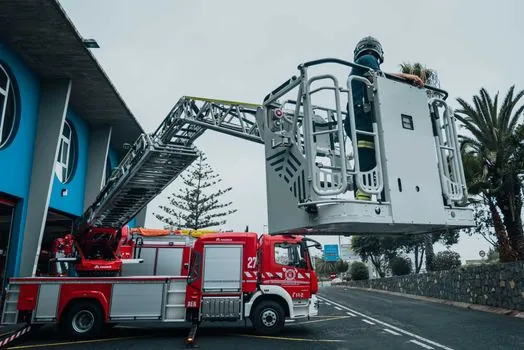
The single largest decision point in an aerial work truck TCO model is chassis class, because the maintenance and fuel curves scale non-linearly with GVW.
A Class 7–8 chassis with a 50–80 ft material-handling or digger-derrick aerial work truck carries a 5-year TCO commonly in the $500K–$900K band, with acquisition at 20–30% of total because the chassis is $140K–$180K and the larger aerial device adds $80K–$200K, but fuel, tires, and insurance are all higher per mile [S1][S5]. The decision criterion is rarely price; it is utilization (annual hours on the boom, miles driven between job sites) and operator certification overhead, because the bigger unit only pencils out when the boom is on a job site 1,200+ hours per year [S1][S3].
Total Cost of Ownership: 5–7 Year Lifecycle for an Aerial Work Truck
The classic TCO formula, TCO = Acquisition Costs + Financial Cost + Operating Cost + Maintenance Costs + Downtime Costs, less Resale Value, applies directly to an aerial work truck once the aerial-device inspection cadence is added as a fixed annual line and the chassis maintenance curve is split by year of service [S4].
Year 1 is depreciation and acquisition heavy, with chassis warranty covering most powertrain repairs and aerial-device warranty (typically 12 months on structure, 6 months on components) covering most boom issues, so out-of-pocket maintenance is low. Years 2–3 typically produce the lowest combined cost per mile as chassis depreciation eases, and out-of-warranty maintenance is still moderate. Years 4–5 see chassis maintenance and downtime rise sharply, but the aerial device is also reaching its mid-life inspection and possible boom-section refurbishment, so the two cost stacks stack on top of each other rather than offset [S5]. The replacement decision point for most fleets is year 7–8, when cumulative maintenance approaches year-1 levels for very different reasons, and a 5-year analysis is too short to capture the boom mid-life cost layer [S5].
Lowering Aerial Work Truck TCO: What Actually Moves the Number
Geotab's TCO framework explicitly lists telematics and fleet management technology as a TCO line item that pays back through improved visibility, reduced fuel waste, lower maintenance costs, and stronger asset utilization, and for an aerial work truck that payback is typically 12–24 months because idling and route deviation are the two largest controllable fuel costs [S4]. Insurance premiums vary by vocation and by driver safety record, and aerial work trucks sit in a higher-risk class than straight vocational trucks because of overhead electrical work, road-side exposure, and two-person crews, so demonstrating boom inspection cadence and operator certification discipline is a direct lever on the insurance line [S1][S3]. Comparable long-lifecycle TCO math on a different capital asset, an overhead bridge crane, follows a similar pattern where acquisition is a minority of 20-year cost and inspection cadence dominates, as detailed in this overhead bridge crane TCO breakdown. For fleet owners comparing acquisition options on the chassis itself, the backhoe loader installation trade-offs and skid steer commissioning flow cover the same upfitting-vs-OEM-frame decision pattern that determines whether your boom install is on a warrantied chassis or a third-party upfit. A trackable signal for the next quarter: ICCT's 2026 TCO calculator release and any 2026 ATRI vocational-truck update that breaks out bucket and digger-derrick units from the broader Class 8 sample.
The underlying component specifications are covered under total station.