
Sand casting in aerospace production typically uses silica-sand molds bonded with clay (green sand) or chemical binders (air set) to pour aluminum alloys such as A356 and A357, with finished part weights documented from a few ounces up to several tons [S2]. For large structural components where surface finish is a secondary concern, the sand casting mold route is the standard process path [S1].
Foundries serve airframe, defense, and space programs through the same basic sequence: pattern placement, mold split, mold re-assembly, pour, cool, and demold [S2]. Process selection between sand and investment casting drives tolerance, surface finish, and per-piece cost, so the upstream mold choice governs downstream machining budgets [S2].
Mold Systems and Binders Used in Aerospace Sand Casting
Air-set sands are widely specified for aerospace sand mold castings because the chemically bonded system tolerates complex geometry and large box dimensions, with silica sand (SiO2) as the dominant aggregate mixed with a binder [S3]. Green-sand systems remain the high-volume workhorse; DISA Match 20/24 automated green-sand molding lines are used by U.S. non-ferrous foundries to minimize cost per casting even on short runs [S5].
U.S. Navy airframes and NASA spacecraft programs both rely on aluminum-alloy sand castings, including wheels, control arms, cross members, steering knuckles, and brake calipers, where the cast part replaces a heavier steel or forged equivalent at roughly one-third the density [S1]. The casting mold choice therefore cascades into alloy selection, heat-treatment schedule, and final machined-tolerance envelope.
Aluminum Alloys: Why A356/A357 Dominate Aerospace Sand Castings
Cast aluminum is documented at approximately one-third the weight of steel, with high corrosion resistance and thermal/electrical conductivity that meet aerospace structural and thermal-management requirements [S1]. Aerospace aluminum alloys pair base aluminum with silicon, manganese, copper, zinc, or magnesium to add strength, and can be further strengthened by cold working plus separate heat-treatment steps [S1].
Skylab, the Space Shuttle, Apollo spacecraft, and the International Space Station all used aluminum alloys to some degree, with NASA specifying cast aluminum for repeated-load mechanical parts because of strength, durability, and weight efficiency [S1]. For procurement teams comparing processes, the mold base selection directly governs which alloys can be poured at the required section thickness without hot-tear or shrinkage defects.
Sand Casting vs Investment Casting: Aerospace Decision Matrix

Investment casting, also called the lost-wax method, uses a wax pattern tree dipped in a ceramic slurry to form a shell mold, with finished part weights documented from a fraction of an ounce to several hundred pounds and a six-step process flow [S2]. It targets thin walls, complex internal passages, and tight tolerances with minimal post-machining [S2].
Sand casting, by contrast, scales from a couple of ounces to several tons per part, uses lower-cost molds, and allows the sand to be reclaimed for new molds, a significant material-economics advantage on large structural castings [S2]. Where a design needs large parts and surface quality is not the gating issue, sand casting is the right technology; where intricate geometries and high surface finish dominate the requirement, investment casting is specified [S2]. For foundries running high-mix defense and aerospace work, the sand mixer and sand cooler lines are sized to support both the green-sand and air-set flows feeding the same pouring floor.
Process Controls, Defect Modes, and Inspection
Top sand casting foundries operate modern equipment such as DISA Match 20/24 automated green-sand molding machines, specialized furnaces, in-house chemical analysis, and flow-simulation software to maintain alloy composition within specification and finished-casting dimensional tolerance [S5]. Routine composition checks on every heat and dimensional inspection on every finished part are cited as baseline practice for premier facilities [S5].
Smart sand molds and 3D design principles are an active research direction at university mechanical and aerospace manufacturing programs, with the explicit goal of integrating sensors and additive pattern tooling into the resin-sand line workflow for next-generation aerospace castings [S4]. For production programs, this translates into a near-term path where 3D-printed patterns replace traditional wooden or metal patterns, shortening lead time on prototype airframe brackets and engine housings without retooling a full match-plate set [S4].
Supplier Selection Criteria for Aerospace Sand Castings
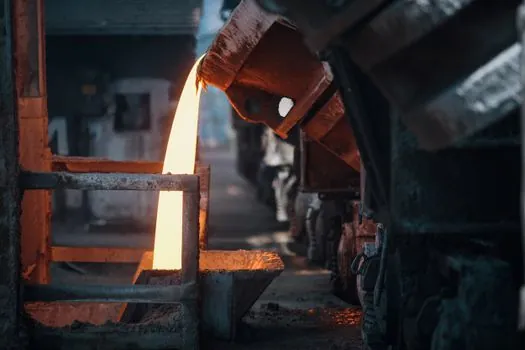
The top U.S. sand casting suppliers differentiate on three documented axes: modern equipment and technology, alloy knowledge across dozens of aluminum-bronze and specialty compositions, and in-house quality control with chemical analysis plus flow simulation [S5]. ITAR registration and MIL-Spec alloy capability are common gating requirements for defense and aerospace work, and several Erie-region foundries list those credentials alongside non-ferrous bronze and aluminum sand casting capacity [S5].
Buyers comparing suppliers should weigh four verifiable criteria: (1) molding line type and automation level, (2) alloy and heat-treatment range, (3) in-house NDT and dimensional inspection, and (4) ITAR/MIL-Spec compliance. For foundries running mixed aluminum bronze and aerospace aluminum work, the C954 aluminum bronze and C89833 copper-bismuth alloy families are cited as baseline competency markers [S5].
Where Sand Casting Is and Is Not the Right Answer
Sand casting fits aerospace use cases where the part is large (tens to thousands of pounds), the alloy is a castable aluminum or copper-based grade, and post-machining can absorb moderate surface roughness. It is the wrong choice where the section is below roughly 3-5 mm with tight tolerance, or where complex internal passages would otherwise drive a ceramic-shell investment casting build [S2].
Trackable signals to watch over the next two quarters: (1) additional DISA Match-class automated molding line announcements at ITAR-registered U.S. foundries, and (2) university-industry smart-sand mold demonstrators moving from coupon-scale tests to flight-relevant bracket geometries. For related spec-first selection workflows on industrial hardware categories, see this vision controller selection spec map for 2026 industrial builds and this pneumatic actuator market share by manufacturer 2026 ranking.