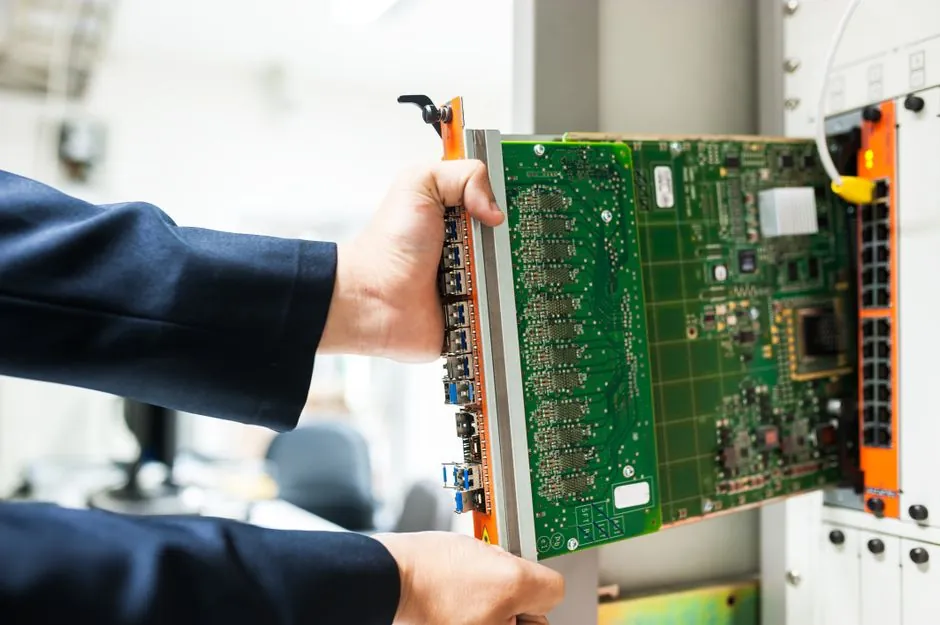
Vision controllers are the real-time processing cores that turn image data from industrial cameras into pass/fail, measurement, and code-read results, and their selection is dominated by four numbers: camera count, peak frame rate, interface bandwidth, and lighting-drive capability [S2][S4].
The three controller classes in scope are standalone vision controllers (often called machine vision controllers or vision processors), smart cameras with embedded controllers, and PC-based industrial controllers running vision software. The class you pick is set by throughput, footprint, and integration, not by brand [S1][S2].
Standalone vs Smart Camera vs PC-Based: Decision Criteria
Standalone vision controllers such as the Zebra 4Sight series target demanding single high-rate or multi-camera imaging applications, where they accept GigE or USB3 Vision inputs, drive external vision light sources, and pass results to a PLC over Ethernet/IP, PROFINET, or discrete I/O [S1].
Smart cameras integrate the sensor, lens, processor, and lighting drive into one IP-rated housing; they win on footprint and cost when a single view resolves the inspection, and they typically cap out around 2 to 5 MP at moderate frame rates [S4].
PC-based industrial controllers pair a fanless or ruggedized box PC with a frame grabber or 10 GigE NIC and run a full vision suite; they are the only realistic answer above roughly four GigE cameras or any line-scan / 3D workload, and they scale by adding machine vision system software licences and PCIe lanes [S1][S4].
A simple selection rule: one camera, simple pass/fail, tight cabinet, choose a smart camera; one high-rate camera or 2-4 cameras with mix of 2D/3D, choose a standalone controller; more than four cameras, line scan, or heavy AI inference, choose a PC-based controller [S2][S4].
Processing Power, Memory, and Frame-Rate Headroom
Frame rate at full resolution is the single number that disqualifies most controllers; a 5 MP CMOS sensor at 60 fps streams roughly 2.4 Gbps internally, and a controller that advertises a 1 GigE uplink will bottleneck the moment two such cameras run together [S4].
For multi-camera builds, count GigE Vision ports, USB3 Vision ports, and any CoaXPress or 10 GigE uplinks on the datasheet; a 4-port GigE controller is the common minimum for cell-level inspection, while line scan and high-resolution 3D work pushes buyers toward dual-port 10 GigE or CoaXPress 2.0 (CXP-12) frame grabbers [S1][S2].
CPU choice still matters even on dedicated vision controllers, because deep-learning classifiers run on the same box; modern standalone units ship with x86 multi-core CPUs plus optional FPGA or Movidius-class accelerators, and the rule of thumb is to size inference capacity at roughly 1.5-2x the steady-state image rate to absorb defect bursts [S2].
RAM and storage are unglamorous but binding: 16 GB is a working minimum for 2D + simple classification, 32 GB or more is the floor once 3D point clouds or deep nets enter the pipeline, and an SSD is mandatory to keep image-log write loops from starving the vision process [S2].
Lighting Drive Methods and I/O
Lighting controller architecture is one of three: external (separate box driving lights), inline (current/voltage driver built into the light), and embedded (driver inside the vision controller), and the Advanced Illumination white paper of 2024-03-01 lays out the trade-offs explicitly [S3].
External controllers give the most stable current regulation and over-drive strobe modes, which is what you want for high-speed lines; embedded drivers save wiring but tie lighting performance to the controller's PSU budget, and inline drivers are the lowest-cost path for fixed-brightness single-light cells [S3].
Drive method is the other axis: current drive regulates LED output independent of forward-voltage spread and thermal drift, while voltage drive is cheaper but produces brightness shift as LEDs warm up; high-speed lines with strobe-on times under 200 microseconds almost always end up on current drive [S3].
Trigger and I/O discipline ties the controller into the line: look for opto-isolated trigger inputs, at least one quadrature encoder input for line-scan synchronisation, and a minimum of 4 to 8 opto-isolated outputs for sorting and reject confirmation, with PLC fieldbus (EtherNet/IP, PROFINET) carried on a separate, managed port where possible [S1][S2].
Connectivity, Power, and Environment
Power and cabling decisions feed back into controller choice; 24 V DC remains the industrial default, but Power over Ethernet (PoE) collapses camera power and data into one cable, which is why PoE+ ports on a standalone or PC-based controller simplify multi-camera builds in tight cabinets [S4].
Camera interface choice has matured around GigE Vision for cable length up to 100 m, USB3 Vision for short high-bandwidth runs, and CoaXPress for line scan and high-speed 3D; mixing them on one controller is fine if the backplane can sustain aggregate bandwidth, which is why a controller spec sheet always has to be read for total throughput, not per-port numbers [S1][S4].
Environmental specs close the deal: an IP65 or IP67 cabinet rating, an operating-temperature range that covers 0 to 50 degrees Celsius at minimum, and CE / UL / KC certification on the controller body are the common line items; food, beverage, and pharma lines add washdown demands that typically push buyers to a sealed smart camera or a fully IP67 PC-based controller rather than a panel-mount standalone unit [S1][S2].
Integration with Vision Software and PLCs
Software compatibility is the silent killer of vision projects: a controller that meets every hardware spec still fails if its SDK cannot hand results to the line PLC in the fieldbus protocol the plant runs, which is why controller selection is inseparable from vision software selection [S1][S2].
Standalone controllers in 2026 commonly expose REST, OPC UA, MQTT, and the legacy TCP/UDP socket interface, plus the traditional PLC fieldbuses; PC-based systems add GenICam, ROS 2, and direct PLC tag mapping, which lets the same box serve machine vision ID reads and SCADA data without a middle gateway [S2][S4].
For traceability-heavy work such as part marking, code reading, and vision measuring machine cells, the controller has to log every image and every result with a millisecond timestamp; expect to budget an additional SSD or NAS mount and verify the controller's log rotation before signing off the spec [S2].
The deep-learning and AI inference story has moved on board: most new standalone and PC-based controllers ship with at least one inference accelerator (Intel OpenVINO-compatible iGPU, Apple-style Neural Engine, or a discrete M.2 card), which is what now lets a 4-camera cell run classification, OCR, and anomaly detection in real time without an offload server [S2][S4].
Spec Shortlist and Common Pitfalls
A spec-first shortlist reads the data sheet in this order: total interface bandwidth, lighting drive type and channel count, trigger/encoder I/O, supported fieldbus protocols, operating temperature, and finally CPU plus accelerator spec; price and brand fall below that, because under-spec'd bandwidth or I/O will always cost more than the controller [S1][S2][S4].
For a buyer comparing a smart camera, a standalone unit, and a PC-based controller, three numbers usually decide it: maximum camera count, sustained image rate at the target resolution, and whether the environment is washdown-rated; if the answers are 1, under 30 fps, and food-grade, the smart camera wins; if the answer is 2-4 cameras, 60-120 fps, and panel-mount, the standalone controller wins; if the answer is 4-plus cameras, line scan, or 3D, the PC-based controller is the only honest pick [S1][S2][S4].
The most common pitfalls are bandwidth under-spec (two 5 MP cameras on a single GigE uplink), lighting drive mismatch (high-speed strobe on a voltage-drive embedded controller), I/O count drift (encoder and reject signal sharing one opto input), and software-licence creep (per-camera fees that flip the cost calculus between standalone and PC-based); each of these is caught by reading the controller's aggregate-throughput line, its lighting drive spec, its I/O map, and its licence model before the PO is cut [S3][S4].
Trackable signals to watch on the next refresh: 10 GigE and CoaXPress 2.0 port counts climbing on standalone units, more on-board AI accelerators replacing offload servers, and OPC UA over TSN starting to replace classical fieldbus on greenfield lines, with first field-deployed units appearing in cell-level controller datasheets over the next two product cycles.
Background reading: Hydraulic Cylinder Market Share by Manufacturer: 2026 Spec Map.