
Agricultural drivelines are not general industrial couplings with a paint job: a tractor PTO at 540 rpm or 1000 rpm, a round baler running through a flywheel cut cycle, and a rotary mower taking a stone strike all sit in a different mechanical neighborhood than a pump or a fan [S1][S3].
Selection starts with three numbers: nominal torque, peak shock torque, and the misalignment envelope the frame, three-point hitch, or drawbar actually produces in the field, then layers in environment, service factor, and maintenance access [S2][S4].
Torque, Service Factor, and the Agricultural Load Profile
Agricultural applications almost never run at steady nominal torque, so design torque must be the running torque multiplied by a service factor that reflects shock and cyclic severity: 2.0 to 2.5 for hydraulic-driven implements and 2.5 to 3.0 for crushers, choppers, and high-inertia loads [S1]. For a mid-size round baler, a 75 kW tractor PTO at 540 rpm delivers about 1325 Nm running torque, which becomes 2650 to 3310 Nm once a 2.0 to 2.5 service factor is applied before any oversize margin for flywheel cut pulse is added [S2].
The common field failure is not insufficient catalog rating, it is undersized dynamic capacity: a coupling that handles nominal torque but yields its elastomer or key on the stook engagement, the mower blade strike, or the slug feed into the chopper [S1][S3]. As a rule, an oversized coupling that ignores peak shock can actually be worse, because added mass raises polar moment of inertia and increases the magnitude of the very torque spikes the driveline is trying to survive [S2].
Power-take-off drivelines also need to be checked against ASAE S331 and ISO 5675 interface geometry, and any driveline crossing a public road or feeding a stationary PTO-driven unit has to respect the master shield and overrun-clutch requirements that govern agricultural implements, even where the coupling itself is generic [S1].
Misalignment Envelope in the Field: Why Tractors, Balers, and Mowers Are Not the Same
All rotating equipment experiences some degree of angular, parallel, and axial misalignment, and on agricultural machinery that misalignment is a moving target, not a static commissioning value [S2]. A tractor with a three-point hitch swings through arcs of several degrees as the implement is raised, and a trailed baler or mower on uneven ground sees parallel offset change with every wheel rut [S1].
Rigid couplings tolerate zero misalignment and are reserved for shafts that are precision-aligned at install and stay that way, typically inside gearbox housings or on aligned motor-pump pairs on stationary drives, not on implement drivelines that move with the tractor [S3]. Elastomeric jaw and tire couplings absorb angular misalignment up to about 4 degrees and parallel offset up to roughly 0.125 in (3.2 mm), which covers most three-point-hitch geometry, while chain and gear couplings cover higher torque with similar misalignment budget but no electrical isolation [S1][S3].
Where the misalignment envelope exceeds what a single flexible coupling can swallow, the spec moves to a spacer or floating-shaft coupling so the two halves can move independently along the axis [S2]. Disc and beam couplings serve the precision end, high torsional stiffness, low inertia, used on seed-meter drives and implement sensor shafts where any angular lag would distort the signal, not the heavy main driveline.
Matching Coupling Type to the Implement: A Decision Map
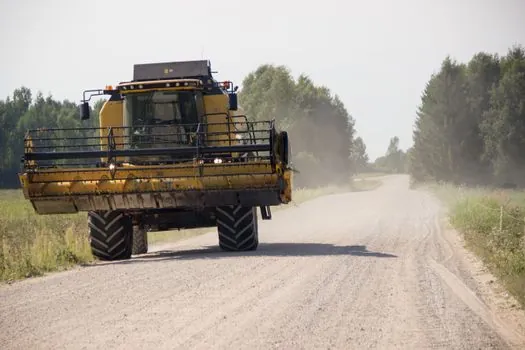
For a tractor main PTO feeding a rotary mower, the typical choice is a jaw coupling or an elastomeric tire coupling: the elastomer dampens the blade-strike shock, the element is field-replaceable, and the misalignment budget covers three-point-hitch swing [S1][S3]. For a baler main driveline carrying flywheel inertia through a stook engagement, gear or chain couplings deliver higher torque density and tolerate contamination better than an open elastomer [S5]. For a high-speed auxiliary such as a fertilizer spreader or a small-diameter seed-meter shaft, a disc or beam coupling keeps torsional stiffness high and inertia low [S2].
Couplings can be lined up on a short list of decision criteria that match how an agricultural buyer actually specifies: peak torque capacity, misalignment budget (angular, parallel, axial), shock and vibration damping, environmental sealing, and field serviceability without removing the shaft [S1][S2][S3].
This is a working map, not a rule set: an undersized gear coupling on a high-shock chopper drive will still fail, and an oversized jaw coupling on a low-speed auger is simply wasted mass that the bearings and shafts must support [S2][S5]. The buying decision is made on torque, misalignment, and damping together, with environment as a tie-breaker, not on a single number. For a broader look at coupling fundamentals shared across industries, the shaft coupling reference page and the shaft fastening primer sit alongside the same engineering language used in steel mill coupling selection and food-grade coupling washdown specs.
Environment, Materials, and What Actually Fails in the Field
Agricultural couplings see temperature swings from roughly -20 to 250 degrees F (-29 to 121 degrees C), constant UV, dust, chaff, fertilizer corrosion, wash-down water, and occasional submersion in mud or manure [S1]. Elastomer selection is the first line of defense: natural rubber gives the best damping and lowest cost but degrades under oil and heat, polyurethane carries higher torque density at the price of more stiffness, and nitrile or EPDM compounds are specified where oil contact, fertilizer splash, or outdoor weathering dominate [S1][S3].
Steel components are usually grade 1045 or 4140 for hubs, with surface treatments from black oxide to zinc plating and, on corrosive or washdown-implement service, powder coat over zinc, while stainless hubs (typically 303 or 316) are reserved for fertilizer and food-adjacent implements where rust staining and contamination are a real risk [S3][S5]. The most common agricultural failure mode is not catastrophic breakage, it is elastomer element wear: a jaw coupling whose spider has lost a lobe, or a tire coupling whose rubber has cracked, leaving the driveline running on a metallic stop and feeding vibration into the tractor PTO and the implement gearbox [S1][S3].
Greaseable gear and chain couplings stay alive in dusty, low-speed service if the lube schedule is honored; once lubricant is ignored, the same coupling that was rated for 50,000 hours becomes a wear part in a single season [S2][S5]. Sealed-for-life elastomeric couplings trade service access for lower maintenance, which is usually the right trade on a tractor that sees the coupling once at pre-season inspection.
Sizing Procedure: A Worked Path from Nameplate to Catalog
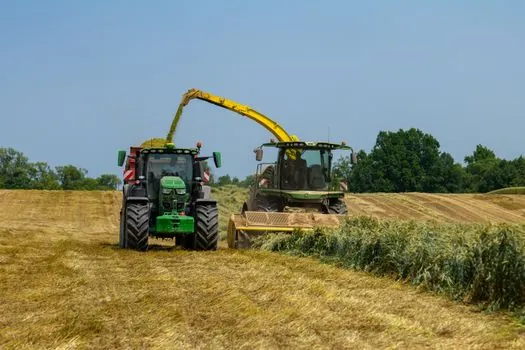
Agricultural sizing follows the same four-step path used in general industrial coupling selection, adapted to peak shock and PTO class [S1][S4]. First, compute the design torque as running torque multiplied by service factor; second, divide by any derating for temperature above the catalog baseline and for non-uniform load; third, check the catalog rating at the actual operating rpm, not just at 100 rpm, because torque capacity on most elastomeric couplings falls as speed rises; fourth, confirm that the selected bore covers both shaft diameters, that the hub length supports the shaft under key or interference-fit rules, and that the spacer or floating-shaft length fits the implement envelope [S2][S4].
Shaft-side hardware is part of the coupling decision, not a separate purchase: a shaft key and a shaft collar lock the hub to the shaft, and the right shaft fastening approach determines whether the coupling can be removed in the field without heating or a puller [S3][S5]. For taper-bore and splined PTO stubs, the coupling-hub interface is essentially the driveline's wear surface, and undersized hub length is one of the root causes of PTO-shaft fretting failures in field service.
Where a clutch function is also required, for example a mower that must freewheel when the blade is stopped, a separate coupling-clutch combination sits in the same envelope and shares the same torque-rating logic, but adds its own engagement and heat-rising constraints on top of the coupling selection.
Standards, Documentation, and What Buyers Should Ask For
Buyers should expect a coupling datasheet that lists continuous torque, peak torque, rated rpm, misalignment envelope broken into angular, parallel, and axial values, bore range with keyway options, service factor guidance, and material/finish declarations, not just a picture and a price [S1][S4]. On agricultural drivelines, the relevant reference frame is the ASAE / ISO PTO interface family (ISO 5675, ISO 5673, ASAE S331, ASAE S304) for the stub end, and AGMA quality classes for gear-type couplings, while the coupling body itself is typically designed to AGMA 9003, AGMA 9103, or the manufacturer's own rating methodology, with balance grade per ISO 1940-1 [S1][S2].
Specifying the operating environment as part of the PO, dust, fertilizer, washdown, ambient temperature band, expected hours per season, is what separates a coupling that lasts 8 seasons from one that fails in the first [S1][S4]. Closing trackable signals to watch: published updates to ISO 5675 and AGMA coupling-class documentation, and any new elastomer compounds rated for bio-based hydraulic oils and oilseed lubricants now common in agricultural hydraulics. The construction-machinery-and-equipment page is the natural reference for the parallel question of driveline selection on heavy mobile plant, where the same torque-and-misalignment logic applies with even less room for error.