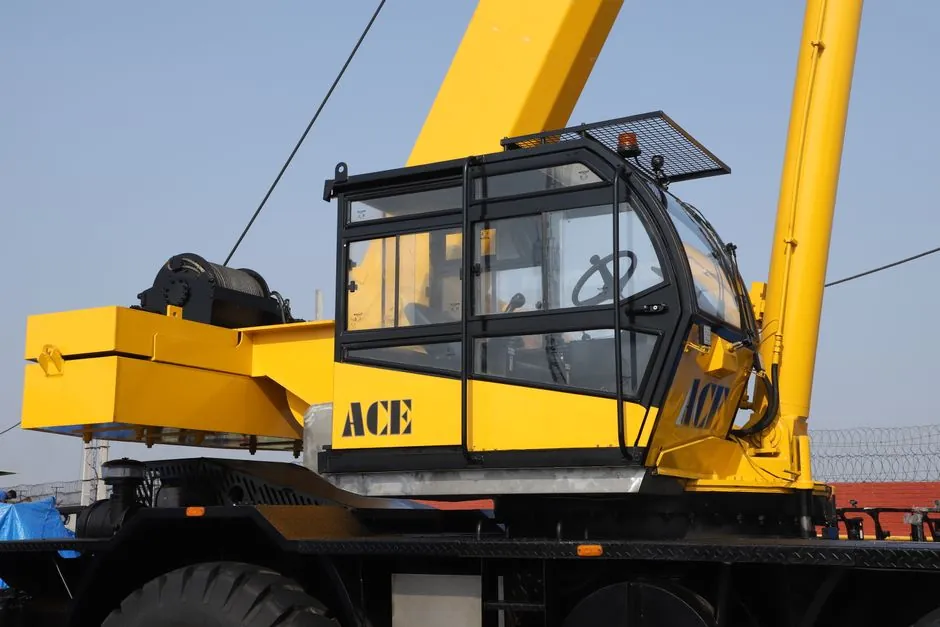
For mixed farm duty, a knuckle-boom crane in the 1-15 tonne-metre lifting moment class, mounted behind the cab or on the rear of a 6x4 or 8x4 chassis rated within the truck's GVWR, covers roughly 80% of hay-bale, bag-handling, and light equipment lifts, with rear fold-away stowage preserving deck payload space [S1].
Agricultural buyers should treat crane capacity, hydraulic reach, and chassis plated weight as a single coupled problem: every kilogram added to crane, body, and outrigger base subtracts directly from the legal payload the truck can still carry on the road, so the chassis GVWR and front/rear axle ratings set the hard ceiling on crane selection before any brand comparison begins [S3].
Knuckle-boom vs telescopic boom on the farm
Knuckle-boom cranes dominate agricultural specification because the folding jib stows tight against the body, leaving the flatbed clear for seed bags, fertilizer pallets, or hay bales, and the multi-articulated geometry gives a low approach angle for placing loads inside low barn doorways [S1]. Telescopic-boom cranes deliver longer straight-line reach for tall silo or roof work but consume deck length when stowed and are less common on farms for that reason [S7].
For dedicated farm-lift cycles, HIAB-class knuckle-boom cranes pair with stability-assist features such as Variable Stability Limit and Load Stability System, which let the operator extend the outrigger footprint based on the live load chart rather than locking to a fixed envelope [S1]. Rough-terrain and crawler cranes are stronger candidates for one-off silo or barn-construction lifts on soft ground, but they are not road-mobile in the same way a truck-mounted unit is and require lowboy transport between fields [S2].
Capacity bands and the chassis they require
Service-crane model codes already map to tonnage: Stellar's 7621 through 14530 hydraulic series covers roughly the 7,200-14,500 lb capacity class, while its electric and electric-hydraulic 2000-6000 series fills the sub-6,000 lb class typical of light agricultural service bodies [S3]. A 4x2 or 4x4 chassis in the 15,500-19,500 lb GVWR class is the usual pairing for the smaller electric-hydraulic units, with 6x4 chassis above 33,000 lb GVWR reserved for the heavier 10K-14K fully hydraulic service cranes [S3].
Buyers should size to the heaviest single piece of equipment that will be lifted, not the average load, because mobile-crane lifting capacity drops sharply as the radius extends and the boom elevates; a crane rated 5 t at 2 m may only lift 1 t at the full radius stated on the load chart [S2]. For hay-bale, bag-stack, and small-AG-handler work, a 2-5 tonne-metre crane is normally sufficient, while grain-bin, large round-bale stack, and PTO-driven implement handling pushes the requirement into the 8-15 tonne-metre band.
Where telehandlers win, and where they don't
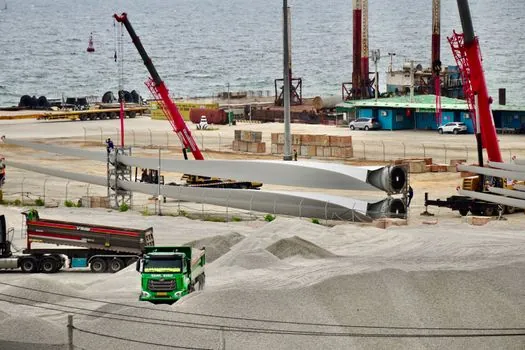
For farms that repeatedly switch between forks, buckets, platforms, and jibs on the same site, a telehandler typically offers higher daily utilization than a truck-mounted crane, because one machine replaces several single-purpose handlers and rides well on rough, muddy terrain [S4]. Truck-mounted cranes win on the opposite duty cycle: highway travel between properties, multi-stop roadside service, and crane-style hook picks where direct road access and rapid deployment matter more than attachment flexibility [S4].
This split maps cleanly to mixed-fleet operators: contractors and equipment-rental yards that work both agriculture and construction often run both, since telehandlers reduce single-purpose machine count on site while truck-mounted cranes cut transport time for service-style work between farms and townships [S4]. The decision pivot is whether the average work day is "lift, carry, stack on one site" or "drive, lift, drive to the next stop".
Outriggers, stability systems, and operator aids
Variable Stability Limit and Load Stability System allow the operator to define the support polygon (outrigger extension, front stabiliser position) per lift, and the crane controller then enforces the matching capacity envelope in real time rather than defaulting to the worst-case minimum [S1]. HiPro control and Crane Tip Control add fine joystick mapping and end-position damping, which materially reduces hook swing when placing fragile items such as irrigation pumps or generator sets on prepared pads [S1].
For farm work, semi-automatic folding speeds the daily cab-to-cab transition between transport and lift modes, and remote-control pendants like CombiDrive3 let a single operator position the load and the truck at the same time on uneven ground, which is the typical case when unloading onto a soft field edge [S1]. Buyers should verify whether stability assist is hydraulic-mechanical (slew-rate limited, robust in dust and cold) or purely software-mapped on a load-moment indicator, because agricultural duty cycles include long idle periods in barns where the latter can drift.
Selection matrix: matching crane type to farm duty
Three decision criteria separate the main options on a real farm: road-mobility requirement, attachment diversity, and the soft-ground share of the lifting cycle. Truck-mounted knuckle-boom cranes score high on road-mobility and moderate on attachments; rough-terrain and crawler cranes score high on soft-ground stability but low on road-mobility; telehandlers score high on attachments and moderate on road-mobility when trailer-transported [S4][S2].
For a single hay-and-livestock farm with infrequent silo work, the truck-mounted knuckle-boom in the 2-5 tm class on a 4x2 chassis is the lowest-total-cost option. For a mixed-grain-and-contracting operation with regular equipment-dealer pickups, stepping up to a 6x4 chassis with a 10-15 tm knuckle-boom and full outrigger spread is the right size. For a soft-ground, low-approach barn site where the unit will rarely leave the property, a telehandler often displaces the truck-mounted crane entirely.
Use cases that change the spec
Loading seed and fertilizer: a 1-3 tm knuckle-boom with 4-6 m hydraulic reach handles palletized bag stacks and bulk-bag lifts without consuming deck space, and pairs with a truck-mounted farm forklift for last-mile field delivery [S1]. For hay-bale cycles, the limiting factor is usually vertical reach to stack the top row in the barn, not raw capacity; 8-12 m of hook height is the typical minimum for round-bale stacking rigs.
Silo, generator, and large-feeder installation on soft ground shifts the spec toward rough-terrain or crawler cranes with outrigger pads, because truck-mounted outriggers punch into soft soil and the load chart collapses faster than the operator expects [S2]. For farm-building construction and renovation, mobile crane rental is the more common route than ownership, since the lifts are infrequent but require a heavier machine than the farm's own unit [S2].
Chassis, GVWR, and compliance constraints
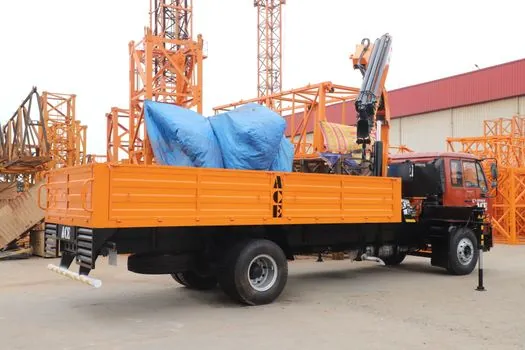
The combined weight of crane, subframe, body, and outrigger base must be subtracted from the chassis GVWR before any payload calculation; exceeding front or rear axle ratings is a roadside-prosecution risk and an insurance exposure that agricultural buyers frequently underestimate [S3]. For North American road use, the truck must also respect bridge-formula and tire-load limits at full crane weight, even when the crane is stowed and travelling empty between fields.
Stellar's electric and electric-hydraulic 2000-6000 series is designed to mount on lighter 4x2 chassis in the 15,500 lb GVWR class, where a fully hydraulic 14530 unit demands a 6x4 chassis above 33,000 lb GVWR [S3]. The pattern is the same across the knuckle-boom segment: every step up in lifting moment and boom length costs chassis weight and operator-license class, so the spec should start from the heaviest legal chassis the farm already operates and work backward to the largest crane that still fits.
Trackable signals and next nodes
Watch two signals over the next 12 months: knuckle-boom manufacturer expansion of mid-range 5-10 tm models with integrated stability-assist controllers aimed at the farm segment, and rough-terrain crane rental fleets adding agricultural-season inventory in the spring planting and fall harvest windows [S1][S2]. A third node is chassis electrification: light-duty 4x2 electric chassis in the 15,500-19,500 lb class, paired with electric-drive knuckle-booms, would reset the on-farm noise and exhaust-heat profile around livestock barns, and OEM delivery dates in this class are the next verifiable fact to watch. Buyers comparing truck-mounted crane options to telehandlers should also weigh a dump truck chassis swap if the farm already runs one for grain haulage, since rear-hinged fold-away cranes preserve dump-bed tip capability when the crane is not in use.
For the relevant spec sheets and selection criteria, see truck mounted concrete pump.
For related coverage, see Screw Pump vs Concrete Pump Truck: Selection Matrix for 2026 Jobsites.