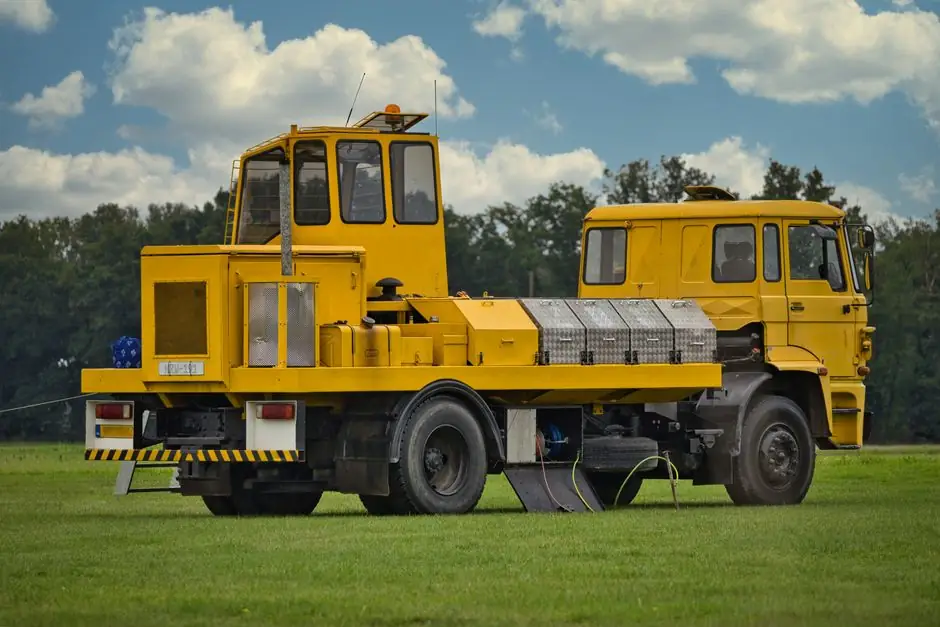
A screw pump (also called an auger or squeeze pump) handles mortar and grout at low pressure with no coarse aggregate, while a concrete pump truck uses a hydraulically driven double-piston pumping cylinder to push structural concrete with 3/4 inch rock through 3 to 5 inch slickline at hundreds of atmospheres [S2].
The two machines solve different problems on a jobsite, and choosing the wrong one costs a crew in plugged lines, slow cycle times, or a complete re-pour. Below is a working engineer's breakdown of when each technology earns its place on the dispatch sheet, the operating envelope that separates them, and the failure modes that show up when the wrong pump is forced into service.
Operating Principle: Auger Cavity vs Double-Piston Cylinder
Concrete pumps in the field today are dominated by hydraulically driven double-piston pumps, with peristaltic and squeeze designs reserved for low-pressure grout and mortar work [S2]. A truck-mounted concrete pump pressurises concrete inside two alternating pumping cylinders, with the return-stroke piston creating a vacuum that draws mix from the feed funnel and the delivery-stroke piston pushing the charge through the transfer tube and boom pipeline; the cylinders are linked through a common hydraulic oil circuit and operate in a two-stroke mode driven by a diesel engine [S2].
A screw pump, by contrast, moves mix by the progressive cavity of a rotating auger or by squeezing a flexible tube with a roller, so the only pressure the mix sees is what the rotating element can push against a downstream restriction. That design envelope is why squeeze pumps, as one operator put it from a Schwing 36M boom pump perspective, are really mortar or grout pumps with no large stone in the mix, just sands [S3]. The rule of thumb in the field for a piston-type high-pressure pump is that the pipe or hose diameter must be at least 3 times the nominal top size of the aggregate, with 4 times being the conservative practice, so a 3/4 inch mix calls for a 3 inch hose, while many slickline placements use 4 inch pipe feeding a 3 1/3 inch by 40 ft placing hose [S3].
Throughput and Head: 180 m3/h and 38 m vs Grout-Duty Output
Boom concrete pump trucks in commercial fleets are routinely rated at outputs up to 180 m3/h, with the CIFA K42L and K56L cited as benchmark models in a dealer's 2025 lineup and used to feed high-rise and large industrial pours [S1]. Historical proof of head capability dates back to 1927, when German engineers Max Giese and Fritz Hull pumped concrete to a height of 38 m and a distance of 120 m through pipes, the demonstration that established the working envelope every modern boom pump is still designed around [S2].
A screw pump cannot approach that envelope. Squeeze and peristaltic designs are limited to lower pressures because the elastomeric tube or the rotating seal is the pressure boundary, not a metal cylinder pushing against a closed valve, and the published line-pump and grout-pump aggregate limits reflect that: line pumps can move 3/4 inch rock, while grout pumps are restricted to 3/8 inch or pea gravel size aggregate only [S2]. For ground slabs, sidewalks, and swimming pools that is fine; for any structural pour with structural coarse aggregate, it is a hard ceiling. Line-pump hoses are offered in standard lengths of 3.0, 3.8, 7.6, and 15.2 m (10, 12.5, 25, and 50 ft), and they are coupled together manually and fed by hand to the pour point [S2].
Mix Design: Flyash Lubrication, Paste Content, and Stone Geometry
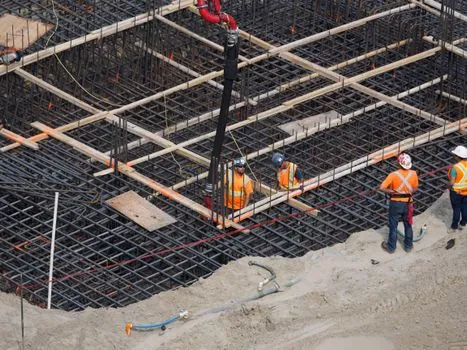
Pumpable concrete is governed by paste content and sand gradation, not water volume, and the consensus from piston-pump operators is that up to 20 to 25 percent of cement by weight can be replaced with flyash before finishability suffers [S3]. Flyash particles are roughly 10 times smaller than cement particles, so the relative smoothness of the fines layer against the pipe wall is what keeps a 3 to 5 inch slickline flowing without plug-ups [S3].
Round, clean stone pumps more easily than crushed stone of the same nominal size, because the smoother surface reduces paste demand and the lower angularity cuts resistance in the slickline; an experienced piston-pump operator will specify round rock and a richer paste whenever the line is long or has multiple reducers [S3]. Reducer geometry matters: a 4 inch to 3.5 inch reducer is typically built 16 inches long, while a 5 inch to 4 inch reducer runs 36 inches long, and the longer the taper, the lower the pressure spike and the lower the risk of a plug at the transition [S3]. Screw pumps cannot tolerate that stone geometry conversation at all, because any coarse particle will either stall the rotor or rupture the elastomer.
Site Fit: Boom Reach, Outrigger Pad, and Crew Size
Boom concrete pump trucks are mounted on a truck chassis and use a multi-section articulating robotic arm controlled from the cab or via remote, with hydraulic outriggers extended for stability before the boom is slewed over the pour [S1]. A typical high-volume boom placement is a less labour-intensive operation than a line pump because the operator does not have to drag and re-couple hose sections by hand, so the crew cost on a structural pour shifts toward the truck and one operator instead of a hose crew of three to five [S2].
Line pumps, including trailer-mounted and small truck-mounted units, are the right tool for tight-access pours where the boom truck cannot set up: residential foundations, sidewalks, driveways, swimming pools, and most ground slabs where the boom cannot be unfolded because of overhead wires, neighbouring structures, or yard access [S1][S2]. A concrete mixer truck feeding a boom pump remains the standard supply chain for any structural pour, and the boom pump's hopper agitator keeps the mix live between mixer truck cycles [S1].
Selection Matrix: Piston Boom Truck, Line Pump, or Screw Pump
Three decision criteria separate the three technologies cleanly. First, maximum aggregate size: boom piston pump 3/4 inch, line pump 3/4 inch, screw/grout pump 3/8 inch [S2]. Second, expected output: boom piston pump up to 180 m3/h in production trim, line pump typically 30 to 90 m3/h, screw pump well below that and limited to low-pressure grout work [S1]. Third, placement geometry: boom arm with outrigger footprint and remote placement, manually coupled hose string 3.0 to 15.2 m sections, or short rotor-driven delivery to a fixed nozzle [S2].
Use a boom concrete pump truck for any structural slab, column, wall, bridge deck, or high-rise pour where coarse aggregate, output above 30 m3/h, or vertical reach above 20 m is in scope [S1][S2]. Use a line pump for residential foundations, sidewalks, driveways, swimming pools, and ground slabs on sites where the boom cannot be set up and the volume per shift is below the break-even point of mobilising a boom truck [S1][S2]. Use a screw or squeeze pump only for grout, mortar, self-consolidating mixes without coarse aggregate, and small repair or hobby pours where a piston pump would be over-spec'd [S3]. A companion concrete pump truck installation field guide walks through outrigger pad prep and first-pour checks for the boom truck branch of this matrix.
Failure Modes and Field Maintenance
The dominant failure mode on a piston concrete pump is a plugged line, almost always triggered by a slump drop, a gap in the aggregate grading, or a reducer that is too short for the volume being pushed [S3]. Cold weather makes plugging more likely because the paste stiffens faster and the lubrication layer on the pipe wall thins, which is why operators flush delivery pipes and hoses aggressively at the end of every shift and watch slump on the first load of the day [S1].
The dominant failure mode on a screw pump is rotor or tube wear, since the elastomer or auger flight is the wear part and the mix is in direct contact with it. A blocked boom truck cannot be cleared by hand, while a plugged screw pump hose usually can be disassembled at the outlet, but the economics still favour specifying the right machine up front rather than treating plugging as a maintenance event. Mixing concrete too wet to "help" pumpability is a common misconception; pumpability is controlled by paste content and sand gradation, not by adding water at the chute [S3].
Standards, Sourcing, and Trackable Signals

There is no single harmonised international standard that fixes a maximum aggregate size, a minimum paste content, or a boom pump pressure rating, so the technical baseline is what the OEM publishes in the model data sheet and what the operator enforces through mix design verification before the first load. Trackable signals for the next planning cycle are CIFA, Schwing, Putzmeister, and Sany model-year output ratings on boom pump chassis, plus the line-pump hose diameter offerings from trailer-pump OEMs in the 3.0 to 15.2 m standard range, which have not shifted materially in the past decade [S1][S2]. dump truck cycle times feeding the boom pump hopper remain the throughput bottleneck on most pours, and a truck scale ticket is still the simplest way to reconcile mixer-truck delivery weights against the cubic metres placed.