
Five functional classes cover roughly 90% of factory-floor AGV deployments: unit-load, tow/tug, forklift, heavy-duty and assembly/under-chassis, each matched to a payload band, guidance method and aisle-width envelope [S5].
Navigation has split into two camps — fixed-reference guidance (magnetic tape, QR/2D floor code, inductive wire, colour tape) and reference-free guidance (laser contour, LiDAR SLAM, natural-feature vision) — with ISO 3691-4:2020 the binding safety standard for both camps and STIQ's 2025 report tracking 26+ vendor self-certification claims against it [S6][S7].
Five Form-Factor Classes: Payload and Aisle Gates
Unit-load AGVs (also called bin or roller-table AGVs) handle 50–1,500 kg payloads on flat warehouse floors and are the dominant form factor in e-commerce fulfilment, where aisle widths down to 900 mm are common [S6]. Tow or tug AGVs pull a train of carts and scale to 3,000–6,000 kg aggregate payload, which makes them the specifier's first call for line-side replenishment in automotive plants; Shenzhen OKAGV builds tug-class units to European tech baselines and is one of the regional suppliers running them into electronics assembly lines [S2]. Forklift AGVs (AGF/counterbalance or reach variants) lift 1,000–3,000 kg to heights of 1.5–6 m and compete directly with stacker crane specs for pallet put-away, but win where the load profile is irregular. Heavy-duty AGVs (≥10,000 kg, often 20–60 t) move coils, containers and large dies; assembly/under-chassis AGVs are low-profile units that ride beneath a workpiece carrier on a fixed-route assembly line.
Each form factor inherits a default navigation stack. Unit-load and tow units still default to magnetic tape or 2D code because the floor infrastructure is cheap to install and easy to audit, while forklift and heavy-duty AGVs have moved to laser-contour guidance against retro-reflective wall targets because the tape is destroyed by wheel scrubbing under heavy axle loads [S3][S7].
Navigation Stack: Fixed-Reference vs Reference-Free
Fixed-reference guidance — magnetic tape, magnetic spot, inductive wire, colour tape, QR/2D-code — gives repeatability of ±10 mm at the lowest installed cost per metre of path, which is why Chinese suppliers (Houde Intelligent, OKAGV) ship the majority of unit-load and tow units in this configuration [S1][S2][S4]. Reference-free guidance — laser contour against reflectors, LiDAR SLAM, and natural-feature vision — removes the floor markings and lets an AGV robot re-plan paths around a dynamic obstacle; 2D safety laser scanners in this class typically scan a 270° aperture at 30 Hz with a 65 m class-1 range, and the same scanner can be dual-purposed for safety (ISO 13849-1 PL d) and navigation when the firmware supports it [S7].
Sensor stacks layer proprioceptive (wheel odometry, IMU) on top of exteroceptive (laser, vision, RFID) — IQS Directory's classification treats proprioception as monitoring the vehicle itself and exteroception as monitoring the environment, while active sensors (LiDAR, ultrasonic) emit energy and passive sensors (camera, RFID reader) only receive [S3]. The decision gate is repeatability versus flexibility: tape or QR for a fixed aisle, LiDAR SLAM when aisles are re-zoned more than twice a year, and natural-feature vision when floor markings are physically impossible (cleanrooms, polished concrete with high gloss).
AGV vs AMR: Where the Line Still Holds
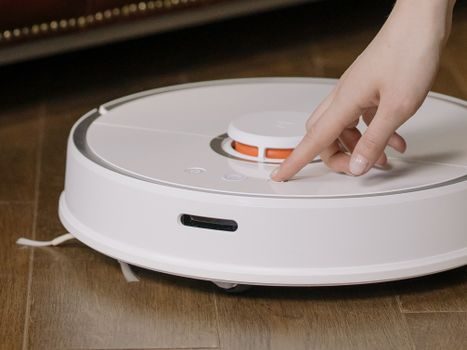
An AGV follows marked lines, wires or reflectors; an AMR robot builds a map at run-time and re-plans around obstacles using SLAM, so the historical boundary is fixed infrastructure versus map-based autonomy [S4][S5]. The line is blurring in 2025–2026: STIQ's 2025 report tracks 26 vendors that sell LiDAR-SLAM units under both the AGV and AMR labels, and the analyst view is that "AGV" is becoming a marketing catch-all rather than a navigation-architecture boundary [S4][S6].
For a specifier this means the procurement question is no longer "AGV or AMR" but "fixed-path or free-path under this load, aisle and safety budget" — a unit-load tug in a 1.0 m aisle with 200 pick-faces per shift is still a fixed-path buy even if the vendor calls it an AMR.
Selection Criteria: Five Gates That Decide the Buy
Payload + load-centre, aisle width and turning radius, navigation accuracy (±10 mm tape vs ±25 mm SLAM), safety class (ISO 3691-4:2020 category FL or higher; ISO 13849-1 PL d on the safety stop circuit), and fleet-management software lock-in form the five hard gates [S3][S6].
Comparative snapshot for the common load bands:
Unit-load (≤1,500 kg): magnetic tape or QR; aisle ≥900 mm; payload priority, lowest CAPEX; vendor-heavy in China (Houde, OKAGV) and Europe (Egemin, Swisslog) [S1][S2][S6]. Tow/tug (≤6,000 kg train): magnetic tape primary, LiDAR optional; aisle ≥1,200 mm; best total-cost-of-ownership for line-side replenishment. Forklift AGV (1,000–3,000 kg, lift 1.5–6 m): laser contour against reflectors; aisle ≥2,600 mm for 1,000 kg reach variants; competes head-to-head with stacker crane TCO economics. Heavy-duty (10,000–60,000 kg): laser contour or natural-feature SLAM; route survey mandatory because floor flatness tolerance is ±3 mm/m; CAPEX one to two orders of magnitude above tug units. Assembly/under-chassis: inductive wire or slotted rail; repeatable to ±0.5 mm; line-cycle-bound, not throughput-bound.
Safety, Standards and Self-Certification Risk

ISO 3691-4:2020 (driverless industrial trucks — safety) is the binding standard; STIQ's 2025 report flags that 26 vendors are self-certifying compliance rather than going through a notified body, which the report treats as the dominant residual risk for European and North American buyers [S6]. On the perception side, safety laser scanners must satisfy IEC 61508 SIL 2 or ISO 13849-1 PL d for the protective stop field, and the 2D LiDAR units commonly shared between navigation and safety have a defined maximum 120° scan window in low-cost variants, rising to 270° in mid-range units, which is a hard limit on coverage when the AGV reverses [S7].
Connectivity is now part of the safety envelope: Wi-Fi roam times under 50 ms and 5G campus networks are becoming a procurement line item rather than a facility assumption, because dropouts stall the fleet manager and stop the AGV [S3][S6].
Vendor Landscape and Where Chinese Suppliers Sit
STIQ's 2025 directory lists 60+ commercial system integrators across three form-factor buckets — tow/unit-load, forklift, and heavy-duty — with Chinese suppliers dominating tow and unit-load volume and European/Japanese suppliers holding the heavy-duty and cleanroom niches [S6]. Houde Intelligent (Zhejiang) ships motor-assembly integrated lines and AGV units under the Holley Group umbrella; OKAGV positions its line against European quality baselines for electronics and automotive in-bound lines [S1][S2]. For buyers running cross-border plants, the practical split is: Chinese tow/unit-load for new greenfield volume, European/Japanese forklift AGV where ISO 3691-4 third-party certification and a 10-year parts commitment are procurement gates.
Two trackable signals to watch through 2026: the finalisation of ISO 3691-4 amendments for outdoor/AMR-class units, and the rollout cadence of 5G campus networks at the 50 ms roam target that the major fleet managers now require [S3][S6].
For component-level specifications, see articulated robot.