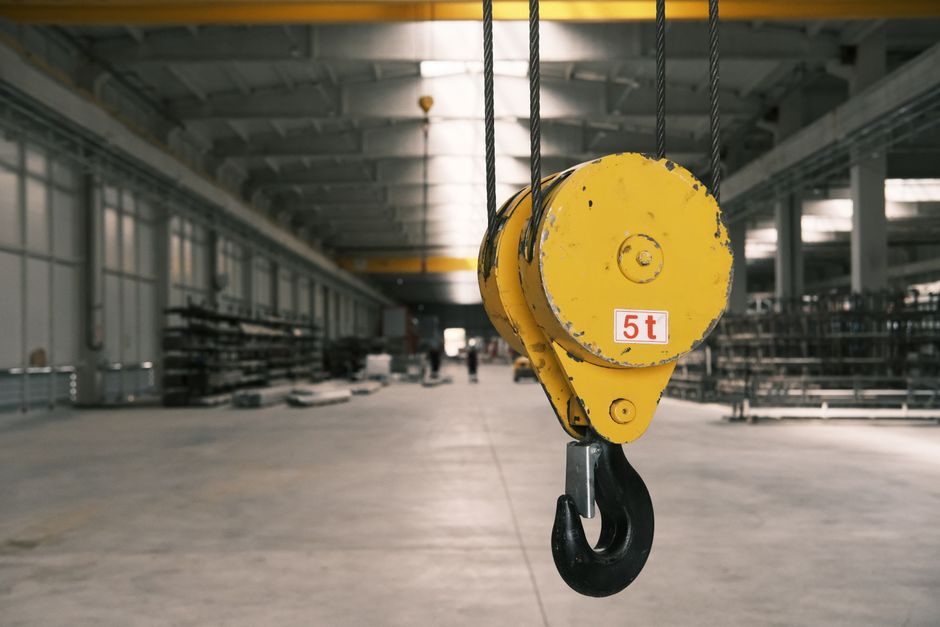
A stacker crane — also called a stacker-retriever or SR/AS-RS crane — is a floor- or rail-mounted mast machine that stores and retrieves unit loads in single-deep or double-deep racks at heights typically from 6 m up to 40 m, with rated loads spanning 100 kg totes to 6,000 kg pallets [S1]. The defining trade-off is straightforward: stacker cranes buy you density, throughput determinism, and operator-free picking at the cost of aisle rigidity, single-load-type commitment, and a hard ceiling on lift height that rules them out for outdoor bulk yards.
This reference treats the stacker crane as a system component, not a brand. The numbers and limits below are the ones a process engineer needs to know before green-lighting an AS/RS line, an auto-storage retrofit, or a pallet stacker replacement on an existing floor.
Density and Throughput: Where Stacker Cranes Beat Conventional Trucks
Cycle times for a 30 m twin-mast SR machine routinely land at 60-90 s for a single-cycle pick-and-deposit, and a mini-load (tote) stacker crane at 6-12 m will run 25-40 s per cycle when the warehouse management system pre-sorts moves.
Throughput determinism is the hidden win. Unlike a forklift driver who varies, the stacker crane runs a Siemens S7-1500 or equivalent PLC traceable to a fixed kinematic profile, so a WMS can pre-shuffle totes to keep dwell times bounded. The same control architecture explains why gantry crane retrofits in cross-dock terminals share a similar deterministic-throughput story, but at a much higher civil-works cost per metre of travel.
Where Stacker Cranes Win on Footprint and Energy
Footprint is the headline advantage. A standard stacker-crane aisle runs 1.0-1.6 m wide for a 1,200 kg pallet load, versus 3.0-3.5 m for a reach truck or counterbalanced forklift on the same rack configuration [S1]. Multiply that aisle delta across a 100-bay rack line and you save roughly 150-200 m² of conditioned warehouse floor, which compounds with sprinkler, lighting, and HVAC load per square metre.
Energy is the second advantage that procurement usually under-counts. A stacker crane regenerates on the lowering stroke, feeding 15-30% of the lift energy back to the bus through a 4-quadrant drive. Over a 16-hour shift, a 2-tonne class unit draws on the order of 8-12 kWh per 1,000 cycles, roughly half what an equivalent diesel forklift consumes in fuel per 1,000 cycles on a like-for-like duty. Indoor air quality is the third quiet win: zero exhaust, no propane changeover, and the cabin-manned models are enclosed with a 75 dB(A) cab rating, well below OSHA's 85 dB(A) 8-hour threshold.
Hard Limits: Lift Height, Aisle Tolerance, and Load Mix

Practical lift ceiling sits at about 40 m for steel-rail top-guided SR machines; above that, mast deflection and seismic drift on the upper guide shoe start to drive structural steel costs nonlinearly. Aisle flatness must hold within roughly ±10 mm over the full rail length — outside that band, the truck sheave wear accelerates and the upper guide will bind, especially on units above 25 m. Rail gauge tolerance sits at ±3 mm on a 1,200 mm typical gauge. [S1]
Load-mix rigidity is the constraint that kills more retrofits than any other. A stacker crane is built around one of four load classes — unit-load 1,000-1,500 kg, mini-load 50-100 kg totes, unit-load heavy 3,000-6,000 kg, and long-load cantilever 4-6 m. Mixing odd-pallet SKUs such as 800 × 600 EUR half-pallets with 1,200 × 1,000 industrial pallets in the same aisle forces a load-handling attachment change that adds 8-15 s per cycle. The same rigidity is why mobile crane yards and outdoor steel-stock yards are wrong territory — they need variable load geometry and rough-terrain travel, neither of which a rail-bound stacker crane provides.
Decision Matrix: Stacker Crane vs Pallet Stacker vs Reach Truck
Stacker crane vs pallet stacker vs reach truck on four decision criteria: lift height (40 m / 5.5 m / 11 m), aisle width (1.0-1.6 m / 2.4 m / 2.7-3.0 m), throughput determinism (high / operator-dependent / operator-dependent), and CapEx per stored position (high / low / medium). A two-axis pick — high throughput AND high density — is where the stacker crane is the only machine that wins both. If you only need one axis, the pallet stacker wins on cost and the reach truck wins on flexibility. [S2]
The same logic holds against crawler crane and stacker crane comparisons in heavy-rigging: a crawler is built for ground pressure and pick-and-carry on unprepared surfaces, while the SR machine is built for repeatability on a precisely levelled rail — they are not substitutes. For warehouses above 8 m storage height with more than 4,000 pallet positions, the stacker crane almost always wins the TCO over a 10-year horizon once you factor labour, lighting, and HVAC delta.
Failure Modes and Sourcing Signals to Track
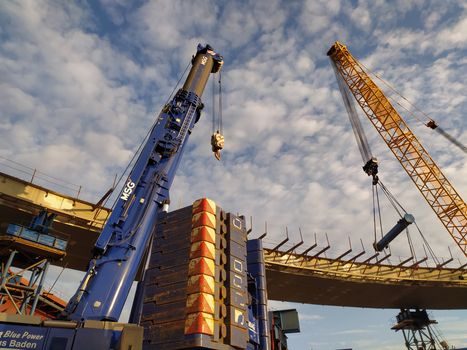
Three failure modes drive the majority of stacker-crane downtime: rail-joint flatness drift (most common above 30 m lift, typically a 6-12 month re-shim cycle), upper guide-shoe wear on twin-mast units (replace at roughly 8,000-12,000 hours), and hoist-rope stretch past 1% of rope length (re-tension or re-rove on the same 8,000-12,000 h band) [S1]. Sourcing signals worth tracking in the next two quarters: lead times on European-built single-mast SR units, where deliveries were running 12-14 months; Asian-built equivalents at 6-8 months but with 4-8 week commissioning gaps; and rack-integrator packages that bundle the SR machine with clad-rack supply to compress interface risk.
For specifiers comparing family-level options, the related reference on Stacker Crane Types and Classifications lines the unit-load, mini-load, and long-load variants against the same height and load envelope used here. Two adjacent references — Demolition Hammer Advantages, Disadvantages and Spec Gates and Pneumatic Conveying Systems: Spec-Driven Pros, Cons and Selection Gates — use the same pros-and-cons gate framework and are useful for cross-checking the decision matrix format on adjacent equipment classes.