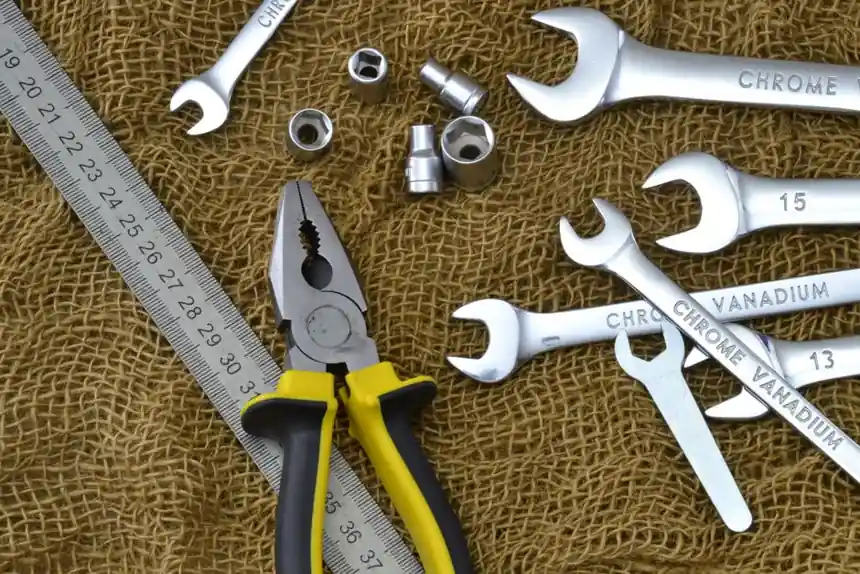
Road-maintenance air impact wrench selection is driven by the largest fastener the crew actually turns, not by the vehicle in the yard: 3/4" drive units in the 600-1000 N·m band cover M16-M22 hub, U-bolt and suspension work, while 1" drive tools (≈2000-2700 N·m, 1.8-3.5 kg class) and 1-1/2" drive heavy units (FW-2700 platform, 14.5-16.0 kg, 1.32 m long) are reserved for truck chassis, mining and rail maintenance [S2][S3].
Three product groups are actively listed by Asian OEM/ODM suppliers as of 2026-08-08: sub-500 N·m service wrenches (TOKU MI-165H class, 2.3 kg, pin-clutch hammer, 12.7 mm anvil) [S2], mid-range 1" truck and trailer wrenches (Chuangyang 1" extended-anvil design with 10" / 254 mm extension) [S6], and 1-1/2" super-duty guns (FW-2700 with 2" anvil) [S3]. Used together, a municipal road crew typically runs one gun per drive size, paired with matching air sockets from the same vendor line [S1][S7].
Match the drive anvil to the largest bolt, not the vehicle
The first decision is the square-drive size, because it sets the maximum torque the hammer mechanism can transfer without shearing the anvil: 3/8" (≈9.5 mm) for M6-M10, 1/2" (12.7 mm) for M12-M16, 3/4" (19 mm) for M16-M22, 1" (25.4 mm) for M22-M30 truck and trailer work, and 1-1/2" (38 mm) for heavy plant and rail [S2][S3][S6]. The TOKU MI-165H lists 12.7 mm socket insertion angle, 16 mm suitable bolt diameter, and 460 N·m maximum tightening torque at 0.62 MPa, with a 2.3 kg mass and 194 mm overall length that suits one-handed under-chassis work [S2].
For truck tire, chassis and trailer frame work, Chuangyang's 1" drive extended-anvil design pairs a 1" (25.4 mm) drive head with a 10" (≈254 mm) extension and 45° air inlet, sold specifically for tire mounting, blowout repair and large machinery disassembly [S6]. The FW-2700 1-1/2" gun weighs 14.5 kg net, ships at 16.0 kg gross, and is 1.32 m long; it is the tool crews reach for when the fastener is structural and not the work to waste time on adapter stacks [S3].
Torque, hammer type and free speed: the spec triangle
Three numbers dominate real-world performance: maximum tightening torque in N·m, free speed in rpm, and hammer mechanism type. The MI-165H delivers 460 N·m, 7500 rpm, and a pin-clutch hammer that TOKU markets for "outstanding torque rise" and continuous hammering efficiency at constant 0.62 MPa inlet [S2]. A 1" truck-class gun typically runs 1900-2700 N·m breakaway and 7000-8500 rpm free speed, and a 1-1/2" super-duty gun such as the FW-2700 class sits in the 3400-5400 N·m band, well above what a 3/4" mechanic gun can deliver [S3].
Pin-clutch and twin-hammer mechanisms are the two designs crews meet most often: pin clutch favours low vibration and a soft torque rise that protects the operator when snapping M16 wheel nuts, while twin-hammer hits harder per cycle and is preferred for M22+ structural bolts. Either way, free speed below ~6000 rpm is a red flag for road work, because crews need to run the nut up before the hammer engages, otherwise seating time on every wheel stretches the shift.
Air supply: consumption, hose size and pressure class
Air consumption is the spec that gets ignored until the compressor cannot keep up: the MI-165H already draws 0.8 m³/min at 0.62 MPa (≈90 psig) [S2], a 1" truck gun typically pulls 1.0-1.8 m³/min, and a 1-1/2" super-duty gun like the FW-2700 will demand 2.0-2.5 m³/min at continuous duty. A road-maintenance truck that runs more than one wrench at once needs a compressor with free air delivery (FAD) at least 1.3× the sum of the nameplate consumption of every gun that may be open at once, plus a margin for the air-hammer breaker used on the same shift.
Standard 3/8" (10 mm) hose on a 1/2" drive gun and 1/2" (13 mm) hose on 3/4" and 1" guns is the practical floor; the 1-1/2" FW-2700 should be fed by 3/4" (19 mm) hose or it will starve and lose torque at the working end [S3]. The MI-165H uses an Rc1/4 inlet port and side exhaust, which keeps the blast away from the operator when working in a pit [S2]. Crews running pneumatic breakers and air impact wrench on the same compressor must regulate to the tool's working pressure (0.62 MPa for the MI-165H class), not the compressor's cut-out.
Vibration, mass and ergonomic limits for field crews
Operator fatigue is a maintenance problem: a 1-1/2" FW-2700 at 14.5 kg is a two-person lift on a vertical wheel hub, and even a 1" truck gun at ~3.5 kg will trigger ISO 28927-2 hand-arm vibration monitoring after a shift on a rebar-into-asphalt patching job. The MI-165H at 2.3 kg and 194 mm long sits in the band that one operator can run all day on M16 work, which is why 1/2" drive pin-clutch guns remain the workhorse of municipal road crews [S2].
Three design features separate a road-friendly wrench from a shop-only one: a rubber sleeve over the body to absorb handling shock and protect the tool if dropped, a 45° swivelling air inlet so the hose does not kink when the gun is held vertically against a wheel, and a side or down exhaust that does not blow chips into the operator's face [S6]. The Chuangyang 1" gun lists all three as standard build, which is why it is sold specifically for truck tire and trailer-chassis work rather than bench assembly [S6].
Comparison: 1/2" service vs 1" truck vs 1-1/2" heavy
Side by side on the four criteria that drive road-maintenance buying decisions:
Drive anvil / max torque: 1/2" (12.7 mm) at 460 N·m for the TOKU MI-165H [S2]; 1" (25.4 mm) at roughly 1900-2700 N·m breakaway for typical OEM 1" truck guns including the Chuangyang 1" extended-anvil model [S6]; 1-1/2" (38 mm) at the 3400-5400 N·m level on the FW-2700-class super-duty gun [S3].
Mass and length: 2.3 kg / 194 mm for the MI-165H [S2]; 3.5-4.5 kg / 350-450 mm for a 1" truck gun with 10" extension [S6]; 14.5 kg / 1.32 m for the FW-2700 1-1/2" gun [S3].
Air consumption at rated pressure: 0.8 m³/min at 0.62 MPa [S2] for the 1/2" class, around 1.2-1.8 m³/min for 1" truck guns, and 2.0-2.5 m³/min for the 1-1/2" class, which means a 7.5 kW portable is the floor for the small gun and a 15-22 kW tow-behind compressor is the floor for the big one.
Field-of-work fit: M12-M16 hub, suspension, small-pneumatic-tool and roadside-repair work for 1/2" [S2]; M22 truck tires, trailer chassis, light machinery service for 1" [S6]; bridge, rail and heavy plant structural bolts only for 1-1/2" [S3]. Crews trying to use a 1" gun for M30 structural work, or a 1-1/2" gun for a U-bolt, waste time on socket stacks and burn the hammer mechanism prematurely; that misapplication boundary is detailed in the air impact wrench vs concrete fastening spec map.
Failure modes and when to stop repairing the wrench
Three failure patterns are the ones crews actually see: loss of torque with air still flowing (worn hammer pins or broken cam on a pin-clutch tool, failed anvil on a twin-hammer), oil mist in the exhaust (worn rotor blades or a failing air motor bearing), and a stuck forward/reverse ring (debris in the reversing valve). On the MI-165H class 460 N·m pin-clutch gun, hammer-pin replacement is a field job with the vendor's pin kit, but a cracked hammer case or a spun bearing journal is a replace-the-tool decision, not a repair decision [S2].
On 1" and 1-1/2" guns the same rule applies at a higher cost: replace the tool when the anvil yoke shows fretting, when the hammer case has been overheated (blueing on the aluminium), or when a 0.62 MPa inlet still cannot produce rated breakaway torque. Repeated stall under load without an in-line lubricator is the most common cause, which is why a torque wrench tester check at 90-day intervals is cheaper than a thrown pin-clutch.
Buying channel and supplier landscape (2026)

Asian OEM/ODM supply is concentrated in three clusters as of 2026-08-08: Taiwan-sourced and listed on CENS-style trade platforms (Sumlin Industrial Co. range of air impact wrenches, ratchets, angle grinders and sanders) [S5], mainland China direct-factory vendors (Jiangsu Chuangyang Machinery & Electronics for 1" extended-anvil truck wrenches, Ningbo Qihui Machinery & Electronic for the impact wrench / air screwdriver / angle grinder triple) [S6][S7], and Japanese premium brands distributed through industrial portals such as TOKU Pneumatic via MISUMI Thailand (MI-165H, 14-day shipment) [S2].
For municipal road tenders, the practical buy is two units: a 1/2" 460 N·m pin-clutch gun for routine M16 work and a 1" 1900-2700 N·m truck gun with extended anvil, sourced from a vendor that stocks matched air sockets and ships a regulator-lubricator in the box. A 1-1/2" FW-2700-class gun is a separate budget line, shared between depots or rented by the day, because at 14.5 kg and 16.0 kg shipping weight it is too heavy to leave on every truck [S3].
Trackable signals to watch over the next two quarters: (1) the published free-air-delivery figures on the next generation of 1" cordless-hybrid impacts, because brushless electric guns are already eating the 1/2" service-wrench end of the road-maintenance market; (2) the lead-time posted by Asian OEM/ODM lines such as Sumlin and Ningbo Qihui on 1" extended-anvil truck wrenches, currently listed as same-week RFQ in 2026-07 [S5][S7]; (3) any tightening of the 0.62 MPa working-pressure specification on pin-clutch wrenches, since the same pressure class also appears on lighter road roller vibrator circuits and on air pick demolition tools, which means shared compressor sizing rules.