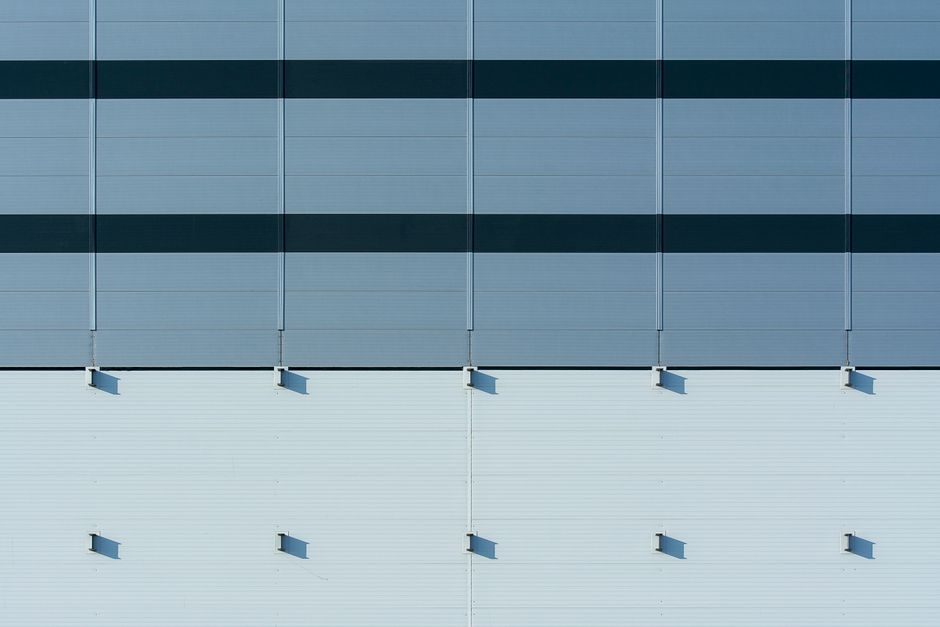
Autoclaved Lightweight Concrete (ALC) panels and waterproofing membranes solve two different problems on a building envelope, and the most common procurement error is treating them as interchangeable [S1][S4]. ALC is a factory-cast, steam-cured aerated concrete element used as a wall, roof, or partition slab with declared thermal conductivity typically in the 0.10–0.16 W/(m·K) range, dry density of roughly 400–650 kg/m³, and compressive strength in the 4–7 MPa class.
A waterproofing membrane is a separate barrier layer — bituminous, polymer-modified bitumen, PVC, TPO/EPDM, or polyurethane liquid — that resists water transmission. PVC single-ply membranes for roofing and civil engineering carry the base polymers, plasticisers, and stabilisers that RENOLIT ALKORPLAN grades list in their published datasheets [S2], and the family also includes aluminium-foil-faced variants shown in manufacturer catalogues [S3].
What an ALC panel actually is, and what it is not
ALC is a cellular concrete produced from a binder (cement plus lime), a fine siliceous aggregate, water, and an aluminium-powder expanding agent, then cut and steam-cured in an autoclave. The result is a lightweight, factory-finished panel that acts simultaneously as structure, fire-rated enclosure, and thermal insulation — three roles that a membrane cannot perform [S4].
Because ALC is a porous cementitious product, it is hygroscopic and will transmit vapour and liquid water unless protected. Standard ALC wall and roof assemblies therefore always include a separate waterproofing layer — a sheet membrane, a liquid-applied coating, or a tanking system — applied to the wet-face side of the panel. Specifiers who treat ALC as "self-waterproofing" are repeating the most expensive error in the spec gate.
On the other hand, a waterproofing membrane contributes no structural capacity, no meaningful R-value, and no fire resistance beyond its own certification. The two materials sit on adjacent layers of the assembly and are functionally complementary, never redundant.
What a waterproofing membrane does, and its main families
Manufacturer catalogues published in 2026 continue to group waterproofing membranes into four practical families: bituminous (APP and SBS modified), self-adhesive bitumen, single-ply synthetic (PVC, TPO, EPDM), and liquid-applied (PU, acrylic, cementitious) [S1][S4][S5]. Each family has its own substrate preparation rules, jointing method, and detailing at penetrations — a single-ply PVC sheet is hot-air welded, while an SBS sheet is torch-applied or cold-adhered.
Self-adhesive SBS / APP modified bitumen membranes such as the CMAX line use a styrene–butadiene–styrene or atactic-polypropylene modified bitumen compound with a release film, eliminating torching on occupied sites [S4]. PVC single-ply membranes are typically supplied in 1.0–1.5 mm thickness with polyester scrim reinforcement and are described by suppliers as "excellent anti-aging, puncture-resistant, with high tensile strength and good dimensional stability," joined by hot-air welding [S1].
Liquid-applied systems — for example the polyurethane and bitumen coating ranges offered by CPWaterproofing — are used for irregular geometry, complex penetrations, and detailing work where sheet membranes cannot be reliably terminated [S5]. RENOLIT ALKORPLAN markets its single-ply range as a sustainable roofing and civil-engineering solution across European project specifications [S2].
Selection criteria by project condition
The decision between membrane families — and where ALC sits in the assembly — is driven by four quantifiable inputs: substrate, exposure, geometry, and traffic. [S1]
Substrate. ALC is a relatively smooth, dry, cementitious face but is sensitive to moisture during cure; it generally accepts both self-adhesive bitumen and PU liquid membranes with a primer, while solvent-based products can attack the surface. On concrete or steel decks, torch-applied SBS is the historical default [S4][S5].
Exposure. UV-exposed roofs favour PVC, TPO, or aluminium-foil-faced membranes, all of which appear in current 2026 manufacturer listings [S2][S3]. Buried or tanked situations (basement walls, lift pits, wet rooms against ALC) favour self-adhesive bitumen or SBS that is then protected by a screed or protection board.
Geometry. Flat or low-slope roofs suit sheet membranes with welded laps; complex geometry, plant rooms, and balcony upstands with many penetrations suit liquid-applied systems [S5]. The supplier ecosystem remains broad — ArchiExpo lists 14 manufacturers of aluminium-foil waterproofing membranes and 89 manufacturers of plastic (PVC/TPO/EPDM) membranes, indicating a competitive multi-vendor field in 2026 [S3].
Traffic. Walkable roofs and plant-room floors require a membrane rated for foot traffic plus a separate protection layer; non-accessible roofs can use a thinner, lower-cost sheet.
Criteria-based comparison: ALC panel vs waterproofing membrane
The two products do not compete head-to-head, but specifiers still need a side-by-side to confirm which role each is playing on a drawing. The table below uses criteria that show up in real procurement RFQs. [S2]
Function. ALC carries structural load, provides fire compartmentation, and delivers R-value in one element; a membrane is a barrier layer only and carries no load. Substituting membrane for ALC on a wall is a structural failure; substituting ALC for membrane on a wet face is a watertightness failure.
Water resistance. ALC alone fails a water-absorption test by design — it is a porous, vapour-open material. Membranes are tested for hydrostatic-head resistance, lap adhesion, and water-vapour transmission as their primary acceptance criteria [S1][S4].
Thermal. ALC adds 0.10–0.16 W/(m·K) conductivity with thicknesses typically 100–300 mm; membranes add negligible R-value (≤0.01 m²·K/W at 1.2 mm). If R-value is on the spec, the work is being done by the panel, not the membrane.
Fire. ALC is non-combustible (Euroclass A1) as a pure cementitious product. Membranes contribute only their own surface-fire rating (e.g. Broof(t2) for external fire on flat-roof systems) and can in fact be a fire risk if the wrong formulation is used over combustible insulation.
Cost lever. The dominant cost driver for ALC is panel thickness and reinforcing steel in lintels; for membranes, it is material grade (SBS vs PVC vs PU liquid) and labour (sheet is faster on flat areas, liquid is faster on complex geometry). Specifiers chasing lifecycle cost should compare a 50-year membrane service life against an ALC element service life in the same 50–80 year range — they depreciate together.
Where they are used together: typical assembly stack-ups
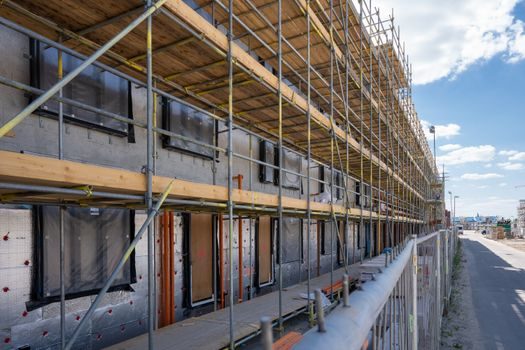
For a flat roof on an ALC deck, the 2026 standard stack reads: structural ALC slab → vapour control layer → tapered insulation → self-adhesive or torch-applied SBS base sheet → SBS or PVC cap sheet → protective layer or ballast. RENOLIT ALKORPLAN single-ply is a common cap-sheet choice on commercial builds in Europe [S2], while CPWaterproofing's liquid systems handle the upstand and penetration detailing [S5].
For a basement or wet-room wall cast in ALC, the wet-face build-up is: ALC panel → bitumen-compatible primer → self-adhesive SBS or hot-applied bitumen membrane → protection board → soil retention or tile finish. Self-adhesive products such as the SBS / APP modified membrane lines remove the torch risk on constrained sites [S4].
For a pitched roof, ALC acts as the structural sarking or insulation layer beneath a separate primary waterproofing underlay and the final tile or metal cladding; here the membrane is hidden under the cladding, but it is still a discrete layer in the assembly.
Limits, failure modes, and what to refuse on the spec gate
ALC has three failure modes that show up repeatedly in forensic reports: carbonation-induced corrosion of embedded steel at high humidity, dimensional movement at panel-to-panel joints when the structure is unrestrained, and water ingress at joints where the waterproofing detailing has been terminated short. The first two are cured by correct reinforcement cover and joint design; the third is cured by membrane detailing, not by adding more ALC. [S3]
Membranes fail by lap delamination (poor weld or primer), puncture under traffic, UV embrittlement of non-UV-stable grades, and root intrusion in green-roof applications. A 1.0 mm PVC sheet with polyester scrim is described by suppliers as "puncture-resistant" with "good dimensional stability", but it is still a 1.0 mm sheet — plant movement and dropped tools will breach it. The ALC substrate must be smooth, dry, and primed before the membrane is laid, or the bond will fail at the interface.
On the spec gate, reject any drawing that calls ALC "waterproof," that omits a membrane on a wet face, that uses a non-UV-stable membrane on an exposed roof, or that torches a membrane directly against an ALC surface without a separating primer layer. The materials are not interchangeable, and the drawing must show both — or the contractor will price the gap and the variation order will dwarf the membrane cost.
Cross-references and what to read next
Engineers writing a full wall spec often pair an ALC wall with an AAC block infill, and the AAC block buying guide 2026 covers the procurement levers on the complementary masonry side. Foundation waterproofing upstream of the wall is covered in the pile driver vs rotary drilling rig spec cut, which sets out the ground-engineering decisions that drive the basement tanking spec the ALC wall then ties into. [S4]
For a deeper primer on the panel itself, see the ALC panel encyclopedia entry, and for the membrane side the waterproofing membrane entry and the modified bitumen membrane entry round out the chemistry and detailing rules. The next node to verify on the spec desk is the compatibility of the chosen primer with the ALC face — that single line item is where most envelope leaks start.