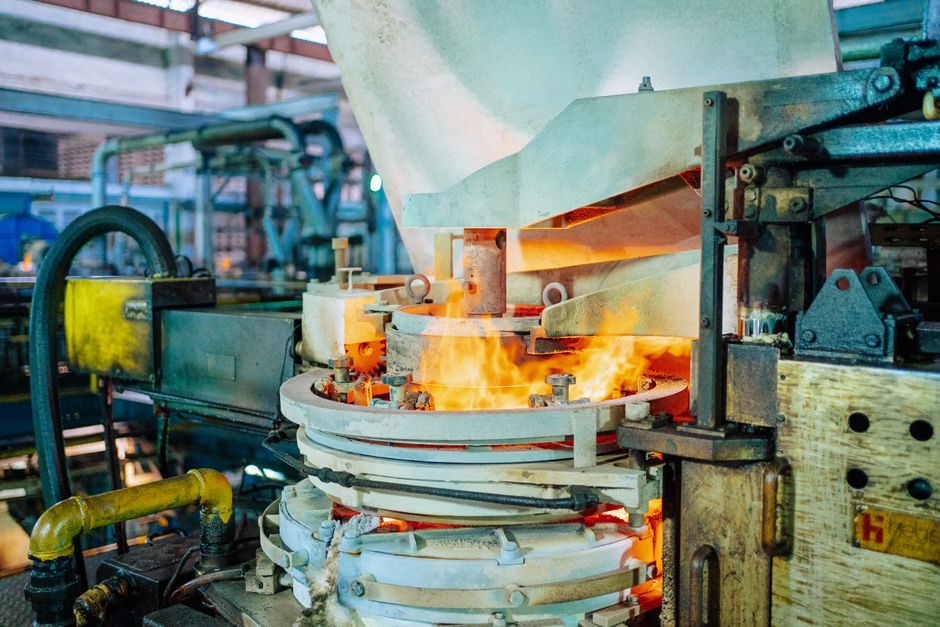
Locking force, platen clearance, shot weight, and intensification pressure are the four gates that decide whether an aluminum die casting machine fits a part. Get any one of them wrong and you buy either a short-shot reject stream or a 1.5x tonnage machine that idles on every cycle [S8].
This guide walks through each gate with the values real Chinese and US shops publish in 2026, then lines cold-chamber hot-chamber and a third vacuum option up against selection criteria. It is written for process engineers, not procurement — every threshold traces back to a part parameter you can measure on the print [S1][S4][S7].
Locking Force: The Tonnage Gate
Locking force is the first number a foundry asks for, and the one most often mis-specified. The classical rule of thumb is 3-5 kN of clamp force per square centimetre of projected area for aluminum cold-chamber work, scaling up to 6-8 kN/cm² for thin-wall structural parts where injection pressure runs at the upper end [S4]. Bardane Manufacturing in Jermyn, PA runs a 23-machine shop that covers this band for both aluminum and zinc, indicating a working fleet of roughly 200-1600 t (2000-16000 kN) units [S1].
On the Chinese OEM side, Ningbo Dongfang lists aluminum cold-chamber models at 800 kN (≈80 t) and 900 kN (≈90 t) for small parts, and a 38-40 t hot-chamber zinc range in the same factory footprint [S8]. That spread — 38 t hot-chamber zinc to 1600 t cold-chamber aluminum — is the realistic tonnage menu an engineer should map against projected area before any brand comparison.
Platen Size and Tie-Bar Clearance
Platen size is the second gate and the one that quietly kills jobs. A 1600 t machine with 1400×1400 mm tie-bar spacing will not accept a die that needs 1500 mm of vertical daylight. Always check three platen dimensions: tie-bar-to-tie-bar clear width, clear height between platens, and die mounting bolt pattern (most Chinese machines follow the standard 200-400 mm pitch grid) [S4][S8].
Alpha Metal Industries, an ISO 9001 certified Indian job shop, runs both pressure and gravity aluminum cells — and the die envelope on the pressure side is the constraint that decides whether a part can be quoted at all [S5]. For very large automotive structural castings (battery trays, rear underbody), a 2000+ t press with ≥1800×1800 mm tie-bar clearance is the practical entry point; below that, multi-slide dies or part-splitting are the only paths.
Shot Weight and Injection Pressure
Shot weight is calculated as part mass + runner + overflow + biscuit, then divided by a 0.6-0.8 fill factor to get the required cold-chamber shot capacity. Aluminum cold-chamber machines typically run intensification pressures of 40-90 MPa (with 60-80 MPa being the modern default), while hot-chamber zinc machines sit at 20-35 MPa [S8]. Lanson Precision, founded 2005 on a 100,000 m² site, builds large-tonnage cold-chamber platforms in this intensification range for the automotive and 3C sectors [S4].
For thin-wall aluminum (≤2.5 mm), real intensification pressure matters more than locking force. Ningbo Yinxier (Yinxier) explicitly markets high-demand complex aluminum castings, and Bian Diecast pushes one-stop aluminum work with international safety certs — both rely on the upper MPa band plus real-time shot profile control, not just raw tonnage [S2][S7]. If your part is a 1.5 mm wall, do not buy a 500 t press; buy a 500 t press with a documented ≥80 MPa intensification stage.
Hot-Chamber vs Cold-Chamber vs Vacuum: A Criteria Comparison
Hot-chamber machines win on cycle time (often 30-40% faster) but are limited to zinc, magnesium, and lead alloys — molten aluminum attacks the iron plunger and gooseneck, so hot-chamber aluminum is not a real option [S8]. Cold-chamber is the default for aluminum; the melt is ladled into a separate shot sleeve per cycle.
For porosity-critical parts (high-vacuum die cast automotive structural nodes, hermetic telecom housings), a vacuum die casting machine drops the chamber pressure below 50 mbar before intensification, cutting gas porosity by roughly 60-80% versus atmospheric cold-chamber. The trade-off is a 15-25% cycle-time penalty and tighter die-sealing discipline. For most general aluminum parts, atmospheric cold-chamber is still the cost-per-shot winner; vacuum is paid for only when the X-ray or pressure-leak spec demands it [S2][S7].
Alloy Window, Melt Holding, and Die Life

Aluminum alloys behave very differently at the shot sleeve. A380, the dominant general-purpose alloy, runs at a melt temperature of 650-680 °C in the sleeve and tolerates long holding times. A383 and A384 add better ductility at the cost of higher silicon content. ADC12 (the Japanese/JIS equivalent to A383) is what most Chinese job shops default to — Bian Diecast and Ningbo Lianggong both work this alloy band for OEM and aftermarket parts [S6][S7].
Die life on H13 tool steel with proper nitriding routinely hits 100,000+ shots for A380 at moderate intensification. Push the intensification above 90 MPa, run the die above 250 °C, and you are in the 40,000-60,000 shot range. G & M Die Casting's heat-treatment and shot-blast secondary cells are an indicator of the post-casting workflow the machine must feed — sizing the press without sizing the trim, shot-blast, and CNC downstream is the classic mistake on greenfield cells [S3][S6].
Control, Safety, and Throughput Math
Modern aluminum cold-chamber presses ship with a PLC + HMI as standard, with closed-loop shot profile and real-time die-temperature mapping as the differentiator. Lanson Precision explicitly markets intelligence-equipment platforms, and Ningbo Dongfang lists AC servo injection as the entry-level configuration on its 80-90 t aluminum presses [S4][S8]. For high-mix low-volume work, closed-loop is optional; for high-volume structural parts, it is mandatory if you want Cpk ≥1.33 on wall thickness.
Throughput math is the final gate. A 900 t cold-chamber machine running a 60-second cycle (real-world, not catalog) delivers 50 shots/hour; at 8 kg per shot that is 400 kg/hour or roughly 3,200 t/year on a two-shift schedule. Cross-check that figure against your annual volume before you accept any supplier's cycle-time claim, and size the die casting machine to a target 70-80% utilization — not 100% — so planned maintenance and die changes fit the calendar.
Who This Guide Is For, and Where It Stops
This guide is written for engineers specifying a new press for an aluminum job that already has a part print, an alloy call-out, and an annual volume target. It is not for buyers shopping a general catalog — the part parameters must exist before any tonnage or shot-weight number makes sense. For engineers weighing aluminum against a gravity die casting machine on a lower-volume, lower-capital project, the crossover is typically around 1,500-2,000 parts/year; below that, gravity wins on tooling cost. [S1]
Trackable signals to watch: clamping-force pricing per kN from the Ningbo cluster (currently USD 17-22k for an 80-90 t aluminum press, USD 10-11k for a 25 t hot-chamber zinc unit) [S8]; tightening of CE/UL electrical-safety and aluminum die casting machine energy-efficiency classes in EU automotive tier-one sourcing; and the gradual migration of magnesium structural parts onto magnesium die casting machine platforms as 3C and EV chassis volumes scale.
For related coverage, see Bucket Elevator Sizing & Selection: Throughput, Lift Height, Bucket Type and Casing.